Most California facility managers understand that Title 24 applies at construction permitting. Fewer understand that the 2025 California Building Energy Efficiency Standards — effective January 1, 2026 — extend compliance requirements deep into ongoing facility operations, with specific HVAC documentation, fault detection, and acceptance testing obligations that survive the Certificate of Occupancy. A single compliance gap — an economiser fault detection log with missing entries, a CO₂ sensor calibration record that lapsed 14 months ago, a VAV air handler re-test skipped after a 2023 controls upgrade — can trigger civil penalties of up to $2,000 per day and stop-work orders on tenant improvements worth far more. Start a free trial on OxMaint or book a demo to see how the Compliance Tracking module builds the documentation discipline that keeps California commercial facilities continuously compliant.
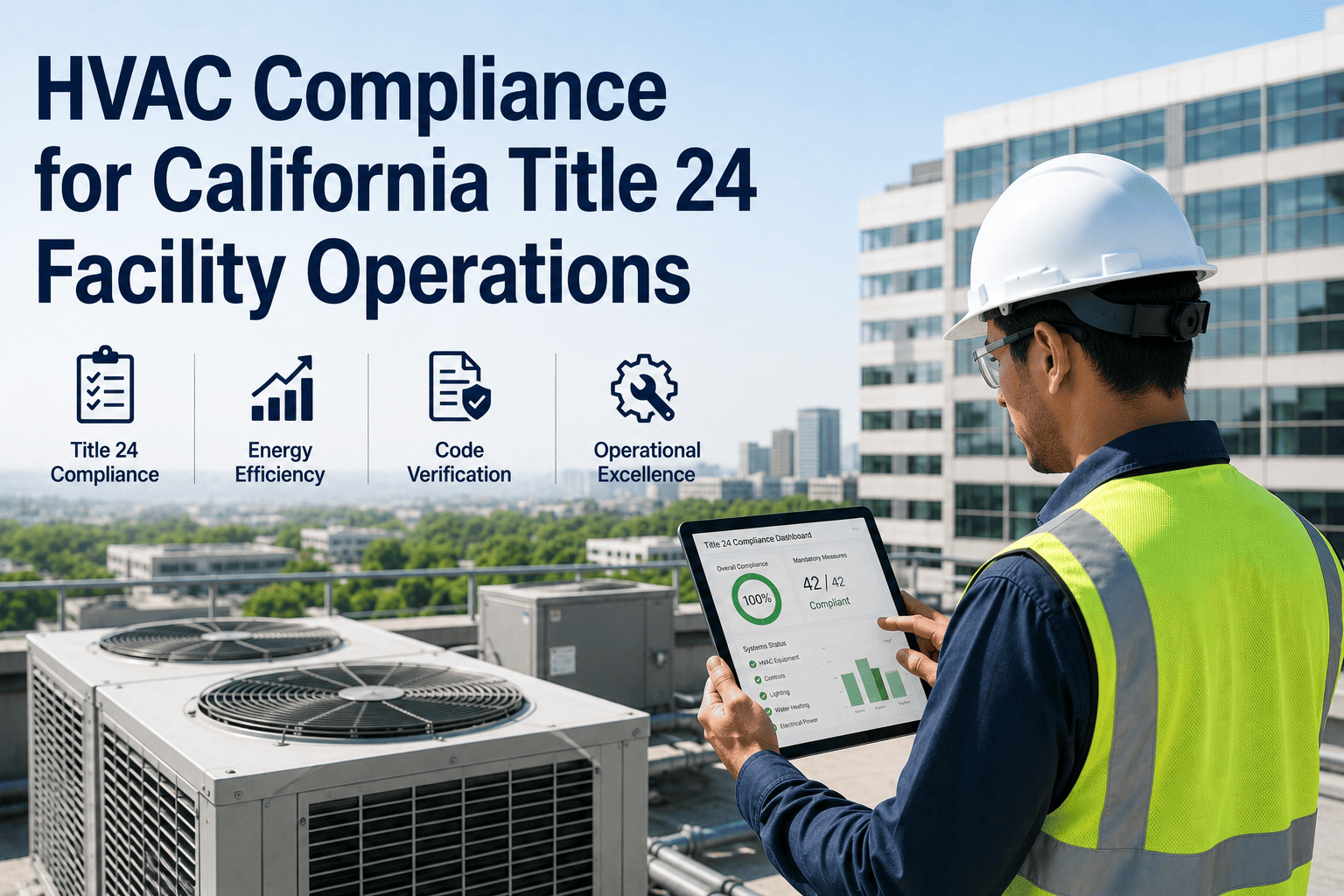
HVAC Compliance for California Title 24 Facility Operations
How to support ongoing 2025 Title 24 Part 6 compliance with documented HVAC maintenance records, FDD monitoring, controls checks, and audit-ready workflows — after the Certificate of Occupancy.
What the 2025 Title 24 Code Actually Requires from Facility Operations
The design phase creates the compliance baseline. The operations phase sustains it — or breaks it. The table below maps the 2025 code requirements that generate recurring maintenance and documentation obligations for California commercial facilities.
| Title 24 Requirement | Code Reference | Facility Operations Obligation | OxMaint Tracking Method |
|---|---|---|---|
| Fault Detection and Diagnostics (FDD) | Part 6, Section 120.2 | Continuous FDD monitoring with logged fault events and documented corrective actions — ongoing, not one-time | Sensor-triggered work orders + fault log with timestamps |
| Economiser Controls Operation | Part 6, Section 140.4 | Documented evidence that economiser is cycling correctly — operation logs, damper position records, corrective actions on faults | Monthly PM with readings log on each AHU economiser |
| Demand-Controlled Ventilation (DCV) | Part 6, Section 120.1 | CO₂ sensor calibration records, NIST-traceable certificates within 12 months, calibration gap = compliance gap | 12-month recurring PM + calibration cert attached to asset |
| ATTCP Acceptance Testing | Part 6, Section 10-103 | Re-testing required after any controls modification — ATTCP-certified contractor, test records retained and retrievable on demand | Test event work order + cert upload on controls change trigger |
| VAV System Controls (ASHRAE GL 36) | Part 6, Section 140.4(c) | Documented setpoint reset sequences, supply air temperature reset verification, DDC controller logic records | Quarterly controls verification PM with parameter log |
| Supply Air Temperature Reset | Part 6, Section 140.4(b) | Evidence of reset strategy in operation — AHU controller records, seasonal adjustment documentation | Seasonal PM with BMS setpoint screenshot captured to asset |
The Three Compliance Failures That Trigger California Title 24 Enforcement
Most enforcement actions against California commercial facilities are not triggered by design failures — they are triggered by documentation failures that are entirely preventable with structured maintenance workflows.
The 2025 code requires continuous FDD monitoring with logged fault events and corrective action evidence. A facility that had FDD software installed but never configured logging — or let the log retention lapse — is non-compliant even if the system was functioning correctly. The compliance requirement is proof, not just performance.
Demand-controlled ventilation requires CO₂ sensors accurate enough to drive ventilation rate decisions. Title 24 requires calibration records proving sensors were verified within 12 months. A calibration gap — common when the calibration was performed by a contractor who never filed the certificate against the specific sensor asset — is a documented compliance violation.
Every controls modification — a new DDC controller, an upgraded BMS sequence, a reprogrammed VAV box — requires ATTCP acceptance testing to be repeated on affected HVAC systems. Most facility teams complete the upgrade and never schedule the re-test. The original acceptance test certificate becomes void the moment the controls change.
Compliance Documentation — Before vs After OxMaint
The following performance data is from a California commercial portfolio (6 buildings, 420,000 sq ft, Climate Zone 12) that implemented structured Title 24 compliance tracking in OxMaint.
How OxMaint Structures Title 24 Compliance Tracking
Each operational Title 24 requirement maps to a specific work order type in OxMaint — with the right trigger, the right documentation fields, and the right escalation path if the task goes overdue.
Every HVAC asset carries its own compliance profile — last ATTCP test date, CO₂ calibration status, FDD monitoring status, and economiser last-verified date — visible at a glance in the asset record without opening a separate compliance system.
Upcoming certification expirations — CO₂ calibration at 12 months, ATTCP re-test windows after controls changes, economiser seasonal verification — surface automatically 60 and 30 days in advance so facility teams have time to schedule contractors before the gap opens.
When FDD monitoring flags a fault — economiser cycling incorrectly, VAV box not resetting, CO₂ sensor drifting — OxMaint auto-generates a work order with SLA timer. The fault event, corrective action, and resolution are all timestamped and stored against the asset record. This is exactly the evidence Title 24 enforcement requires.
Every compliance work order in OxMaint is exportable in a structured report — sorted by asset, date range, work type, and regulatory category. A Title 24 compliance evidence package that previously took three weeks of manual assembly is generated in under four hours from a single export command.
Frequently Asked Questions
Title 24 Compliance Is Operational — Not Just a Design Certificate
OxMaint's Compliance Tracking module turns every ongoing Title 24 operational requirement into a scheduled, documented, and retrievable work order — so California facility teams stay continuously compliant, not just initially certified.