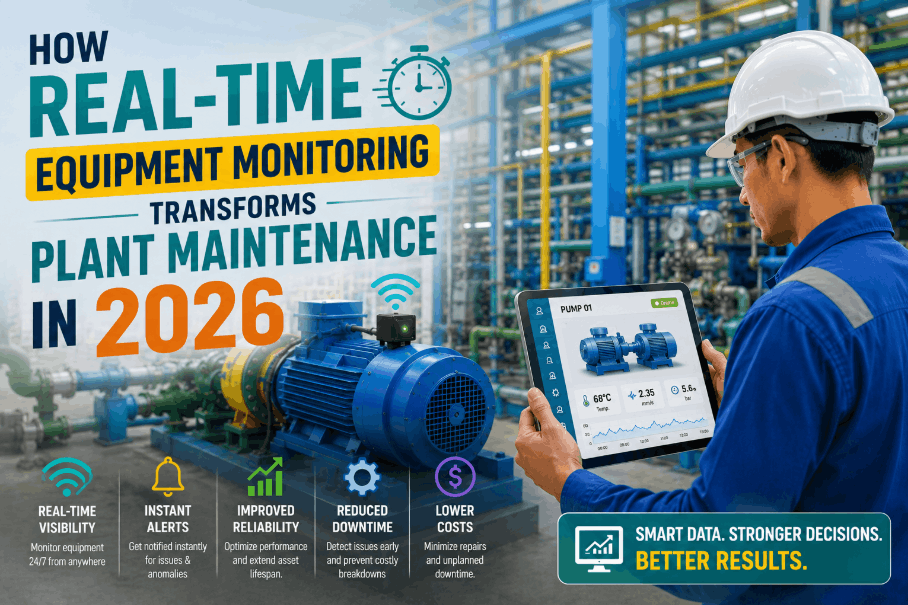
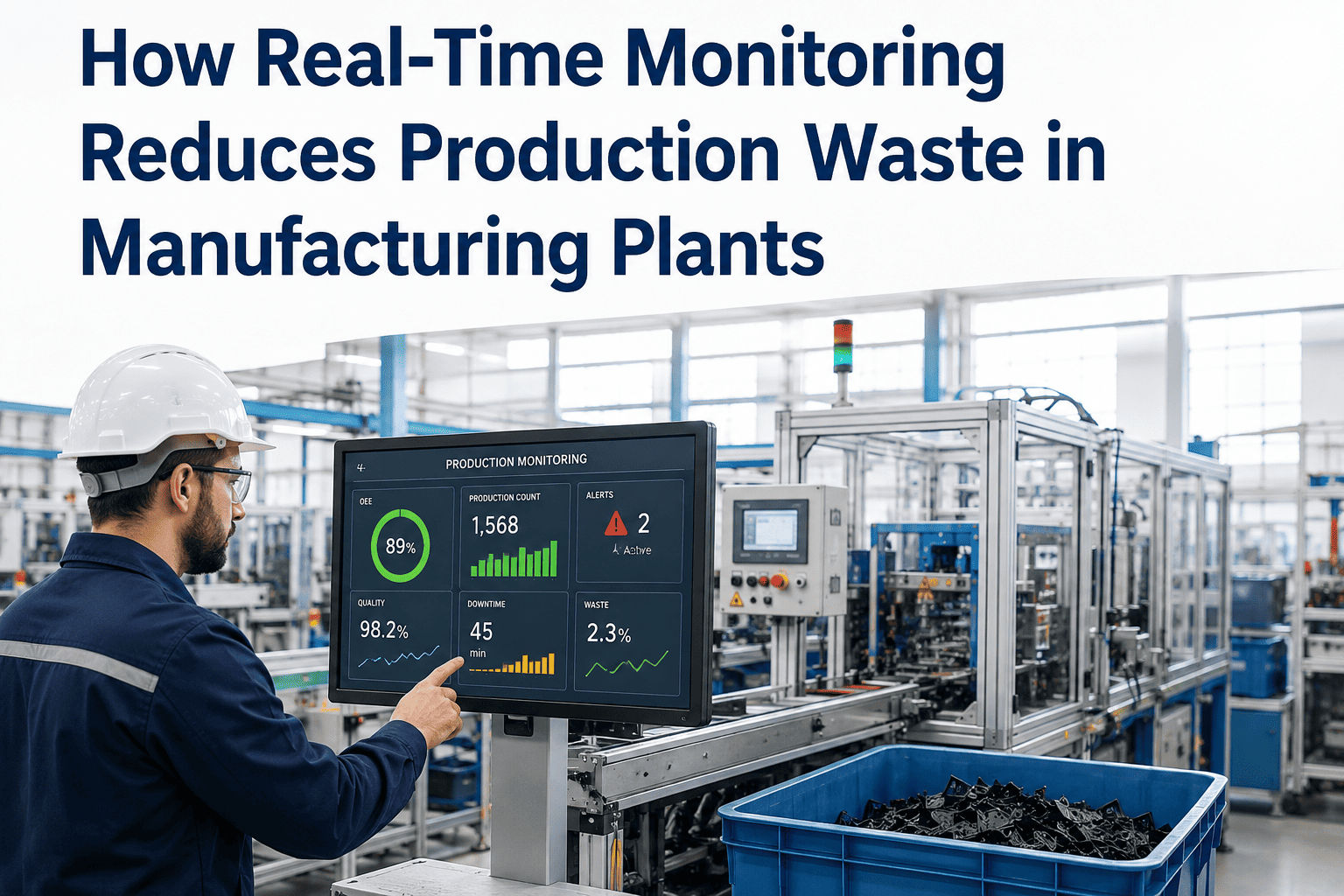
Every minute a production line stands still, money bleeds. Siemens estimates unplanned downtime costs manufacturers $1.5 trillion globally — roughly 11% of annual revenues. The technology to prevent most of that loss already exists. 5G-connected IoT sensors, edge AI, and real-time CMMS platforms are transforming maintenance from a reactive cost center into a predictive engine that catches failures 60 to 90 days before they happen — and the factories deploying it today are pulling ahead faster than anyone expected.
5G Manufacturing Guide 2026
The Factory That Never Goes Dark
5G isn't just faster Wi-Fi for the shop floor. It's the connectivity backbone that makes real-time predictive maintenance, autonomous sensors, and edge AI finally possible at industrial scale.
50.3%
CAGR of the 5G IoT market through 2030
90 days
Earlier failure detection with 5G predictive maintenance
50%
Downtime reduction achievable with 5G-enabled PdM
What Makes 5G Different for Manufacturing
Every generation of wireless technology brought incremental improvements. 5G is a structural break. The combination of ultra-low latency (as low as 1 millisecond), massive device density (up to 1 million connected devices per square kilometer), and consistent high bandwidth fundamentally changes what's possible on a manufacturing floor. Previous networks forced manufacturers to choose between coverage and speed. 5G removes that trade-off entirely.
Metric
Latency
Bandwidth
Device Density
Reliability
Mobility Support
PdM Suitability
4G LTE / Wi-Fi
30–70 ms
100 Mbps
10K / km²
99.9%
Limited
Limited
Private 5G
1–5 ms
10 Gbps
1M / km²
99.9999%
Full
Purpose-Built
5G's 5 Transformation Layers in Maintenance
1
Dense Sensor Networks Without Bandwidth Limits
Legacy wireless networks simply couldn't handle thousands of sensors transmitting simultaneously. 5G supports millions of connected devices per square kilometre, letting manufacturers instrument every bearing, motor, pump, and conveyor in the plant without network congestion. The result: complete asset health visibility, not sampled data from a handful of critical machines.
Foundation
2
Real-Time Condition Monitoring at Millisecond Speed
High-speed milling machines, robotic arms, and precision presses generate failure signals that last milliseconds. At 30ms latency on 4G, those signals disappear before the system responds. At 1ms on 5G, AI models catch micro-vibration anomalies, thermal spikes, and acoustic patterns the instant they appear — triggering automated shutdowns before damage occurs. GF Machining cut milling failure rates dramatically, saving EUR 30 million per plant per year using exactly this capability.
Speed
3
Edge AI: Processing Where Data Is Born
Sending all sensor data to a central cloud introduces latency and creates bandwidth bottlenecks. Edge AI processes data at the device or local node — eliminating the cloud roundtrip entirely. 5G connects edge nodes with enough bandwidth to handle high-resolution video, acoustic sensors, and vibration analysis simultaneously. IDC projects that 50% of all enterprise data will be processed at the edge by 2025, and manufacturing is driving the majority of that shift.
Intelligence
4
Wireless Flexibility for AGVs and Mobile Assets
Wired sensors cannot follow a forklift, a robotic welding arm, or a mobile inspection unit. 5G provides full-speed connectivity to assets in motion across the entire plant floor without the dead zones of traditional Wi-Fi. Automated Guided Vehicles (AGVs) maintain real-time CMMS sync as they move, and maintenance crews receive live work order updates on tablets anywhere in the facility.
Mobility
5
Digital Twins Powered by Live Data
A digital twin is only as accurate as the data feeding it. 5G enables continuous, high-fidelity data streams from every physical asset, keeping the digital model synchronized in real time. Maintenance teams can simulate repair scenarios, stress-test operating parameters, and forecast replacement timelines on the twin before touching the physical asset — eliminating the trial-and-error that drives unplanned downtime.
Simulation
Is your CMMS ready to handle 5G sensor data?
Oxmaint's IoT integration layer connects directly to 5G-enabled sensors — automatically converting live equipment data into work orders, MTBF trends, and predictive alerts your team can act on immediately.
Real Deployments, Real Results
5G in manufacturing is no longer a pilot project or a whitepaper promise. Industrial 5G IoT deployments are generating measurable ROI across automotive, energy, food production, and heavy industry. These are verified outcomes from facilities that have moved past theory into production-scale operation.
EUR 30M
saved per plant per year
Deployed 5G for predictive maintenance of high-speed milling machines. Ultra-low latency was essential because machine speed and acceleration meant failures happened in milliseconds. The failure rate of the milling process was greatly reduced after deployment.
Real-time
spindle health monitoring deployed
Spindles previously only removed after failure. 5G now provides early warning signs of damage — reducing both repair costs and unplanned downtime. Machine status analysis feeds directly to cloud systems for enterprise-wide visibility.
Full 5G
private network factory launched Q1 2025
Siemens inaugurated a fully 5G-equipped digital factory supporting advanced industrial IoT applications and autonomous production lines — setting the benchmark for next-generation facility design.
Multi-year
5G IoT sensor supply contract
Bosch secured a major contract in Q1 2025 to supply 5G-enabled IoT sensors across smart manufacturing plants — validating the commercial maturity of 5G maintenance technology at automotive production scale.
The 5G Maintenance Stack: From Sensor to Decision
Understanding how 5G fits into your existing maintenance infrastructure is critical before committing to deployment. The architecture isn't complex — but each layer must be in place for the system to function. The diagram below shows how data flows from a machine sensor to a live CMMS dashboard and actionable work order.
Layer 1
IoT Sensor Layer
Vibration sensors
Thermal cameras
Acoustic monitors
Pressure gauges
Current sensors
5G Ultra-Low Latency Transmission
Layer 2
Edge AI Processing
Anomaly detection
Pattern recognition
Failure prediction
Alert generation
Layer 3
Oxmaint CMMS
Auto work orders
MTBF / MTTR live
PM schedule engine
Cost analytics
Layer 4
Maintenance Action
Scheduled repair
Parts pre-ordered
Zero unplanned stops
Full audit trail
Industry-Specific 5G Maintenance Use Cases
5G Maintenance ROI: What the Numbers Actually Show
35–50%
Unplanned Downtime Reduction
McKinsey research on 5G-enabled predictive maintenance across manufacturing sectors
25–30%
Maintenance Cost Reduction
Industry studies across automotive, food, and heavy manufacturing 5G PdM deployments
10%
Spare Parts Inventory Reduction
Hexagon analysis: asset condition monitoring reduces safety stock requirements significantly
95%
Predictive Maintenance Adopters Report Positive ROI
Industry survey — 27% achieve full investment payback within the first year of deployment
Private 5G vs. Public 5G: Which Is Right for Your Plant?
The decision between private and public 5G is the single most consequential infrastructure choice a plant manager makes when deploying industrial IoT. Speak with our team to assess which architecture fits your facility's scale and budget. The table below outlines the core trade-offs clearly.
Recommended for Critical Operations
Private 5G Network
A dedicated network built exclusively for your facility. Your data never leaves your premises. Latency is guaranteed. Security is entirely within your control.
Guaranteed sub-5ms latency for mission-critical assets
Network slicing for priority traffic management
Full data sovereignty and security compliance
No contention with public network traffic
Higher upfront infrastructure cost
Requires dedicated spectrum licensing
Best for: Automotive, semiconductor, pharma, chemical plants
Public 5G Network
Leverage carrier-deployed 5G infrastructure. Lower entry cost, faster deployment — suitable where latency guarantees and data sovereignty are less critical.
No infrastructure investment — use existing carrier network
Faster deployment, lower upfront cost
Ideal for distributed or multi-site operations
Latency varies with network congestion
Data passes through carrier infrastructure
Less suitable for ultra-precision applications
Best for: Food, beverage, consumer goods, logistics
Frequently Asked Questions
How much does deploying 5G for predictive maintenance actually cost?
Costs range widely based on facility size, network type, and sensor density. Public 5G deployments using existing carrier networks can start with sensor hardware costs alone — often $50,000 to $200,000 for a medium-sized plant. Private 5G infrastructure typically runs $500,000 to $2 million for a full facility buildout. However, with 5G predictive maintenance delivering 25–30% maintenance cost reduction and 35–50% downtime reduction, most facilities see full investment payback within 12 months.
Book a free ROI assessment to model the numbers for your specific facility.
Can 5G maintenance technology integrate with our existing CMMS?
Yes — and the CMMS integration is precisely where 5G delivers its greatest maintenance value. Sensor data is only useful when it triggers structured work orders, updates MTBF calculations, and informs PM schedules. Oxmaint's IoT integration layer accepts data from 5G-connected sensors and edge AI systems, automatically converting equipment health signals into maintenance actions without manual data entry.
Sign up free and connect your first sensor to Oxmaint in under 30 minutes.
How far in advance can 5G-powered predictive maintenance detect failures?
Multiple independent studies confirm that 5G-enabled condition monitoring can identify failure indicators 60 to 90 days before the actual failure event. This window is long enough to order parts, schedule a planned shutdown, and complete the repair without any production interruption. By contrast, traditional periodic inspection catches failures an average of days before they occur — often too late to avoid emergency repair costs.
See how Oxmaint's predictive alert engine works with your IoT data.
Which industries benefit most from 5G industrial maintenance in 2026?
Semiconductor and high-precision manufacturing see the fastest ROI because their downtime costs exceed $1 million per hour, making the business case immediate. Automotive, chemical, and pharmaceutical plants follow closely — these industries have both complex equipment and strict regulatory requirements where 5G-enabled documentation and real-time monitoring deliver compounding value. Food and beverage manufacturers are among the fastest-growing adopters in 2025–2026 due to contamination prevention requirements.
Schedule a sector-specific consultation to map 5G use cases to your operation.
Do we need to replace all existing sensors to move to 5G maintenance?
Not immediately. Many facilities phase their 5G rollout, starting with 5G gateways that aggregate data from existing wired or Wi-Fi sensors while simultaneously deploying new 5G-native sensors on critical assets. This hybrid approach protects existing sensor investments while building toward full 5G connectivity. The key requirement is a CMMS platform flexible enough to ingest data from both legacy and new sensor types without separate dashboards or manual reconciliation.
Oxmaint supports hybrid IoT architectures — start your free trial and connect what you have today.
The 5G Maintenance Era Is Here
Your Sensors Are Talking. Is Your CMMS Listening?
Oxmaint's IoT integration connects 5G sensor networks directly to your maintenance workflows — automatically generating work orders, tracking MTBF trends, and alerting your team before equipment fails. Set up in under 30 minutes. No hardware vendor lock-in. No implementation fees.