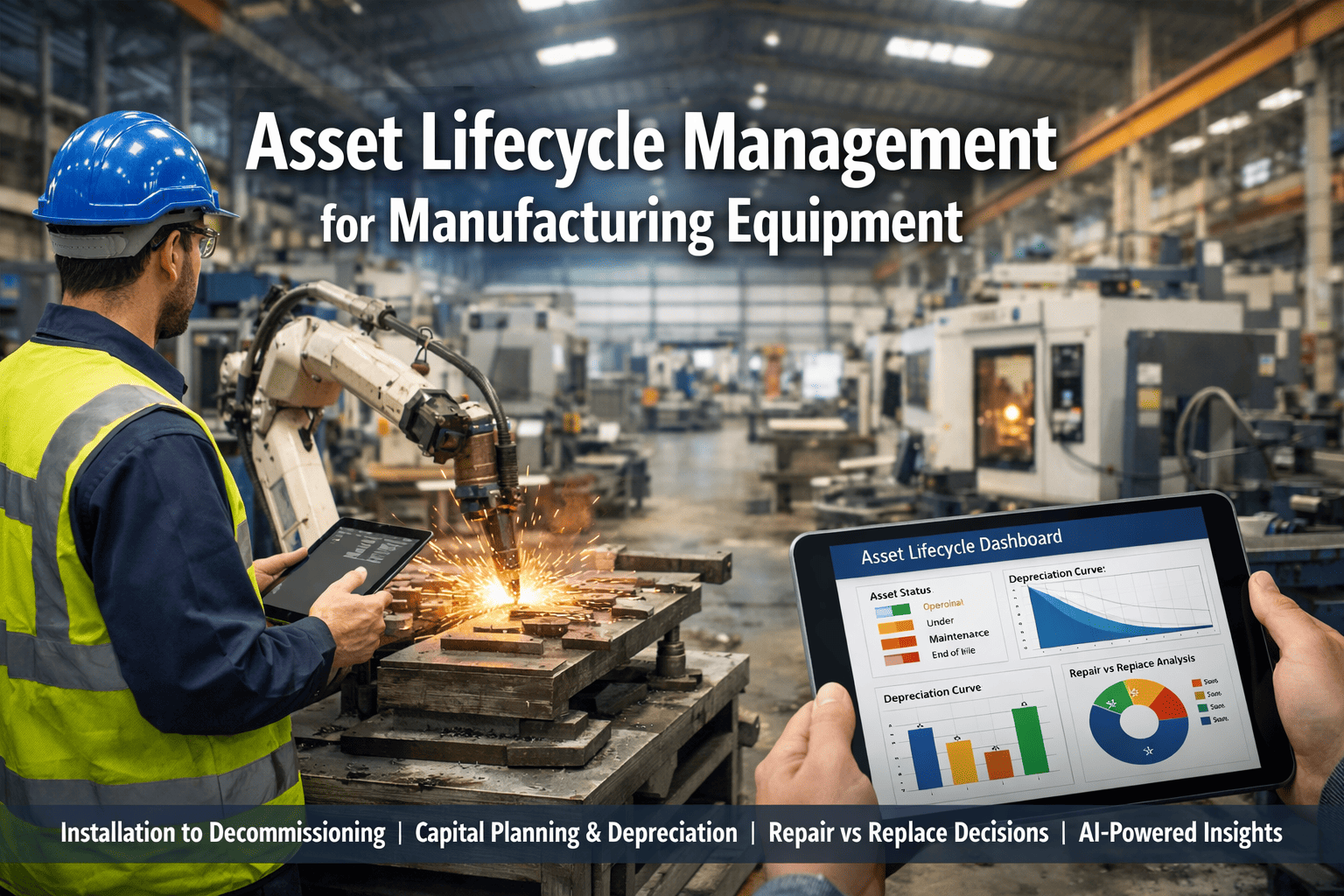
Asset lifecycle economics for manufacturing leaders is the strategic discipline that reframes equipment management from a cost center activity into a financially optimized investment decision process. Understanding the true lifecycle economics of production assets — repair spend trajectories, renewal timing windows, long-term value retention, and the compounding cost of deferred replacement — is what separates manufacturing leaders who control capital expenditure from those who are perpetually surprised by it. Sign Up Free to see how OxMaint gives manufacturing leaders the asset lifecycle data they need to evaluate repair spend against renewal timing and optimize total equipment investment across their production portfolio. Organizations that formalize asset lifecycle economics typically reduce unnecessary capital expenditure by 15–25% while simultaneously improving asset availability — because they replace the right assets at the right time, not reactively after catastrophic failure or prematurely based on arbitrary depreciation schedules.
Evaluate Asset Lifecycle Economics with OxMaint
Lifecycle cost accumulation. Renewal timing analysis. Condition-trend tracking. Capital planning support. Built for manufacturing leaders managing long-term equipment value.
Why Manufacturing Leaders Struggle with Asset Lifecycle Economics
The barriers to sound lifecycle economic analysis are almost entirely data-related. When maintenance costs are not accumulated per asset, when condition trends are not tracked over time, and when replacement cost data is not connected to repair histories, manufacturing leaders are forced to make major capital decisions based on intuition and political pressure rather than financial evidence. Book a Demo to see how OxMaint builds the asset data foundation that lifecycle economics analysis requires.
Repair Spend Not Tracked Against Replacement Value
Without comparing accumulated maintenance spend to current replacement cost, manufacturing leaders have no objective trigger for replacement decisions — continuing to repair assets long past the point of economic justification.
Renewal Timing Driven by Crisis, Not Analysis
When asset lifecycle data is unavailable, replacement decisions are made reactively after catastrophic failures — at the worst possible time, with no budget preparation and maximum production disruption.
Condition Trend Data Not Informing Capital Plans
Vibration trends, wear measurements, and condition monitoring data that could predict remaining service life is collected but not linked to capital planning models — leaving future expenditure forecasts disconnected from actual asset health.
Depreciation Schedules Driving Premature Replacement
Accounting depreciation schedules do not reflect actual asset condition — causing organizations to replace well-maintained assets prematurely while retaining deteriorating assets that finance has already written down.
Criticality Not Weighting Lifecycle Investment Decisions
Lifecycle economics analysis that does not incorporate asset criticality misallocates renewal investment — applying the same replacement threshold to a standby pump and a critical production line conveyor.
No Renewal Trigger Framework Across Asset Classes
Without defined renewal trigger criteria by asset category, replacement decisions are made inconsistently — creating asset portfolios where lifecycle economics vary widely by department, site, or manager preference.
Asset Lifecycle Economics Framework — 7 Core Analytical Layers
Sound asset lifecycle economics for manufacturing leaders requires seven interconnected analytical layers — from initial acquisition cost accounting through end-of-life renewal trigger management. Each layer builds toward a complete picture of total asset value and the optimal point for renewal investment. Sign Up Free to implement this framework using OxMaint's asset management and cost analytics modules.
| Lifecycle Layer |
What It Measures |
OxMaint Feature |
Capital Decision Enabled |
| Acquisition and Commissioning Cost |
Initial purchase, installation, and commissioning spend per asset |
Asset Register + Cost Baseline |
True replacement cost baseline |
| Maintenance Cost Accumulation |
Lifetime labor, parts, and contractor spend per asset |
Work Order Cost Tracking |
Total cost of ownership calculation |
| Condition Trend Monitoring |
Vibration, wear, temperature trends indicating remaining service life |
Predictive Maintenance + PLC Integration |
Remaining useful life estimation |
| Failure Rate Trajectory |
Increasing failure frequency as asset approaches end-of-life |
Reliability Analytics (MTBF Trend) |
Deterioration rate and renewal urgency |
| Downtime Cost Integration |
Production revenue loss per failure event over asset lifetime |
Downtime Tracking + OEE Analytics |
Total economic impact of continued operation |
| Criticality-Weighted Renewal Priority |
Replacement urgency ranked by asset impact on production continuity |
Criticality Matrix + Capital Planning |
Capital allocation prioritization |
| Renewal Trigger and Capital Roadmap |
Defined replacement thresholds with forward capital expenditure forecast |
Asset Lifecycle Analytics Module |
Proactive capital budget planning |
How OxMaint Supports Asset Lifecycle Economics for Manufacturing Leaders
01
Lifetime Cost Accumulation Per Asset
OxMaint automatically accumulates all maintenance costs — labor, parts, contractor, and downtime impact — against each asset record from first work order to last. This continuous accumulation produces the lifetime cost data that makes repair vs. renew analysis financially credible rather than anecdotal.
Book a Demo to see lifetime cost accumulation configured for your asset portfolio.
02
Condition Trend Tracking and Remaining Useful Life
OxMaint integrates with PLC systems, vibration analyzers, and condition monitoring equipment — tracking wear and performance trends per asset over time. These trends give manufacturing engineers an evidence-based view of remaining service life that is far more accurate than depreciation schedules for capital planning purposes.
03
Renewal Trigger Management and Capital Roadmap
OxMaint allows reliability engineers to define renewal triggers per asset class — based on lifecycle cost ratio, failure rate trajectory, or condition threshold crossing — and generates capital expenditure forecasts when assets approach renewal criteria. This converts ad hoc replacement decisions into a managed capital roadmap.
Sign Up Free to configure renewal triggers for your production asset classes.
04
Criticality-Weighted Capital Prioritization
OxMaint combines lifecycle cost data with asset criticality ratings to produce priority-ranked capital renewal lists — ensuring that replacement investment is directed toward the assets where deterioration poses the greatest risk to production continuity, safety, and regulatory compliance, rather than simply the oldest equipment on the register.
Asset Lifecycle Economics Results in Manufacturing Operations
The following examples show how manufacturing leaders use OxMaint's lifecycle economics capabilities to optimize repair spend, improve renewal timing, and build credible capital plans supported by asset-level financial data.
Automotive Components
Optimizing Renewal Timing Across Production Lines
ChallengeCapital replacements reactive and unplanned — budget surprises averaging $1.8M annually
AppliedOxMaint lifecycle cost accumulation; renewal triggers at 70% of replacement value threshold
ResultCapital budget variance reduced from 34% to 8%; 3-year capital roadmap built from asset data
Chemical Processing
Condition-Based Remaining Life Assessment
ChallengeReactor vessel replacement schedule driven by age — not actual condition or remaining service life
AppliedOxMaint condition trend monitoring with corrosion measurement data; remaining life model per vessel
Result4 vessels deferred 18–24 months based on condition data; $2.3M capital expenditure deferred safely
Paper and Pulp
Long-Term Value Comparison Across Asset Classes
ChallengeOEM and generic replacement parts being selected without understanding impact on asset service life
AppliedOxMaint lifecycle cost comparison by maintenance strategy and parts specification per asset class
ResultOEM parts justified for critical rotating equipment; total lifecycle cost reduced 19% vs. generic alternative
Pharmaceutical
Criticality-Weighted Capital Allocation
ChallengeCapital renewal budget distributed evenly across asset classes regardless of production criticality
AppliedOxMaint criticality matrix combined with lifecycle cost data to produce priority-ranked renewal list
ResultCritical clean room HVAC prioritized for renewal; regulatory compliance risk eliminated before FDA inspection
Step-by-Step: Implementing Asset Lifecycle Economics in OxMaint
Step 1
Establish Asset Register with Acquisition Cost and Replacement Value
Record each production asset in OxMaint with its original acquisition cost, current estimated replacement value, and commissioning date. This baseline data is the foundation of lifecycle cost ratio calculations and capital planning models.
Book a Demo to see asset register configuration for lifecycle economics analysis.
↓
Step 2
Activate Per-Asset Maintenance Cost Accumulation
Configure OxMaint to require asset linkage and cost entry on all work orders. As maintenance activity is completed and closed, costs automatically accumulate against each asset's lifetime record — building the repair spend history that lifecycle economics analysis depends on.
↓
Step 3
Connect Condition Monitoring Data to Asset Records
Integrate OxMaint with your condition monitoring equipment — vibration analyzers, thermal cameras, corrosion measurement tools — so that wear trend data is captured against asset records over time. This data transforms lifecycle analysis from cost-only to condition-informed remaining useful life assessment.
Sign Up Free to activate condition monitoring integration for your critical assets.
↓
Step 4
Define Renewal Triggers Per Asset Class
Set renewal consideration thresholds in OxMaint for each asset category — for example, lifecycle cost ratio exceeding 65% of replacement value, MTBF declining below a defined threshold, or condition monitoring readings crossing a defined deterioration level. OxMaint will flag assets meeting these criteria for capital review.
↓
Step 5
Build Forward Capital Expenditure Roadmap
Use OxMaint's lifecycle analytics to identify assets approaching renewal triggers over the next 12, 24, and 36 months — producing a forward capital expenditure roadmap that gives finance teams the budget visibility they need to plan and approve replacement investment without emergency approvals.
Sign Up Free to generate your first lifecycle-driven capital roadmap in OxMaint.
Key KPIs for Asset Lifecycle Economics
These metrics give manufacturing leaders the financial and operational visibility needed to evaluate asset value, optimize renewal timing, and align capital investment with actual equipment condition and criticality. Book a Demo to see how OxMaint tracks these metrics across your production asset portfolio.
Lifecycle Cost Ratio
Accumulated maintenance spend as a percentage of replacement asset value. The primary trigger metric for renewal consideration — typically actionable at 60–80% depending on asset criticality and condition.
Total Cost of Ownership per Asset
Acquisition cost plus all maintenance, downtime, and operational costs over the asset's service life. The comprehensive financial metric for comparing asset investment decisions across classes and vintages.
MTBF Trend (Deterioration Rate)
Direction and rate of change in mean time between failures over successive periods. Accelerating MTBF decline is the operational signal that lifecycle cost trajectory is about to increase significantly.
Remaining Useful Life Estimate
Projected remaining operational life based on condition trend data and historical failure patterns. Allows capital planning teams to schedule renewal within operational windows rather than responding to failures.
Capital Budget Variance
Difference between planned and actual capital expenditure on asset renewal. High variance indicates reactive replacement decision-making; low variance confirms that lifecycle economics analysis is driving proactive capital planning.
Renewal ROI by Asset Class
Financial return on renewal investment — calculated as the combination of avoided maintenance costs, reduced downtime losses, and improved OEE following replacement. Justifies renewal investment in financial terms that resonate with manufacturing leadership and finance teams.
Evaluate Asset Lifecycle Economics with Confidence Using OxMaint
Lifetime cost accumulation. Condition-trend tracking. Renewal trigger management. Criticality-weighted capital prioritization. All in one CMMS built for manufacturing leaders.
Frequently Asked Questions
What is asset lifecycle economics for manufacturing leaders?
It is the practice of evaluating total asset value — repair spend, condition trends, remaining useful life, and renewal timing — to optimize capital investment decisions and align replacement timing with actual equipment economics rather than accounting schedules.
How does OxMaint support asset lifecycle economics analysis?
OxMaint accumulates lifetime maintenance costs per asset, tracks condition trends from integrated monitoring equipment, defines renewal triggers by asset class, and generates forward capital expenditure roadmaps — giving manufacturing leaders a complete lifecycle economics platform.
What is the lifecycle cost ratio and how is it used?
The lifecycle cost ratio is accumulated maintenance spend as a percentage of current replacement value. When an asset's ratio crosses a defined threshold — typically 60–80% — it becomes a candidate for capital renewal consideration, depending on criticality and remaining condition.
How does condition monitoring improve lifecycle economics decisions?
Condition monitoring data provides objective remaining service life estimates — allowing capital planning teams to defer replacement of healthy assets and accelerate renewal of deteriorating ones, rather than relying on age or depreciation schedules alone.
What KPIs should manufacturing leaders track for asset lifecycle economics?
Core metrics include lifecycle cost ratio, total cost of ownership, MTBF trend, remaining useful life estimate, capital budget variance, and renewal ROI by asset class — all trackable in OxMaint's analytics module.
How does asset criticality affect lifecycle renewal decisions in OxMaint?
OxMaint combines criticality ratings with lifecycle cost data to produce priority-ranked renewal lists — ensuring that capital investment is directed toward assets where deterioration poses the greatest production, safety, and compliance risk.
Book a Demo to see criticality-weighted capital planning in OxMaint.
Give Your Manufacturing Team the Lifecycle Economics Tools They Need
OxMaint delivers asset lifecycle cost accumulation, condition trend tracking, renewal trigger management, and criticality-weighted capital planning — purpose-built for manufacturing leaders who need to make equipment investment decisions with financial confidence.



.png)