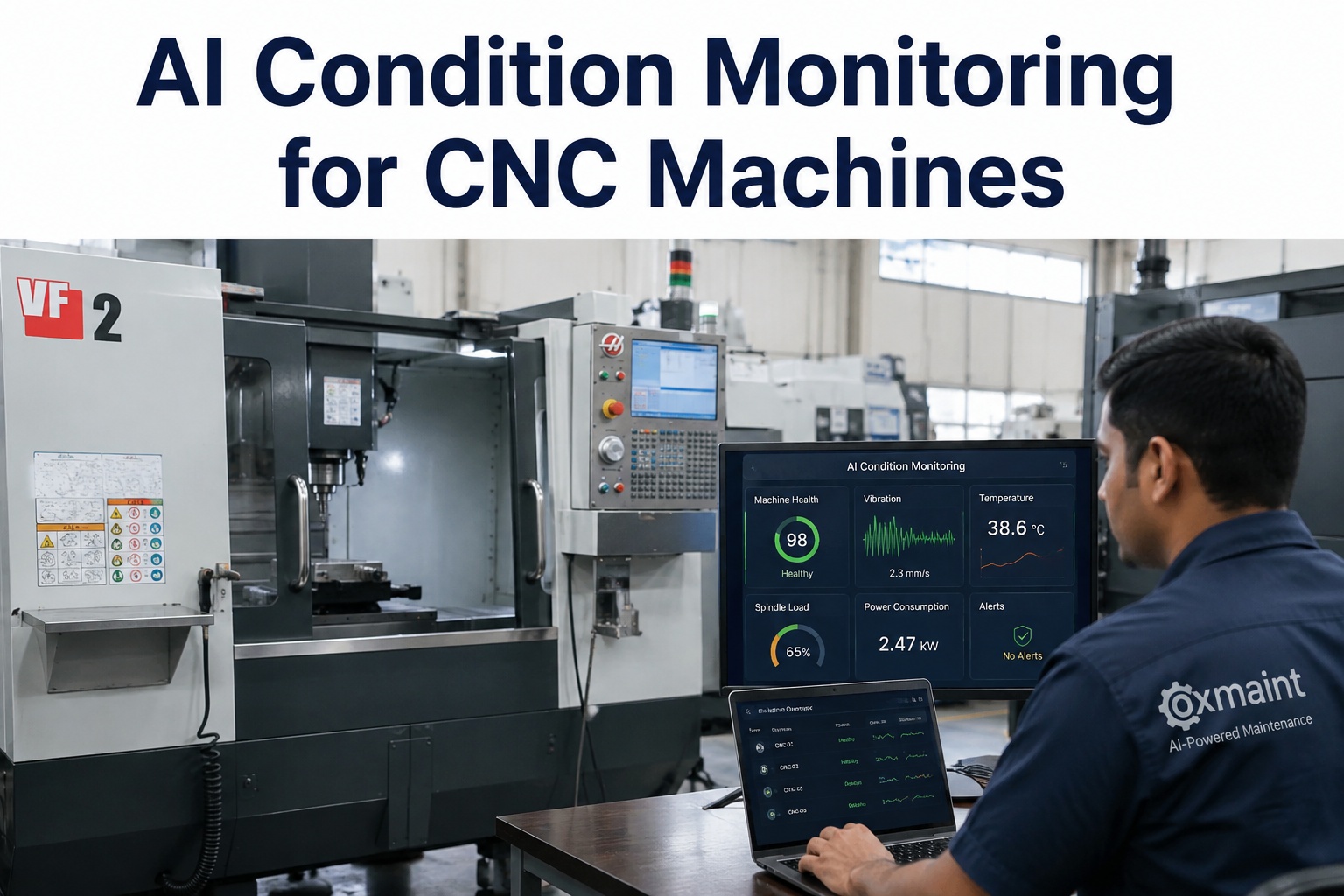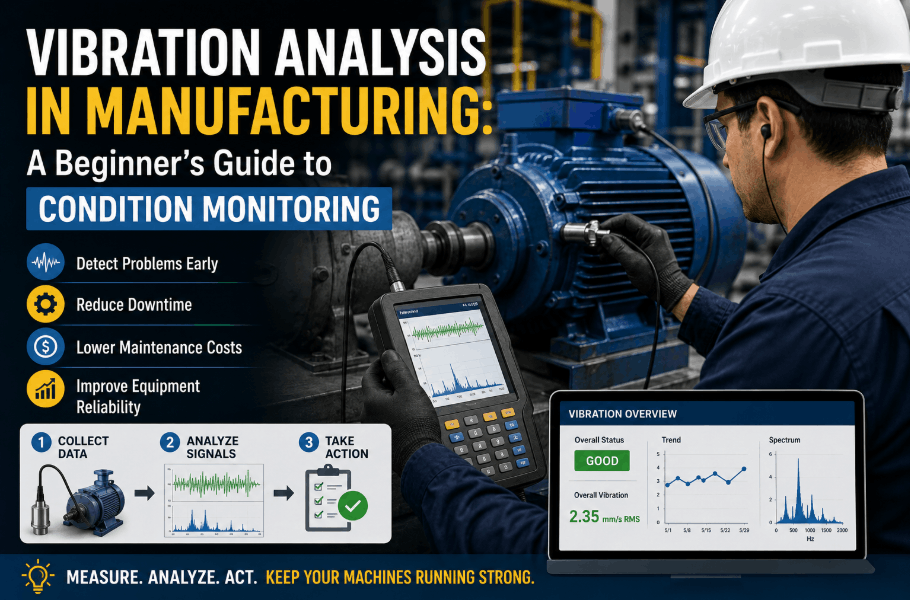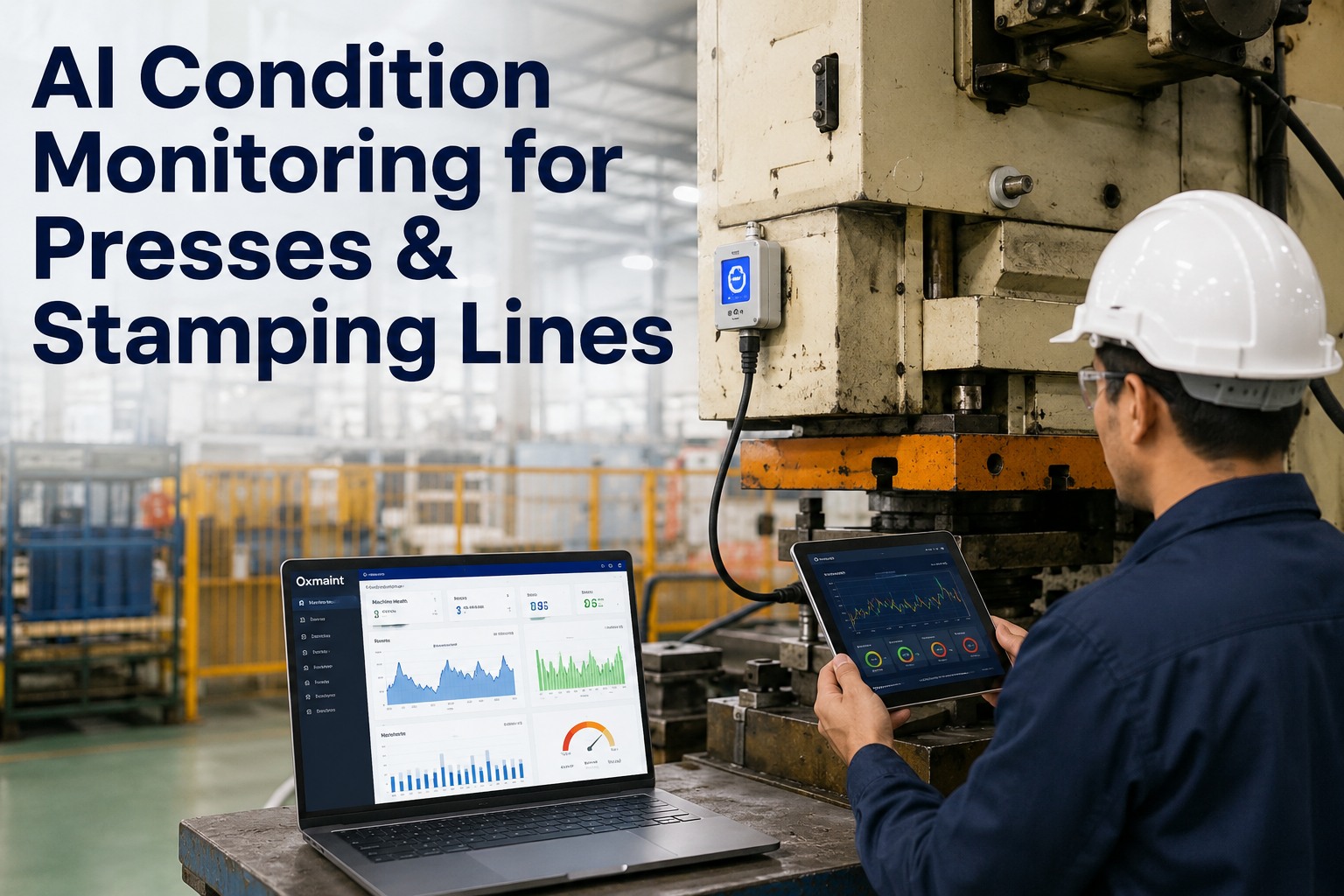
AI condition monitoring for presses and stamping lines runs on four independent signal channels tonnage signature, vibration signature, acoustic signature, and thermal signature each catching a different failure mode long before the press trips or the die splits. World-class automotive stamping runs at 82–88% OEE while the job-shop industry average sits at 58–72%, and the gap is almost entirely availability losses from unplanned mechanical downtime and die-change stoppages. A single bearing failure on a mechanical press under load carries secondary damage that multiplies repair cost by an order of magnitude — the reason AI condition monitoring is now the difference between an eight-minute planned swap and a two-day catastrophic rebuild. Book a Demo to see how OxMaint ingests strain-gauge, vibration, and current signals in real time and lands each anomaly as a mobile work order tied to the exact press and shift.
AI Condition Monitoring for Presses & Stamping Lines
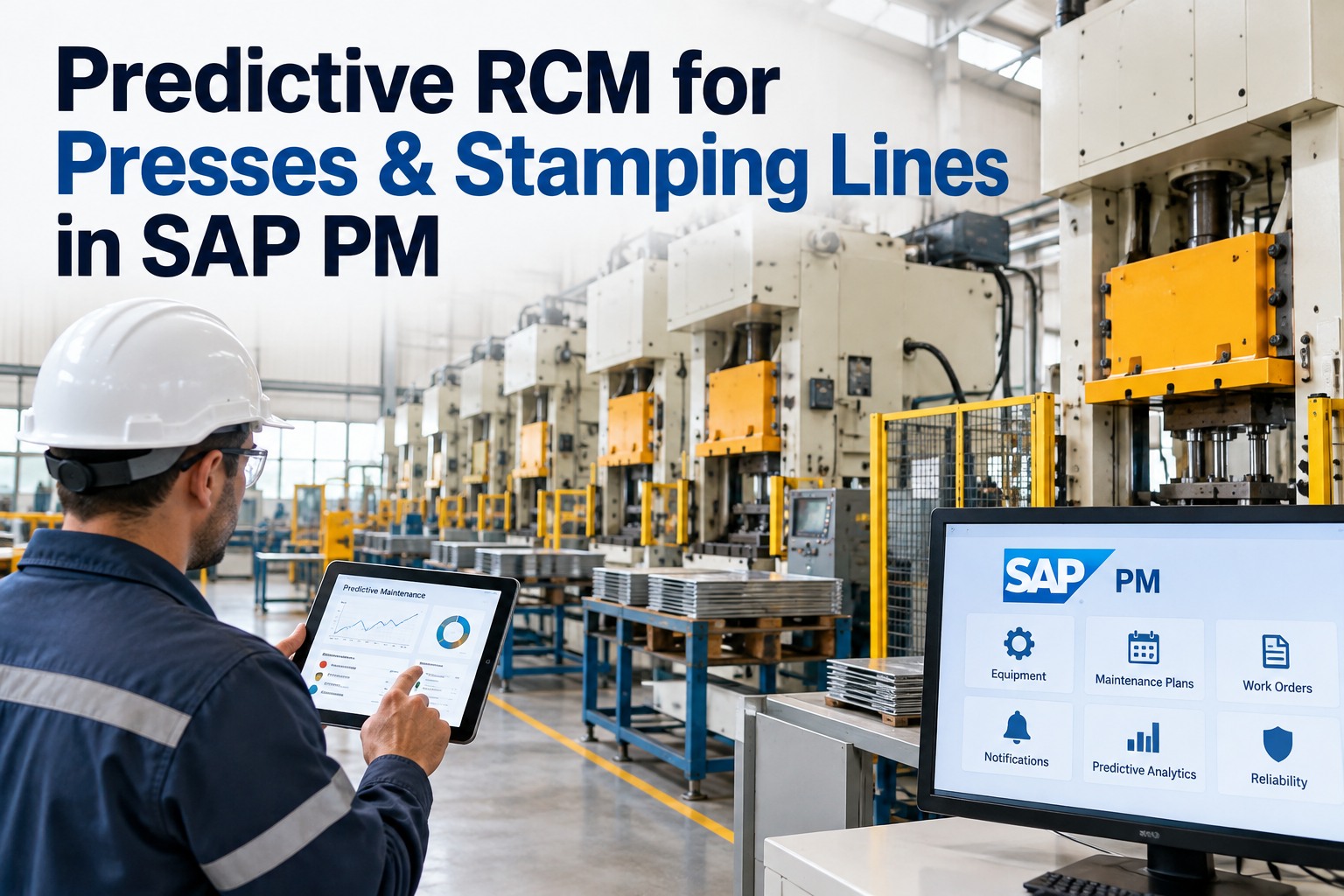
Vibration, temperature, current, and tonnage signals turned into technician-ready work orders. Detect flywheel bearing, clutch, hydraulic, and die failures weeks early with OxMaint — before the press stops the line.
The 4 Signature Types That Make AI Monitoring Work
A press condition monitoring program that leans on one signal type misses failure modes the other three would have caught. AI models fuse all four signatures against a learned healthy baseline — the reason a rising flywheel-bearing vibration and a widening tonnage-signature deviation both surface in the same OxMaint queue. Start a free OxMaint workspace and register your first press with all four signature channels wired to the same asset — the free plan includes IoT sensor ingestion, PM scheduling, and mobile work orders.
The Tonnage Signature — What Healthy Looks Like vs. What Doesn't
The tonnage signature is the single most information-dense signal on a stamping press. A healthy stroke has a predictable force curve; a faulty stroke deviates in shape, peak location, or duration. AI compares every cycle against the learned baseline and flags the anomaly to the OxMaint work order queue in real time. Book a live demo to see tonnage signature deviation running against your actual press data — an OxMaint engineer walks the alert-to-work-order flow in the same session.
5 Press & Line Failure Modes AI Monitoring Catches Early
Stamping presses fail at predictable subsystems, and each carries its own signature fingerprint. Below are the five highest-impact failure modes and the AI monitoring pattern that catches them — with the OxMaint work order that closes the loop. Sign up for free and load these five failure modes into your PdM library on day one — the free tier includes anomaly triggers, baseline learning, and mobile technician response.
A Bearing Under Load Fails Loudly — And Takes the Crankshaft With It.
The secondary damage from a mechanical failure on a press under tonnage is what breaks the budget. AI monitoring catches the primary signal weeks ahead — OxMaint turns it into the work order that prevents the collateral damage.
Threshold Alarms vs. AI Baseline Learning — Why the Old Way Misses
Traditional condition monitoring uses fixed thresholds — vibration above X, temperature above Y — which either fire constantly on nuisance events or miss slow-drift failures entirely. AI baseline learning models the healthy signature per press, per die, per shift, and flags departures no fixed threshold could reliably catch. Schedule a working session to see the OxMaint baseline-learning model applied to your press-shop asset list — the migration from threshold-based to AI-based monitoring is walked through live.
The Signal-to-Wrench OxMaint Loop
Every AI condition-monitoring alert on a press or stamping line follows the same four-node path in OxMaint — capture, classify, dispatch, close. Here's what happens between the sensor signal and the technician's mobile confirmation. Start free and run the first signal-to-wrench loop on one press within the first shift — no CAPEX, no rip-and-replace of your existing sensors or PLC controls.
We had strain gauges on every column and a vibration cabinet on the flywheel — but the alerts landed in three different systems, and nobody watched them during a production run. Piping every channel into OxMaint and letting the AI learn our healthy tonnage profile per die changed the game. We caught a crankshaft bearing at 800 hours to failure, swapped it during a Sunday-night die change, and avoided what would have been a five-day rebuild. The OEE gap between our line and the automotive benchmark closed by more than ten points in two quarters.
Frequently Asked Questions
Close the OEE Gap with the Signals You Already Have.
Tonnage. Vibration. Acoustic. Thermal. OxMaint ingests every channel, learns the healthy baseline per press, classifies the failure mode, and lands the work order on the right technician's phone — the reason world-class stamping OEE stops being someone else's number.