An industrial HVAC system fails on a Monday morning twenty days after it started telling you it was going to. The chiller approach temperature crept up two degrees. The AHU fan drew another half-amp. Cooling-tower sump pH drifted. Condition monitoring reads those drifts continuously and converts them into work orders — so a fouling condenser becomes a planned clean on Friday instead of a shutdown on Monday. OXMAINT AI is the AI-powered CMMS and maintenance management software that holds the sensor stream per subsystem, scores against the asset's own baseline, and raises the fix in the planner's queue before the failure.
INDUSTRIAL HVAC · CONDITION-BASED MAINTENANCE GUIDE · 2026
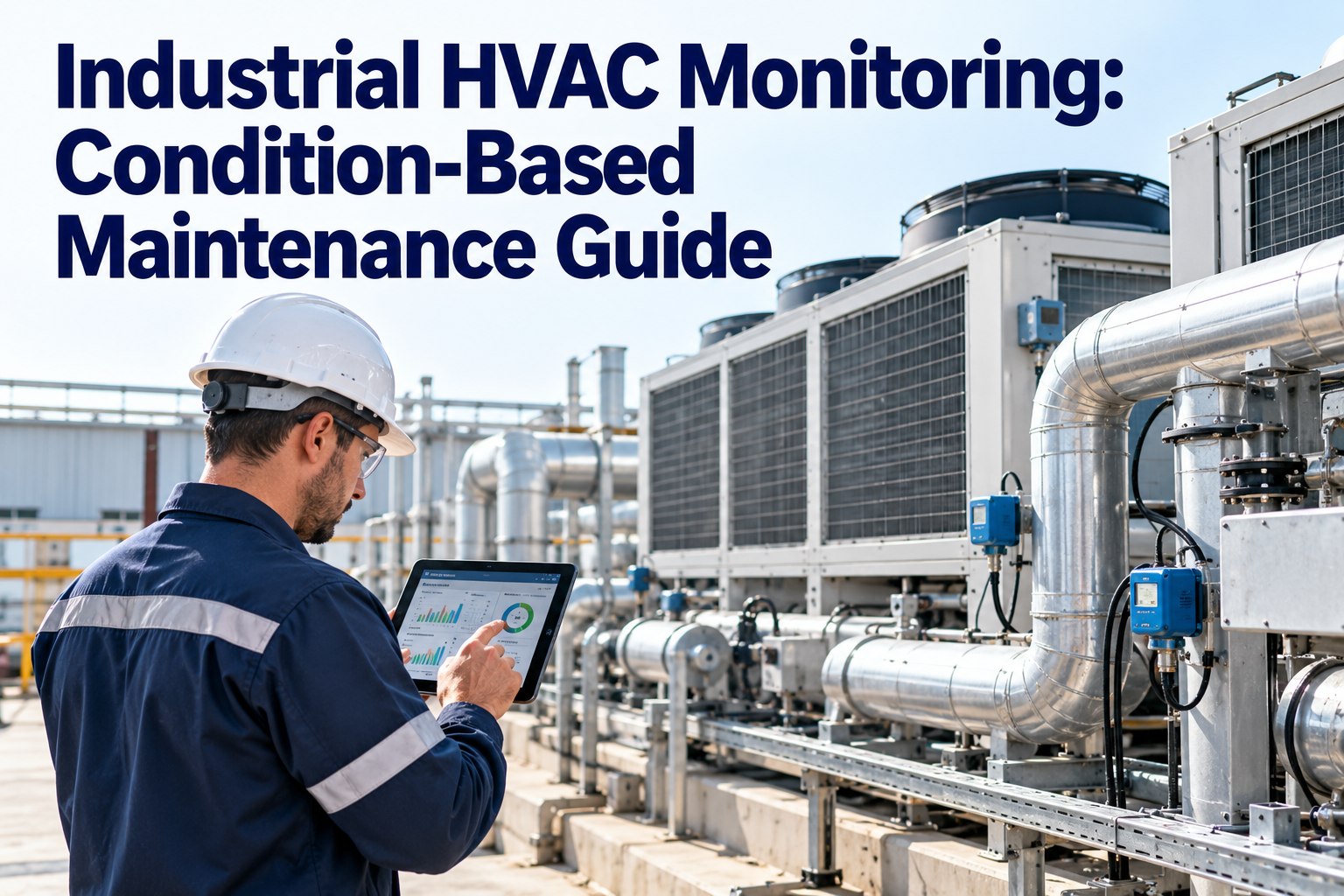
Industrial HVAC Monitoring: Condition-Based Maintenance Guide
Five subsystems carry the whole industrial HVAC load — chillers, AHUs, cooling towers, pumps, fans. Each has three or four signals that reliably predict its failures. The OXMAINT AI software reads those signals continuously, baselines each asset to itself, and raises the right work order before the comfort complaint or process trip.
CChiller
AAHU
TTower
PPump
FFan
5
subsystems carry industrial HVAC — each with its own condition-signal set
10-30%
energy over-spend typical on an HVAC system running without condition monitoring
7-21
days of early warning the condition signals give before most HVAC failures
1
asset-baseline per unit beats generic thresholds for alert quality
The Five Subsystems — What Each One Tells You
Industrial HVAC is five systems in a trench coat. Each one has its own signature failure modes and its own condition parameters. OXMAINT AI holds the signal set per subsystem per asset — so a chiller alert isn't "high vibration", it's "evaporator approach widening, 2.3°F in 14 days" — schedule a walkthrough of the HVAC signal map in OXMAINT AI.
CHILLER
Signals: approach temp, kW/ton, suction/discharge pressure, oil differential
Flags: tube fouling, refrigerant loss, compressor wear, oil degradation
AHU
Signals: filter ΔP, fan amps, supply/return temp, VFD fault codes
Flags: dirty filters, coil fouling, belt slip, damper fault, sensor drift
COOLING TOWER
Signals: approach, water conductivity/pH, fan vibration, make-up flow
Flags: scale, biological growth, fill plugging, drift, fan bearing wear
PUMPS
Signals: vibration (1×/2×), discharge pressure, motor current, seal leak
Flags: impeller wear, bearing degradation, cavitation, mechanical seal failure
FANS
Signals: vibration, bearing temp, motor current, VFD fault codes
Flags: imbalance from fouling, bearing wear, belt tension, blade damage
Fault-to-Signal Matrix: Which Reading Catches What
The real diagnostic value is matching a signal pattern to a specific fault. OXMAINT AI holds this matrix per asset — so an alert names the suspect component, not just the subsystem.
Fault
Primary signal
Secondary signal
Days of warning
Chiller condenser tube fouling
Approach temp rising
kW/ton climbing at same load
14-30
Refrigerant loss
Suction superheat up
Discharge pressure down; capacity down
7-14
AHU filter loading
Filter ΔP rising
Fan amps up to hold flow
continuous
Cooling tower scale
Approach widening
Water conductivity high; make-up up
14-21
Pump bearing wear
Vibration (BPFO/BPFI)
Bearing housing temp
7-28
Fan imbalance (dirt / damage)
1× vibration rising
Motor current wobble
7-14
Belt slip (AHU / tower)
Fan speed below VFD command
Supply temp drifts
3-7
The Live HVAC Condition Board
The facilities team's morning view is a priority-ranked board of HVAC assets with current status, trend direction and alerts from the last 24 hours. OXMAINT AI generates it from the signal stream directly — the morning stand-up is a glance, not a round of phone calls.
LIVE HVAC BOARD · CENTRAL PLANT · 07:00
CH-02 ChillerApproach +2.3°F in 14dPlan tube clean
P-14 CHW pumpBPFO + rising housing tempBearing replace
AHU-06 West wingFilter ΔP 85% of change-outOrder filters
CT-01 Tower cell AConductivity climbingBlowdown check
F-22 Exhaust fanStableOK
The Severity Ladder — What Happens After the Alert
A signal breach doesn't always mean "stop". The severity ladder maps the breach size to the right next action — OXMAINT AI routes each one automatically.
01 · MONITOR
Signal above baseline, below threshold — log the reading, keep watching the trend.
02 · PLAN REPAIR
Threshold crossed — planned WO raised against the asset for the next shop window.
03 · URGENT
Rate-of-change severe — urgent WO with supervisor escalation; may require stop-use.
04 · STOP & INSPECT
Safety or process-trip risk — the asset is tagged out until the inspection closes.
Comfort Complaints Are Lagging Indicators. Signals Are Leading Ones.
By the time a user calls facilities, the HVAC fault has been developing for weeks. The OXMAINT AI software reads the leading indicators — approach, pressure, vibration, current — and raises the work order while the comfort number is still fine.
How OXMAINT AI Runs Industrial HVAC Monitoring
The subsystem register, condition-signal ingest, fault-to-signal matrix, severity ladder and work-order loop all live natively in the OXMAINT AI maintenance management software — spin up a free account and connect your first HVAC asset in OXMAINT AI.
Subsystem-Aware Register
Chiller, AHU, tower, pump and fan each held with the condition parameters that actually predict their failures.
BMS & Sensor Ingest
Signals pulled from the BMS, OPC UA, wireless accelerometers and IEPE sensors into one asset-grounded view.
Per-Asset Baseline
Normal operating band learned per unit at each load point — alerts measure against reality, not vendor defaults.
Fault-to-Signal Library
The six-plus HVAC fault signatures held per asset — alerts name the suspect component, not just the subsystem.
Severity-to-WO Router
Monitor / Plan / Urgent / Stop each routes to the right crew and queue, with history and spectrum attached.
Energy & Comfort Tie-Back
kW/ton and comfort trends tracked alongside condition signals — so the business case for the fix stays visible.
Frequently Asked Questions
What's the single highest-value HVAC signal to start with?
Do we need to replace the BMS to add condition monitoring?
No. OXMAINT AI reads from the existing BMS over BACnet, OPC UA or Modbus and adds wireless vibration/temp sensors only where a signal is missing — typically on pumps, fan bearings and standalone AHUs.
How does this differ from a BMS alarm?
A BMS alarm fires when a value crosses a static limit. Condition monitoring tracks the trend against the asset's own baseline and the fault-signature library — so you see the drift weeks before the limit, and know which component is failing, not just that something is wrong.
How fast can we go live?
A first wave covering the central-plant chillers, pumps and towers typically goes live in 4-6 weeks — signal mapping, baseline learning, severity ladder and WO loop. Book a walkthrough and the team will scope your plant.
Catch the Drift Before the Comfort Call.
Put every industrial HVAC subsystem on the OXMAINT AI maintenance management software — condition signals read continuously, scored against the asset's baseline, matched to the fault-signature library, and routed to the right crew by severity. Weeks of warning, not minutes.