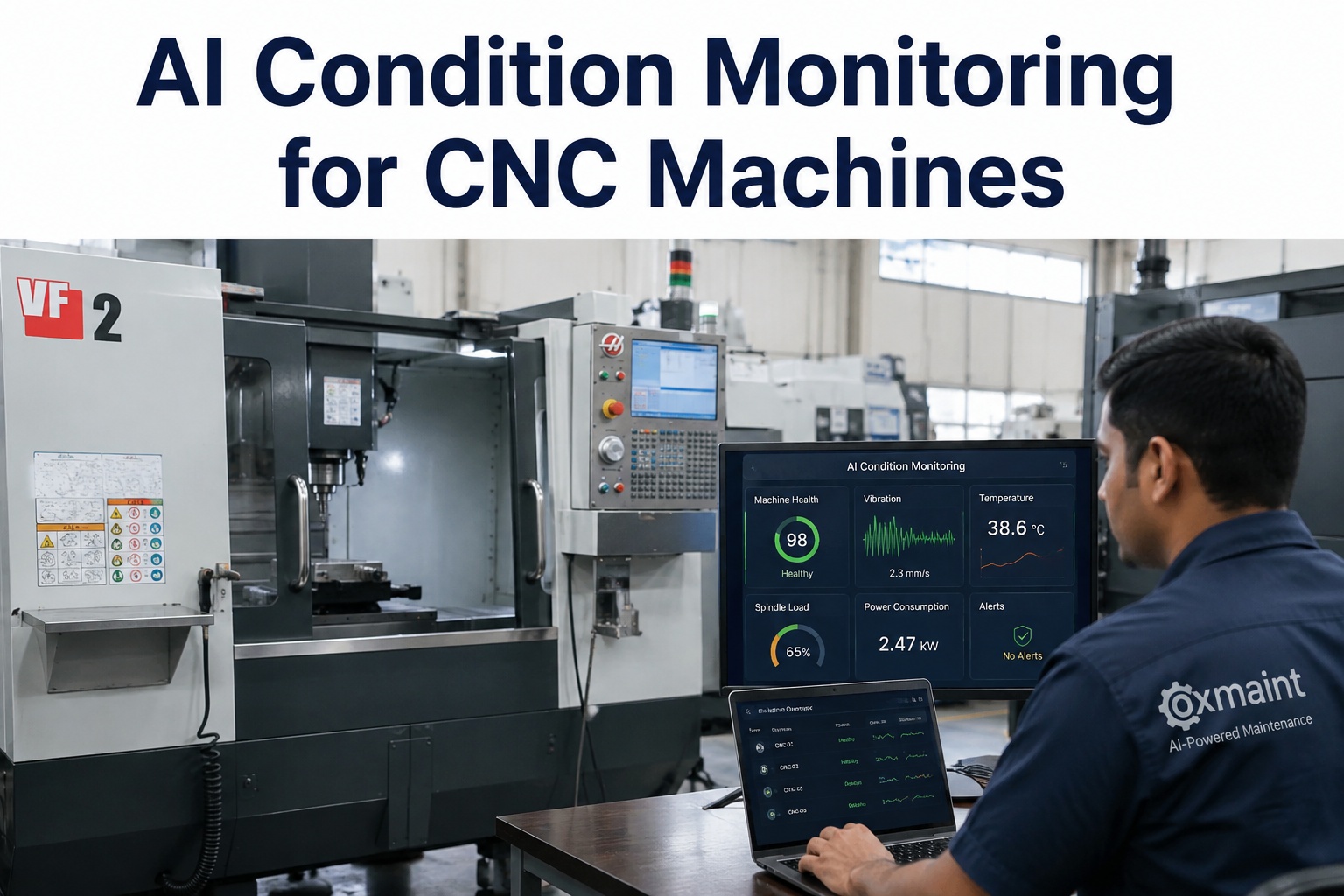
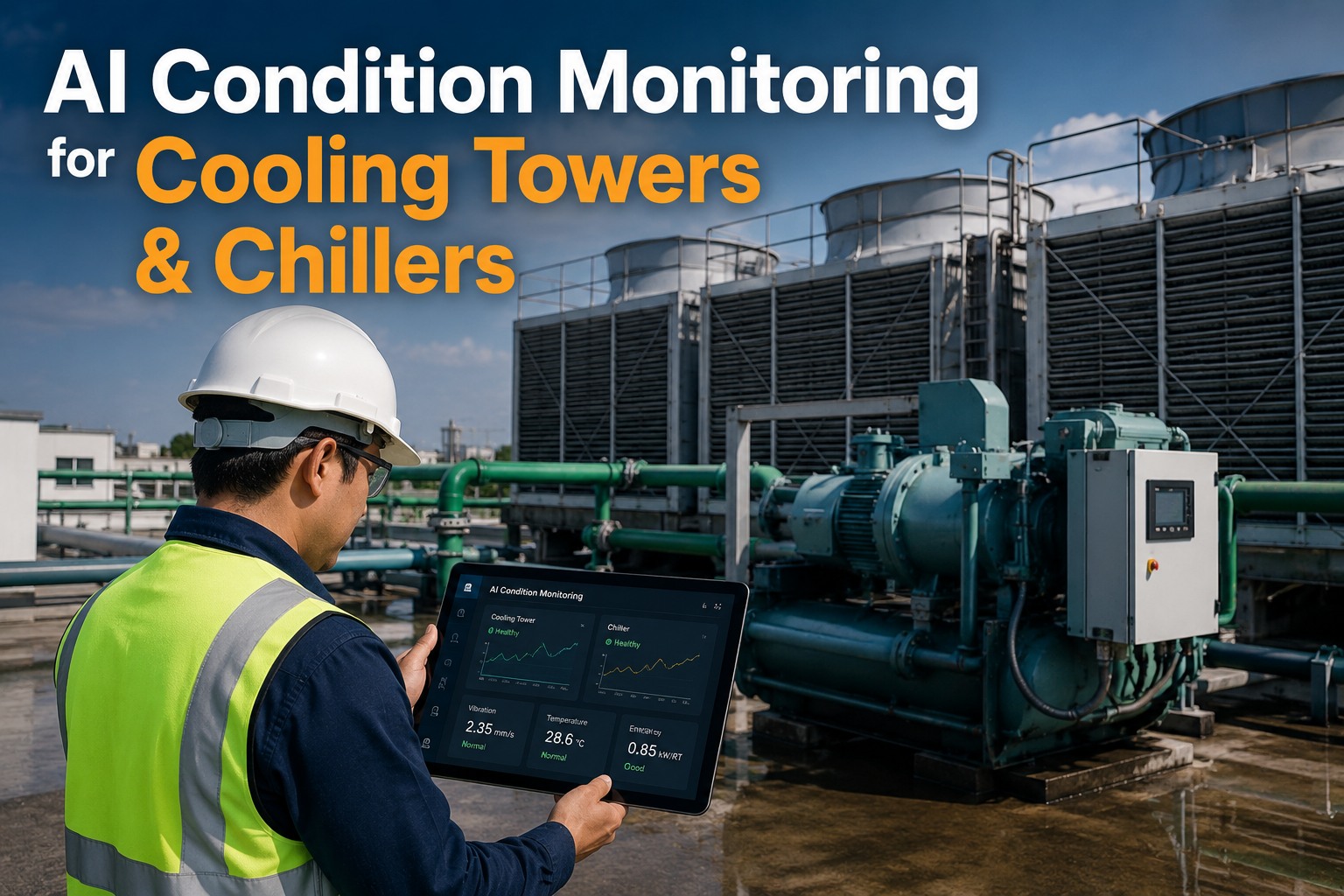
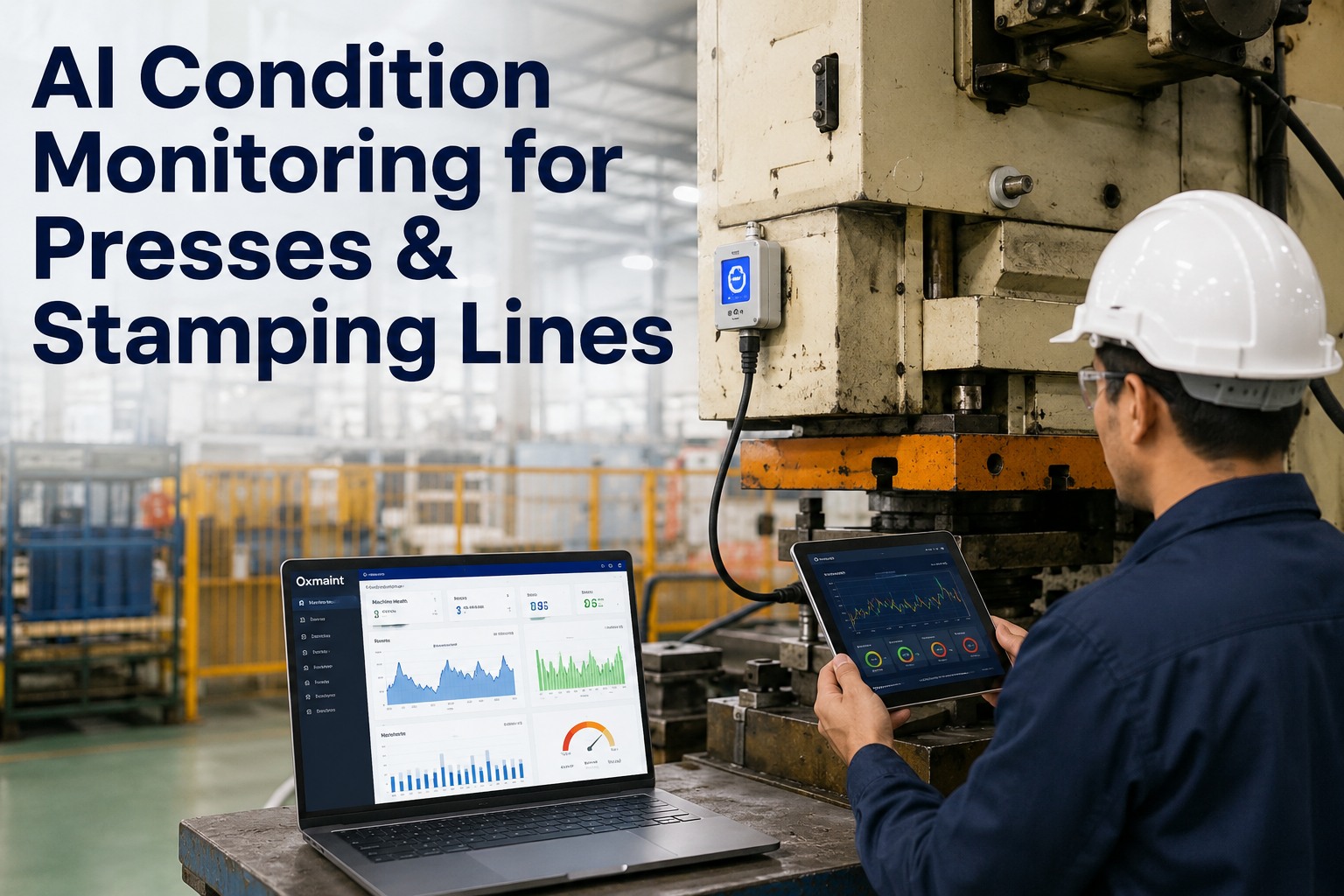
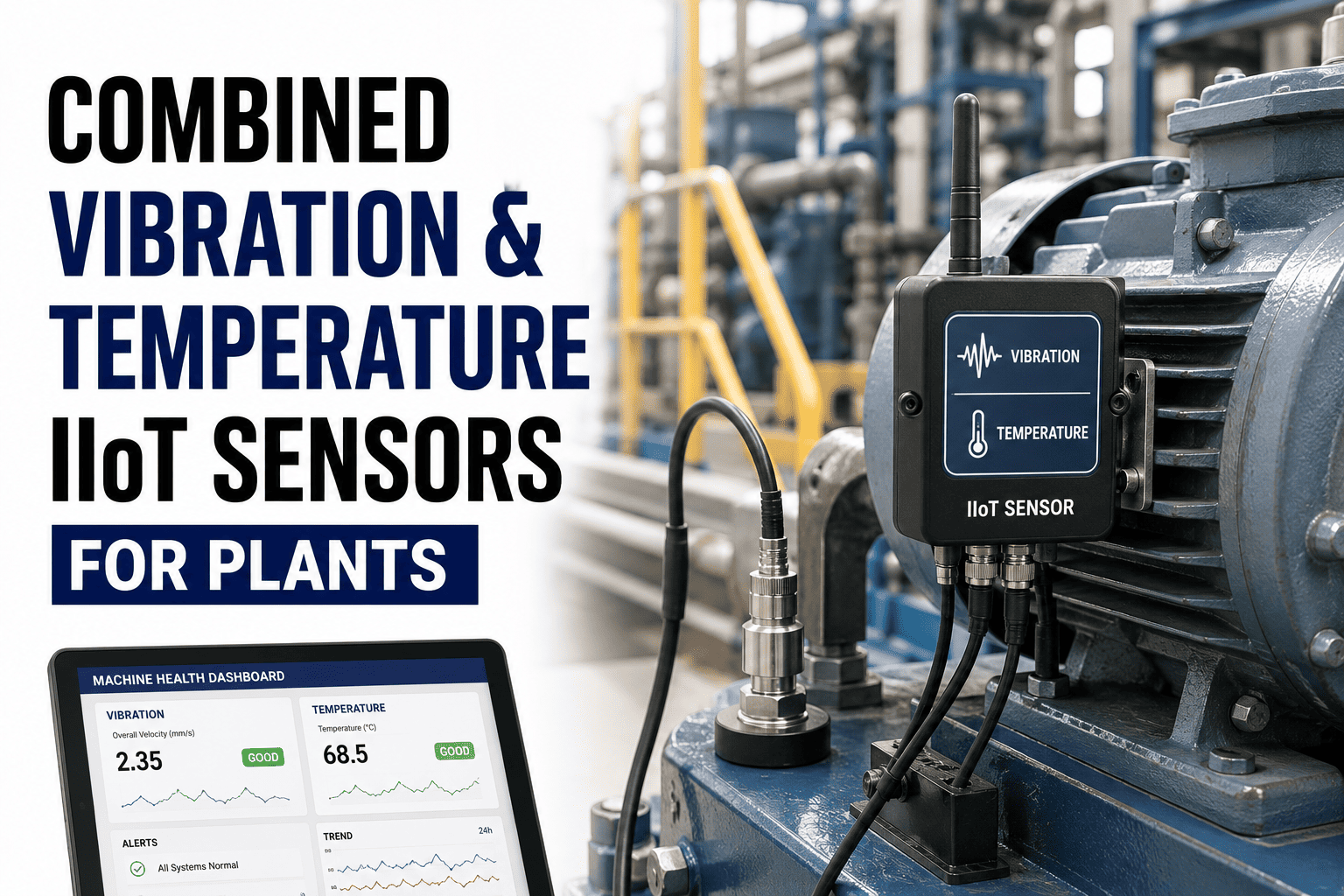
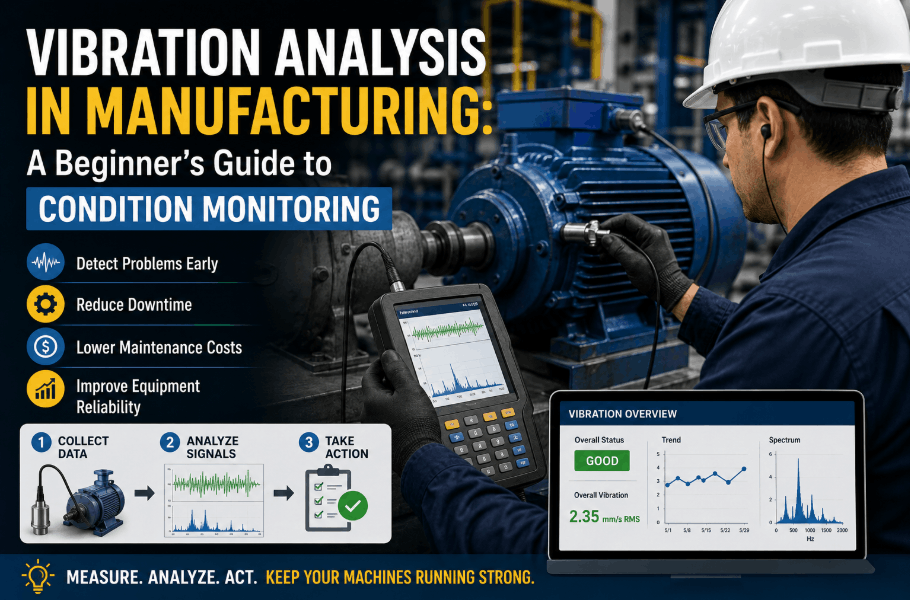
AI condition monitoring for CNC machines lives at a scale where a minor bearing defect on a spindle turning 15,000–30,000 RPM can escalate from detectable vibration to catastrophic seizure in under 200 operating hours and an emergency spindle rebuild runs $15,000–$50,000 in parts, freight, and lost throughput. The AI stack that catches this delivers 2–3 weeks of failure lead time by fusing five signals: spindle vibration signature, motor current draw, bearing temperature, servo drive telemetry, and coolant particle count. Programs that route these signals into a CMMS work-order queue consistently avoid the emergency, extend spindle life, and hold tolerance on precision parts. Book a Demo to see OxMaint's CNC condition-monitoring workflow — real-time signal ingestion, green/yellow/red spindle health, and auto-generated mobile work orders on one dashboard.
Precision Machining · AI Condition Monitoring · CMMS 2026
AI Condition Monitoring for CNC Machines
Vibration, temperature, current signals turned into technician-ready work orders. Detect spindle bearing, ball screw, tool holder, and servo drive failures weeks early with OxMaint — before the machine trips and takes the part with it.
200 hrs
Time it takes a minor spindle bearing defect to progress to catastrophic seizure without intervention
$15K–$50K
Typical emergency spindle rebuild cost — parts, expedited freight, and lost machine hours
2–3 weeks
Advance-warning window AI condition monitoring delivers on spindle bearing degradation
30,000 RPM
Peak spindle speed on modern high-performance machining centres where defects escalate fastest
The CNC Anatomy — Where Every Sensor Sits
A modern CNC machine has six subsystems where failure is expensive and predictable — spindle, X/Y/Z axis drives, tool holder interface, and coolant loop. AI condition monitoring covers each with its own sensor set, feeding one unified queue in OxMaint. Start a free OxMaint workspace and register your first machining centre with all subsystem sensors mapped to the asset in one session — the free plan includes IoT ingestion via OPC-UA, MTConnect, or direct API.
SPINDLE
Accelerometer · Housing thermocouple · Motor current
Bearing wear, misalignment, imbalance — the highest-value monitoring target on any CNC.
X-AXIS DRIVE
Servo torque · Encoder feedback · Ball screw vibration
Ball screw backlash, linear guide wear, servo drive fault codes.
Y-AXIS DRIVE
Servo torque · Encoder feedback · Ball screw vibration
Same signal set as X-axis — separate asset record for independent trending.
Z-AXIS DRIVE
Servo torque · Counterbalance pressure · Brake condition
Gravity-loaded axis — brake wear and counterbalance drift are unique to Z.
TOOL HOLDER
Runout probe · Draw-bar force · Taper temperature
Fretting wear at the taper interface degrades surface finish and shortens tool life.
COOLANT LOOP
Flow rate · Particle count · Concentration & pH
Contamination reaches spindle and ball screws — coolant health is spindle health.
Spindle Health at a Glance — Green / Yellow / Red
The single most valuable piece of information for a machine-shop supervisor is: which spindles are healthy right now, which need attention this shift, and which need immediate action. OxMaint's AI reduces the full signal-processing pipeline to a three-state status per subsystem — visible on any screen, on any shift. Book a live demo to see the green/yellow/red dashboard populated with a real CNC fleet — an OxMaint reliability engineer walks the click-through from status to work order live.
Machining Centre Fleet · Live Spindle Health
CNC-01
HEALTHY
Baseline nominal · No action
CNC-02
ATTENTION
Vibration drift 12% · Inspect this shift
CNC-03
HEALTHY
Baseline nominal · No action
CNC-04
IMMEDIATE
Bearing frequency 3× baseline · WO auto-generated
Green — within baseline, no action
Yellow — deviation, inspect on shift
Red — work order fires automatically
5 CNC Failure Modes AI Monitoring Catches First
CNC failures don't come from nowhere. Each of the five highest-impact failure modes carries a distinct signature the AI catches at the earliest stage possible — sometimes weeks ahead of any audible or visible warning. Below is the signature-to-work-order map for each. Sign up free and load these five failure modes into your OxMaint asset library on day one — the free tier includes anomaly triggers, baseline learning, and mobile technician response.
Spindle Bearing Wear
Signature: Rising vibration in bearing-defect frequency bands · housing temperature drift above 113°F baseline.
OxMaint WO: Scheduled bearing changeout during next planned window — parts staged, RUL context attached.
Ball Screw & Linear Guide Degradation
Signature: Rising servo torque at constant load · axis-encoder positioning error · vibration on ball nut.
OxMaint WO: Ball screw inspection + backlash measurement + lubrication service.
Tool Holder Fretting / Runout
Signature: Runout probe reading trending upward · draw-bar force drift · surface finish variance.
OxMaint WO: Tool holder inspection + taper cleaning + draw-bar force calibration.
Servo Drive Fault
Signature: Fault code stream from servo drive · rising motor current at constant load · fan degradation.
OxMaint WO: Drive diagnostics + cooling fan replacement + firmware verification.
Coolant System Contamination
Signature: Particle count rising · concentration drift · pH shift · flow-rate drop below spec.
OxMaint WO: Coolant service + filter change + tramp oil removal + concentration correction.
A Spindle at 24,000 RPM Doesn't Warn You Twice.
The window between the first vibration anomaly and a catastrophic bearing seizure can be under 200 hours. OxMaint's AI catches the first signal and lands the work order on the technician's phone — turning a $50,000 emergency into a scheduled swap.
Calendar-Based PM vs. AI Condition Monitoring — The CNC Delta
Time-based CNC maintenance replaces components based on operating hours regardless of actual duty cycle, cutting speed, feed rate, or thermal profile — meaning spindle bearings are either replaced with 30–50% remaining useful life on the shelf, or too late to prevent seizure. AI condition monitoring replaces the calendar with data. Schedule a walkthrough to see the transition applied to a machining centre in your fleet — bring one machine's PM history and OxMaint's engineer will show what the AI would have caught.
The OxMaint Signal-to-Work-Order Loop for CNC
Every AI-detected CNC anomaly follows the same four-node path in OxMaint — ingest, classify, dispatch, close — with the failure outcome feeding back to sharpen the next prediction. This is what closes the gap between analysis and action on a shop floor. Start free and run the first signal-to-work-order loop on one CNC within your first shift — no rip-and-replace, no CAPEX, just OPC-UA or MTConnect connection to the machine you have.
01 · INGEST
Signal Ingest
Vibration, temperature, servo torque, coolant, and current streams land in OxMaint via OPC-UA, MTConnect, MQTT, or direct API.
02 · CLASSIFY
AI Classification
Learned baseline compared to live signal. Anomaly pattern-matched to known CNC failure modes. RUL estimate returned.
03 · DISPATCH
Mobile Dispatch
OxMaint spawns work order with machine ID, subsystem, signal snapshot, repair history — push to assigned technician's phone.
04 · CLOSE
Closure & Feedback
Technician closes on mobile with findings, photos, parts used. Actual failure outcome feeds back to sharpen the next RUL prediction.
"
We were replacing spindle bearings at 8,000 operating hours on a calendar. When we moved to OxMaint, the AI told us three machines were still running at full baseline health well past 12,000 hours, and one was drifting hard at 6,400 hours — bearing frequency triple baseline. We caught that one during a Saturday changeover, avoided a Monday-morning seizure, and stopped throwing away good bearings on the others. First quarter alone we saved more in avoided spindle rebuilds and bearing waste than the platform costs annually.
Machine Shop Foreman · Precision Aerospace Job Shop · 14 machining centres · Midwest USA
Frequently Asked Questions
Do I need new sensors, or can OxMaint use my CNC's built-in signals?
Both. Existing CNC controller tags (Fanuc, Siemens, Heidenhain, Mazak, Okuma) connect via OPC-UA or MTConnect. Wireless accelerometers and thermal sensors add coverage on assets that don't have built-in instrumentation, with no downtime for installation.
How long before the AI produces useful alerts?
The model observes 2–4 weeks of normal operation per machine to establish a healthy baseline per spindle and axis. Anomaly detection is live from day one; failure-mode classification and RUL scoring sharpen after the baseline window closes.
Does OxMaint support multi-brand CNC fleets?
Yes. Fanuc, Siemens, Heidenhain, Mazak, Okuma, Haas, and other controllers all connect through OxMaint's API layer — one platform for mixed fleets across multiple sites without vendor lock-in.
Can OxMaint overlay SAP PM or IBM Maximo?
Yes. OxMaint runs alongside SAP PM or IBM Maximo, adding AI condition monitoring, mobile execution, and reliability analytics without disturbing ERP-side records that finance and procurement depend on.
Is this cost-justified for a small precision shop?
Even a single-machining-centre shop typically recovers cost with one prevented spindle rebuild — a $15,000–$50,000 emergency event covered by the first year of monitoring. Start free and scale as you prove ROI on the highest-value spindle.
Catch the Signal Before the Spindle Catches Fire.
Vibration, temperature, current, servo torque, coolant chemistry — every CNC signal ingested, baselined, classified, and routed as a mobile work order in OxMaint. Green stays green. Yellow gets action. Red gets prevented.