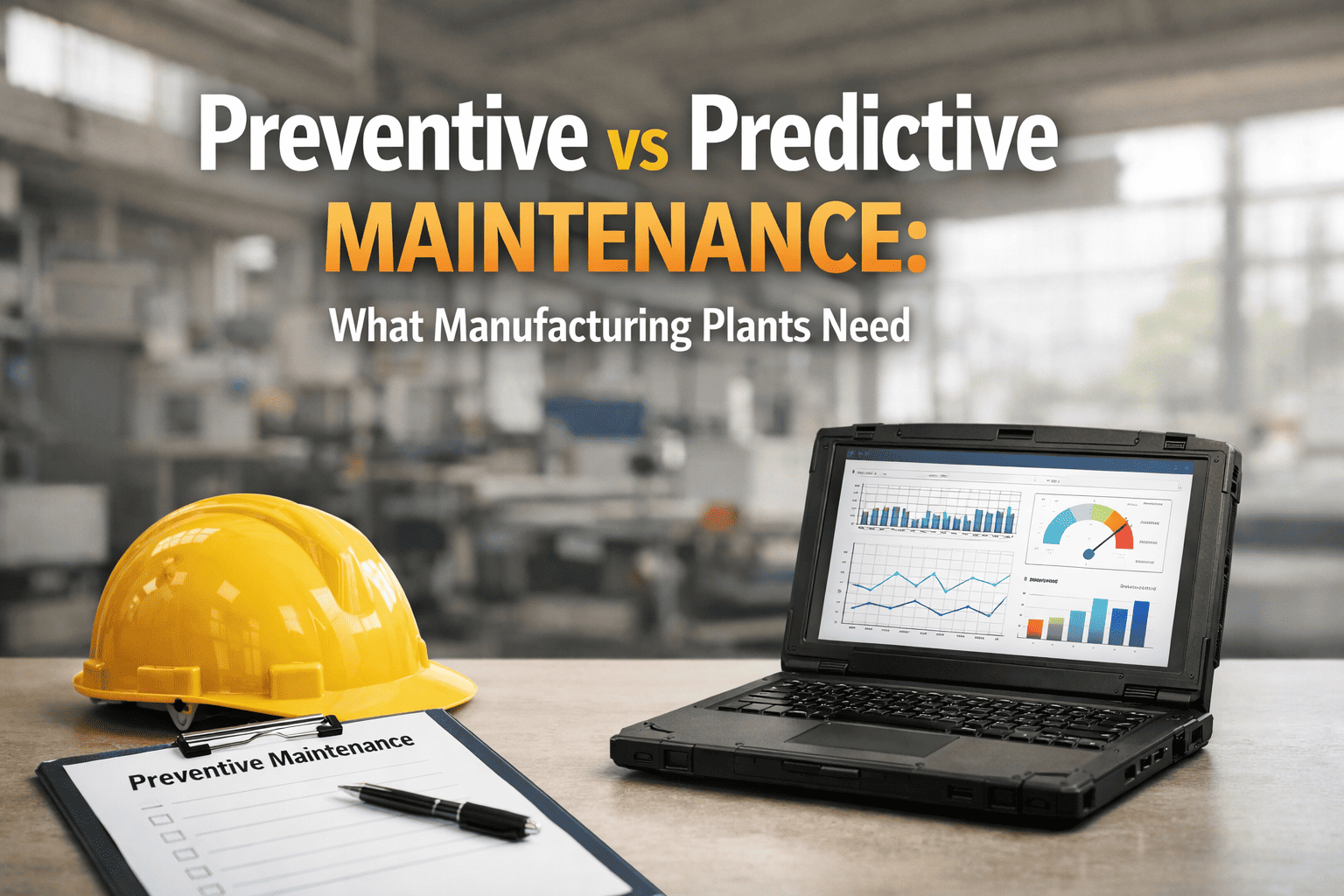
Preventive vs Predictive Maintenance: What Manufacturing Plants Need
By oxmaint on February 28, 2026
Manufacturing downtime is not just an inconvenience — it is a direct hit to your bottom line. The average large manufacturing plant loses over $250 million per year from unplanned equipment failures, and that number keeps climbing. Choosing the right maintenance strategy is no longer a technical detail left to your maintenance team — it is a business-critical decision that shapes profitability, safety, and competitive advantage. This guide breaks down exactly how preventive and predictive maintenance work, where each one excels, and how forward-thinking manufacturers are combining both for maximum uptime. Schedule a free consultation to find the right maintenance strategy for your facility.
What Is Preventive Maintenance and How Does It Work in Manufacturing?
Preventive maintenance (PM) is a scheduled, proactive approach where equipment is serviced at predetermined intervals — based on time, usage hours, or production cycles — regardless of whether the machine shows signs of trouble. It is the maintenance equivalent of changing your car oil every 5,000 miles: you do it on schedule because waiting for the engine to seize is far more expensive.
In manufacturing, PM programs typically include routine lubrication, filter replacements, belt inspections, calibration checks, and component swaps based on manufacturer guidelines or historical failure patterns. The goal is straightforward: prevent breakdowns before they happen by keeping equipment in reliable operating condition at all times.
88%of manufacturers use preventive maintenance as their primary strategy
67%actively implementing PM to reduce downtime right now
56%track PM completion rate as their top maintenance KPI
Preventive maintenance is easy to implement, predictable to budget for, and effective at extending equipment life. However, it has a significant blind spot: because servicing happens on a fixed schedule, it often leads to over-maintenance of healthy equipment while still missing failures that develop suddenly between service windows.
What Is Predictive Maintenance and Why Are More Plants Adopting It?
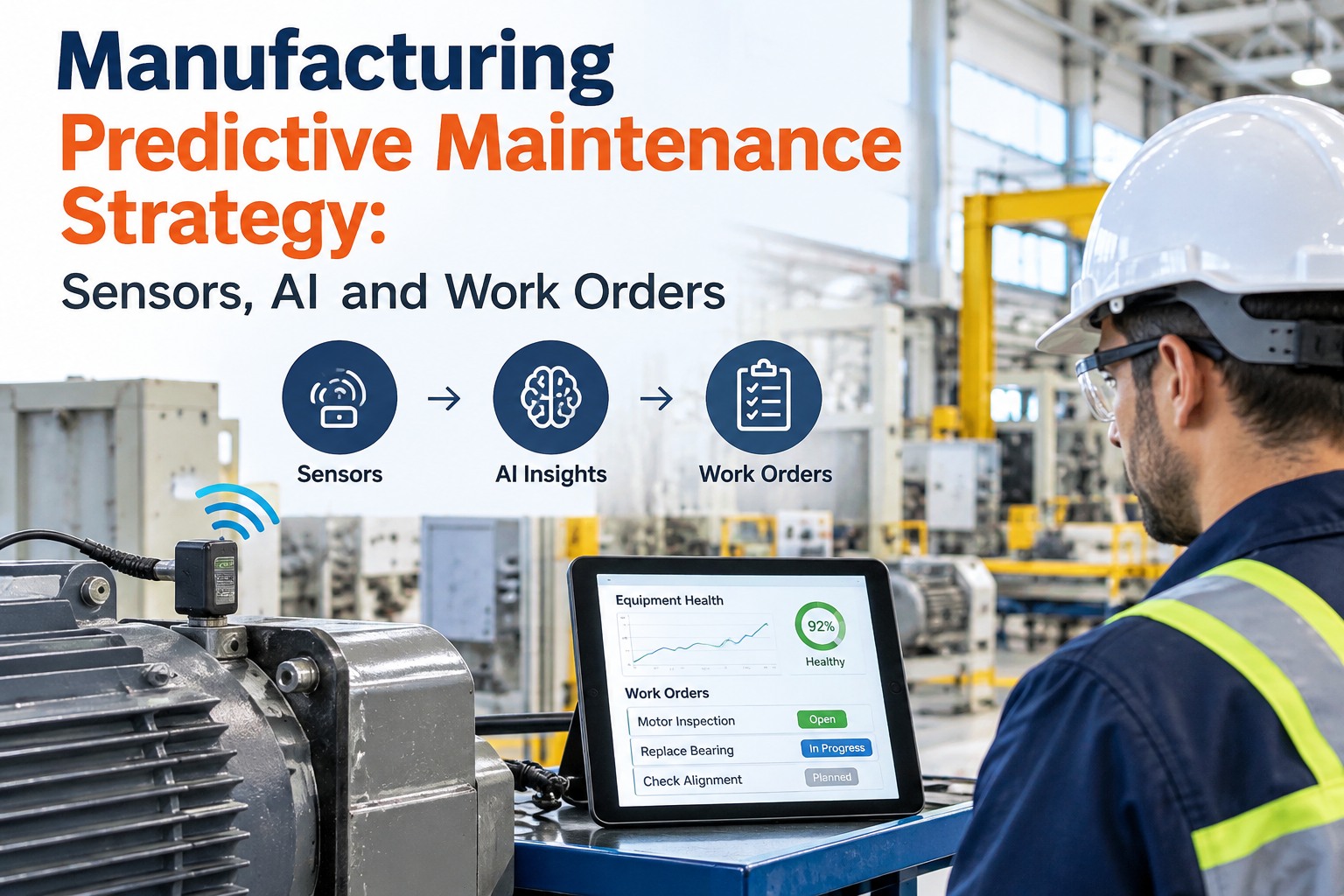
Predictive maintenance (PdM) flips the approach entirely. Instead of asking "Is it time to service this machine?", it asks "Does this machine actually need service right now?" The answer comes from real-time data collected by IoT sensors monitoring vibration, temperature, acoustic signatures, electrical current, and other performance indicators.
Machine learning algorithms analyze these data streams against established baselines to detect anomalies, identify degradation trends, and predict when a component is likely to fail — often weeks before any visible problem appears. Maintenance is then triggered at the exact moment it is needed: late enough to avoid wasting effort on healthy equipment, but early enough to prevent costly breakdowns. Sign up for Oxmaint to start monitoring asset health with real-time condition-based alerts.
Preventive Maintenance
Schedule-Driven Approach
Fixed time or usage-based intervals
Follows manufacturer recommendations and checklists
Can miss sudden failures between service windows
Low upfront cost, predictable budgeting
Best for: routine assets, compliance requirements, limited sensor budgets
Predictive Maintenance
Condition-Driven Approach
Triggered by real-time sensor data and AI analytics
Detects degradation before visible symptoms appear
Maintenance at the optimal moment — not too early, not too late
Requires IoT sensors, analytics platform, and data literacy
Best for: critical assets, high-value equipment, expensive downtime scenarios
Try both preventive and predictive maintenance workflows in one platform. Sign up for Oxmaint to set up automated PM schedules and real-time condition alerts — see which strategy drives the biggest uptime improvement for your assets.
How Much Does Unplanned Downtime Really Cost Manufacturers?
The financial case for smarter maintenance is overwhelming. Unplanned equipment failures do not just stop a single machine — they cascade through production schedules, supply chains, labor utilization, and customer commitments. Here is what recent industry data reveals about the true cost of getting maintenance wrong.
$253M
Average annual loss per large manufacturing plant from unplanned downtime alone
25
Average unplanned downtime incidents per month in a typical manufacturing facility
326 hrs
Total hours of unplanned downtime per year — nearly 14 full days of lost production
81 min
Average mean time to repair, up from 49 minutes due to skills gaps and supply delays
These numbers make one thing clear: reactive maintenance — waiting for things to break — is the most expensive approach by far. Both preventive and predictive maintenance deliver significant savings, but their impact varies depending on your equipment, industry, and how they are implemented.
Preventive vs Predictive Maintenance: Complete Comparison for Plant Managers
Understanding the practical differences between PM and PdM helps you allocate resources where they deliver the greatest return. Here is how the two strategies compare across every factor that matters in a manufacturing environment.
Comparison Factor
Preventive
Predictive
Maintenance Trigger
Calendar, hours, or cycle count
Real-time condition data from sensors
Technology Investment
Basic CMMS + checklists
IoT sensors + analytics platform + CMMS
Downtime Reduction vs Reactive
25 - 30%
30 - 50%
Maintenance Cost Savings
12 - 18%
10 - 40%
Over-Maintenance Risk
High — parts replaced on schedule, not need
Low — intervention only when data warrants
Implementation Complexity
Low — standard procedures and training
Moderate to high — sensor infrastructure + data skills
Time to Value
Immediate — start scheduling today
3 to 6 months — requires baseline data collection
Asset Lifespan Impact
Extends life through regular care
Extends life 20 - 40% through precision timing
Want to see how these maintenance cost savings apply to your plant? Schedule a free demo with our team — we will walk you through your specific equipment setup and show you exactly where PM scheduling and predictive alerts reduce your downtime and costs.
Which Maintenance Strategy Is Right for Your Manufacturing Plant?
There is no one-size-fits-all answer. The right choice depends on asset criticality, downtime cost, available budget, and your team's technical readiness. The smartest manufacturers do not pick one strategy over the other — they match the right approach to each asset based on a clear decision framework.
Asset-Level Maintenance Decision Framework
1
How critical is this asset to production?
If a single failure stops your production line or creates a safety hazard, this asset is a strong candidate for predictive monitoring. Non-critical or easily replaceable assets can stay on PM schedules.
2
What does one hour of downtime cost for this equipment?
Calculate the actual hourly cost of lost production, labor idle time, and downstream delays. If the number justifies sensor investment (typically over $500/hour), predictive maintenance pays for itself quickly.
3
Are failures time-based or random?
If components wear predictably over time (belts, filters, lubricants), PM scheduling works well. If failures are random — caused by vibration, overheating, or electrical faults — predictive monitoring catches what schedules miss.
4
Does your team have data capabilities?
PdM requires interpreting sensor data and acting on alerts. If your team is new to digital maintenance, start with a CMMS-based PM program and layer predictive capabilities as your data maturity grows.
Building a Combined Maintenance Strategy That Delivers Real Results
The data is clear: manufacturers combining preventive and predictive approaches are achieving the strongest outcomes. Industry research shows that optimized hybrid strategies can reduce unplanned downtime by 50 to 65 percent while extending asset lifespan by 20 to 40 percent. Here is the practical roadmap for building that combined strategy from the ground up.
Phase 1
Digitize and Standardize
Move from spreadsheets and paper logs to a centralized CMMS. Catalog every asset, define PM schedules based on manufacturer specs, and establish standard work order procedures. This eliminates reactive chaos immediately.
Result: 25-30% reduction in unplanned breakdowns within the first 90 days
Phase 2
Prioritize and Monitor
Rank every asset by criticality and downtime cost. Install condition-monitoring sensors on your top 10-20 most expensive and failure-prone machines. Connect sensor data to your CMMS so alerts flow directly into technician work queues.
Result: Early detection catches 70-80% of failures before they cause unplanned stops
Phase 3
Optimize and Scale
Use maintenance data to refine PM intervals — stretch schedules where data shows equipment is healthy, tighten them where failures cluster. Expand predictive monitoring to additional asset classes as ROI is proven.
Result: 40%+ reduction in maintenance costs with fewer parts wasted and better labor allocation
Start Phase 1 right now — digitize your maintenance in under 10 minutes. Sign up for Oxmaint to create your asset catalog, set up your first PM schedules, and begin tracking work orders from a centralized dashboard. No credit card needed to get started.
Why a CMMS Is the Foundation for Every Maintenance Strategy
Whether you run a pure PM program, a full predictive setup, or a hybrid of both, a Computerized Maintenance Management System is the platform that holds everything together. Around 70% of manufacturing plants have already implemented some form of CMMS — and those that use it effectively report measurable improvements in equipment uptime, maintenance cost control, and regulatory compliance. Here is what a modern CMMS delivers for manufacturing maintenance teams.
Automated PM Scheduling
Create recurring work orders by calendar time, meter readings, or production cycles. Auto-assign tasks to the right technician based on skill and availability.
Condition-Based Alerts
Integrate IoT sensors and receive real-time notifications when vibration, temperature, or performance crosses your defined thresholds.
Mobile Work Orders
Technicians access, update, and close work orders from any device. Attach photos, log parts, and record notes — all synced instantly to the central dashboard.
Maintenance Analytics
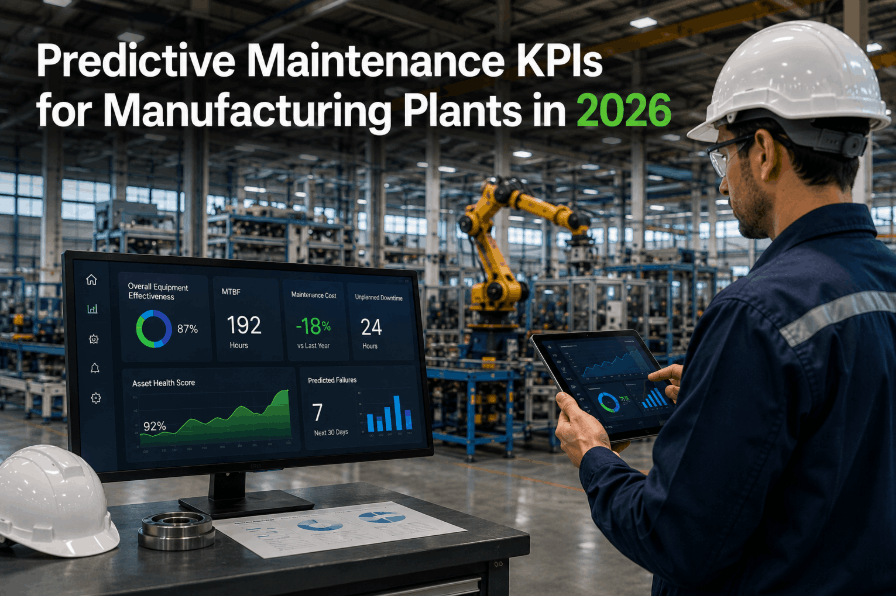
Track MTBF, MTTR, cost per asset, and PM completion rates. Use data to justify investments, refine schedules, and report performance to leadership.
Asset Lifecycle Tracking
Maintain complete records from acquisition to disposal — maintenance history, warranty status, depreciation, and total cost of ownership for every asset.
Inventory and Parts Management
Track spare parts in real time. Automatic low-stock alerts and reorder triggers ensure the right part is available when the technician needs it.
Oxmaint gives manufacturing teams one platform to schedule preventive maintenance, track asset health in real time, and make data-backed decisions that cut downtime and extend equipment life. Join thousands of maintenance professionals already running smarter operations.
What is the main difference between preventive and predictive maintenance?
Preventive maintenance follows fixed schedules — servicing equipment at set time or usage intervals whether it needs work or not. Predictive maintenance uses real-time sensor data and analytics to determine actual equipment condition and triggers service only when indicators show a developing problem. The core distinction is schedule-driven decisions versus condition-driven decisions.
How much can predictive maintenance reduce costs compared to preventive maintenance?
Industry research shows predictive maintenance can reduce overall maintenance costs by 10 to 40 percent compared to traditional approaches by eliminating unnecessary service, optimizing parts usage, and preventing costly secondary damage from catastrophic failures. Combined hybrid strategies deliver even stronger results — reducing unplanned downtime by up to 65 percent. Book a demo to see how these savings translate to your specific operation.
Can small or mid-sized manufacturers afford predictive maintenance?
Yes. Cloud-based CMMS platforms and affordable IoT sensors have made predictive capabilities accessible to plants of all sizes. You do not need to monitor every asset — starting with your 5 to 10 most critical and expensive machines delivers immediate ROI. The Predictive Maintenance-as-a-Service model is also growing rapidly, allowing smaller operations to access advanced analytics without large upfront investments. Sign up for Oxmaint to explore PdM capabilities built for lean manufacturing teams.
Should I replace my preventive maintenance program with predictive?
No — and trying to do so is one of the most common mistakes. The best-performing manufacturers use a hybrid strategy where preventive maintenance provides the reliable foundation for routine servicing and compliance, and predictive monitoring is layered on top for critical, high-value equipment. PM handles the basics; PdM catches the failures that fixed schedules miss.
What kind of CMMS supports both preventive and predictive workflows?
Look for a CMMS that combines automated PM scheduling, IoT sensor integration, real-time dashboards, mobile work order management, and analytics — without requiring enterprise-level complexity or cost. Oxmaint is designed specifically for this purpose, giving manufacturing teams both capabilities in one unified platform. Create your free account to see the platform in action.