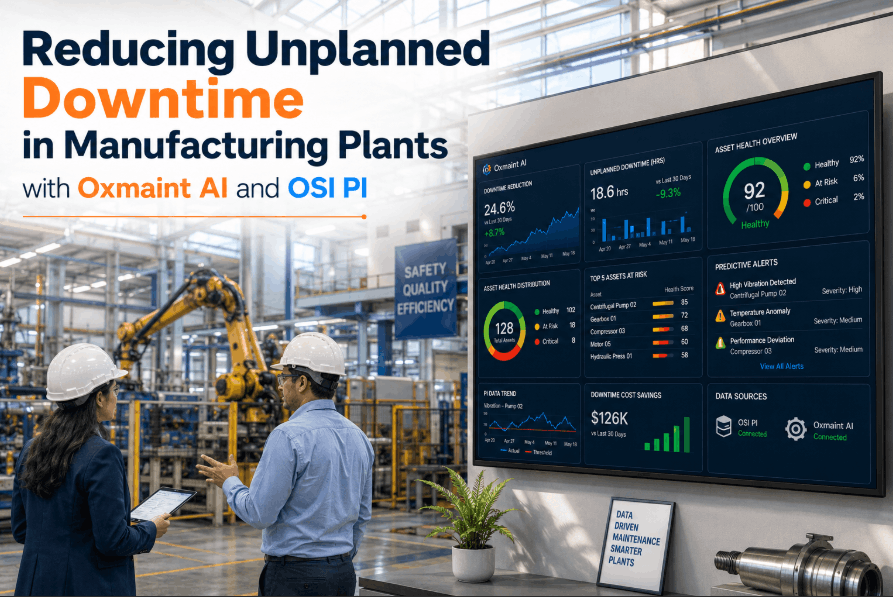
Manufacturing plants running OSI PI Historian sit on a goldmine of real-time process data — vibration trends, temperature curves, pressure deviations, flow anomalies — yet most of that data never reaches the maintenance team in time to prevent failure. Oxmaint AI closes this gap by ingesting PI tag streams directly into its predictive maintenance engine, converting historian data into actionable work orders before a fault becomes a breakdown. Plants integrating Oxmaint with OSI PI report measurable reductions in unplanned downtime within the first 90 days. Sign Up Free to connect your PI environment and start capturing fault predictions your current CMMS cannot see. The pages below walk through the integration architecture, the workflow it enables, and the ROI manufacturing teams are reporting across process industries.
Connect OSI PI to Oxmaint AI — Start Predicting Faults, Not Reacting to Them
Oxmaint AI reads your PI Historian tag data in real time and converts anomaly signals into prioritised work orders — before equipment fails. Most plants are live within 48 hours.
Why OSI PI Data Alone Does Not Prevent Unplanned Downtime
Gap #1
Data Without Decision
PI Historian stores millions of tag readings per day but has no native mechanism to convert a deviation into a maintenance work order. The signal exists; the action does not.
Gap #2
Alarm Fatigue
Traditional PI alarm thresholds generate high alert volumes. Maintenance teams learn to ignore alarms — and genuine early-fault signals get lost in the noise.
Gap #3
No Asset Context
PI tags are linked to process variables, not asset maintenance history. Without CMMS context, a rising vibration trend has no connection to the last bearing replacement or open inspection.
Gap #4
Reactive Work Order Creation
In most plants, a work order is raised after a technician manually reviews PI trends — hours or days after the early-fault window has already closed.
Gap #5
No Downtime Attribution
When a breakdown occurs, there is no structured record linking the PI anomaly history to the failure event — making root cause analysis slow and post-mortem improvement impossible.
Gap #6
Siloed Systems
Process engineers live in PI. Maintenance teams live in CMMS. These systems rarely speak to each other — and the translation gap between them is where unplanned downtime originates.
How Oxmaint AI Integrates with OSI PI to Reduce Unplanned Downtime
01
PI Tag Ingestion
Oxmaint connects to your PI Historian via PI Web API or PI AF — pulling real-time and historical tag streams for mapped assets across your plant.
→
02
AI Anomaly Detection
Oxmaint AI models baseline behaviour per asset using historical PI data, then flags statistically significant deviations — vibration, temperature, pressure, and flow — before threshold breach.
→
03
Predictive Work Order
When the AI detects a degradation pattern, Oxmaint automatically raises a predictive work order — linked to the asset, assigned by priority, and visible to the maintenance team instantly.
→
04
Maintenance Action & Closeout
Technicians act on the predictive WO, log findings, and close out — creating a linked fault-to-resolution record that feeds back into the AI model for continuous accuracy improvement.
Shift Handover to Work Order — Closing the Night-Shift Information Gap
PI Data Layer
Real-time tag monitoring across all mapped assets
Historical trend analysis for baseline model training
Multi-parameter correlation — vibration, temp, pressure
AI Prediction Engine
Per-asset anomaly scoring updated continuously
Failure mode classification by asset type
Remaining useful life estimate per flagged asset
CMMS Work Order Engine
Auto-generated predictive WOs with asset and fault context
Priority assignment based on criticality and RUL score
Technician assignment with mobile WO access on floor
Downtime Avoidance Outcome
Faults addressed in predictive window — not post-failure
Planned repair vs emergency breakdown — lower cost per event
Full audit trail from PI signal to closed work order
40%
Reduction in unplanned downtime reported by plants connecting Oxmaint AI to PI Historian in Year 1
72hrs
Average early-fault detection lead time Oxmaint AI identifies before a critical equipment failure occurs
3.2×
Higher work order completion rate when predictive WOs are generated from PI data vs manual inspection schedules
48hrs
Typical time to live — from PI API connection to first predictive work orders appearing in Oxmaint dashboard
Oxmaint AI vs Standard CMMS for PI-Driven Downtime Reduction
Standard CMMS — No PI Integration
Maintenance schedules based on fixed intervals — not actual asset condition
PI anomalies never reach the CMMS — faults go unactioned until breakdown
Work orders raised reactively after equipment has already failed
No connection between PI trend history and CMMS fault records
Emergency repair costs 3–5× higher than planned intervention cost
Downtime root cause analysis requires manual data reconciliation across systems
Oxmaint AI + OSI PI Integration
Condition-based predictive WOs triggered by real PI Historian anomaly signals — Sign Up Free
AI converts PI tag deviations into prioritised maintenance actions automatically
Faults addressed in predictive window — 24–72 hours before failure threshold
PI signal history linked to every WO — full fault-to-resolution record
Planned interventions replace emergency callouts — measurable cost reduction
One-click downtime reports — PI data + CMMS records unified for RCA and compliance
Downtime Reduction KPIs — What to Track When Oxmaint AI Connects to PI
These six KPIs give maintenance managers measurable evidence that PI-driven predictive maintenance is working — and Oxmaint calculates all of them automatically. Book a Demo to see your plant's live downtime reduction dashboard.
KPI 01
Predictive-to-Reactive WO Ratio
Percentage of work orders generated from PI anomaly signals vs post-failure reports. Rising predictive ratio is the primary indicator that downtime avoidance is working.
Downtime Avoidance
KPI 02
Mean Time Between Failures (MTBF)
Tracks whether assets connected to PI-driven predictive maintenance are failing less frequently over time. Rising MTBF directly reflects downtime reduction ROI.
Asset Reliability
KPI 03
Fault Detection Lead Time
Average hours between Oxmaint AI raising a predictive WO and the point at which a fault would have caused an unplanned stop. Target: 48+ hours across critical assets.
Prediction Accuracy
KPI 04
Emergency Work Order Rate
Number of emergency/breakdown WOs per month. Sustained decline in this metric is the clearest financial evidence that PI integration is reducing unplanned downtime costs.
Cost Reduction
KPI 05
Overall Equipment Effectiveness (OEE)
Tracks availability, performance, and quality across PI-monitored assets. OEE improvement directly reflects the business value of downtime reduction across the production floor.
Production Impact
KPI 06
Predictive WO Closure Rate
Percentage of AI-generated predictive work orders that are acknowledged and closed before asset failure. Low closure rate indicates capacity or prioritisation issues — not a data problem.
Execution Quality
Industries Using Oxmaint AI + OSI PI for Unplanned Downtime Reduction
Process Manufacturing
Continuous Production Line Protection
Chemicals, refining, and plastics plants run PI Historian across compressors, reactors, and heat exchangers. Oxmaint AI maps PI tags to these assets and raises predictive WOs when deviation patterns match known failure signatures — reducing unplanned stops on critical continuous lines. Sign Up Free for your process facility.
Power & Utilities
Turbine & Rotating Equipment Reliability
Power generation and utility plants rely on PI Historian for turbine and generator monitoring. Oxmaint AI correlates vibration, bearing temperature, and lube oil pressure tags to produce early-fault signals — enabling planned outage windows instead of forced shutdowns.
Food & Beverage
Hygiene-Critical Line Uptime
F&B plants using PI for temperature and flow monitoring in CIP and filling lines connect Oxmaint to detect early refrigeration drift, pump degradation, and valve anomalies — preventing both production downtime and compliance failures in a single integration. Book a Demo for your facility.
Oil & Gas
Upstream & Midstream Asset Integrity
Upstream and midstream operations with PI deployments across well sites and pipeline assets use Oxmaint to correlate pressure, flow, and temperature tags with maintenance history — enabling condition-based intervention strategies that reduce both downtime and safety risk at remote locations.
Your PI Historian Already Has the Fault Signals. Oxmaint AI Acts on Them.
Connect Oxmaint to your OSI PI environment and start converting tag anomalies into predictive work orders — before the next unplanned breakdown. Book a Demo to see the PI integration workflow live with your asset types.
Frequently Asked Questions
How does Oxmaint AI connect to OSI PI Historian?
Oxmaint connects via PI Web API or PI AF, pulling real-time and historical tag data for mapped assets. No custom middleware is required — most plants complete the integration and see first predictive work orders within 48 hours.
What types of unplanned downtime can Oxmaint AI + PI prevent?
Oxmaint detects early degradation patterns in rotating equipment, heat exchangers, pumps, compressors, and process lines — covering vibration anomalies, thermal drift, pressure deviations, and flow irregularities before they cause unplanned stops.
Does Oxmaint replace OSI PI or AVEVA system software?
No. Oxmaint sits alongside PI Historian as the maintenance execution layer — it reads PI data and converts anomaly signals into CMMS work orders. PI continues to manage all process data collection and storage.
How quickly does PI predictive maintenance reduce downtime in Oxmaint?
Plants typically see measurable reductions in emergency work orders within 60–90 days of connecting PI data to Oxmaint AI. Full downtime reduction ROI — tracked against MTBF and OEE baselines — is reportable within the first production quarter.
Can Oxmaint generate compliance reports from PI + CMMS data combined?
Yes. Oxmaint links every predictive work order to its originating PI anomaly signal — creating a unified fault-to-resolution audit trail that satisfies regulatory, insurance, and internal compliance reporting requirements.
Stop Losing Production Hours to Failures Your PI Data Already Predicted.
Oxmaint AI bridges OSI PI Historian and your maintenance team — converting real-time tag anomalies into prioritised work orders automatically. Sign Up Free and run your first PI-driven predictive maintenance workflow today.
.png)


