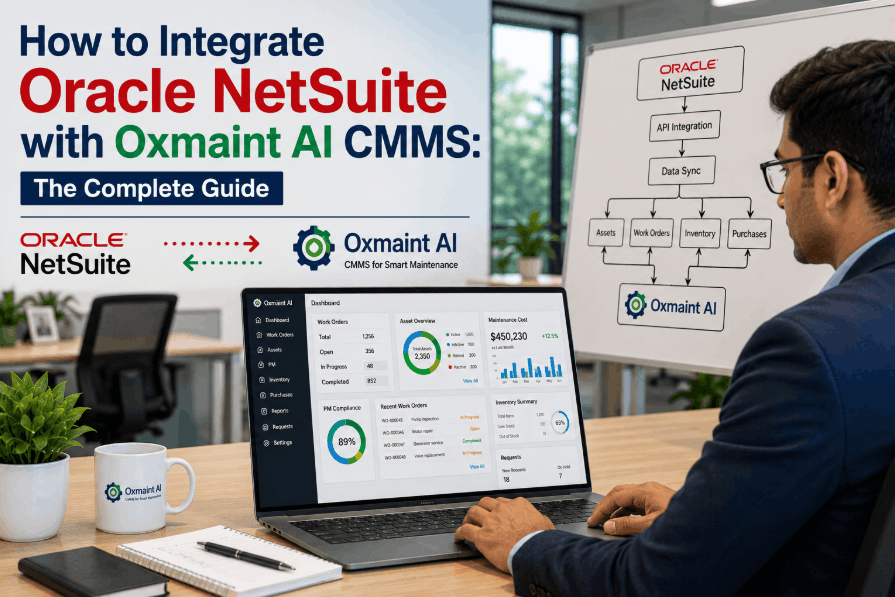
Manufacturing plants that run Oracle NetSuite for financial management and a separate CMMS for maintenance operations are unknowingly creating a cost blindspot. When work order spend, parts consumption, contractor invoices, and labor hours live in disconnected systems, finance teams are always one reporting cycle behind. Sign Up Free to see how Oxmaint integrates with your NetSuite environment and brings real-time maintenance cost data directly into your GL, cost centers, and budget workflows. The Oracle NetSuite and Oxmaint AI integration gives CFOs, plant controllers, and maintenance directors a single financial truth — where every maintenance dollar is tracked, coded, and reportable the moment a work order closes. Book a Demo to explore how manufacturing finance teams use Oxmaint to eliminate the month-end reconciliation gap between ERP and CMMS.
Connect NetSuite Financial Data to Live Maintenance Operations
Oxmaint syncs work order costs, parts spend, and labor hours directly to your NetSuite GL and cost centers — no manual exports, no reconciliation lag, no budget surprises.
Why NetSuite Alone Cannot Close the Maintenance Finance Gap
Oracle NetSuite gives finance teams powerful visibility across procurement, accounts payable, and general ledger — but it has no native awareness of what is happening at the asset level on the plant floor. Maintenance costs enter NetSuite only after invoices are processed or payroll is posted, meaning finance sees historical spend, not live operational cost. Book a Demo to understand how Oxmaint bridges this gap by pushing real-time cost data from work orders directly into NetSuite, giving controllers an accurate picture of maintenance spend before month-end close.
NetSuite Without Oxmaint
Maintenance costs visible only after invoice processing
No asset-level cost attribution in GL entries
Budget variances discovered at month-end close
Contractor spend reconciled manually from POs
Capex vs opex classification done by finance team alone
No MTTR or downtime cost linked to financial impact
NetSuite + Oxmaint AI
Work order costs posted to NetSuite on task close
Every expense coded to asset, department, and cost center
Live budget vs. actual dashboards updated in real time
Contractor work orders linked to PO and NetSuite vendor record
Oxmaint AI flags spend thresholds for capex reclassification
Downtime duration and financial impact reported together
Key Financial Visibility Use Cases for the NetSuite–Oxmaint Integration
The integration between Oracle NetSuite and Oxmaint is built around the financial workflows that matter most to manufacturing CFOs and plant controllers. Sign Up Free to configure your NetSuite connection and start mapping Oxmaint cost categories to your existing chart of accounts within the guided setup.
GL Cost Posting per Work Order
Every Oxmaint work order — corrective, preventive, or project — posts labor, parts, and contractor costs directly to the mapped NetSuite GL account on completion. No batch uploads. No manual journals.
Cost Center and Department Allocation
Maintenance spend is allocated automatically to the cost center or department owning each asset. Finance teams get clean department P&L without reclassification effort.
Asset Lifecycle Cost Tracking
Oxmaint aggregates total cost of ownership per asset — parts, labor, downtime, and contractor spend — and feeds this into NetSuite fixed asset records for accurate depreciation and replacement planning.
Maintenance Budget vs. Actual Reporting
Finance teams set maintenance budgets in NetSuite. Oxmaint tracks spend in real time against those budgets, surfacing variance alerts before overruns occur — not after close.
Capex vs. Opex Classification
Oxmaint AI monitors cumulative spend per asset and flags work orders that may require capitalization. Finance reviews and reclassifies in NetSuite with full work order audit trail attached.
Contractor PO Reconciliation
Contractor work orders in Oxmaint are linked to NetSuite purchase orders. When a contractor closes a job in the field, the PO is automatically updated — eliminating the AP-to-maintenance reconciliation cycle.
Financial KPIs Unlocked by the NetSuite–Oxmaint Integration
Scroll →
| Financial KPI |
Data Source in Oxmaint |
NetSuite Destination |
Business Value |
| Maintenance Cost per Unit Produced |
Work order labor + parts totals |
GL cost center report |
Benchmark efficiency against output |
| Planned vs. Emergency Spend Ratio |
PM vs. corrective work order split |
Budget variance dashboard |
Quantify reactive maintenance cost |
| Asset Total Cost of Ownership |
Lifetime work order history |
Fixed asset record |
Inform replace vs. repair decisions |
| Contractor Spend vs. In-House Labor |
Contractor work order cost log |
Vendor spend analysis |
Optimize make vs. buy decisions |
| Downtime Financial Impact |
Downtime duration × production rate |
OEE impact reporting |
Justify preventive maintenance budget |
| Maintenance Budget Utilization |
Cumulative work order spend |
Budget vs. actual module |
Prevent year-end budget surprises |
How Oxmaint AI Enhances Financial Decision-Making in NetSuite
Step 01
Predictive Spend Forecasting
Oxmaint AI analyzes asset failure patterns and PM schedules to forecast maintenance spend 30–90 days ahead — giving finance teams data to build accurate maintenance budget projections in NetSuite.
Step 02
Anomaly Detection on Costs
AI flags assets where maintenance spend is accelerating abnormally — before costs become material variances in NetSuite. Finance and reliability teams receive proactive alerts, not reactive reconciliations.
Step 03
Replace vs. Repair Scoring
Oxmaint AI scores aging assets based on cumulative maintenance cost, downtime frequency, and parts availability — surfacing replacement candidates with financial justification ready for NetSuite capex planning.
Step 04
Compliance Cost Tracking
Regulatory inspections and statutory maintenance tasks are tracked in Oxmaint with full cost attribution. Compliance spend flows automatically to the correct NetSuite cost center, simplifying audit preparation.
Roles That Benefit from NetSuite–Oxmaint Financial Visibility
CFO / Finance Director
Enterprise Cost Oversight
Maintenance spend consolidated across all plants and cost centers in NetSuite — with asset-level granularity that general ledger entries alone cannot provide.
Plant Controller
Real-Time Budget Control
Live budget vs. actual visibility per department and asset class. Variance alerts triggered before month-end close eliminate reactive financial management.
Maintenance Manager
Operational Cost Accountability
Every work order carries a financial footprint. Maintenance managers see per-asset spend in real time and can justify budget requests with lifecycle cost data, not estimates.
Reliability Engineer
Cost-Driven Reliability Decisions
MTBF, MTTR, and failure frequency data linked to financial impact — enabling reliability programs to be prioritized by cost avoidance potential, not just technical severity.
What Financial Visibility Looks Like After Integration
Real-Time
Maintenance costs posted to NetSuite GL the moment a work order closes — no batch delays
Zero Manual
Cost journals, department allocations, and PO reconciliations handled automatically by the integration
Asset-Level
Every dollar of maintenance spend traceable to a specific asset, location, and cost center in NetSuite
Audit-Ready
Full work order history, parts logs, and contractor records attached to every financial transaction in NetSuite
Give Your Finance Team the Maintenance Cost Visibility NetSuite Alone Cannot Provide
Oxmaint connects your plant maintenance operations directly to Oracle NetSuite — real-time GL posting, cost center allocation, budget tracking, and asset lifecycle costing in one connected workflow.
Book a Demo to see how manufacturing CFOs use Oxmaint to close the ERP–CMMS financial gap, or
Sign Up Free and connect your NetSuite environment today.
Frequently Asked Questions
How does Oxmaint integrate with Oracle NetSuite for maintenance cost management?
Oxmaint connects to NetSuite via API, automatically posting work order costs — labor, parts, and contractor spend — to mapped GL accounts and cost centers the moment a work order is closed. No manual data entry or batch uploads are required.
Can Oxmaint map maintenance costs to specific NetSuite cost centers and departments?
Yes. During setup, each asset or asset group in Oxmaint is mapped to a corresponding NetSuite cost center, department, and GL account. All maintenance spend is then automatically coded to the correct financial dimension on posting.
How does the integration support capex vs. opex classification for maintenance work?
Oxmaint AI tracks cumulative spend per asset and flags work orders that cross configurable capitalization thresholds. Finance teams review flagged items in NetSuite with the full Oxmaint work order history attached as supporting documentation.
Does Oxmaint support maintenance budget tracking inside NetSuite?
Oxmaint tracks real-time spend against budgets configured in NetSuite, surfacing variance alerts before month-end close. Finance and maintenance teams share the same budget visibility without manual reconciliation.
How quickly can a manufacturing plant go live with the NetSuite–Oxmaint integration?
Most integrations are live within one to two weeks. The guided setup covers GL mapping, cost center configuration, and NetSuite API connection.
Sign Up Free to begin or
Book a Demo for a structured onboarding walkthrough.
Free to Start — No Credit Card Required
Oracle NetSuite + Oxmaint AI — Complete Financial Visibility for Manufacturing Maintenance
Stop managing maintenance costs in a system that finance cannot see. Connect Oxmaint to NetSuite and give every stakeholder — from plant floor to CFO — a single financial truth for every maintenance dollar spent.