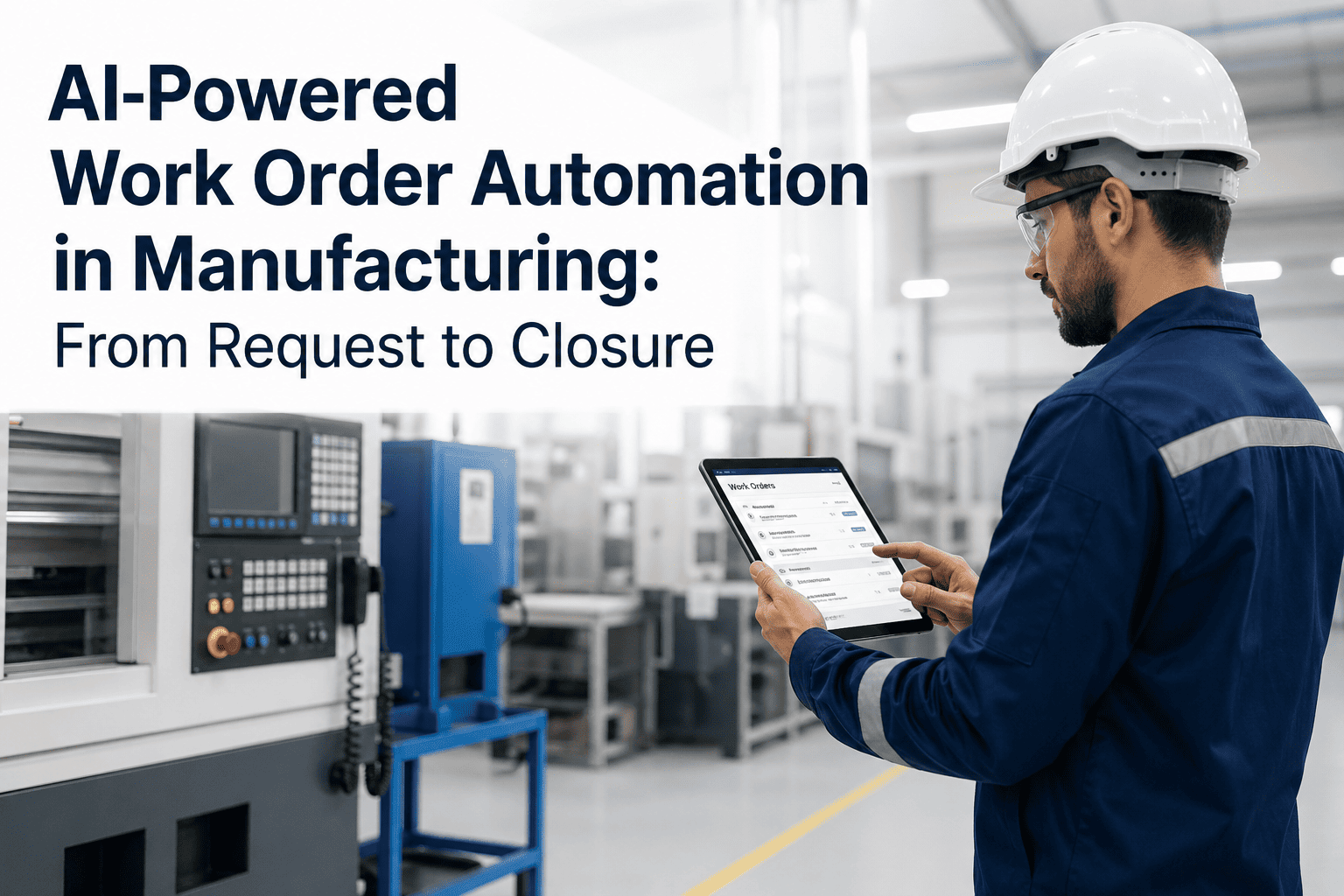
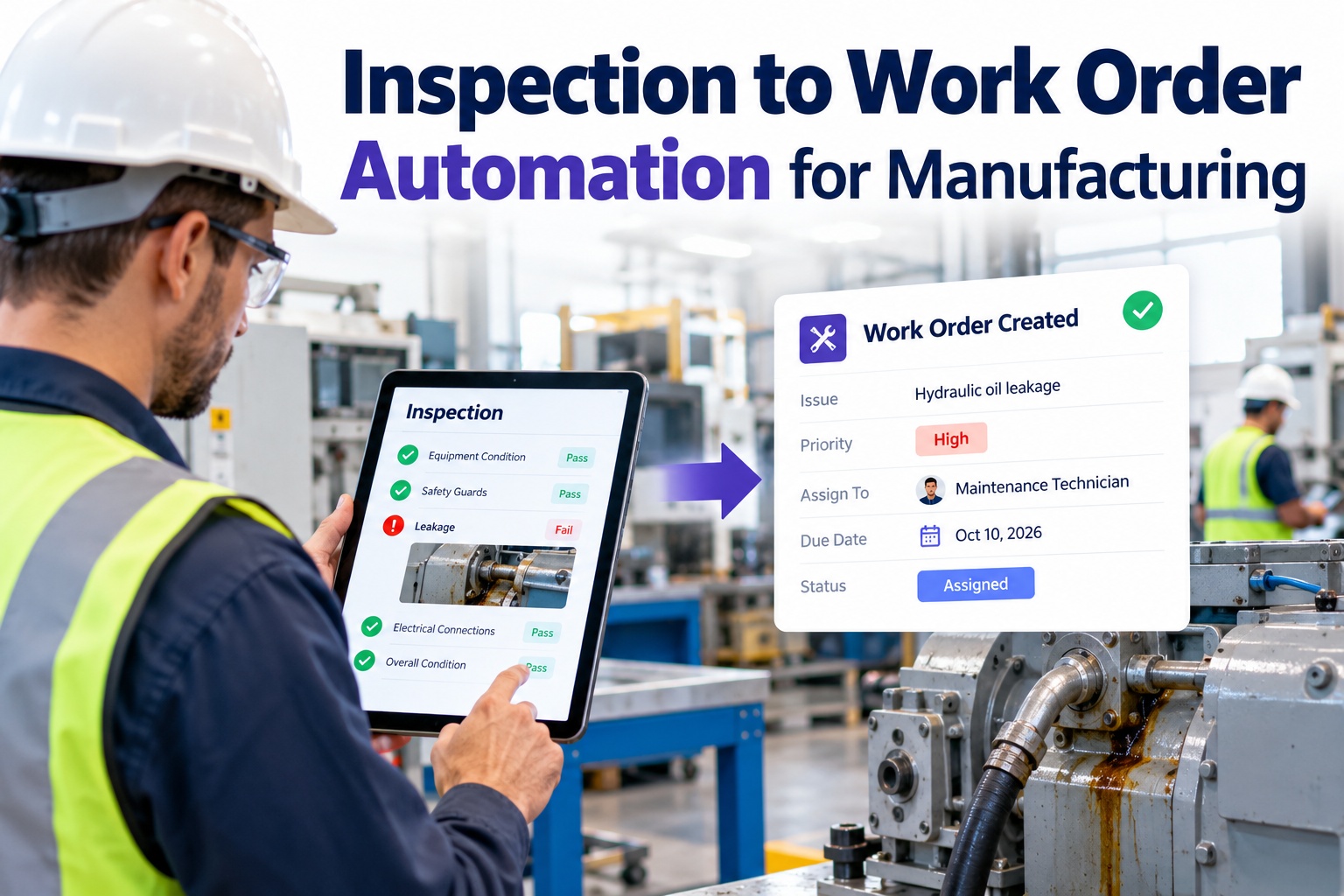
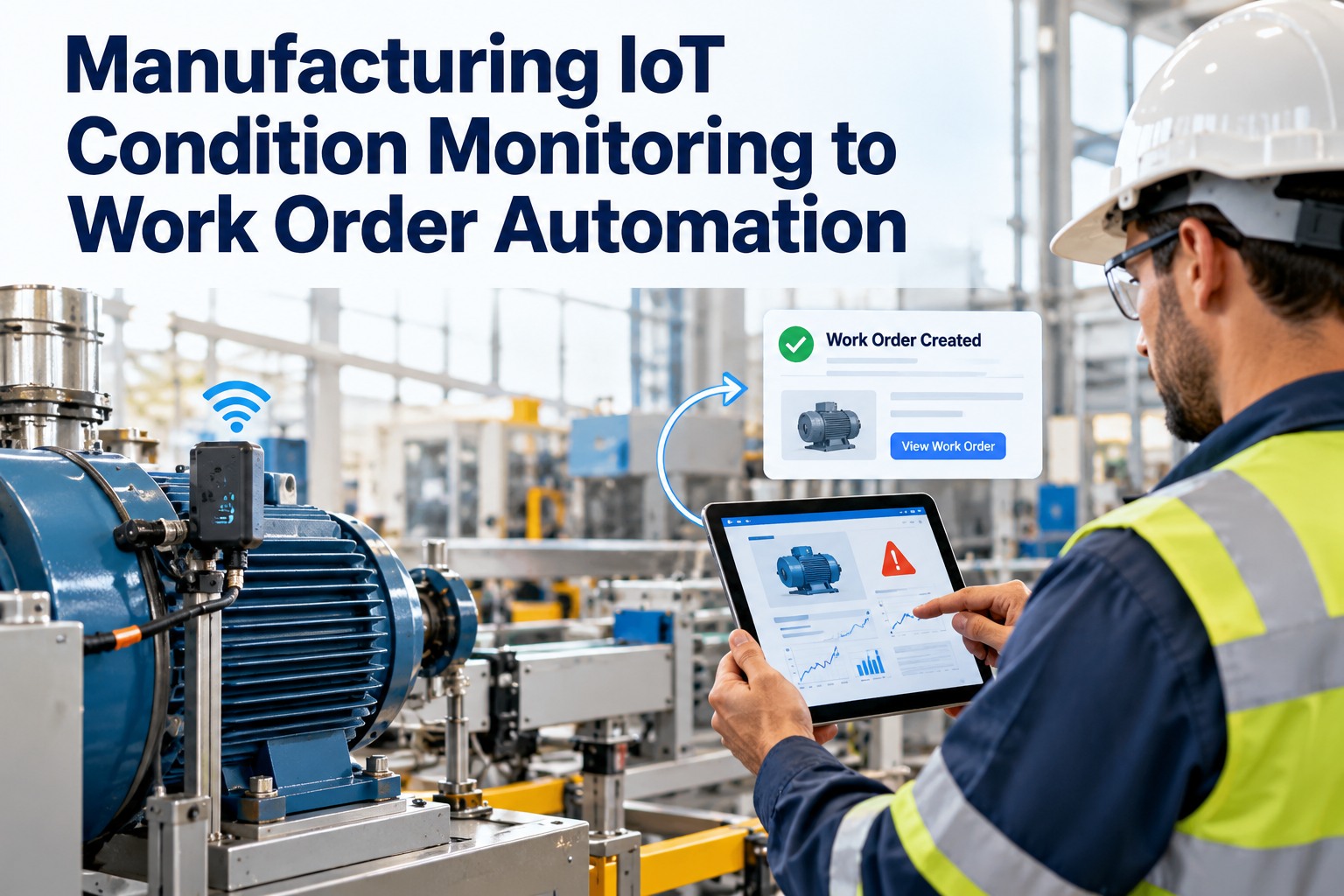
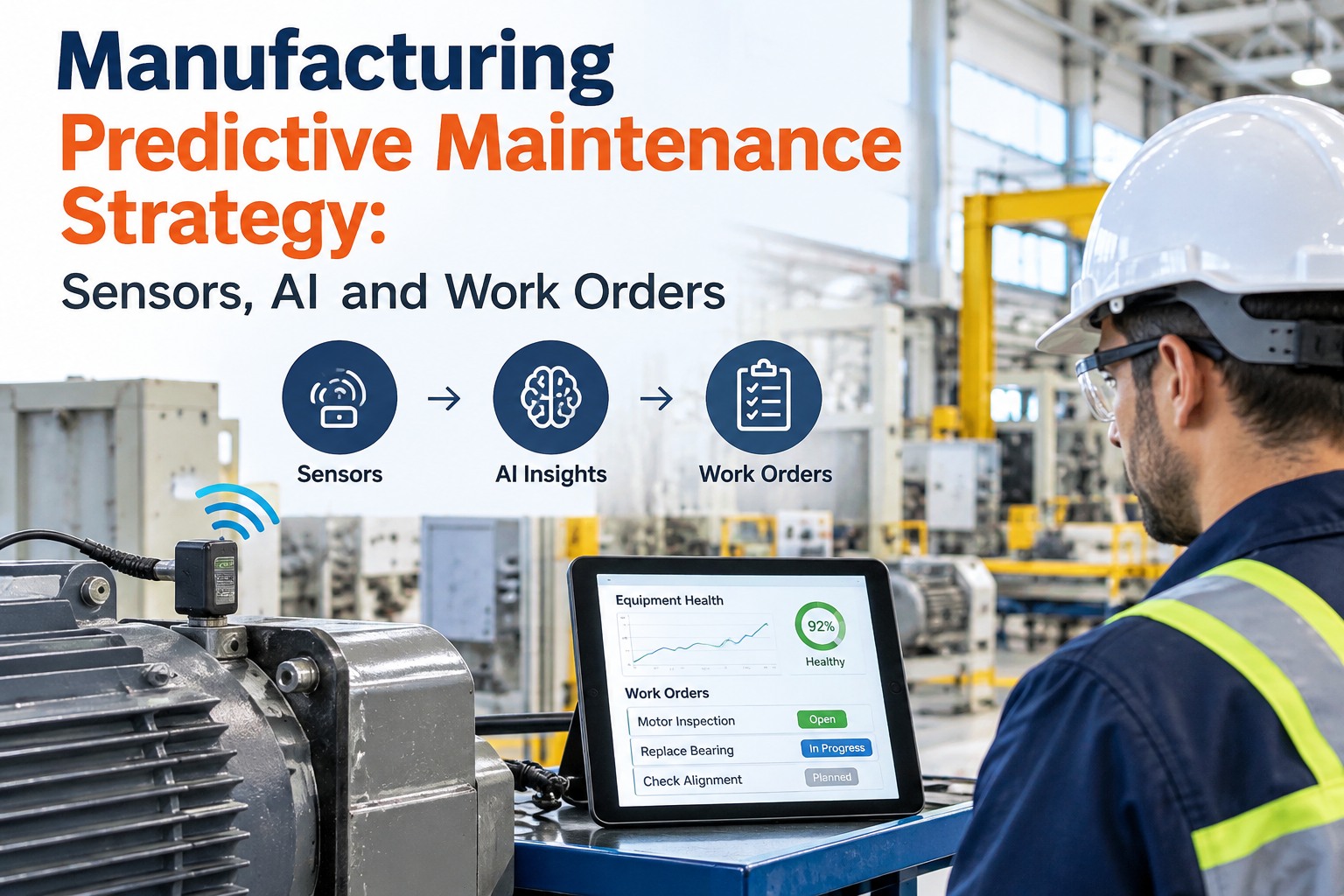
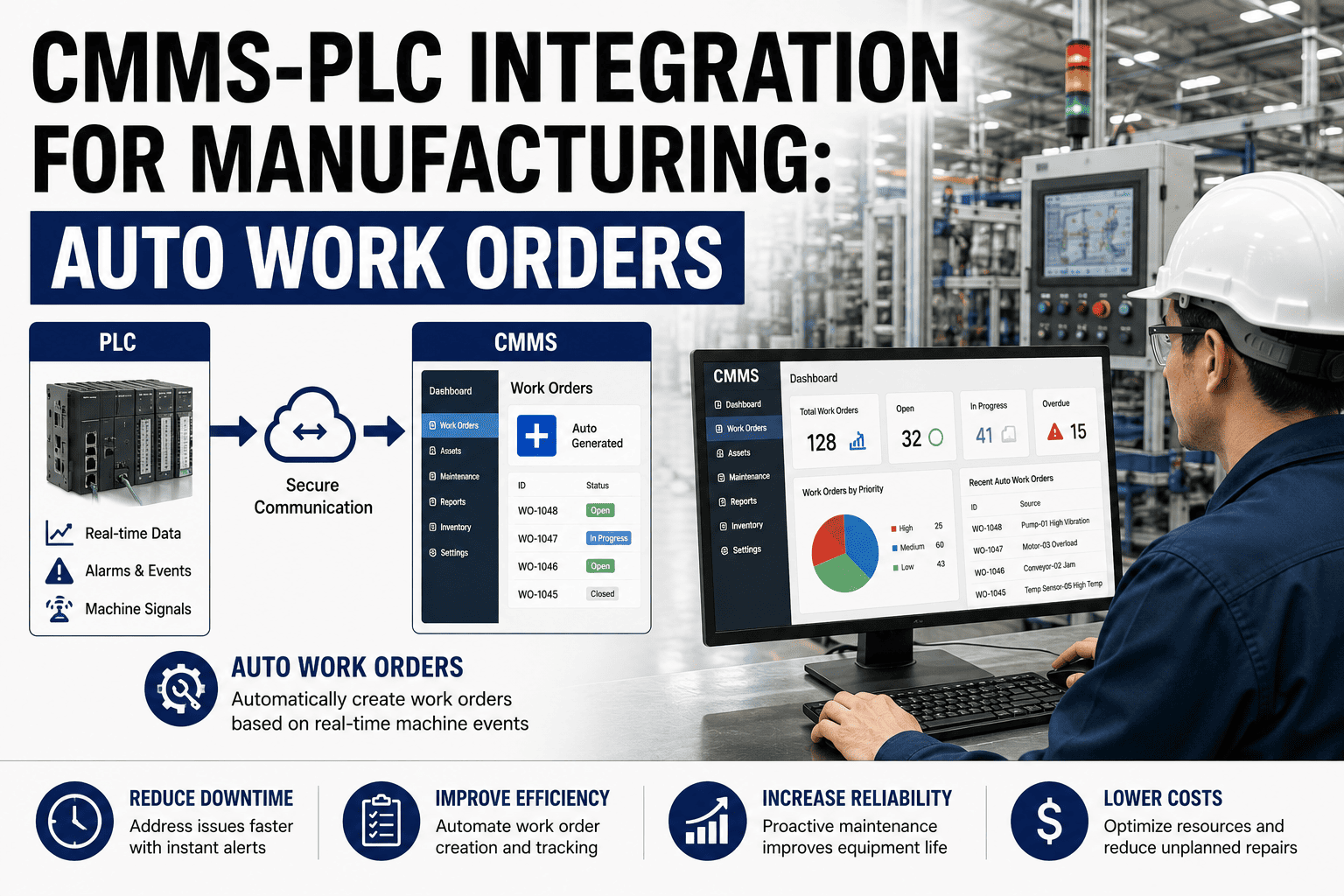
A technician spots a machine vibrating differently than usual. She logs a request on paper, hands it to the supervisor, who keys it into the system, categorizes it, assigns a priority, finds an available tech, and schedules the job — three days later. In a plant running AI-powered work order automation, that same observation is captured on a mobile device, triaged by machine learning within seconds, auto-assigned to the nearest qualified technician, and closed with full documentation before the shift ends. The difference is not efficiency alone — it is the difference between a managed repair and an unplanned breakdown. The AI work order market is growing at over 35% annually because manufacturers have quantified exactly what manual workflows cost them. This guide breaks down how AI handles the full work order lifecycle in manufacturing plants, where the biggest gains come from, and what to look for in a platform before you invest. Explore AI-powered work orders in Oxmaint or book a live demo to see the automation in action.
AI-Powered Maintenance
AI Work Order Automation in Manufacturing: From Request to Closure
Manual work orders are costing your plant more than you realize — in delays, missed data, and reactive firefighting. See how machine learning transforms every step of the work order lifecycle.
28%
Reduction in unplanned downtime with AI-driven CMMS
40%
Improvement in data accuracy with mobile + AI logging
19%
Efficiency gain from AI-targeted maintenance tasks
3x
Cheaper — planned work vs. reactive emergency repair
The Full Work Order Lifecycle — Automated
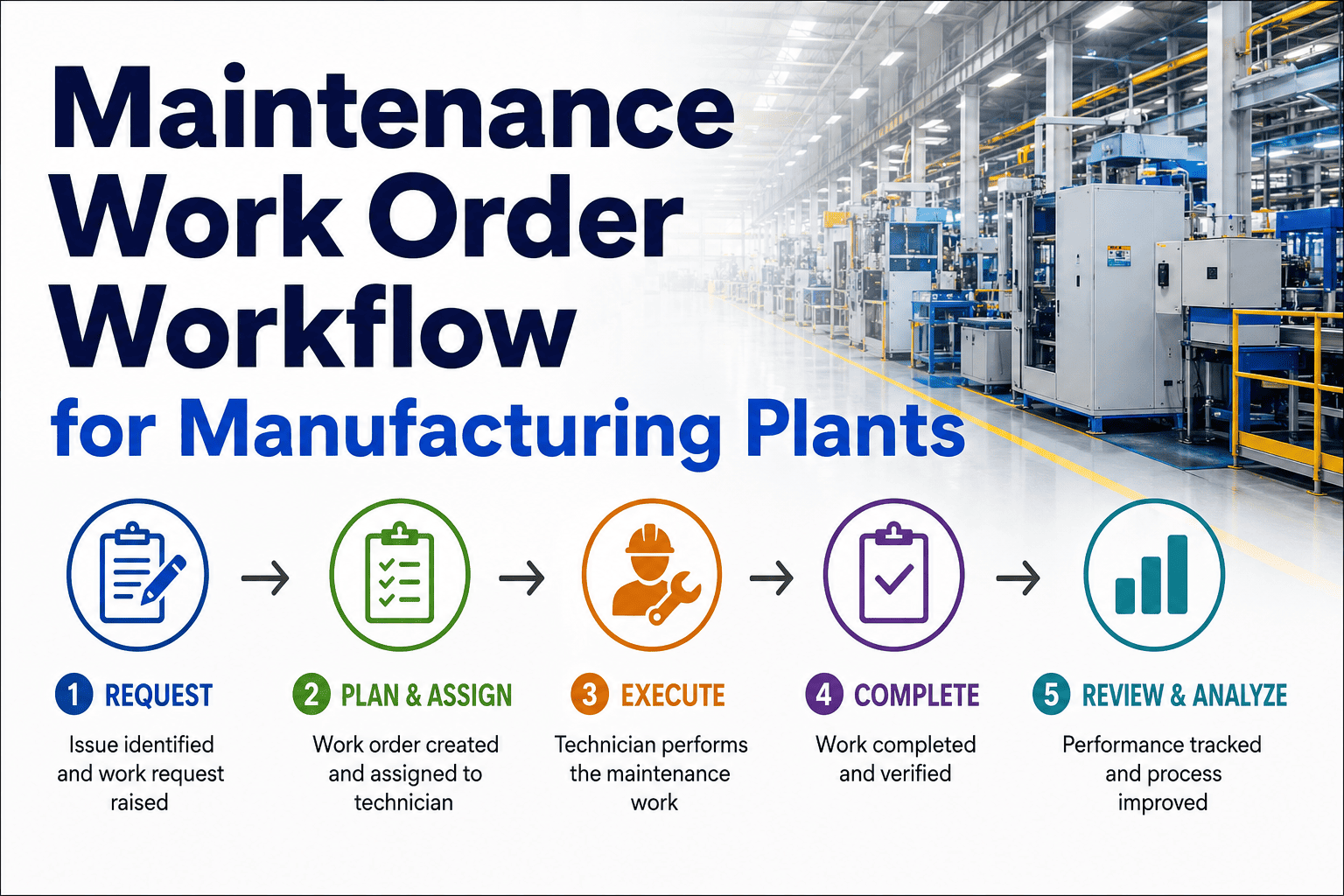
Traditional work order management is a six-step relay race where every handoff loses time. AI collapses those handoffs into a continuous, automated loop. Here is what each stage looks like with and without AI:
1
Request & Capture
Manual: Paper log or email to supervisor. Data often incomplete, delayed, or lost.
AI: Mobile submission, voice-to-text, or IoT-triggered auto-creation when sensor thresholds are exceeded.
2
Triage & Priority
Manual: Supervisor judgment. Inconsistent. Critical issues can wait behind routine jobs.
AI: NLP reads the request, cross-references asset criticality and maintenance history, and assigns priority within seconds.
3
Assignment & Scheduling
Manual: Dispatcher checks technician availability manually, often by phone or whiteboard.
AI: Matches job to nearest qualified technician with the right skills, parts availability, and open schedule — automatically.
4
Execution & Parts
Manual: Technician searches for SOP, checks parts bin manually, records labor on paper at end of shift.
AI: SOP surfaces automatically on mobile device. Parts are pre-staged. Labor and parts are logged in real time.
5
Closure & Documentation
Manual: Closed by supervisor after review — often days later. Data gaps are common.
AI: Prompts technician for required fields, validates completeness, and auto-closes with full audit trail and cost capture.
6
Learning & Improvement
Manual: Monthly review meeting. Patterns identified slowly if at all.
AI: Analyzes every closed WO to refine future predictions, flag recurring failure patterns, and update PM intervals automatically.
Your plant is leaving hours on the table every week.
Oxmaint's AI engine handles triage, assignment, and closure automatically — giving your team time back for high-value work.
How Machine Learning Powers Each Stage
AI is not a single technology — it is a stack of tools applied at specific stages of the work order process. Understanding which AI technique handles which task helps you evaluate platforms more accurately.
Natural Language Processing
Request Parsing
NLP reads free-text maintenance requests and extracts asset name, failure type, urgency signals, and location — turning unstructured input into structured work orders without manual intervention.
Predictive Analytics
Failure Forecasting
ML models trained on sensor data (vibration, temperature, pressure) and historical failure logs predict failures before they occur — triggering preventive WOs automatically when risk thresholds are crossed.
Optimization Algorithms
Smart Scheduling
AI optimizes technician assignment by balancing skill requirements, proximity, parts availability, and production schedule impact — maximizing first-time fix rate while minimizing production disruption.
Pattern Recognition
Root Cause Detection
By analyzing completed work orders across assets, AI identifies recurring failure patterns and root causes — enabling targeted PM adjustments that eliminate repeat breakdowns at the source.
AI Work Order Automation: Before vs. After
Numbers tell the real story. This comparison reflects documented outcomes from manufacturing plants that transitioned from manual to AI-automated work order management.
| Metric |
Manual WO Process |
AI-Automated WO Process |
Typical Improvement |
| WO creation time |
15–30 minutes |
Under 2 minutes (or automatic) |
85–90% faster |
| Priority accuracy |
Inconsistent, supervisor-dependent |
Consistent, data-driven |
Fewer missed criticals |
| WO data completeness |
60–70% complete on average |
95%+ with AI prompts |
40% improvement |
| First-time fix rate |
55–65% |
75–85% |
20–30% gain |
| Unplanned downtime |
Baseline |
Reduced by up to 28% |
Significant cost impact |
| Inventory accuracy |
80–85% |
95–98% with real-time sync |
12–18% excess stock reduction |
What to Look for in an AI Work Order Platform
Not all CMMS platforms with "AI" in their marketing deliver the same results. These six capabilities separate genuine AI automation from feature labeling.
01
IoT Sensor Integration
Real-time sensor data should flow directly into work order triggers — not require manual export and re-import. Look for native connectors to common industrial protocols.
02
Mobile-First Execution
Technicians should complete work orders entirely on mobile — including parts logging, photo capture, and signature. Data captured at point of work is 40% more accurate than end-of-shift entry.
03
ERP/MES Bidirectional Sync
Work order costs, labor hours, and parts consumption should sync automatically to your ERP. Without this, reconciliation wastes $28K–$75K annually in finance and maintenance labor.
04
Predictive WO Generation
The system should create work orders based on asset condition, not just time intervals. Condition-based triggers reduce unnecessary PMs while catching real degradation early.
05
Skills-Based Auto-Assignment
Assignment logic should factor in technician certifications, current workload, and location — not just availability. First-time fix rate depends on sending the right person, not just the nearest person.
06
Continuous Learning Loop
The AI should improve its predictions over time by analyzing completed work orders. Platforms that require manual model retraining by data scientists will not scale with your operation.
Frequently Asked Questions
How does AI create work orders automatically without human input?
IoT sensors stream real-time asset data — vibration, temperature, pressure, runtime hours — to an AI model that detects anomalies and degradation patterns. When readings cross defined risk thresholds, the system generates a work order automatically, pre-populated with asset details, failure type, priority level, and recommended resolution steps.
What is the typical ROI timeline for AI work order automation?
Most manufacturers see measurable ROI within 6 to 8 months of deployment, driven primarily by reductions in emergency repair costs, labor time recovered from manual administration, and inventory carrying cost reduction. Plants moving from bottom-quartile to top-quartile maintenance practices typically reduce total maintenance spend by 15 to 25% within 12 months.
Does AI work order automation require replacing our existing CMMS?
Not necessarily. Modern AI-powered platforms can integrate with existing CMMS or ERP systems via API, layering intelligent triage, assignment, and prediction on top of your current infrastructure. A full replacement makes sense when the underlying system lacks mobile capability or real-time data integration.
How does Oxmaint handle AI work order assignment and scheduling?
Oxmaint's AI engine reads incoming work requests, scores them by asset criticality and condition data, and assigns them to the best-matched available technician automatically. It also cross-references the production schedule to avoid maintenance conflicts during critical production windows — all without dispatcher intervention.
Is our maintenance data sufficient to train an AI model?
Most plants have enough historical work order data within 12 to 24 months of records to support initial model training. Modern AI platforms use transfer learning and pre-trained industrial models to reduce the data requirement significantly — meaning you do not need years of perfectly clean data to get started.
Stop Managing Work Orders Manually
Oxmaint automates the full work order lifecycle — from IoT-triggered creation to AI-powered assignment, execution, and closure. Less admin. Fewer breakdowns. Better data. Every shift.