Every second a problem goes unseen on your factory floor is a second of capacity you will never recover. The Andon system — born in the Toyota Production System and now reengineered for Industry 4.0 — gives every operator on your line the power to surface problems the instant they occur, automatically routing alerts to the right person within seconds instead of minutes. OxMaint's real-time Andon module connects production alerts directly to maintenance work orders, so the moment a machine signals a fault, a technician is already dispatched — no phone calls, no walkie-talkies, no delays. Book a 15-minute demo to see a live Andon alert flow from your first connected production line.
Andon System in Manufacturing: Real-Time Alerts That Actually Close the Loop
From Toyota's cord to digital Andon 4.0 — how modern alert systems reduce response times by 60%, connect directly to CMMS work orders, and give every level of your plant full visibility in real time.
Andon: 50 Years Old, Still the Fastest Way to Surface a Problem
The word "Andon" is Japanese for lantern. Toyota introduced the concept in the 1970s — a cord above the assembly line that any worker could pull to halt production and signal a problem. That single idea — give every operator the ability to raise an alarm the moment something goes wrong — is the foundation of TPM and Lean manufacturing's visual management philosophy. What has changed in 50 years is everything that happens after the signal.
Physical rope above the line. Pull to stop production and light a lamp. Manual, analog, zero data capture. Supervisor walks to the station.
Red-yellow-green tower lights per station, visible across the floor. Still manual triggers, still no digital data, still no automatic escalation.
LCD screens replace light boards. Events logged digitally. Basic notification to supervisors. Response time improves — but loop still closes manually.
Sensor-triggered + operator-raised alerts. Auto-routes to right technician. Creates CMMS work order in under 60 seconds. Full audit trail. Escalation if no acknowledge in 2 minutes.
One System, Four Types of Production Signal — All Routed Automatically
A modern Andon system handles more than breakdown alerts. Every type of production deviation — quality, material, safety, equipment — needs its own signal, its own routing, and its own escalation rule. Here is how a complete Andon system covers all four.
The highest-priority signal. A machine fault that goes unacknowledged within 2 minutes on an automotive assembly line can cascade into a full shift stoppage. Automated routing to the right technician — not a general broadcast — is what closes this gap.
Material starving a line is a performance loss, not a breakdown — and it does not appear in breakdown data. An Andon signal at the moment material runs low (not after it runs out) gives the material handler time to respond before production stops.
A single quality escape in a high-mix electronics line can become thousands of defective units before anyone upstream sees the problem. Andon-triggered quality alerts stop defect propagation at the source — the same shift, not the next day's inspection report.
Safety alerts bypass all delay rules — they escalate the moment they fire. Process deviation signals (temperature, pressure, speed out of spec) go to process engineering immediately, preventing a parameter drift from becoming a scrap run or a quality escape.
Every Andon Alert on Your Line Can Become a Work Order in OxMaint — in Under 60 Seconds.
OxMaint connects to your existing PLCs, sensors, and operator input stations. Equipment faults auto-create work orders with asset ID, fault code, timestamp, and 24-hour trend. No manual handoff between operations and maintenance. No alert that closes without a documented resolution.
What Happens When Response Time Drops From 18 Minutes to 90 Seconds
The business case for digital Andon is built entirely on one number: how long it takes from problem occurrence to technician on-site. Research across manufacturing operations shows that intelligent Andon systems reduce downtime response time by over 60%. Here is what that looks like in practice across three common failure scenarios.
| Scenario | Without Digital Andon | With OxMaint Andon | Time Saved Per Event |
|---|---|---|---|
| Conveyor jam — packaging line | Operator walks to find supervisor: 8–12 min response | Auto-alert to maintenance mobile: 90-sec response | 7–11 min per event |
| Weld fault — automotive cell | Operator radios supervisor, supervisor calls maintenance: 15–20 min | Sensor triggers WO + technician alert: under 2 min | 13–18 min per event |
| Material runout — assembly station | Line stops, operator flags team leader, waits for material: 10–15 min | Bin sensor alert to material handler before runout: 0 min stoppage | Full stoppage avoided |
| Quality deviation — electronics PCB | Detected at end-of-line inspection, rework of entire batch | In-process alert stops defect propagation at source: same unit | Full batch scrap avoided |
The Numbers Behind a Working Andon System
Why Light Stacks Are No Longer Enough
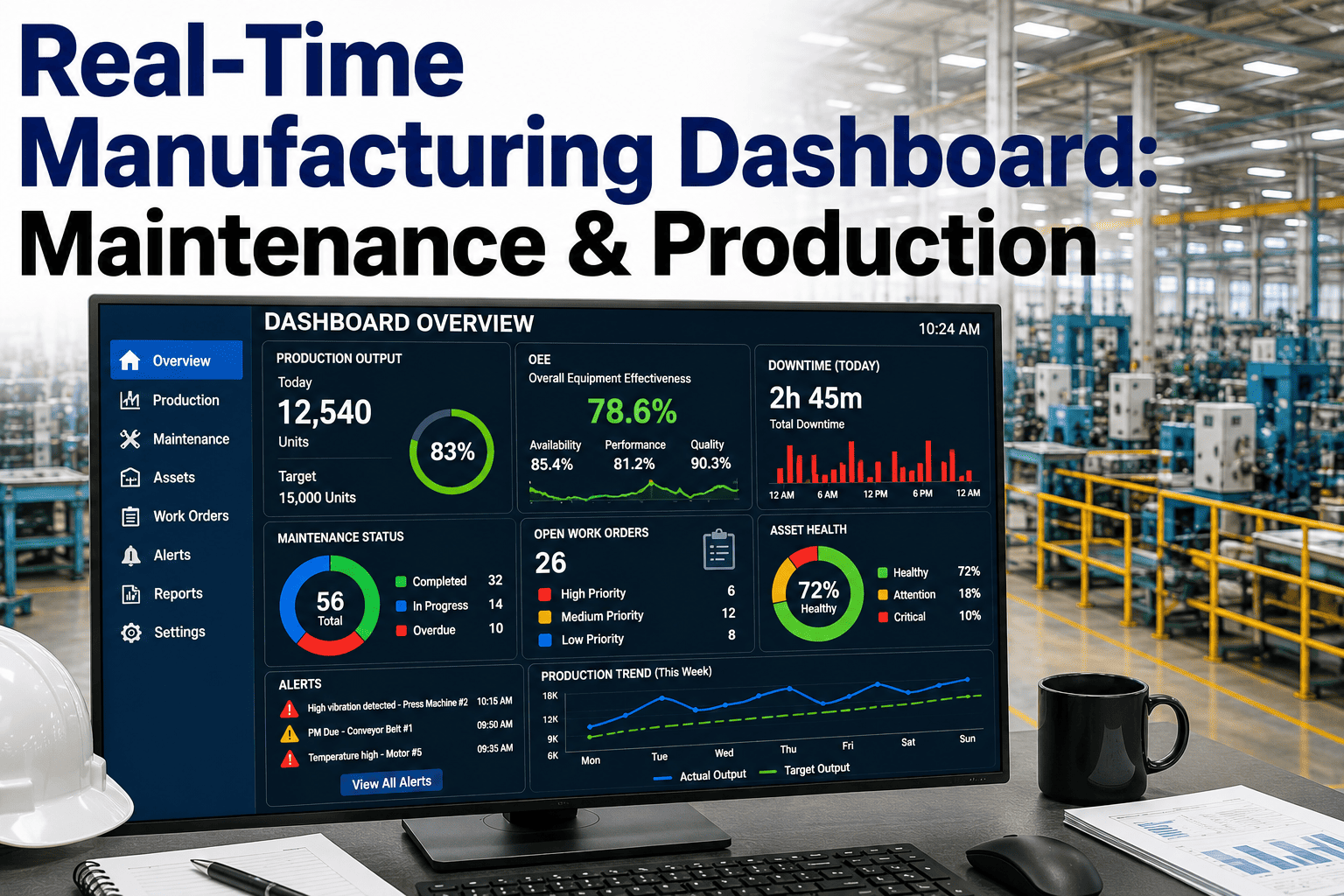
A physical Andon light tells you something is wrong at a specific station. A digital Andon system tells you what is wrong, who is handling it, how long it has been open, and whether it is about to miss its SLA — all in one dashboard visible to every level of the plant. The gap between these two is the gap between reacting and managing.
How to Implement Digital Andon in Four Phases Without Disrupting Production
The plants that fail at Andon implementation try to do everything at once. The plants that succeed start with the highest-frequency alert type on one line, prove the value in 30 days, then scale. This four-phase approach is designed to deliver measurable results before you commit to full deployment.
Map your four alert categories (equipment, material, quality, safety) to specific assets and stations. Define who receives each alert type, what the acknowledge window is, and who the escalation target is. Register all assets in OxMaint with their alert configurations before connecting a single sensor. This step takes less than one day in OxMaint — the asset registry and alert rule builder are pre-configured for manufacturing environments.
Select the one line with the most frequent unplanned stops or the highest cost of downtime. Connect PLCs via OPC-UA or Modbus TCP, or deploy non-intrusive IoT sensors for legacy equipment. Activate operator call buttons at each station. All alerts from this line now flow to OxMaint — every event logged, every work order auto-created. Most plants see measurable response time improvement within the first week of connection.
Activate the plant-wide Andon dashboard — visible on floor monitors, browser, and mobile. Configure escalation timing per alert type: equipment faults escalate in 2 minutes, material shortages in 5 minutes, quality deviations in 10 minutes. After 4 weeks of data, run the first Pareto analysis to identify the top 3 alert causes across the pilot line. These become the first targeted improvement projects.
Replicate the Phase 2 setup across all remaining lines using the routing rules defined in Phase 1. With 90 days of continuous alert data, OxMaint's predictive models begin identifying recurring fault patterns and generating preventive maintenance work orders before the fault occurs — transitioning your Andon system from reactive signalling to proactive intervention. Sign in to configure your Phase 1 asset registry in OxMaint today.
How OxMaint Closes the Loop Between Alert and Resolution
Every alert reaches the right person via mobile push notification, in-app dashboard, and email — simultaneously. Technicians acknowledge from their phone without being at a workstation. Supervisors see full plant status from any browser. No alert goes unseen because someone was in a different part of the floor. Sign in to configure your alert routing in OxMaint.
When an equipment fault alert fires, OxMaint creates a work order pre-populated with asset ID, fault code, alert timestamp, current reading, and 24-hour history. The technician arrives with full context, not a description relayed through two phone calls. Finding-to-work-order conversion rises to 100% — zero alerts lost between detection and resolution. Book a demo to see automatic work order creation in action.
Set independent escalation rules for each alert type: equipment faults escalate to area manager if unacknowledged in 2 minutes, material shortages in 5 minutes, quality deviations in 10 minutes. Escalation history is logged so no critical alert can silently expire without a documented response or escalation. Sign in to build your escalation rules in OxMaint.
Every Andon event is stored with open time, acknowledge time, resolve time, and resolution notes. OxMaint builds the Pareto of top alert causes automatically — no spreadsheet exports. After 4 weeks, you have a data-driven list of the 2–3 changes that will eliminate 70% of your alert volume. Book a demo to see the Andon analytics dashboard.
Frequently Asked Questions About Andon Systems in Manufacturing
What is the difference between a traditional Andon light stack and a digital Andon system?
A traditional light stack shows that a problem exists at a specific station — nothing more. A digital Andon system records the alert type, routes it to the correct person, tracks acknowledge and resolve times, auto-creates maintenance work orders, and builds historical trend data for continuous improvement. Traditional lights require a supervisor to physically see the signal and manually initiate a response. Digital Andon sends direct notifications to technicians' mobile devices in under 60 seconds, escalates automatically if unacknowledged, and documents every action — none of which a light can do. OxMaint's Andon module connects to your existing sensors and PLCs to deliver all of this without replacing your current hardware.
How does OxMaint connect to existing production equipment to receive Andon signals?
OxMaint connects via OPC-UA, MQTT, Modbus TCP, and REST API — supporting PLCs from Siemens, Rockwell, Mitsubishi, and most other major vendors without custom middleware. For legacy machines without digital outputs, non-intrusive IoT sensors detect running state via vibration or power monitoring and install in under 30 minutes without modifying equipment. Operator call buttons connect via standard digital input modules or through the OxMaint mobile app. Book a demo to see the exact connection method for your equipment — most plants go live with their first line within one week of starting configuration.
Can one person on the line trigger an Andon without stopping the entire production line?
Yes — and this is a critical design choice. Modern Andon systems support soft-stop and hard-stop configurations per alert type. A material shortage alert can notify the material handler while the line continues running. An equipment fault can trigger a hold on the affected station only. A safety signal can stop the entire line instantly. OxMaint allows you to configure stop behaviour independently for each alert type and each station — so operators are empowered to raise signals without fear of unnecessarily halting downstream production. Sign in to configure station-level stop rules in OxMaint for your specific line architecture.
How quickly will we see OEE improvement after implementing a digital Andon system?
Most plants identify measurable response time improvement within the first week of digital Andon deployment — simply because alerts now reach the right person directly instead of travelling through two or three intermediaries. OEE-level improvement typically becomes statistically significant within 30–60 days as the Pareto of top alert causes becomes actionable. Plants that act on their top 2–3 alert causes with targeted engineering changes consistently achieve 10–25% production efficiency gains within 6 months — without any capital equipment investment. Book a demo to see how OxMaint's Andon analytics quantifies your current response time baseline in the first 48 hours of connection.
Your Line Is Signalling Problems Right Now. Is the Right Person Seeing Them?
Every minute between a production fault and a technician on-site is capacity you paid for and did not get. OxMaint's Andon module routes every alert to the right person, creates the work order automatically, and builds the Pareto of your top causes from day one. Start free — first line connected today, first Andon alert routed before your next shift.