Every maintenance team has faced it: a technician standing in front of a failing machine, paper manual in one hand, phone in the other, waiting 40 minutes for the right expert to pick up. In 2026, that scenario is becoming a relic. AR-powered maintenance tools and wearable devices are fundamentally rewriting how industrial teams diagnose, repair, and document equipment failures — cutting repair times, eliminating guesswork, and connecting frontline workers to real-time intelligence without ever taking their eyes off the job.
2026 Industrial Guide
AR & Wearables Are Rewriting Industrial Maintenance
From smart glasses that overlay step-by-step repair instructions to wristbands that alert workers before equipment fails — this is what the maintenance floor looks like in 2026.
$120B
Global AR market size in 2025
28M
AR smart glasses shipping in 2026
41%
CAGR of industrial AR market through 2030
Why Maintenance Teams Are Adopting AR Right Now
The case for AR in maintenance has never been clearer. Unplanned downtime costs manufacturers an average of $260,000 per hour, and the single biggest driver of that downtime is slow, error-prone repair execution. AR directly attacks that problem by delivering the right information to the right person at exactly the right moment — in their field of view, hands-free, without stopping work.
01
The Skills Gap Is Real
68% of business decision-makers now list wearables as a priority as experienced technicians retire faster than replacements are trained. AR bridges this gap by packaging expert knowledge into on-demand visual guidance that any trained worker can follow.
02
Hardware Has Matured
Industrial AR headsets in 2026 are lighter, longer-lasting, and explosion-proof rated for factory floors. What cost $15,000 in 2020 now delivers more functionality at a third of the price, making ROI calculations straightforward for plant managers.
03
CMMS Integration Is Here
Modern CMMS platforms like Oxmaint now connect directly with wearable devices, pushing work orders, asset histories, and repair checklists to a technician's smart glasses the moment they approach an asset — no keyboard, no tablet, no context-switching.
04
Competitors Already Have It
Boeing cut wire assembly errors to near zero using smart glasses. DHL expanded AR-guided operations to 350 facilities. Companies that don't adopt AR maintenance tools within the next 24 months will face measurable competitive gaps in repair speed and labor productivity.
The 4 Wearable Technologies Transforming Maintenance in 2026
Most Adopted
Smart Glasses & AR Headsets
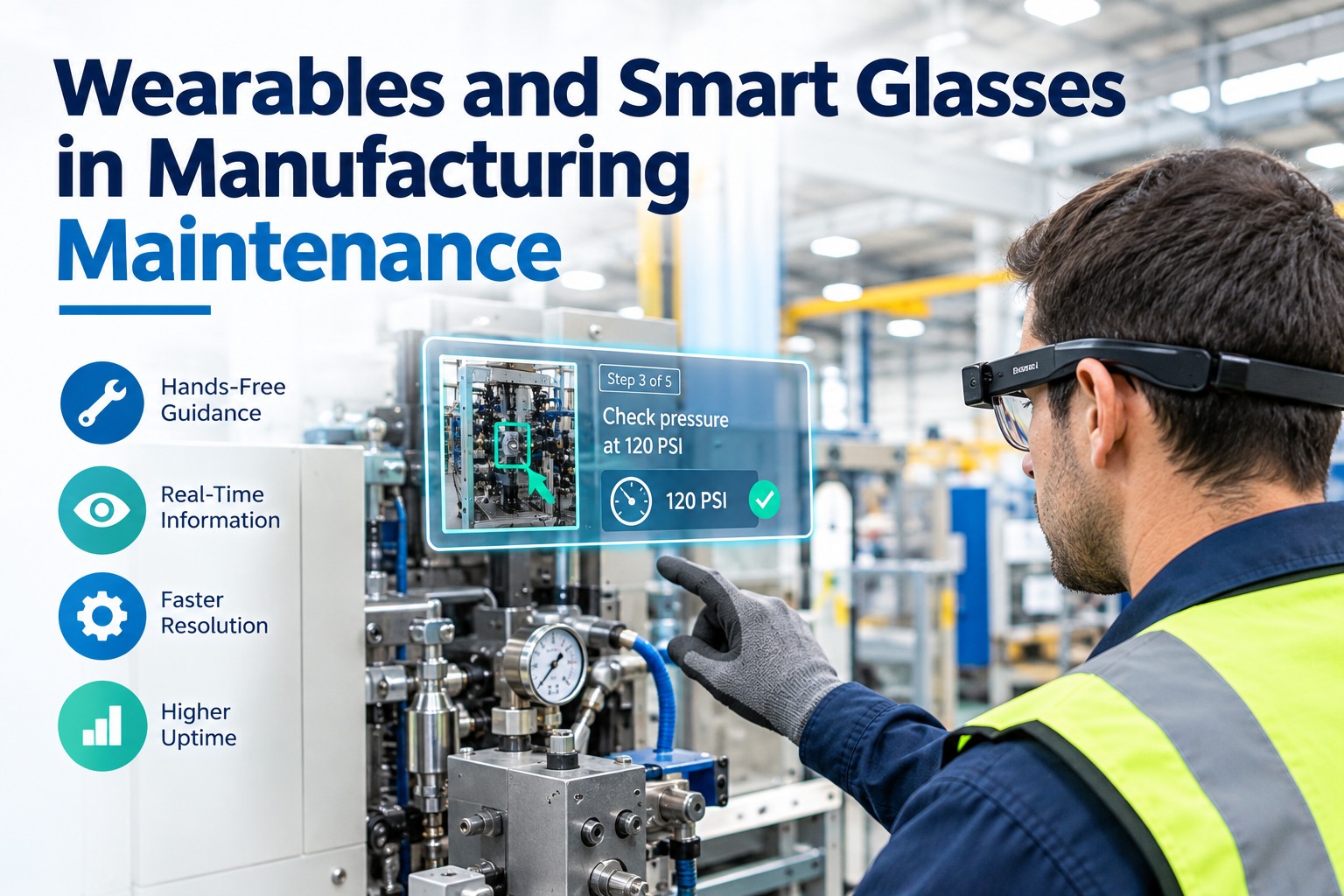
Overlay digital work instructions, equipment specs, and warning indicators directly onto the physical asset in the technician's field of view. The technician never needs to look away or touch a screen. Voice commands advance steps. Best for: complex multi-step repairs, environments where both hands must remain free, and situations requiring visual alignment guidance.
25%
Assembly time reduction (Boeing)
~0%
Error rate with AR guidance
Industrial Smartwatches
Deliver real-time PM alerts, vibration-based safety warnings, and work order notifications to the wrist. Ruggedized for extreme heat, moisture, and impact. When connected to a CMMS, they push task reminders, escalation alerts, and completion confirmations without requiring the technician to reach for a phone.
38%
Fastest growing AR/wearable segment CAGR
Real-time
Work order push alerts
Wearable Cameras & Body Cams
Chest or helmet-mounted cameras stream live video to remote experts who can annotate the feed in real time, draw arrows, circle components, and verbally guide repairs. Especially powerful when rare failures require specialist expertise that isn't on-site — reducing the need for expensive travel and enabling 24/7 expert coverage across multiple facilities.
400%
Delivery time reduction with AR-guided process
Multi-site
Expert coverage without travel
Environmental & Biometric Sensors
Embedded in vests, bands, or helmets — these sensors monitor ambient temperature, gas exposure, worker fatigue indicators, and proximity to hazardous machinery. When integrated with maintenance management platforms, they trigger preventive alerts before unsafe conditions develop, protecting both the worker and the equipment from failure events.
Predictive
Safety alerts before failure
IoT
Full CMMS data sync
Ready to connect wearables to your CMMS?
Oxmaint's mobile-first CMMS is designed for wearable integration — pushing work orders, asset histories, and checklists directly to smart devices on your floor.
How AR Changes the Maintenance Repair Workflow
The most dramatic impact of AR isn't the hardware — it's the workflow transformation. Every step from fault detection to work order closure becomes faster, more accurate, and fully documented when AR and wearables are integrated with a connected CMMS platform. The comparison below shows where the real time savings come from.
Technician walks to control room, looks up asset ID in system, prints work order, returns to equipment
Asset Identification
Smart glasses scan asset QR code, work order and full repair history appear in field of view instantly
Flips through paper manual, calls a colleague for the right page, loses 15–30 minutes before wrench turns
Accessing Instructions
Step-by-step 3D overlaid instructions appear on the actual component, voice command advances each step
Phones an expert, tries to describe the fault verbally while re-explaining context from scratch
Expert Consultation
Streams live first-person video to remote expert who annotates the feed in real time with repair guidance
Fills in paper form post-repair, often hours later, with incomplete or estimated data on repair times
Work Order Closure
Wearable auto-captures timestamps, failure codes, and repair steps — CMMS record closes automatically
Supervisor reviews incomplete paper forms weekly to identify repeat failures, patterns go unnoticed
Post-Repair Analysis
CMMS generates real-time MTBF and MTTR trends from clean AR-captured data for immediate KPI action
Real Industry Results: What the Numbers Say
Boeing
25% faster
Wire assembly process time using AR headsets with Skylight platform. Errors reduced to near zero percent from previous manual methods.
DHL Logistics
350 facilities
Now deploying smart glass operations across North America after initial pilots demonstrated measurable productivity gains and error reduction at scale.
Manufacturing Sector (Avg)
40% YoY growth
XR device shipments for industrial use grew over 40% year-over-year in 2025 as ROI cases became undeniable across automotive, pharma, and heavy industry.
AR-Guided Repairs (Industry)
10–25% MTTR cut
Mean Time to Repair reductions achievable within 60 days of deploying AR-guided workflows and pre-staged parts kits — no capital equipment investment needed.
AR Wearables + CMMS: The Integration That Makes It Work
AR hardware without a connected maintenance management system is like a smartphone without apps — powerful hardware running at a fraction of its potential. The real ROI from wearable maintenance technology comes when devices sync bidirectionally with a CMMS, turning every field interaction into clean, structured data that improves every future repair. See how Oxmaint's wearable integration works in a live demo and discover what your team can accomplish in 30 days.
Wearable Device
Smart glasses
Industrial smartwatch
Body cam stream
Sensor vest
Work Orders, Asset History, Checklists, PM Schedules
Timestamps, Failure Codes, Photos, Completion Data
Oxmaint CMMS
Live KPI dashboards
MTBF / MTTR tracking
PM schedule engine
Cost reports
Faster Repairs
Cleaner Data
Hands-Free Workflows
Auto-Closed Work Orders
Real-Time Expert Access
Choosing the Right AR Setup for Your Facility
Your Facility Is Ready for This. Is Your CMMS?
Oxmaint is built from the ground up for mobile and wearable workflows. Configure your dashboard, connect your devices, and start capturing clean maintenance data from day one — no consultants, no months-long implementation.
Frequently Asked Questions
Do AR wearables actually reduce repair time, or is the ROI overstated?
The data from real deployments is consistent: AR-guided maintenance reduces Mean Time to Repair by 10–25% within 60 days of implementation. Boeing's wire assembly time dropped 25% using smart glasses, and DHL scaled AR operations to 350 facilities after proving productivity gains at pilot sites. The ROI is clearest when AR is paired with a CMMS that auto-captures repair data — eliminating both the repair delay and the post-repair paperwork burden.
Book a demo to see how Oxmaint calculates MTTR reductions from your work order data.
What is the minimum setup needed to start using AR for maintenance?
You can start with nothing more than a tablet or smartphone — most industrial AR solutions work on devices your team already carries. Dedicated smart glasses deliver a better hands-free experience but require an investment of $1,500–$5,000 per unit depending on ruggedness requirements. The critical foundation is a CMMS that can push work orders and asset data to mobile devices; without this, AR hardware delivers only a fraction of its potential.
Oxmaint's mobile CMMS works on any device and takes under 15 minutes to configure.
How do smart glasses connect to a CMMS like Oxmaint?
Smart glasses run lightweight apps that communicate with the CMMS via cloud API. When a technician approaches an asset and scans its QR code or RFID tag, the glasses retrieve the active work order, repair history, and step-by-step instructions from the CMMS in seconds. As the technician completes steps, timestamps and failure codes sync back automatically. Oxmaint's mobile integration layer is designed to support these bidirectional workflows natively — no custom development required.
See the full integration workflow in a live Oxmaint demo.
Is AR maintenance technology suitable for small or mid-size manufacturing facilities?
Absolutely — in fact, smaller facilities often see faster ROI because their maintenance teams are leaner, making each hour of reduced repair time more impactful. Tablet-based AR requires no capital investment in hardware, and cloud CMMS platforms like Oxmaint scale from 5 to 500 technicians at the same per-seat cost. The 41% CAGR of the industrial AR market reflects strong adoption among mid-market manufacturers, not just Fortune 500 enterprises.
Start free and scale as your team grows with Oxmaint.
What happens to maintenance data captured through wearables — where does it go?
Every interaction captured by a wearable device — timestamps, repair steps completed, failure codes, photos, video clips — flows directly into the connected CMMS as structured work order data. This means your MTBF and MTTR calculations become dramatically more accurate because they're sourced from real-time field data rather than technician memory hours after the repair. Over time, this data trains your predictive maintenance model, making each future repair faster than the last.
Sign up free to see how Oxmaint transforms raw field data into live KPI dashboards.