Maintenance is no longer something that only happens when a technician shows up with a wrench. A new generation of AI-driven systems and autonomous robots is fundamentally changing who — and what — keeps industrial equipment running. These systems monitor thousands of sensor signals simultaneously, predict failures weeks in advance, generate their own work orders, and in some deployments, execute physical inspections and minor repairs without human intervention. The results are measurable: AI-based predictive maintenance has reduced unexpected equipment failures by up to 50%, while Siemens' industrial deployments have documented 85% better downtime-forecast accuracy and 50% fewer unplanned outages. The predictive maintenance market alone is projected to grow from $10.93 billion in 2024 to over $70 billion by 2032. This page breaks down exactly how autonomous maintenance works, what it can do for your plant, and the realistic path to getting there. When you're ready to put AI to work on your maintenance backlog, sign up free on Oxmaint and start today.
Trending: Autonomous Maintenance · AI-Powered Predictive Maintenance
Autonomous Maintenance: AI and Robotics Reducing Equipment Downtime by 70%
When machines monitor themselves, predict their own failures, and trigger their own repairs — maintenance stops being a cost center and becomes a competitive advantage. Here's how it works and how to get there.
The Proof Is in the Data
70%
Maximum reduction in equipment downtime reported by manufacturers fully deploying autonomous AI maintenance programs
97.3%
Fault detection accuracy achieved by self-healing AI systems in industrial deployments
50%
Fewer unplanned outages achieved by Siemens after deploying AI-driven predictive strategies across industrial facilities
85%
Better downtime-forecast accuracy from AI-driven digital twin and predictive maintenance integration (Siemens data)
95%
Accuracy at which AI-integrated robotic diagnostics can now identify and predict equipment failures in industrial settings
$70B+
Projected predictive maintenance market size by 2032, growing at 26%+ CAGR — the fastest-growing maintenance category globally
The Autonomy Spectrum: From Reactive to Self-Healing
Autonomous maintenance is not a single technology — it is a progression. Most plants sit somewhere in the middle. Understanding where you are tells you exactly what your next move should be.
Level 1
Reactive
Fix it when it breaks. No sensors, no history, no prediction. Emergency repairs dominate. Most expensive maintenance model at 3–10× the cost of planned work.
Level 2
Preventive
Calendar-based PM schedules. Better than reactive, but services equipment that may not need it yet — and still misses failures that happen between scheduled tasks.
Level 3
Predictive
IoT sensors and AI analyze real-time machine behavior to forecast failures days or weeks ahead. Maintenance is triggered by condition, not calendar. Most plants target this level first.
Level 4
Autonomous
AI not only predicts failures but automatically generates work orders, schedules technicians, reserves parts, and dispatches inspection robots — with minimal or zero human trigger needed.
Level 5
Self-Healing
The system detects an anomaly, predicts the failure mode, autonomously executes or coordinates the repair, validates the fix with post-repair sensor data, and updates its own predictive model — all without human initiation. Achieving 89.4% self-recovery in current deployments.
How Autonomous Maintenance Works: The Technology Stack
Four layers of technology work together to take maintenance from human-triggered to machine-initiated. Each layer adds intelligence and reduces the time between a developing fault and a resolved repair.
Layer 1
Sensor & Data Collection
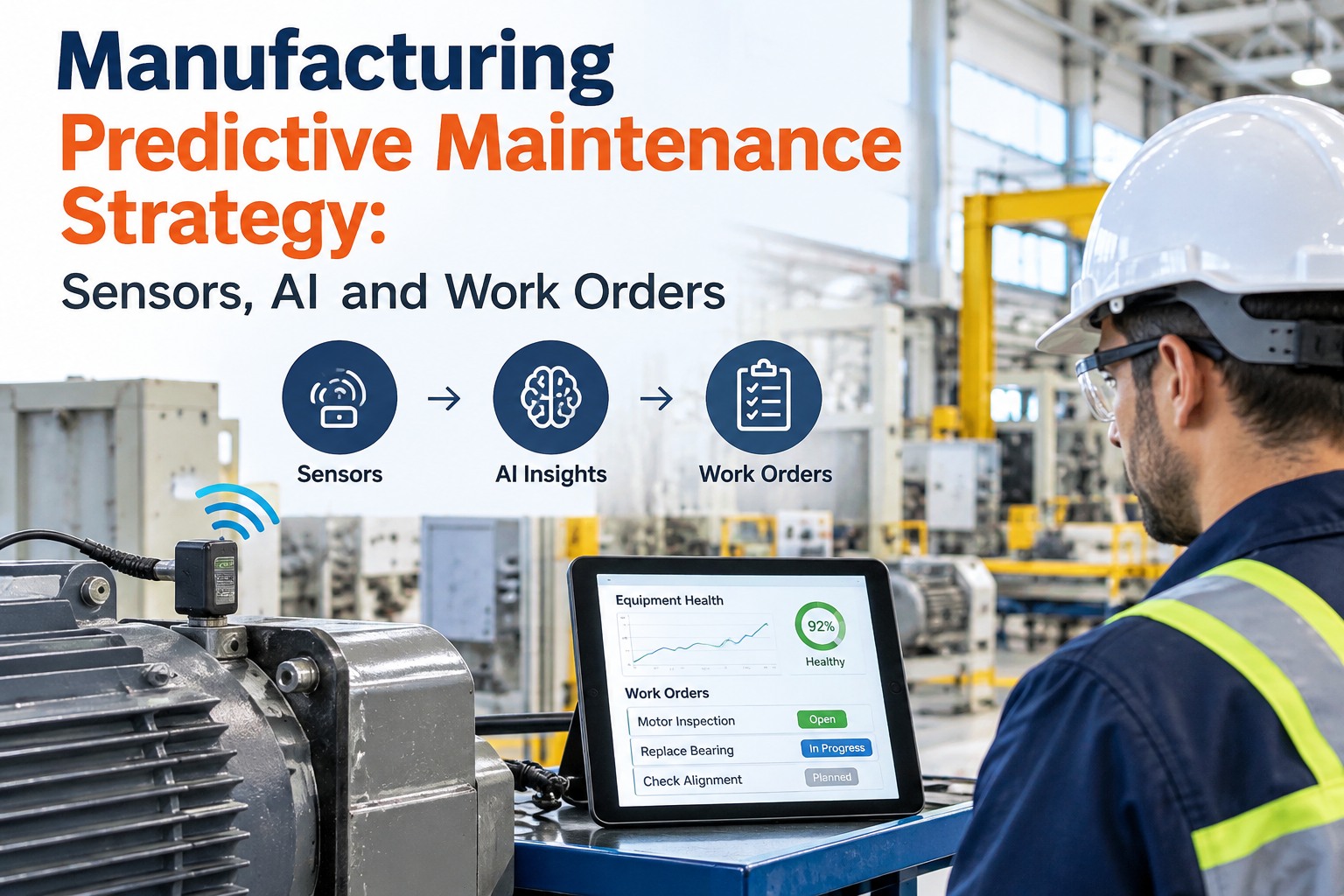
Vibration sensors, thermal cameras, current monitors, acoustic detectors, and pressure transducers stream high-frequency data from every critical asset. Edge AI processes this data on-site to reduce latency — no cloud round-trip required for real-time anomaly detection.
Cobots achieve 97% human-detection accuracy with multimodal perception sensors
Layer 2
AI Anomaly Detection & Prediction
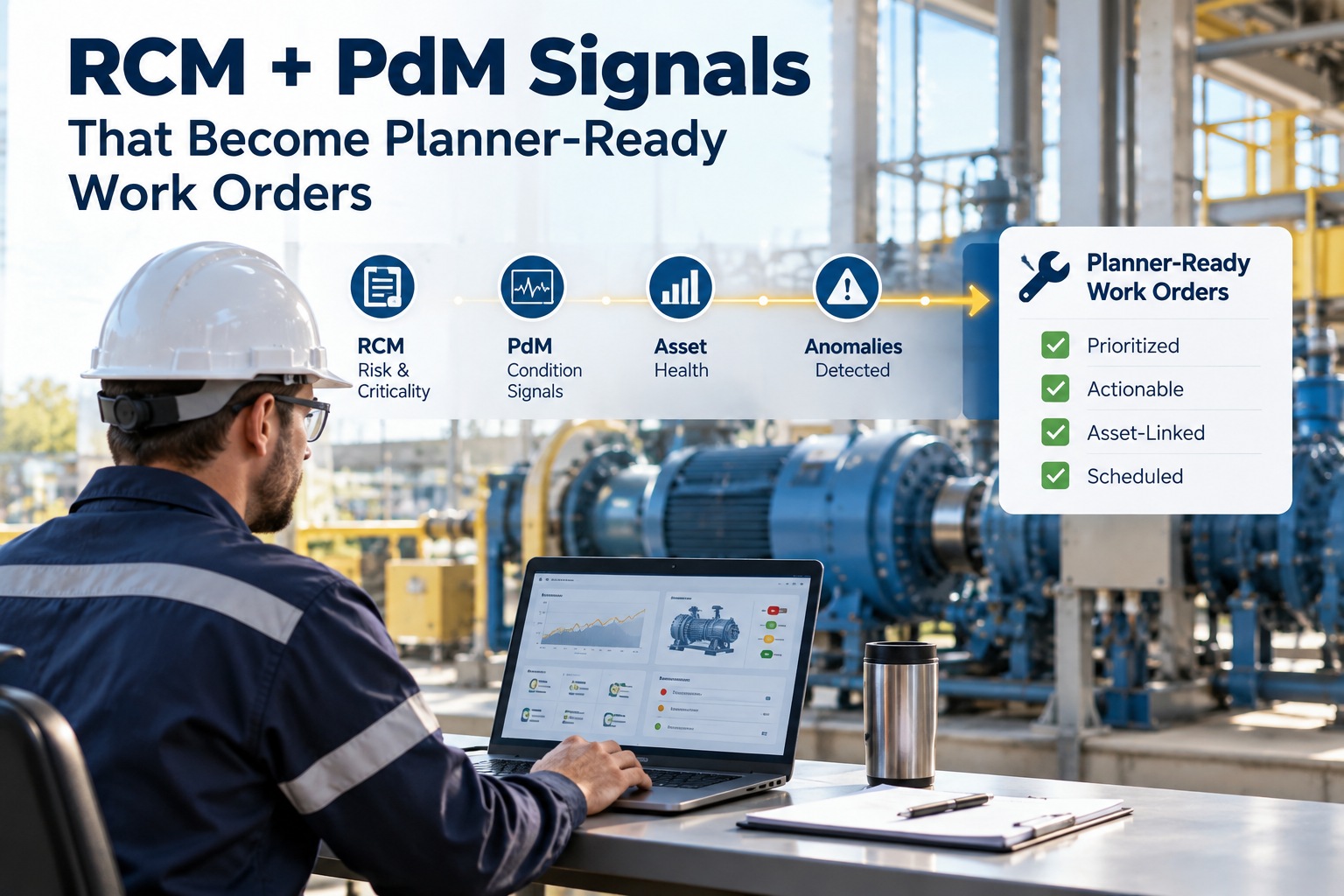
Machine learning models trained on failure history continuously compare live sensor signatures against normal operating profiles. Deviations trigger anomaly flags. Supervised learning predicts failure mode, severity, and estimated time-to-failure — with up to 95% diagnostic accuracy in current industrial deployments.
AI-based predictive maintenance reduces unexpected failures by 50%
Layer 3
Automated Work Order Generation
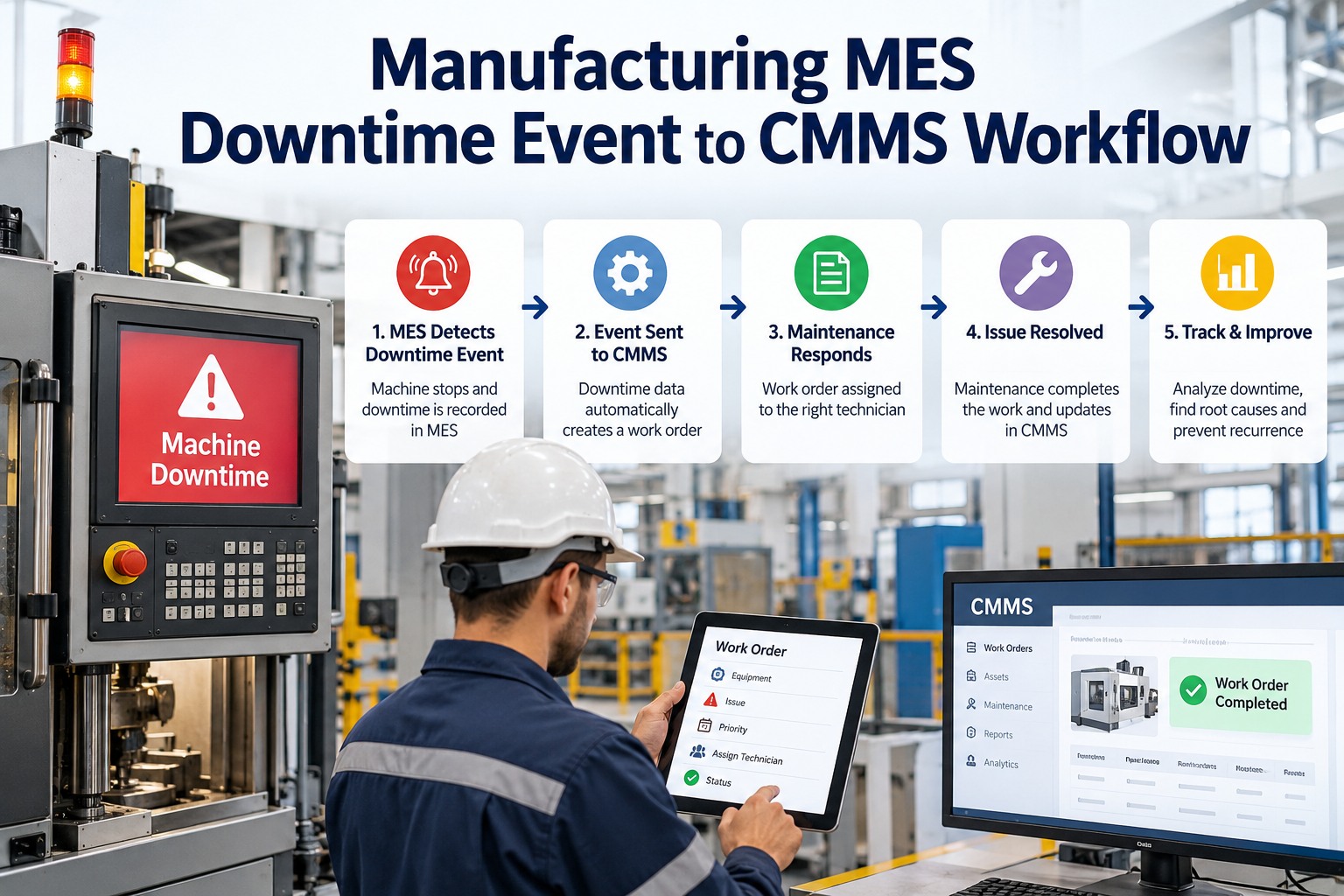
When the AI confirms a predicted failure, it automatically creates a structured work order in the CMMS — complete with asset ID, failure mode, recommended repair action, required parts, and priority ranking. The right technician is notified with everything needed to start the job immediately.
Autonomous scheduling tied directly to ERP and CMMS systems cuts response time by 31.7%
Layer 4
Robotic Inspection & Execution
Autonomous inspection robots equipped with thermal cameras and force sensors physically traverse the facility on scheduled routes — scanning equipment, logging readings, and flagging anomalies that sensor networks alone might miss. Next-generation robots track torque load, thermal stress, and encoder drift, running self-tests between shifts.
AI-enabled robots reducing manufacturing errors by 70% in high-precision environments
Oxmaint is the CMMS layer where autonomous maintenance connects to action. AI predictions trigger work orders automatically, technicians get mobile alerts with full asset context, and every repair feeds back into the prediction model.
Documented Results Across Industries
These are not projections — they are published outcomes from manufacturers and industrial operators that have deployed AI-driven autonomous maintenance at scale.
Siemens Industrial
AI Predictive + Digital Twin
85%Better downtime forecast accuracy
50%Fewer unplanned outages
55%Higher staff productivity
Tier 1 Automotive (CNC)
IoT + Vibration Monitoring + AI
68%Reduction in spindle downtime
$2.1MAvoided repair costs per year
14 moInvestment payback period
Energy Sector (Peer-Reviewed)
AI-Powered Twin + Condition-Based
35%Reduction in unplanned downtime
8.5%Higher throughput
20–30%Operational efficiency gain
AI Robotics (Cross-Industry)
Autonomous Mobile Robots + AI
200–300%ROI within 18–24 months
40%Reduction in downtime
50%Productivity improvement
Your Roadmap to Autonomous Maintenance
Full autonomy is not an overnight deployment. The most successful programs follow a phased approach that delivers ROI at each stage while building toward zero-touch maintenance.
Phase 1 · Months 1–3
Connect & Baseline
Instrument your 10–15 most critical assets with IoT sensors. Integrate sensor data with your CMMS. Establish normal operating baselines so the AI has clean data to learn from. This phase delivers your first failure predictions within 60–90 days.
Phase 2 · Months 3–6
Predict & Alert
AI models become reliable as historical data accumulates. Predicted failures begin generating automatic CMMS alerts. Maintenance transitions from calendar-based to condition-based on covered assets. First measurable downtime reduction becomes visible.
Phase 3 · Months 6–12
Automate & Schedule
Predicted failures auto-generate full work orders — with technician assignment, parts reservation, and safety procedures. Human involvement shifts from initiation to approval and execution. Planned maintenance percentage climbs toward 90%+.
Phase 4 · Month 12+
Scale & Optimize
Expand coverage to full asset inventory. Introduce robotic inspection routes for hazardous or hard-to-reach equipment. AI models continuously self-improve using repair outcome data. The maintenance program moves toward genuine autonomy across the facility.
Frequently Asked Questions
What exactly is autonomous maintenance and how is it different from predictive maintenance?
Predictive maintenance uses AI to forecast when equipment will fail — it tells you a problem is coming. Autonomous maintenance goes further: the system not only detects and predicts the failure, but also automatically initiates the response. That means generating a work order without human trigger, assigning the technician, reserving the required part, and in advanced deployments, dispatching an inspection robot to gather more data or perform a minor repair. Predictive maintenance is the intelligence layer; autonomous maintenance is the full action layer built on top of it.
How much downtime reduction can a manufacturing plant realistically expect?
Results vary by deployment depth, but published industrial data consistently shows significant reductions. AI-based predictive maintenance alone reduces unexpected equipment failures by 50%. Full autonomous deployments using AI plus digital twins and condition-based triggers have achieved 68–70% downtime reduction in documented cases. The energy sector peer-reviewed study documented 35% unplanned downtime reduction with 8.5% higher throughput. Most plants see their first measurable improvements within 3–6 months of activating sensor-based prediction, with the largest gains coming in months 6–18 as AI models mature on plant-specific data.
What role do robots play in autonomous maintenance?
Robots serve two distinct roles in autonomous maintenance programs. First, autonomous inspection robots patrol scheduled routes through the facility using thermal cameras, force sensors, and vibration probes to gather condition data from assets that are difficult, hazardous, or too numerous to inspect manually at adequate frequency. Second, next-generation self-diagnosing robots — particularly in advanced manufacturing — track their own torque load, thermal stress, and encoder drift against baseline models, run self-tests between shifts, and flag issues before they cause production stops. Combined with AI diagnostics, these systems achieve up to 95% fault prediction accuracy.
How does a CMMS like Oxmaint fit into an autonomous maintenance architecture?
The CMMS is the operational execution layer where autonomous intelligence connects to real-world action. When the AI predicts a failure, Oxmaint receives that signal and automatically creates a structured work order — including asset details, failure type, recommended repair procedure, required parts, and technician assignment. The technician gets a mobile notification with everything needed to start the job. After the repair, the technician closes the work order with actual repair data — labor hours, parts used, root cause — which feeds back into the AI model to continuously improve its predictions. Oxmaint also tracks MTBF, MTTR, PM compliance, and cost per asset in real time, giving maintenance managers the KPI visibility to measure and optimize autonomous program performance.
What is the ROI timeline for implementing autonomous maintenance?
Most manufacturers see initial ROI within 3–6 months from the predictive maintenance phase alone — primarily from avoided emergency repair costs and prevented downtime events. Companies deploying AI robotics and full autonomous maintenance programs report 200–300% ROI within 18–24 months. Amazon and BMW achieved full ROI within 14–22 months of AI robotics integration. The key variable is starting point: facilities with no existing sensor infrastructure take longer to reach the predictive layer but often see the largest absolute gains because their baseline reactive maintenance costs are highest.
Your Equipment Is Ready to Start Maintaining Itself. Are You?
Oxmaint gives your maintenance team the AI-powered platform to go from reactive firefighting to autonomous, predictive operation — starting with day one work order automation, KPI tracking, and PM scheduling that builds toward the intelligent maintenance program your plant needs.