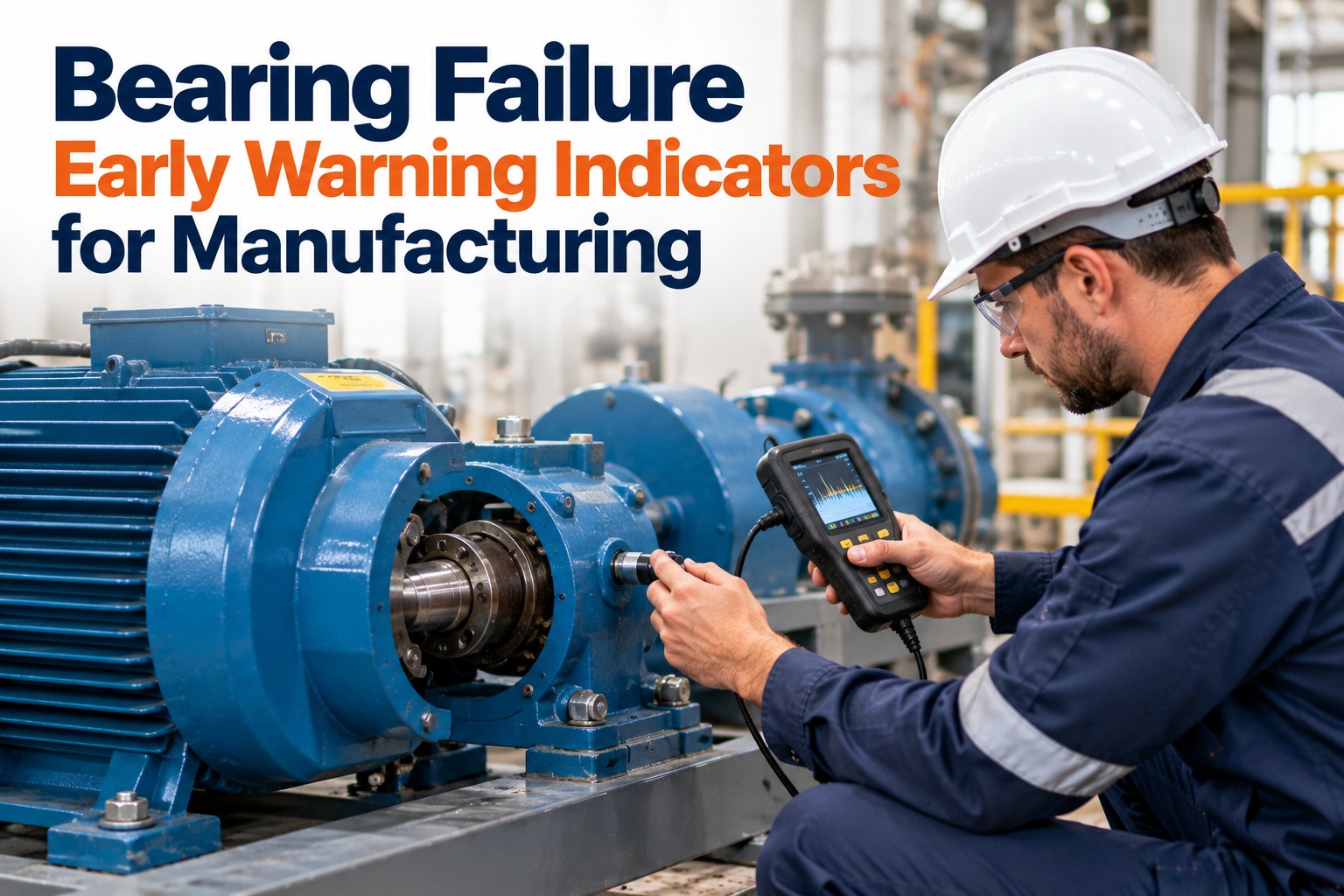
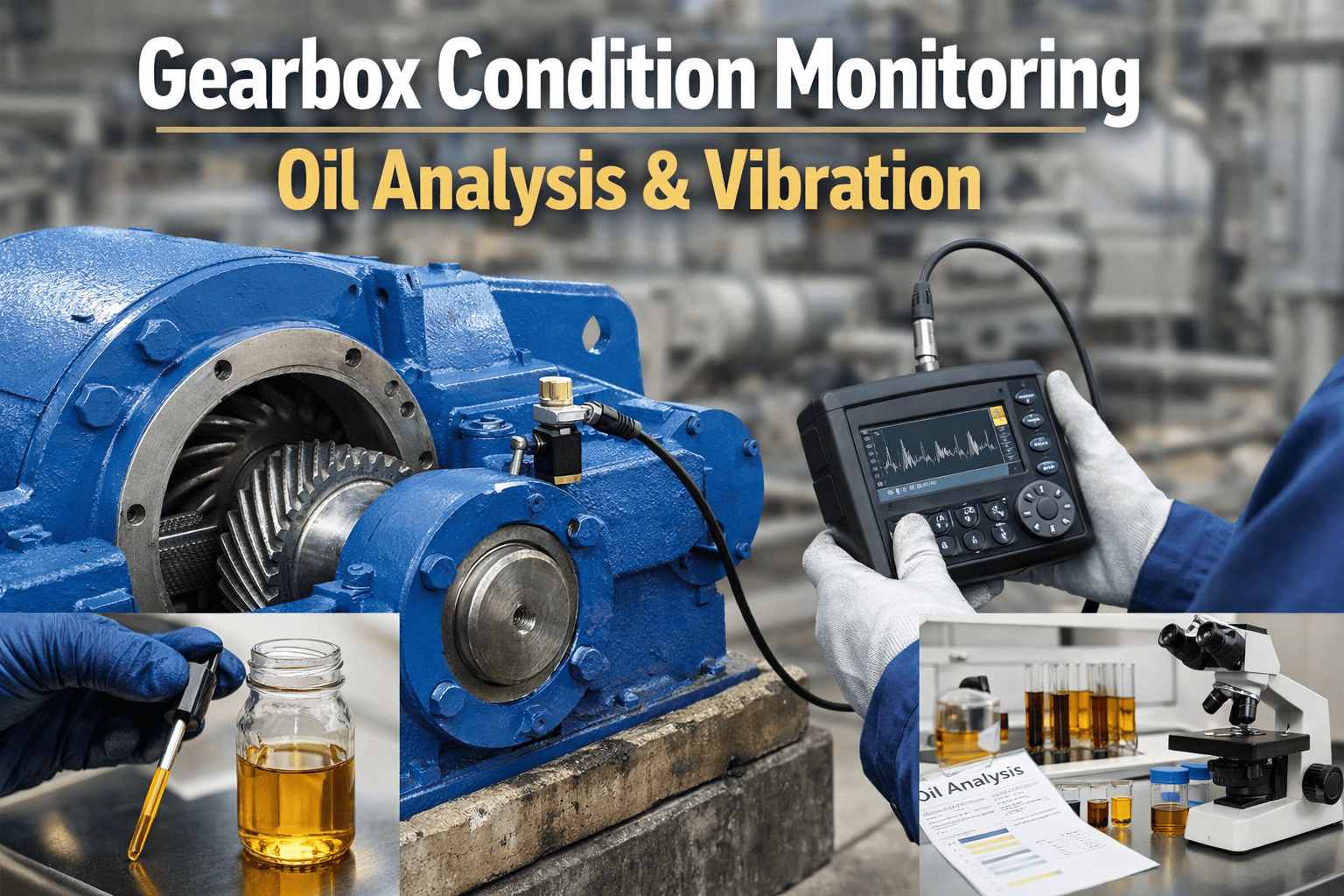
A bearing almost never fails without warning — it fails after weeks of signals nobody was listening for. Sub-surface fatigue starts far above the range a human ear or a basic sensor can catch, climbs through defect frequencies only a vibration analyzer sees, and only becomes an audible rumble or a hot housing in the final days. Catch it in the first stage and you plan a bearing change; catch it in the last and you clean up a wreck. This guide maps the early-warning indicators stage by stage, and how OXMAINT AI, the AI-powered CMMS, turns a threshold crossing into a work order before the bearing lets go.
Manufacturing · Rotating Equipment · Bearing Early-Warning · 2026
Bearing Failure Early Warning Indicators for Manufacturing
A seized bearing that took a motor, a pump or a gearbox with it — and weeks of warning signals nobody was watching. OXMAINT AI, the AI-powered CMMS and maintenance management software, watches the signals that matter in order: the ultrasonic whisper first, then the vibration defect frequencies, then heat — and raises a prioritized work order with the bearing's history and parts the moment a threshold is crossed.
1Ultrasonic
→
2Vibration
→
3Heat
→
4Work Order
REMAINING LIFE BY STAGE
Stage 1Ultrasonicweeks–months
Stage 2Vibrationweeks
Stage 3Noise & heatdays
Stage 4Catastrophicshut down now
4
stages from first signal to catastrophic failure
20–60 kHz
ultrasonic band where the first signal appears
2–8 wk
typical advance warning before collapse
48–96 hr
contamination failures — the monthly-check blind spot
The Four Stages, and What Each One Says
Bearing failure runs a predictable course, and each stage announces itself on a different physical signal — which is exactly why no single sensor catches it all. Watch the stages in order and the window to act shrinks the longer you wait. OXMAINT AI trends each signal against its threshold. Book a demo to see stage detection in OXMAINT AI.
1
Incipient — ultrasonic zone
weeks to months left
Sub-surface fatigue and micro-pitting begin. No audible noise, no vibration a standard sensor sees — the only trace is stress-wave energy in the 20,000–60,000 Hz band. Caught here, it's a planned bearing change.
Detect with: ultrasonic / acoustic emission
2
Micro-pitting — defect frequencies
weeks left
Defects start resonating at the bearing's natural frequencies, around 500–2,000 Hz, and the defect frequencies (BPFO, BPFI, BSF, FTF) appear in the vibration spectrum. Small pits are visible on the races under inspection.
Detect with: vibration accelerometer analysis
3
Visible damage — harmonics & heat
days left
Harmonics and sidebands stand out clearly in the vibration spectrum, the housing temperature climbs, and spalling or race damage is obvious on inspection. The window for a planned stop is closing fast.
Detect with: vibration + thermal confirmation
4
Catastrophic — noise-floor spike
shut down now
The high-frequency noise floor spikes as the bearing geometry disintegrates. Continued operation risks taking the whole machine — the motor, pump or gearbox around it — with the bearing.
Action: immediate shutdown
Reading the Vibration: What Each Defect Frequency Means
Stage 2 is where a vibration analyzer earns its keep — the FFT spectrum decomposes the signal and shows exactly which part of the bearing is degrading, and often why. Each defect frequency points to a component and a root cause. OXMAINT AI tracks them against ISO severity zones. Start free and decode defect frequencies in OXMAINT AI.
The trend matters more than the single reading: a velocity climbing steadily week over week signals more urgency than a higher number that's held stable for months. Severity is read against the ISO 10816 zones, where the move from zone B into zone C is the call to act.
The Signal Is There Weeks Early. Someone Has to Be Listening.
A bearing gives two to eight weeks of warning before it collapses — but only if the right signal is being watched at the right stage. OXMAINT AI trends ultrasonic, vibration and temperature data together and raises the work order the moment a threshold crosses, so the warning reaches a planner instead of dying in a log.
No Single Sensor Catches It All
Each stage lives on a different physical mechanism, so a real early-warning program layers the technologies rather than betting on one. OXMAINT AI brings the readings together against the asset. Book a demo to see the monitoring stack in OXMAINT AI.
Ultrasonic / acoustic emission
Catches the Stage 1 stress waves weeks to months out — the only method that sees incipient failure before anything else does.
Vibration analysis
Stage 2–3 workhorse — FFT decomposes the signal into defect frequencies, naming the component and the severity.
Temperature / thermography
A rising delta above ambient confirms friction, and often rises before vibration — an independent warning on a separate mechanism.
Motor current (MCSA / ESA)
Non-invasive detection for bearings that can't be reached with a sensor, reading the fault signature in the motor current.
From Threshold Crossing to Planned Repair
An indicator only matters if it becomes an action. OXMAINT AI closes the loop from the sensor reading to a technician holding a work order with everything attached. Start free and close the loop in OXMAINT AI.
1
Threshold crossed
A reading crosses its configured limit on ultrasonic, vibration or temperature.
→
2
Prioritized work order
A work order generates automatically, its priority set by the stage and severity.
→
3
History & parts attached
The bearing's full history, the right parts and technician instructions come with it.
→
4
Planned, not reactive
The change is scheduled into a window instead of becoming an unplanned breakdown.
Why OXMAINT AI for Bearing Early-Warning
Early warning only works when the readings, the thresholds and the response live in one place. OXMAINT AI ties the condition data to the asset and the work order. Book a demo to see it on your rotating equipment in OXMAINT AI.
◉
Multi-Signal Trending
Ultrasonic, vibration and temperature trended per bearing, so the earliest stage is caught on the signal that shows it first.
◉
Defect-Frequency Awareness
BPFO, BPFI, BSF and FTF tracked against ISO severity zones, so an alert names the component, not just a number.
◉
Trend-Based Alerts
Rate-of-change alerts catch a climbing reading early, instead of waiting for an absolute limit the day before failure.
◉
Auto Work Orders
A threshold crossing raises a prioritized work order with the bearing's history, parts and instructions pre-filled.
◉
Inaccessible-Bearing Coverage
Motor-current analysis reaches bearings a sensor can't, so nothing critical sits unmonitored.
◉
Full Bearing History
Every reading and change logged against the asset, so the next analyst sees the whole life of the bearing.
“
We ran monthly vibration routes and still lost bearings between checks — because the ones that killed us failed from contamination in a couple of days, long before the next route. Adding continuous trending with ultrasonic on the critical machines closed that gap: we started catching the incipient stage weeks out and the fast ones within hours, and the alert came in as a work order with the part already identified. The seized-bearing teardowns basically stopped.
Rotating Equipment Reliability Engineer · Manufacturing Plant
Frequently Asked Questions
What is the earliest sign of bearing failure?
Stress-wave energy in the ultrasonic band, roughly 20,000–60,000 Hz, from sub-surface fatigue and micro-pitting — well before any audible noise or standard vibration signal. It's only detectable with ultrasonic or acoustic-emission monitoring, and catching it here leaves weeks to months of runway.
Book a demo to see stage-1 detection in OXMAINT AI.
What do BPFO, BPFI, BSF and FTF tell you?
Each points to a part of the bearing: BPFO the outer race (overload, contamination), BPFI the inner race (misalignment, bending), BSF the rolling elements (over-lube, contamination), and FTF the cage (lubricant starvation) — FTF often appearing weeks before the others. A 1× running-speed peak points to shaft unbalance rather than the bearing.
How much warning does a bearing give?
Typically two to eight weeks before catastrophic collapse when monitored continuously — but contamination-driven failures can run their whole course in 48 to 96 hours, which is the blind spot that monthly inspection routes miss and continuous trending covers.
Does temperature alone give enough warning?
Not on its own — by the time heat rises significantly the bearing is often already in stage 3. But a temperature delta climbing faster than ambient is a valuable independent confirmation on a separate physical mechanism, so it's layered with ultrasonic and vibration rather than relied on alone.
How does the CMMS turn a reading into action?
When a reading crosses its configured threshold, OXMAINT AI generates a prioritized work order — priority set by stage and severity — attached to the bearing's full history, parts requirements and technician instructions, so the warning becomes a planned repair instead of a line in a log.
Start free and automate the response in OXMAINT AI.
Catch the Bearing Before It Catches the Machine.
Monitor bearing early-warning indicators with the OXMAINT AI maintenance management software — ultrasonic, vibration and temperature trended per bearing, defect frequencies read against ISO zones, and a prioritized work order the moment a threshold crosses. Turn weeks of warning into a planned change, not a catastrophic teardown.