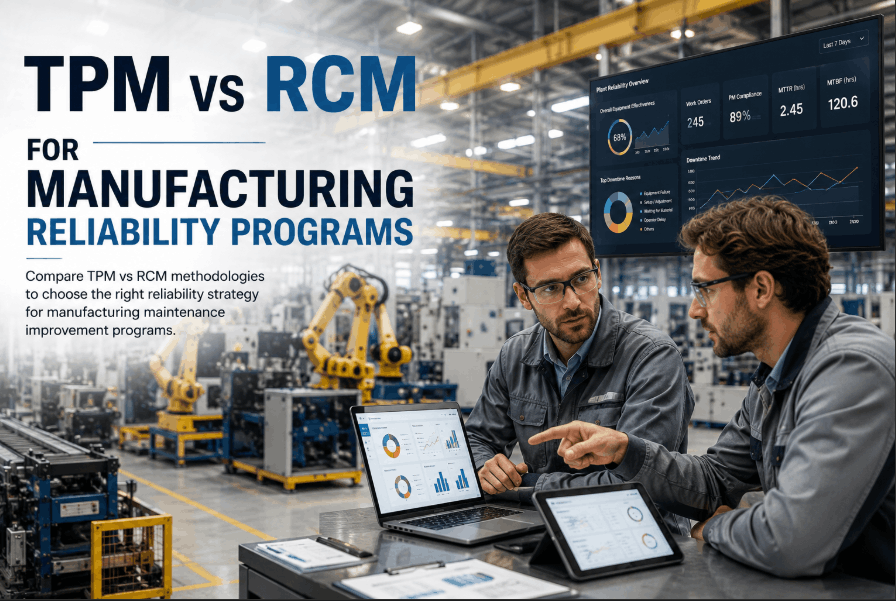
Manufacturing plants that ignore the choice between Total Productive Maintenance and Reliability Centered Maintenance end up applying the wrong strategy to every asset class — burning maintenance budget on over-maintained machines while chronically failing on critical ones. TPM and RCM are not competing philosophies; they are complementary frameworks that serve different purposes in a mature reliability program. Understanding when to apply each — and how a CMMS like OxMaint unifies both — is what separates reactive shops from plants that consistently hit availability targets. Sign Up Free to see how OxMaint's preventive maintenance and analytics modules support both TPM-style autonomous maintenance and RCM-driven task selection from a single platform. Whether your plant is introducing structured maintenance for the first time or optimizing an existing reliability program, the principles remain the same: match the maintenance strategy to the asset criticality, capture failure data systematically, and use that data to make smarter scheduling decisions. Book a Demo to explore how OxMaint's asset management and work order modules give your reliability engineers the data infrastructure both frameworks require.
Run TPM and RCM Programs From One Reliability Platform
Autonomous maintenance checklists. RCM failure mode libraries. AI-powered predictive alerts. All in OxMaint.
TPM vs RCM — Core Differences Manufacturing Teams Must Understand
Both frameworks target equipment reliability but approach it from opposite directions. TPM starts with operator involvement and waste elimination across all equipment. RCM starts with failure mode analysis on critical assets and works backward to justify each maintenance task. Knowing the distinction prevents misapplication — and wasted spend.
Origin
Lean manufacturing / Toyota Production System
Aviation safety analysis (SAE JA1011)
Primary Goal
Eliminate all losses; maximize OEE across every asset
Justify each maintenance task against failure consequence
Scope
All equipment; operator-led autonomous maintenance
Critical assets; engineering-led failure mode analysis
Maintenance Task Logic
Standardized PM schedules applied broadly
Each task justified by specific failure mode and consequence
Operator Role
Central — operators perform daily inspections and minor repairs
Secondary — reliability engineers drive the analysis
Key Metric
OEE (Availability × Performance × Quality)
MTBF, MTTR, failure mode recurrence rate
Implementation Speed
Faster — culture and process driven
Slower — detailed FMEA analysis required
Best Fit
High-volume discrete manufacturing, repetitive lines
Process industries, critical asset-heavy plants
The 8 Pillars of TPM and How OxMaint Supports Each One
TPM is structured around eight pillars that together eliminate the six big losses reducing OEE. Sign Up Free to see how OxMaint's work order, inspection, and OEE analytics modules operationalize every pillar without separate systems.
01
Autonomous Maintenance
Operators own daily inspections, cleaning, and lubrication. OxMaint's mobile checklist app delivers structured AM tasks to operators on the shop floor with photo evidence capture.
02
Planned Maintenance
Scheduled PM tasks aligned to manufacturer intervals and historical failure data. OxMaint auto-generates recurring work orders with parts lists and skill requirements attached.
03
Quality Maintenance
Links equipment condition to product defect rates. OxMaint's Statistical Quality Control module connects asset health data to quality rejection trends for root cause analysis.
04
Focused Improvement (Kaizen)
Systematic elimination of chronic losses. OxMaint's Pareto analytics surface top downtime contributors so improvement teams can prioritize the highest-impact kaizen events.
05
Early Equipment Management
Capturing maintenance requirements during equipment design and commissioning. OxMaint's asset hierarchy and document management store PM schedules and failure histories from day one.
06
Training and Education
Building operator and technician skill across maintenance tasks. OxMaint's team management module tracks technician certifications and assigns work orders matched to skill level.
07
Safety, Health, and Environment
Zero-accident maintenance environment. OxMaint's EHS management module embeds safety checklists and permit-to-work workflows directly inside work orders.
08
TPM in Administration
Extending loss elimination to support functions. OxMaint's shift logbook and automated reporting reduce manual overhead in planning, procurement, and operations reporting.
How RCM Analysis Works — The 7 Questions Every Reliability Engineer Asks
RCM is a structured methodology codified in SAE JA1011. It forces maintenance engineers to justify every task against the function, failure mode, and consequence of each asset. Book a Demo to see how OxMaint's asset performance management and failure tracking modules provide the data foundation RCM analysis requires.
Q1
What are the functions and performance standards of the asset?
Defines what the equipment must do in its operating context — primary functions, secondary functions, and acceptable performance thresholds.
Q2
In what ways can it fail to fulfill these functions?
Identifies functional failures — not component failures, but the specific ways the asset stops delivering its required performance.
Q3
What causes each functional failure?
Enumerates failure modes — bearing wear, seal degradation, corrosion, operator error — that produce each functional failure state.
Q4
What happens when each failure occurs?
Describes the failure effects — what the operator notices, what systems are impacted, and what production or safety consequence follows.
Q5
In what way does each failure matter?
Classifies consequences: safety, environmental, operational, or non-operational. Consequence category drives the maintenance task selection logic.
Q6
What can be done to predict or prevent each failure?
Selects proactive tasks — condition monitoring, scheduled restoration, scheduled discard — only where technically feasible and worth doing given the consequence.
Q7
What if no suitable proactive task can be found?
Determines default actions: redesign, run-to-failure (if consequence is non-critical), or one-time tasks to reduce risk to an acceptable level.
When to Use TPM, When to Use RCM, and When to Use Both
Most manufacturing plants benefit from applying both frameworks simultaneously — TPM broadly across all assets, RCM deeply on critical ones. The asset criticality ranking determines which approach takes priority for each machine. Book a Demo to see how OxMaint's asset criticality scoring and maintenance planning tools help reliability teams make this call systematically.
Use TPM When
- You operate high-volume repetitive manufacturing lines where operator involvement in basic care prevents the majority of stoppages
- OEE improvement is the primary business objective and you need a structured cultural framework, not just a task list
- Your maintenance team is under-resourced and autonomous maintenance by operators can extend technician capacity to complex work
- You are building a maintenance program from scratch and need a structured deployment roadmap across all eight pillars
- Equipment is largely similar in criticality and standard PM intervals are defensible across most of the asset base
Use RCM When
- You operate critical assets where failure has safety, environmental, or major production consequence that justifies deep analysis investment
- Existing PM schedules are not reducing failure rates and you need an evidence-based method to redesign task selection and frequencies
- You are in a regulated industry (aerospace, pharma, power generation) where maintenance task justification must be documented and auditable
- Your reliability team has identified chronic repeat failures that standard PM is not addressing and root cause work has stalled
- You need to optimize maintenance spend by eliminating tasks on non-critical assets while protecting coverage on high-consequence ones
KPIs That Measure TPM and RCM Program Effectiveness
| KPI |
Framework |
What It Measures |
OxMaint Module |
| OEE % |
TPM |
Combined availability, performance, and quality score per asset |
OEE Analytics |
| Autonomous Maintenance Compliance |
TPM |
% of daily AM tasks completed on schedule by operators |
Inspection Management |
| Planned vs. Unplanned Ratio |
Both |
Share of reactive vs. preventive maintenance activity |
Work Order Analytics |
| MTBF by Asset |
RCM |
Average operating hours between failure events per machine |
Asset Performance Management |
| MTTR by Failure Mode |
RCM |
Average repair duration segmented by failure category |
Work Order Management |
| Failure Mode Recurrence Rate |
RCM |
How often the same failure mode repeats on the same asset |
Analytics and Reporting |
| PM Task Completion Rate |
Both |
% of scheduled preventive tasks executed on time |
Preventive Maintenance |
| Maintenance Cost per Asset |
Both |
Total labor and parts spend per machine per period |
Analytics and Reporting |
How OxMaint Gives Manufacturing Teams the Infrastructure for Both TPM and RCM
Step 1
Build an Asset Hierarchy With Criticality Scores
OxMaint's enterprise asset management module structures every machine, line, and facility into a searchable hierarchy. Assign criticality ratings so the system routes RCM-level attention to high-consequence assets automatically.
Sign Up Free to start mapping your asset base today.
↓
Step 2
Deploy Autonomous Maintenance Checklists to Operators
OxMaint's mobile inspection app delivers daily AM checklists to operators via QR code scan — capturing lubrication, cleaning, and visual inspection records with photo evidence without a desktop or paper form.
↓
Step 3
Capture Failure Mode Data Through Structured Work Orders
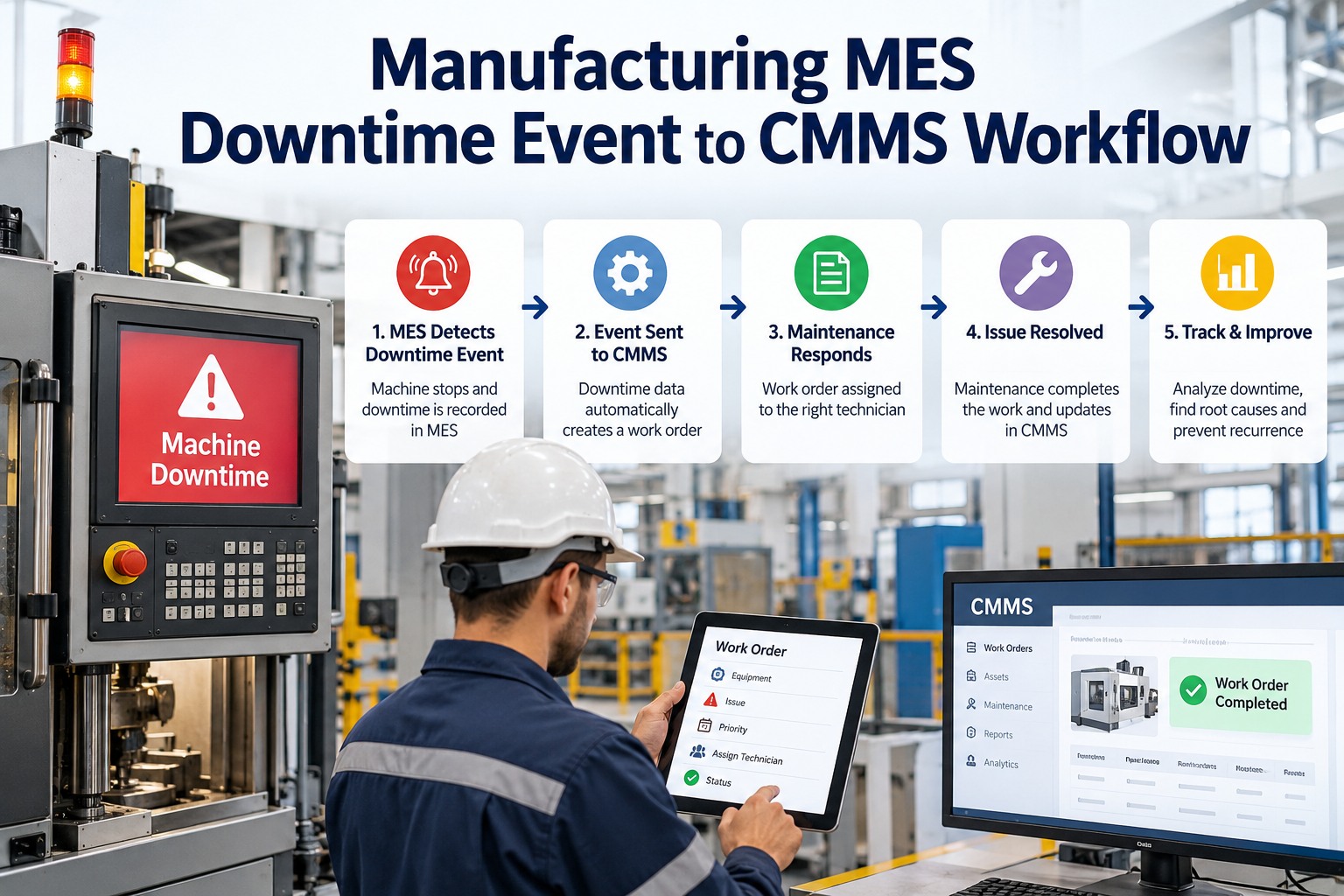
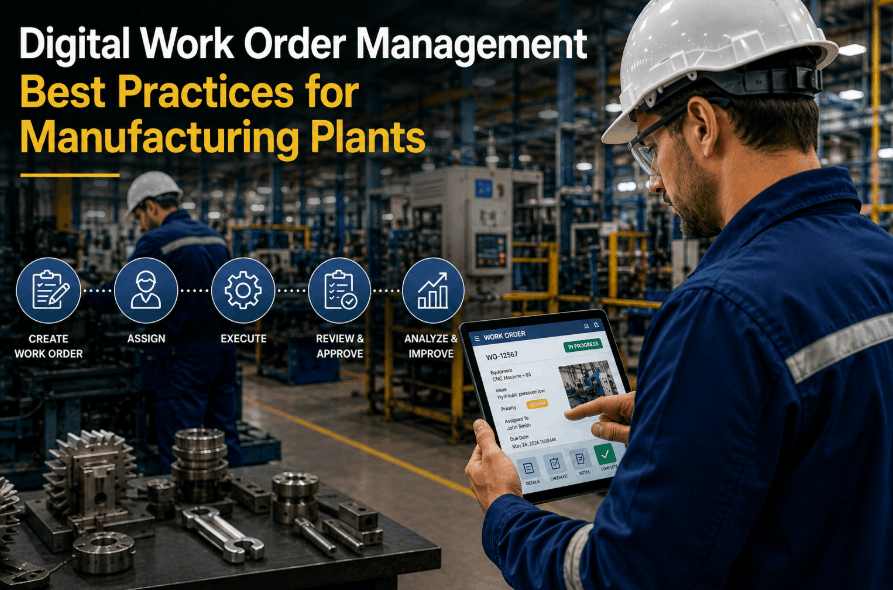
Every corrective work order in OxMaint requires a failure mode category, asset ID, and resolution method. This structured capture builds the failure history database that RCM analysis depends on — without requiring a separate FMEA tracking system.
↓
Step 4
Use Predictive Alerts to Surface Condition-Based Triggers
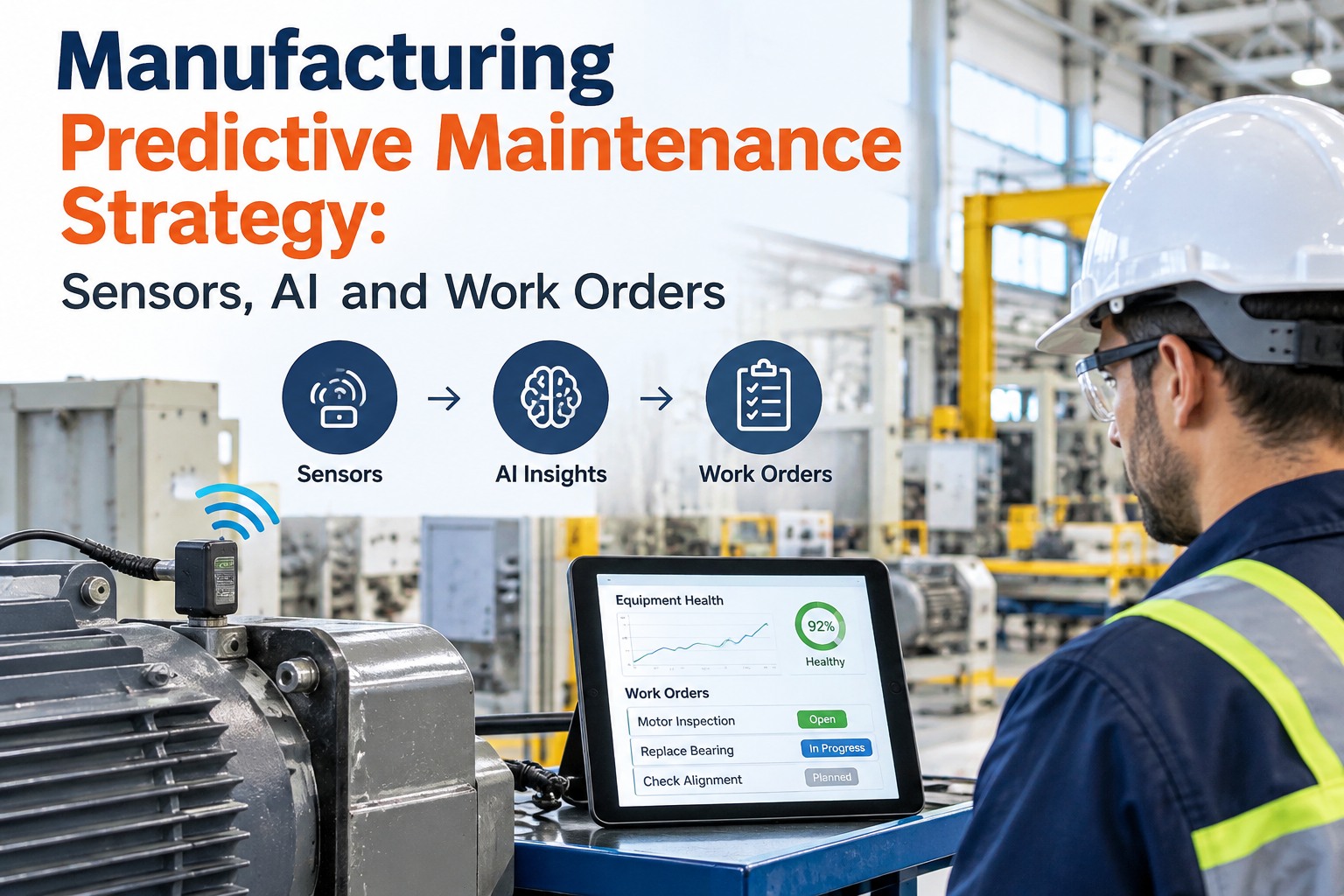
OxMaint's predictive maintenance module processes PLC sensor data and AI Vision camera feeds to generate early failure alerts — giving reliability engineers the condition monitoring capability that RCM tasks require without separate sensor software.
Book a Demo to configure predictive triggers for your critical assets.
↓
Step 5
Track OEE and MTBF Trends to Measure Program Performance
OxMaint's OEE Analytics and asset performance dashboards calculate availability, MTBF, MTTR, and planned vs. unplanned ratios automatically from captured work order and downtime data — giving both TPM and RCM programs a live performance signal.
One Platform for TPM Checklists, RCM Failure Tracking, and Predictive Maintenance
OxMaint connects autonomous maintenance, work order analytics, and AI-powered condition monitoring in a single reliability platform built for manufacturing plants.
TPM vs RCM — Frequently Asked Questions
What is the main difference between TPM and RCM in manufacturing?
TPM focuses on eliminating all losses across every asset through operator involvement and the eight-pillar framework. RCM focuses on justifying each maintenance task based on failure mode analysis and consequence classification for critical assets. Both improve reliability but from different starting points.
Can a manufacturing plant implement both TPM and RCM simultaneously?
Yes — most mature reliability programs use both. TPM is applied broadly across all equipment while RCM analysis is reserved for critical or high-consequence assets. OxMaint supports both frameworks from the same platform.
Which framework improves OEE faster — TPM or RCM?
TPM typically shows faster OEE gains because autonomous maintenance engages operators immediately and addresses the high-frequency minor stoppages that reduce performance and availability most. RCM delivers deeper gains on critical assets over a longer implementation horizon.
What data does RCM analysis require and how does a CMMS support it?
RCM requires failure mode history, mean time between failures, and failure consequence data by asset. A CMMS like OxMaint captures this data through structured work orders and asset performance tracking, giving reliability engineers the evidence base for FMEA without spreadsheet reconstruction.
How does OxMaint support TPM autonomous maintenance programs?
OxMaint delivers daily autonomous maintenance checklists to operators via mobile app and QR code, captures photo evidence, and tracks AM completion rates — giving maintenance planners visibility into whether operator-level care activities are being executed consistently across all shifts.
What KPIs should a manufacturing plant track for a TPM program?
The primary KPIs are OEE, autonomous maintenance task compliance rate, planned vs. unplanned maintenance ratio, and downtime by loss category. OxMaint calculates all of these automatically from work order and inspection data without manual report building.
Is RCM suitable for small manufacturing plants with limited reliability engineering resources?
Streamlined RCM (also called RCM2 or MSG-3 lite) is accessible for smaller teams by focusing analysis on the top 20% of assets by criticality. Starting with a CMMS that captures structured failure mode data from day one dramatically reduces the effort of formal RCM analysis later.
Give Your Reliability Program the Data Infrastructure It Needs
OxMaint delivers structured work orders, autonomous maintenance checklists, predictive alerts, and OEE dashboards — everything TPM and RCM programs require in one platform built for manufacturing.