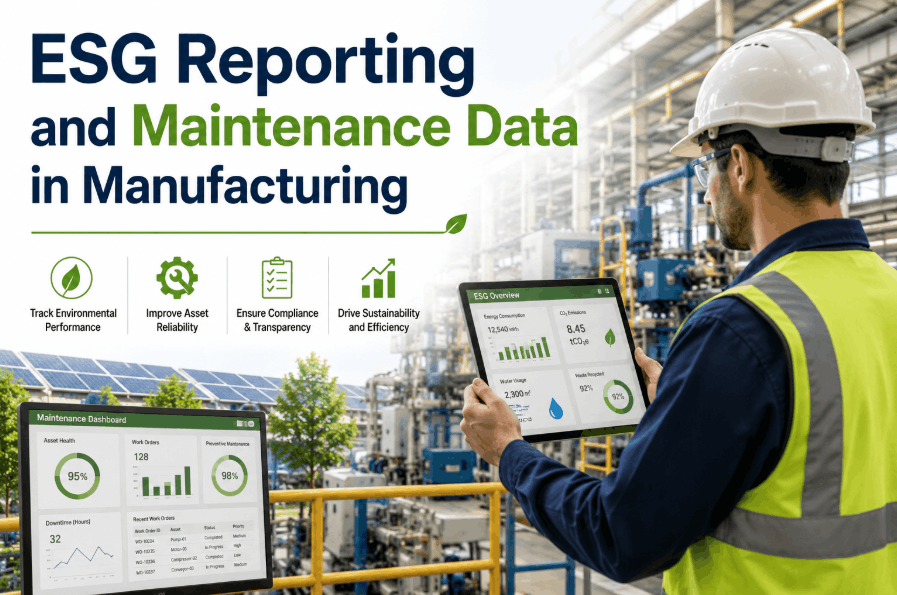
ESG reporting in manufacturing is no longer a compliance checkbox — it is a strategic performance discipline where maintenance data has become one of the most consequential and underutilized inputs. Energy consumption, equipment uptime, emissions-linked asset failures, and regulatory compliance records are all generated inside the maintenance function, yet most manufacturing plants report ESG metrics in complete isolation from their CMMS or work order systems. With Sign Up Free on Oxmaint, maintenance teams connect operational asset data directly to ESG reporting frameworks — turning work order records, energy consumption logs, and inspection compliance rates into structured sustainability evidence that satisfies investor, regulatory, and internal governance requirements. Book a Demo to see how Oxmaint structures maintenance data for ESG-aligned reporting across manufacturing facilities.
Why Maintenance Data Is the Missing Link in Manufacturing ESG Reporting
Manufacturing ESG frameworks — whether GRI, SASB, CDP, or TCFD-aligned — demand granular evidence: energy consumption by asset, water usage tied to operational events, emissions data traceable to specific equipment failures, and compliance inspection records with audit-ready timestamps. Finance and sustainability teams assembling these reports routinely find that the data either does not exist in a structured form or exists only inside spreadsheets and disconnected maintenance logs that cannot be validated. Sign Up Free to access Oxmaint's asset-level cost and performance tracking that generates the maintenance data backbone ESG reports depend on. The result of the current gap is qualitative ESG reporting that cannot withstand investor due diligence or regulatory scrutiny — a risk that is escalating as mandatory ESG disclosure requirements expand across jurisdictions.
Maintenance Data Categories That Feed Manufacturing ESG Reports
Understanding which maintenance data categories map to which ESG pillars is the first step toward building a coherent reporting structure. The table below links operational maintenance data generated inside Oxmaint to specific ESG reporting dimensions used by manufacturing sustainability teams. Book a Demo to see how Oxmaint captures and structures each of these data streams for your facility.
| ESG Pillar | Maintenance Data Input | ESG Metric Enabled | Reporting Framework | Oxmaint Data Source |
|---|---|---|---|---|
| Environmental (E) | Equipment energy consumption logs | Energy intensity per unit of output | GRI 302, CDP | Asset meter readings + work orders |
| Environmental (E) | Leak and spill inspection records | Environmental incident frequency rate | GRI 306, SASB | Inspection checklists + compliance log |
| Environmental (E) | PM completion rate by emissions-linked asset | Preventive maintenance compliance % | TCFD operational resilience | PM schedule compliance reports |
| Social (S) | Safety inspection completion records | Safety compliance rate, incident prevention | GRI 403, ISO 45001 | Inspection forms + work order closure |
| Governance (G) | Audit trails, work order approval records | Maintenance governance traceability | SOX, ISO 55001 | Work order audit log + approvals |
How to Build an ESG-Aligned Maintenance Data Program with Oxmaint
Tag Assets by ESG Relevance and Regulatory Category
ESG-linked maintenance reporting starts with asset classification. Oxmaint's asset management module supports custom attribute tagging — enabling maintenance teams to flag assets by emissions category, energy consumption tier, environmental hazard classification, and applicable regulatory standard. This tagging layer makes it possible to filter all work order activity, inspection records, and cost data by ESG-relevant asset groups at report generation time.
Configure Inspection Checklists for Environmental and Safety Compliance
Environmental compliance inspections — leak checks, emissions control verification, hazardous material handling audits — require structured digital records to support ESG disclosure. Oxmaint's inspection and checklist module allows maintenance teams to build custom inspection forms with mandatory fields, conditional logic, and photo capture, producing timestamped compliance records that are directly exportable for ESG audit packages without manual reconstruction.
Track Preventive Maintenance Compliance Rate as an ESG KPI
Preventive maintenance compliance rate is simultaneously a reliability metric and an ESG governance indicator — high PM compliance on emissions-linked or energy-intensive assets demonstrates systematic environmental risk management. Oxmaint's PM compliance dashboards track scheduled versus completed maintenance by asset, department, and time period, providing sustainability teams with the operational evidence base that qualitative ESG reporting cannot produce on its own.
Link Downtime Events to Environmental Impact Calculations
Unplanned equipment failures in process manufacturing generate disproportionate emissions spikes — flaring events, cooling system failures, and process upset conditions all have environmental consequences that structured downtime tracking can quantify. Oxmaint's downtime logging captures failure cause, duration, and affected assets, giving environmental managers the operational incident data needed to calculate emissions impact from unplanned stoppages and include it in TCFD-aligned climate risk disclosures.
Generate ESG-Ready Maintenance Reports for Disclosure Packages
Oxmaint's analytics and reporting module produces maintenance performance reports by asset group, department, time period, and failure category — structured for direct integration into ESG disclosure packages. PM compliance rates, inspection completion records, downtime frequency by asset class, and maintenance cost per unit of output are all exportable in formats compatible with sustainability reporting templates used by GRI, CDP, and CSRD-aligned frameworks.
ESG Maintenance KPIs Manufacturing Plants Should Track in Oxmaint
A defined set of maintenance KPIs tied to ESG outcomes gives sustainability teams the operational data they need for credible disclosure. Book a Demo to configure these KPIs inside Oxmaint for your manufacturing environment.
Tracks scheduled preventive maintenance completion on assets flagged as emissions-linked or environmentally regulated. Direct evidence of proactive environmental risk management for ESG disclosure.
Percentage of mandatory environmental inspections completed on schedule with signed-off digital records. Audit-ready timestamp trail eliminates manual reconstruction at ESG reporting time.
Unplanned failures on emissions-intensive or safety-critical assets represent both operational and ESG risk. Monthly trend tracking enables climate risk disclosure under TCFD operational resilience reporting.
Measures timely resolution of safety-flagged maintenance work orders. Feeds GRI 403 and ISO 45001 social pillar reporting with quantified evidence of workplace safety maintenance governance.
Normalized maintenance efficiency metric connecting operational cost control to resource intensity reporting. Improving trends demonstrate operational sustainability alongside financial performance to ESG investors.
Governance pillar KPI measuring whether all work orders carry complete approval, cost, and closure records. Directly supports ISO 55001 asset management governance and SOX compliance audit requirements.
ESG Reporting Gaps Maintenance Teams in Manufacturing Must Close
ESG Maintenance Reporting Across Manufacturing Industry Segments
ESG reporting requirements and the maintenance data most relevant to each disclosure framework vary meaningfully by manufacturing sector. Sign Up Free to configure Oxmaint's ESG-aligned reporting for your specific manufacturing environment.
- Emissions events linked to equipment failure require traceable downtime records
- Leak detection inspection compliance is a mandatory ESG evidence category
- Turnaround and shutdown planning data feeds climate risk disclosure models
- Condition monitoring integration reduces unplanned emissions-generating failures
- Water consumption per unit output requires equipment performance tracking data
- Food safety inspection compliance records support social pillar ESG disclosure
- Sanitation and hygiene work order completion rates evidence operational ESG governance
- Packaging line OEE links directly to material waste intensity reporting
- Asset-level energy consumption data is the primary ESG evidence category
- Equipment efficiency degradation tracking links maintenance to energy intensity trends
- Safety inspection records on high-hazard assets are core social pillar disclosures
- Predictive maintenance on energy-intensive assets generates measurable ESG ROI
- Validated maintenance records and equipment qualification data are governance ESG pillars
- Environmental monitoring system PM compliance feeds regulatory ESG submissions
- Work order audit trails with approval chains satisfy SOX governance disclosure requirements
- Calibration and inspection record completeness is a direct investor governance signal