
Smart factory maintenance in 2026 is defined by the convergence of AI-driven diagnostics, IoT sensor infrastructure, and cloud-based CMMS platforms that transform manufacturing maintenance from a cost center into a predictive reliability discipline. The gap between plants operating on disconnected spreadsheets and reactive call-outs and those running AI-assisted work order prioritization, condition-based monitoring, and digital inspection workflows is widening at a pace that will determine competitive manufacturing cost positions for the decade ahead. With Sign Up Free on Oxmaint, manufacturing maintenance teams access the connected CMMS infrastructure — predictive work order management, digital inspections, real-time KPI dashboards, and asset performance analytics — that underpins every smart factory maintenance trend reshaping industrial operations in 2026. Book a Demo to see how Oxmaint positions manufacturing plants to execute on the reliability technologies defining smart factory maintenance this year.
Why 2026 Is a Pivotal Year for Smart Factory Maintenance Technology
Three forces converging in 2026 are accelerating smart factory maintenance adoption at a pace that earlier years of connected maintenance investment did not produce. Industrial IoT sensor costs have dropped to the point where broad asset coverage is economically viable in mid-market manufacturing, not just capital-intensive process plants. AI-assisted maintenance recommendation engines embedded in CMMS platforms now require no data science expertise to operate — maintenance managers configure them, not IT departments. And labor shortages in skilled maintenance trades are forcing plants to extract more reliability value from the maintenance workforce they have through digital work management, guided inspections, and predictive scheduling. Sign Up Free to access the Oxmaint CMMS platform that integrates all three capability layers for manufacturing plants at any stage of smart factory transition.
Top Smart Factory Maintenance Trends Reshaping Manufacturing in 2026
AI-Assisted Predictive Maintenance Moves from Pilot to Production
In 2026, AI-assisted predictive maintenance transitions from proof-of-concept deployments in flagship plants to production-standard maintenance operations across multi-site manufacturing portfolios. Machine learning models trained on vibration, temperature, and operational data patterns now generate actionable failure predictions with enough accuracy and lead time to replace calendar-based PM intervals on rotating equipment, compressors, and high-value production line assets.
IIoT Sensor Integration Becomes Standard CMMS Infrastructure
Industrial IoT sensor integration with CMMS platforms is the foundational infrastructure shift defining smart factory maintenance in 2026. Real-time asset condition data — vibration signatures, motor current draw, bearing temperature trends, and pressure differentials — feeds directly into work order triggers and PM schedule adjustments without manual data transfer. CMMS platforms that accept IIoT data streams become the operational hub connecting physical asset condition to maintenance response workflows.
Mobile-First Digital Work Management Replaces Paper in the Field
Smart factory maintenance execution in 2026 is mobile-first — technicians receive, execute, and close work orders on handheld devices on the plant floor, with guided inspection steps, asset history, parts availability, and digital sign-off built into each work order. The operational data generated at the point of work — actual repair times, parts consumed, failure codes entered in real time — becomes the asset health dataset that trains predictive models and informs future PM scheduling decisions.
Condition-Based Maintenance Displaces Fixed-Interval PM Scheduling
Fixed-interval preventive maintenance schedules generate both over-maintenance waste and under-maintenance risk — replacing components that have useful life remaining and missing failures that develop between scheduled intervals. Condition-based maintenance triggered by actual asset health indicators rather than calendar elapsed time is the 2026 standard in smart manufacturing environments, reducing PM labor costs while improving failure prevention rates on the assets where it matters most.
Digital Twins Enable Maintenance Simulation Before Physical Intervention
Digital twin integration with maintenance management platforms reaches practical manufacturing adoption in 2026. Virtual asset models populated with real-time sensor data and historical maintenance records allow reliability engineers to simulate failure scenarios, test maintenance strategy changes, and evaluate component replacement timing decisions against operational data before committing physical maintenance resources — compressing the reliability improvement cycle from years to weeks.
Automated Work Order Generation from Condition Triggers
Smart factory CMMS platforms in 2026 generate work orders automatically when sensor readings or AI model outputs cross defined thresholds — eliminating the human observation gap between asset condition deterioration and maintenance response initiation. Automated work order creation with priority classification, parts pre-staging recommendations, and technician assignment logic compresses mean time to repair on condition-triggered failures from days to hours in well-configured manufacturing environments.
Maintenance Analytics and KPI Dashboards Drive Operational Decisions
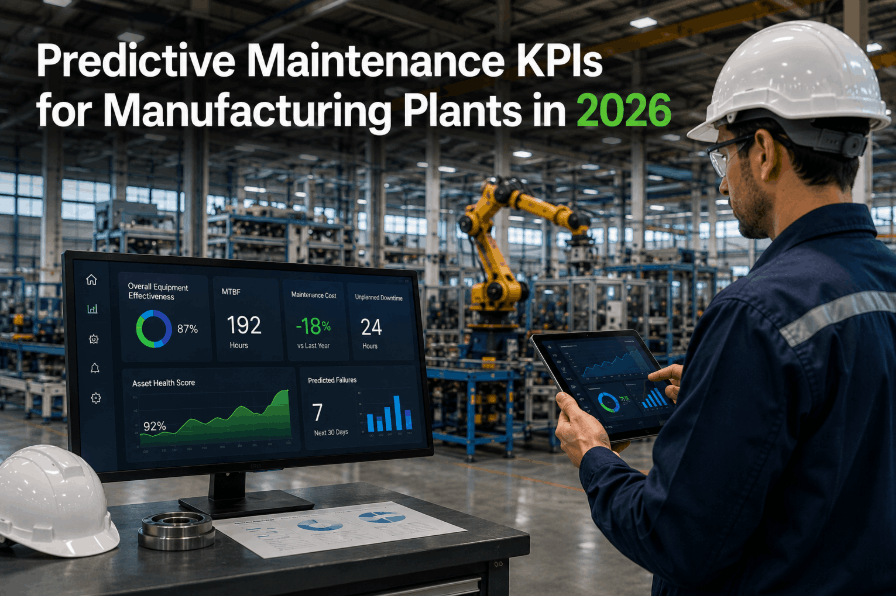
Real-time maintenance analytics dashboards tracking MTTR, MTBF, PM compliance, planned versus reactive spend ratios, and asset cost concentration become standard management tools in smart manufacturing plants. The shift from periodic maintenance reporting to continuous KPI monitoring gives plant directors and reliability engineers the operational visibility to make proactive maintenance program adjustments — before cost deviations become budget overruns or downtime events become production crises.
Autonomous Inspection Technology Expands Asset Coverage
Drone-based thermal inspection, autonomous robot patrols in hazardous areas, and AI-powered visual defect detection are extending condition monitoring coverage to assets that human inspection programs cannot cost-effectively reach at required frequencies. Smart factory maintenance programs integrate autonomous inspection data with CMMS records — creating a continuous asset health picture that scheduled human inspection alone cannot maintain at the frequency that reliability programs require.
Smart Factory Maintenance Maturity: Where Does Your Plant Stand in 2026?
Manufacturing plants entering 2026 occupy four distinct maturity positions in the smart factory maintenance transition. Understanding current maturity level defines the highest-leverage technology investment for each facility. Book a Demo to assess your plant's maintenance maturity and identify the Oxmaint capabilities that will generate the fastest reliability improvement in your environment.
- Maintenance triggered by failure or operator complaint
- Work orders on paper or spreadsheets with no digital history
- No PM program or calendar-only scheduling with low compliance
- Immediate priority: CMMS implementation, work order digitization
- CMMS deployed with work order and PM schedule management
- Asset registry established with basic cost tracking
- PM compliance above 70% with digital inspection records
- Next step: mobile technician workflows, KPI dashboard activation
- Maintenance KPIs tracked in real time with benchmark comparison
- Pareto cost analysis driving PM investment prioritization
- Work order data used for failure pattern analysis and schedule optimization
- Next step: IIoT condition monitoring integration on critical assets
- Condition monitoring data triggering automated work order generation
- AI-assisted failure prediction on high-criticality rotating equipment
- Digital twin simulation informing maintenance strategy decisions
- Next step: autonomous inspection integration and enterprise reliability modeling
How Oxmaint Supports Smart Factory Maintenance in 2026
Connected Asset Management Foundation
Smart factory maintenance capability builds on a complete, current asset registry. Oxmaint's asset management module captures full lifecycle data — installation date, replacement value, maintenance history, failure codes, and condition attributes — providing the structured asset data foundation that IIoT sensor integration, predictive analytics, and digital twin applications require. Without this foundation, smart factory maintenance technology investments fail to reach their reliability potential.
Mobile-First Work Order Management for Technician Productivity
Oxmaint's mobile work order management gives manufacturing technicians a guided digital workflow on the plant floor — receiving work assignments, accessing asset history and technical documentation, recording parts usage and labor time, and closing work orders with digital sign-off in a single mobile interface. Real-time work order data capture at the point of work generates the operational history dataset that drives maintenance analytics and informs PM schedule optimization decisions.
Digital Inspection and Compliance Checklist Management
Oxmaint's inspection module allows manufacturing maintenance teams to build custom digital inspection forms with conditional logic, mandatory fields, and photo documentation — executed on mobile devices with timestamped completion records. Inspection compliance dashboards track completion rates by asset, department, and time period, providing the regulatory compliance evidence and condition data input that smart factory maintenance programs require for both reliability management and ESG reporting.
Predictive PM Scheduling and Condition-Based Trigger Configuration
Oxmaint supports condition-based PM scheduling triggered by meter readings, runtime hours, and sensor threshold crossings — moving maintenance scheduling beyond fixed calendar intervals toward the asset health-driven approach that defines smart factory maintenance. Predictive scheduling reduces over-maintenance waste on healthy assets while ensuring failure prevention work reaches assets showing early deterioration indicators before failures develop to production-impacting severity.
Real-Time Maintenance Analytics and Benchmarking Dashboards
Oxmaint's analytics module delivers live KPI dashboards tracking the full smart factory maintenance performance set — MTTR, MTBF, PM compliance rate, planned versus reactive spend ratio, asset cost concentration, and emergency repair frequency — updating with every closed work order. Plant directors and reliability engineers access continuous operational visibility that enables proactive maintenance program management rather than reactive response to budget variances and production disruptions.
Smart Factory Maintenance Technology Comparison: 2024 vs 2026
The pace of change in smart factory maintenance technology between 2024 and 2026 is most visible in capability democratization — technologies previously accessible only to the largest industrial manufacturers now reach mid-market plants through cloud CMMS platforms and affordable IIoT hardware. Sign Up Free to access the 2026-generation maintenance capabilities Oxmaint delivers for manufacturing plants at any production scale.
| Capability | 2024 Status | 2026 Status | Oxmaint Support |
|---|---|---|---|
| AI failure prediction | Pilot programs in large plants | Production deployment in mid-market | Predictive PM trigger configuration |
| IIoT condition monitoring | Process-intensive sectors only | Cross-sector mainstream adoption | Sensor-triggered work order automation |
| Mobile work management | Early adoption phase | Standard maintenance execution mode | Full mobile work order and inspection app |
| Condition-based PM scheduling | Limited to critical assets | Broad asset coverage standard | Meter and runtime-based PM triggers |
| Real-time maintenance analytics | Custom BI build required | Pre-configured CMMS dashboards | Live KPI and benchmarking dashboards |
| Digital inspection records | Mixed paper and digital | Fully digital with audit trails | Custom checklists with photo capture |


.png)

.png)