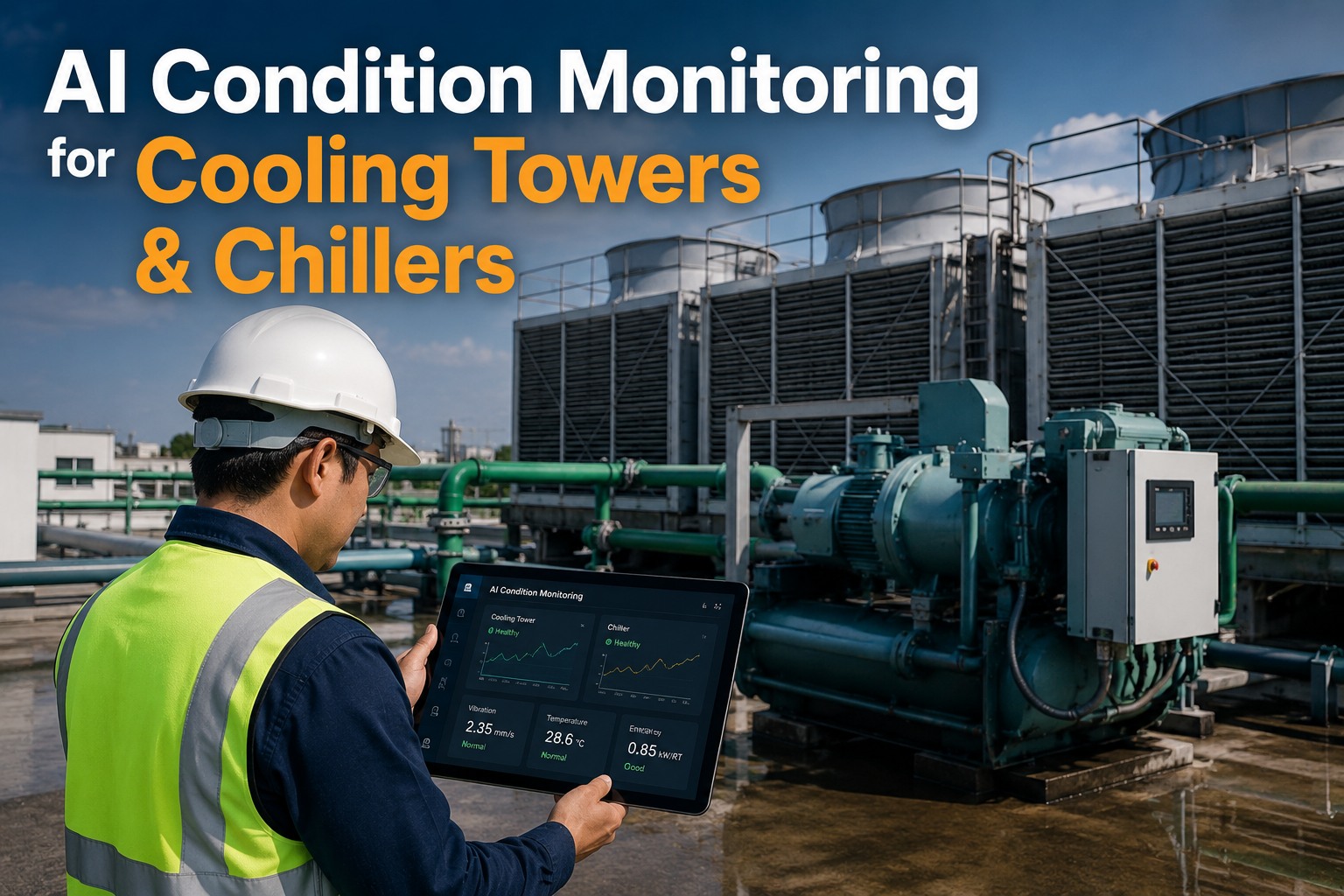
Industrial chillers are the silent workhorses of manufacturing cooling — and when a chiller fails mid-shift, the cascade is immediate: process temperatures spike, product quality drops, and production lines halt while emergency crews scramble for parts that take days to arrive. Chiller predictive maintenance using compressor vibration analysis, refrigerant circuit monitoring, and condenser performance tracking gives facilities teams 2–6 weeks of advance warning before compressor failure, refrigerant leaks, or heat exchanger fouling costs them a production run. This guide covers the critical monitoring parameters, fault signatures, and implementation steps for manufacturing cooling reliability.
85%
of chiller failures show detectable warning signs before breakdown
$80K–$500K
total cost of unplanned chiller failure including production loss
15–30%
energy waste from fouled condensers and degraded refrigerant charge
2–6 wks
advance warning window with continuous compressor monitoring
Why Chillers Fail in Manufacturing: The Four Root Causes
Manufacturing chillers operate under more demanding conditions than commercial HVAC — higher ambient temperatures, variable process loads, continuous duty cycles, and aggressive chemical environments. These conditions accelerate four specific failure pathways that account for the vast majority of unplanned downtime.
Bearing wear, valve plate fatigue, and motor winding degradation. The highest-cost single failure — compressor replacement runs $15,000–$80,000 and lead times of 6–12 weeks make reactive repair catastrophic for production schedules.
Vibration signature shift
Current draw rise
Discharge temp trend
Refrigerant Circuit Issues
Refrigerant leaks, moisture contamination, oil carryover, and non-condensable gas accumulation. Refrigerant issues reduce capacity, increase compressor load, and — if undetected — cause compressor failure through liquid slugging or acid formation.
Suction/discharge pressure ratio
Superheat deviation
Subcooling change
Scale buildup, biological growth, and debris accumulation on condenser tubes or air-cooled coils. Each 1mm of scale reduces heat transfer efficiency by 7–10%, forcing the compressor to work harder and increasing discharge pressure toward trip limits.
Condensing temp rise
Approach temperature
Compressor kW/ton trend
Chilled Water System Faults
Evaporator fouling, pump cavitation, flow control valve failure, and glycol concentration drift. These faults manifest as process temperature instability and chiller short-cycling — both of which accelerate compressor wear and reduce production yield.
Evaporator approach temp
Delta-T across evaporator
Flow rate trend
The Critical Monitoring Parameters: What to Track and Why
Compressor Health Monitoring
Primary fault source — highest consequence failure
Vibration (bearing housing)
Detect bearing wear, imbalance, and valve plate defects. ISO 10816 Class III limits apply. Rising high-frequency components (4–10 kHz) indicate early bearing race fatigue 4–8 weeks before failure.
Continuous
Motor current signature
MCSA detects winding faults, rotor bar defects, and mechanical load anomalies through the current waveform — no physical contact required. Current rising above 5% of baseline at constant load signals developing compressor fault.
Continuous
Discharge temperature
Compressor discharge temperature above 120°C indicates poor lubrication, refrigerant overcharge, or valve leakage. A rising trend of 2–3°C per week at constant load conditions is an early-warning flag for valve plate wear.
Every 5 min
Oil pressure differential
Oil pressure below 50 kPa differential trips the compressor on safety — but trending toward low-side over weeks reveals bearing clearance growth or oil pump wear long before the safety activates.
Every 5 min
Refrigerant Circuit Analytics
Silent efficiency killers — invisible without instrumentation
Suction / discharge pressure ratio
The compression ratio is the fundamental refrigerant circuit health indicator. Deviation from baseline at the same operating conditions signals refrigerant charge loss, non-condensable gas, or valve leakage — all causing compressor overwork.
Continuous
Superheat at compressor inlet
Low superheat risks liquid refrigerant entering the compressor — the primary cause of liquid slugging failure. Target 5–10°C superheat. Below 3°C is an immediate risk condition. Above 20°C indicates low refrigerant charge or TXV fault.
Continuous
Subcooling at condenser outlet
Subcooling below 2°C indicates refrigerant undercharge or flash gas in the liquid line — both reduce capacity and efficiency. Rising subcooling above 10°C suggests condenser fouling or non-condensable gas accumulation.
Every 15 min
Alert Threshold Reference
Compressor vibration
OK <4.5 mm/s
Warn 4.5–7.1
Act >7.1
Discharge temp (°C)
OK <100°C
Warn 100–115
Act >115
Superheat (°C)
OK 5–10°C
Warn 3–5 / 10–20
Act <3 / >20
Approach temp (°C)
OK <3°C
Warn 3–6°C
Act >6°C
kW/ton efficiency
OK <+5%
Warn +5–15%
Act >+15%
Motor current drift
OK <±3%
Warn ±3–7%
Act >±7%
Efficiency Impact of Deferred Maintenance
1mm condenser scale
+7–10% energy use
10% refrigerant undercharge
+20% compressor load
5°C condenser approach rise
+15% kW/ton
Dirty evaporator coil
+12% capacity loss
Non-condensable gas (1%)
+3% head pressure rise
Connect Chiller Sensor Alerts to Maintenance Work Orders Automatically
Oxmaint integrates with chiller BAS/BMS systems and standalone sensors to auto-generate work orders the moment performance thresholds are breached — with fault context, asset history, and parts recommendations included.
Fault Progression Timeline: From First Signal to Failure
Stage 1
6–10 weeks out
AI detectable only
High-frequency vibration sideband emergence (<5% above baseline)
Approach temperature creep of 0.5–1°C per week
kW/ton efficiency beginning to drift (+3–5%)
Plan maintenance window
Stage 2
3–6 weeks out
Sensor alerts trigger
Overall vibration crossing warning threshold
Discharge temperature trending up 3–5°C
Motor current drift exceeding ±5% at constant load
Expedite maintenance
Stage 3
Days to 2 weeks
Visible symptoms
Audible bearing noise, abnormal compressor tone
High-pressure / low-pressure trips occurring
Chilled water temperature setpoint no longer maintained
Emergency maintenance
Stage 4
Hours
Shutdown
Compressor seizure or motor burnout
Catastrophic refrigerant release
Production process temperature out of control
Full replacement + RCA
Common Chiller Faults and Their Predictive Signatures
| Fault |
Primary Signal |
Secondary Signal |
Detection Window |
Reactive Repair Cost |
| Compressor bearing failure |
Vibration HF rise + bearing temp |
Motor current increase |
4–8 weeks |
$25,000–$80,000 |
| Refrigerant leak |
Suction pressure drop + superheat rise |
Capacity degradation |
1–4 weeks |
$5,000–$30,000 |
| Condenser tube fouling |
Approach temp rise + head pressure |
kW/ton efficiency loss |
Weeks to months |
$3,000–$15,000 |
| Liquid slugging risk |
Superheat below 3°C |
Suction line frosting |
Hours to days |
$20,000–$100,000 |
| Non-condensable gas |
High head pressure at low load |
Condenser approach anomaly |
Detectable immediately |
$2,000–$8,000 |
| Evaporator fouling |
Evaporator approach temp rise |
Chilled water delta-T drop |
Weeks to months |
$4,000–$20,000 |
| Oil system degradation |
Oil pressure differential drop |
Discharge temp rise |
2–5 weeks |
$8,000–$40,000 |
Frequently Asked Questions
Your Chillers Are Running Right Now — Do You Know Their Condition?
Oxmaint gives your maintenance team real-time chiller health visibility, automatic fault detection, and condition-based work order creation — all in one platform built for manufacturing reliability. Start with your most critical process cooling assets and expand from there.