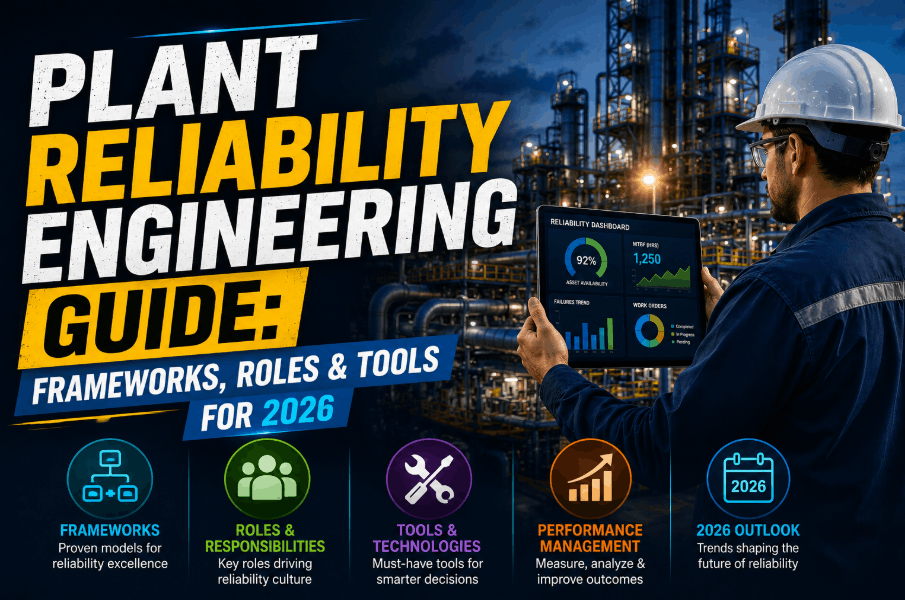
Plant Reliability Engineering Guide: Frameworks, Roles & Tools for 2026

By Josh Turly on May 18, 2026

plant-reliability-engineering-guide-frameworks,-roles-&-tools-for-2026

Plant reliability engineering has become one of the most strategically critical disciplines in modern manufacturing — yet most facilities still manage reliability reactively, responding to failures rather than preventing them. A mature plant reliability program integrates failure analysis frameworks, condition monitoring, reliability-centered maintenance (RCM), and digital CMMS tools to systematically reduce unplanned downtime, extend asset life, and control maintenance costs. This guide covers the complete reliability engineering landscape for 2026: roles, frameworks, performance benchmarks, failure analysis tools, and how platforms like OxMaint help reliability engineers operationalize data-driven maintenance programs. Whether you're building a reliability function from scratch or optimizing an existing program, Book a Demo to see how CMMS-integrated reliability tools accelerate results.

Start Building a Smarter Reliability Program Today

OxMaint gives reliability engineers the tools to track asset health, manage work orders, and reduce unplanned downtime — all in one platform.

What Is Plant Reliability Engineering?

Plant reliability engineering is the discipline of designing, measuring, and improving the probability that manufacturing assets perform their required functions without failure — under defined conditions, for defined time periods. It sits at the intersection of mechanical engineering, data analysis, and maintenance strategy, and is distinct from traditional maintenance management in one key way: reliability engineering is proactive and predictive, not reactive. Reliability engineers use Sign Up Free to access tools that quantify failure risk, identify root causes, and drive systemic asset improvement rather than firefighting breakdowns.

Reliability vs Maintenance
Maintenance fixes failures. Reliability engineering prevents them by analyzing failure modes, applying predictive strategies, and designing maintenance programs that match asset criticality to intervention frequency.
Core Engineering Focus
FMEA, RCM, failure data analysis, MTBF/MTTR tracking, condition-based monitoring, and PM optimization — all aimed at extending mean time between failures and reducing mean time to repair.
Business Outcome
World-class reliability programs achieve OEE above 85%, reactive work ratios below 20%, and maintenance cost as a percentage of replacement asset value (RAV) below 2.5%.
Digital Enablement
Modern reliability programs depend on CMMS platforms that capture failure history, automate PM scheduling, track KPIs, and feed condition data into predictive models — replacing spreadsheet-based tracking.

Reliability Engineering Frameworks — RCM, TPM, and CBM Compared

Three frameworks dominate industrial reliability programs in 2026. Each has a distinct methodology, entry point, and operational requirement. Most mature programs combine elements of all three, selecting the appropriate strategy for each asset class based on criticality, failure consequence, and monitoring feasibility.

Framework Core Methodology Best For CMMS Dependency Implementation Lead Time
Reliability-Centered Maintenance (RCM) Structured failure mode analysis to select optimal maintenance task for each failure mode by consequence and probability Critical rotating equipment, complex systems with multiple failure modes High — requires failure history and task tracking 3–9 months per asset class
Total Productive Maintenance (TPM) Operator-led autonomous maintenance combined with planned maintenance to eliminate all losses: breakdowns, minor stops, speed loss, defects High-volume production lines, process manufacturing, food & beverage Medium — OEE tracking and PM scheduling critical 6–18 months for full deployment
Condition-Based Monitoring (CBM) Real-time or periodic sensor data (vibration, temperature, oil analysis) used to trigger maintenance only when asset condition warrants intervention Rotating equipment, HVAC, pumps, motors with measurable degradation signals High — sensor integration and anomaly detection essential 30–90 days per asset group
Preventive Maintenance Optimization (PMO) Review of existing PM tasks to eliminate over-maintenance, adjust intervals based on actual failure data, and shift tasks to CBM where condition monitoring is available Facilities with established PM programs seeking cost reduction Medium — failure history analysis required 2–4 months

The Reliability Engineer Role — Responsibilities and Skills in 2026

01
Failure Mode and Effects Analysis (FMEA)

Lead cross-functional FMEA workshops to identify failure modes, assess severity and occurrence, and define detection controls. Output drives PM task selection and spare parts stocking decisions.

02
Asset Criticality Ranking

Classify all plant assets by consequence of failure — safety, production impact, repair cost, redundancy — to allocate monitoring intensity and maintenance investment proportionally to business risk.

03
KPI Ownership and Reporting

Own and report MTBF, MTTR, OEE, planned maintenance compliance, reactive work ratio, and maintenance cost/RAV monthly. Drive improvement targets aligned to plant production goals and Book a Demo to see how OxMaint automates KPI dashboards.

04
Root Cause Analysis (RCA)

Lead RCA investigations on repeat failures and high-consequence events. Apply 5-Why, fishbone, or fault tree methods. Document findings and drive corrective actions through CMMS work orders.

05
PM Program Development

Build, review, and optimize preventive maintenance task libraries. Ensure PM intervals are based on failure data, not manufacturer defaults. Reduce over-maintenance on low-criticality assets.

06
Condition Monitoring Program

Define vibration, thermography, oil analysis, and ultrasound routes for critical assets. Integrate sensor data into CMMS to trigger condition-based work orders automatically and Sign Up Free to connect your first data source.

Plant Reliability Performance Benchmarks — 2026 Industry Standards

85%+
Overall Equipment Effectiveness (OEE)
World-class threshold for discrete manufacturing
<20%
Reactive Work Order Ratio
Below 20% signals mature proactive maintenance program
<2.5%
Maintenance Cost / RAV
Replacement Asset Value benchmark for world-class facilities
90%+
PM Schedule Compliance
Percentage of planned tasks completed on schedule
3–5×
MTBF Improvement Target
Achievable over 24–36 months with structured RCM program
28%
Maintenance Cost Reduction
Average reduction achieved with AI-assisted predictive maintenance

Failure Analysis Tools Every Reliability Engineer Uses

FMEA
Failure Mode and Effects Analysis — maps failure modes to consequences and controls. Foundation of RCM task selection.
Fault Tree Analysis
Top-down deductive method. Identifies all paths that lead to a defined failure event. Used for safety-critical systems and complex interdependencies.
5-Why / Fishbone
Rapid RCA tools for repeat failures and operational incidents. Structured investigation leading to corrective action with CMMS documentation.
Weibull Analysis
Statistical failure distribution modeling. Defines optimal PM intervals and identifies infant mortality, random, or wear-out failure patterns from historical data.
Vibration Analysis / FFT
Accelerometer-based frequency spectrum analysis for rotating equipment. Identifies bearing wear, imbalance, misalignment, and looseness weeks before failure.
Oil Analysis
Particle count, viscosity, and contamination testing. Detects internal wear in gearboxes, compressors, and hydraulic systems. Extends oil change intervals to condition-based schedule.

How OxMaint Supports Plant Reliability Programs

A reliability program is only as strong as its data infrastructure. OxMaint provides reliability engineers with a CMMS built specifically for industrial maintenance operations — combining asset management, predictive maintenance AI, work order automation, inspection checklists, and real-time KPI dashboards. Reliability engineers at manufacturing facilities Sign Up Free to connect their first asset group and begin capturing failure history from day one. Book a Demo to see how OxMaint maps to your plant's asset hierarchy and maintenance workflow.

Asset Hierarchy and Criticality Tagging
Build a complete plant asset register with parent-child hierarchy, location mapping, criticality classification, and maintenance cost tracking — replacing disconnected spreadsheets.
PM Schedule and Compliance Tracking
Define PM tasks by asset, set frequency rules (time, runtime, meter), and track compliance automatically. Compliance reports surface over- and under-maintained assets immediately.
Predictive Maintenance AI Integration
Connect BMS sensor streams and equipment data to OxMaint's AI anomaly detection layer. Confirmed anomalies auto-generate CMMS work orders at the optimal intervention window — 2 to 8 weeks before failure.
Work Order and RCA Documentation
Capture failure codes, root cause classifications, parts used, and technician time on every corrective work order. MTBF and MTTR calculations update automatically from closed work order data.
Inspection and Compliance Checklists
Deploy mobile-ready inspection checklists for operator rounds, safety checks, and regulatory compliance audits. Results feed back into asset health records and PM adjustment logic.
Reliability KPI Dashboard
Live dashboards for MTBF, MTTR, OEE, reactive ratio, PM compliance, and maintenance cost/RAV — giving reliability engineers the reporting infrastructure to present program performance to plant leadership.

Reactive vs Proactive Reliability — Program Maturity Comparison

Reactive / Low-Maturity Program
Maintenance triggered by failures only
No asset criticality ranking — all assets treated equally
PM intervals set by OEM defaults, never reviewed
Failure history in technician memory, not CMMS
Reactive work ratio above 50%
KPIs tracked quarterly in spreadsheets, if at all
Proactive / World-Class Reliability Program
Maintenance driven by condition data and RCM analysis
Asset criticality matrix drives monitoring and PM intensity
PM intervals optimized from Weibull and failure history
Every failure captured in CMMS with RCA documentation
Reactive work ratio below 20% (world-class: below 10%)
Real-time KPI dashboards updated from CMMS work order data

Operationalize Your Reliability Program with OxMaint

From asset hierarchy to predictive AI — OxMaint gives reliability engineers the CMMS infrastructure to track failure history, automate PM scheduling, and measure program performance in real time.

Frequently Asked Questions — Plant Reliability Engineering

What is the difference between reliability engineering and maintenance management?
Maintenance management executes work — scheduling PMs, dispatching technicians, managing parts. Reliability engineering analyzes why failures occur and designs maintenance strategies to prevent them. Both functions are required; reliability engineering sets the strategy that maintenance management executes.
What CMMS features does a reliability engineer need?
Reliability engineers require failure history capture, root cause coding, MTBF/MTTR calculation, PM compliance tracking, asset criticality tagging, and condition monitoring integration. OxMaint provides all of these in a single platform accessible via web and mobile.
How do you build an asset criticality ranking for a manufacturing plant?
Score each asset across five dimensions: safety consequence, production impact, repair cost, lead time for parts, and availability of redundancy. Weight scores by business priority. Assets in the top criticality tier receive CBM and RCM analysis; lower-tier assets receive time-based PMs or run-to-failure strategies.
What is a realistic MTBF improvement target for a new reliability program?
A well-structured RCM program targeting the top 20% of assets by failure frequency typically achieves 2–3× MTBF improvement within 18–24 months. Facilities adding condition monitoring to rotating equipment see MTBF improvements of 3–5× over 36 months.
How does OxMaint support reliability-centered maintenance implementation?
OxMaint provides the data infrastructure RCM requires: structured asset registers, failure code libraries, PM task management, compliance tracking, and MTBF reporting. The predictive AI layer adds condition-based anomaly detection, automatically generating work orders at the optimal intervention window.
What industries benefit most from plant reliability engineering programs?
Manufacturing, oil and gas, food and beverage, pharmaceuticals, utilities, and facilities management all benefit significantly. Any industry with capital-intensive rotating equipment, safety-critical assets, or high cost of unplanned downtime gains measurable ROI from a structured reliability program.

Ready to Build a World-Class Reliability Program?

OxMaint connects reliability engineers with the asset data, PM automation, predictive AI, and KPI dashboards needed to move from reactive maintenance to world-class reliability performance.

Share This Story, Choose Your Platform!