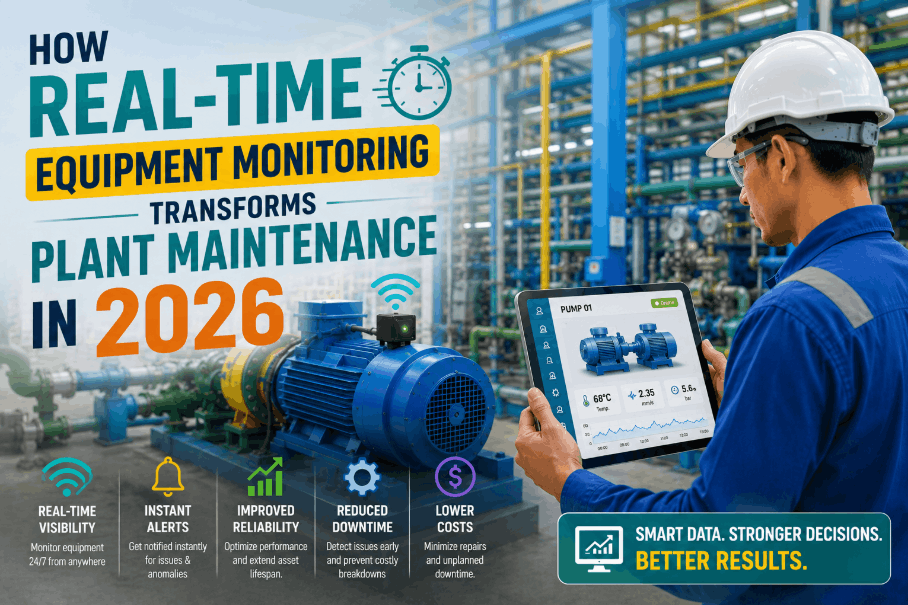
Real-time equipment monitoring has moved from a competitive advantage to an operational baseline in 2026 — manufacturing plants that run on reactive maintenance cycles are accumulating hidden downtime costs their competitors have already eliminated. Sign Up Free to connect your assets to live condition monitoring. Oxmaint integrates IoT sensor data, AI-powered anomaly detection, and CMMS-linked alerts into a single plant monitoring platform — giving maintenance teams the visibility to act before failure, not after. Book a Demo to see how live equipment dashboards are replacing spreadsheet-based maintenance planning across manufacturing, utilities, and heavy industry in 2026. Plants running Oxmaint's real-time asset monitoring eliminate manual condition checks, cut mean time to repair, and shift resource allocation from emergency response to precision-timed preventive action. Sign Up Free and connect your first monitored asset today — no credit card required.
From Reactive Breakdowns to Real-Time Plant Visibility
Oxmaint connects live sensor data, AI anomaly detection, and automated work orders into one real-time equipment monitoring platform — purpose-built for manufacturing plants in 2026.
Why Real-Time Equipment Monitoring Is Non-Negotiable in 2026
Manufacturing plants in 2026 operate under compressing margins and tightening OEE targets — conditions where a single unplanned failure on a critical asset can erase a week of production gains. Traditional condition monitoring — manual rounds, periodic vibration checks, scheduled inspections — creates blind spots between observations that live equipment monitoring closes entirely. Book a Demo to see how Oxmaint's IoT-connected monitoring platform streams sensor data continuously to live dashboards, triggering automated CMMS alerts the moment asset behaviour deviates from defined baselines — before failure propagates.
Reactive Maintenance Approach
Equipment condition checked on fixed rounds — failures occur between visits
Fault detection depends on operator awareness or audible failure signals
No baseline data — no way to detect gradual degradation trends
Downtime hours unknown until production line stops
Spare parts ordered reactively — emergency procurement at premium cost
MTTR driven by diagnosis time, not repair time
Oxmaint Real-Time Monitoring
Continuous sensor streams — temperature, vibration, pressure, current monitored 24/7
AI anomaly detection flags deviations automatically — no human observation required
Asset health baselines established per equipment — degradation trends visible in dashboards
Downtime risk quantified before failure — intervention planned, not scrambled
Predictive alerts trigger parts pre-staging — right part at point of repair
MTTR reduced because technicians arrive informed, not investigating
Core Capabilities of an Effective Real-Time Equipment Monitoring System
Not every monitoring solution delivers production-grade reliability intelligence. The capabilities below define what separates a real-time plant monitoring platform from basic sensor dashboards — and how Oxmaint addresses each requirement for manufacturing environments. Book a Demo to walk through Oxmaint's monitoring architecture live with a product specialist.
PLC and Sensor Integration
Oxmaint connects directly to PLC systems and industrial sensors — acquiring real-time data on temperature, vibration, pressure, and motor current without custom middleware.
AI-Powered Anomaly Detection
Machine learning models trained on asset-specific baselines detect abnormal behaviour patterns — distinguishing early-stage fault signatures from normal operational variance.
Live Equipment Health Dashboards
Plant managers and reliability engineers see real-time asset health status across every monitored equipment group — with drill-down to individual sensor streams and trend history.
Automated CMMS Work Order Triggers
When a monitored parameter breaches a defined threshold, Oxmaint auto-generates a corrective or predictive work order — assigned, prioritised, and linked to the asset record instantly.
OEE and Downtime Impact Tracking
Every monitoring event linked to production output — OEE impact calculated automatically as monitoring alerts translate into downtime events or avoided failures.
AI Vision Camera Inspection
NVIDIA-powered visual inspection detects cracks, corrosion, leaks, thermal anomalies, and PPE violations in real time — extending monitoring beyond sensor coverage to visual condition.
Mobile Alert Delivery
Critical monitoring alerts pushed to technician mobile devices instantly — with asset location, fault description, and suggested corrective action pre-loaded in the work order.
Predictive Maintenance Scheduling
Monitoring trend data feeds Oxmaint's predictive maintenance engine — scheduling interventions based on actual asset condition, not fixed calendar intervals.
Reliability Analytics and Reporting
MTTR, MTBF, failure frequency, and monitoring alert response times aggregated in live reliability dashboards — the data foundation for continuous maintenance improvement.
Real-Time Equipment Monitoring: Key Parameters Tracked by Asset Type
Scroll →
| Asset Type |
Monitored Parameters |
Fault Signatures Detected |
Alert Threshold Example |
Work Order Triggered |
CMMS Integration |
| Rotating Machinery |
Vibration (RMS/FFT), bearing temperature, motor current |
Bearing wear, imbalance, misalignment, lubrication failure |
Vibration >7.1 mm/s RMS — ISO 10816 Zone C breach |
Predictive WO: bearing inspection and lubrication |
Auto-linked to asset failure history and PM schedule |
| Air Compressors |
Discharge temperature, inlet pressure, outlet flow, filter ΔP |
Filter blockage, seal degradation, thermal overload risk |
Filter ΔP >0.6 bar — replacement threshold |
Corrective WO: filter element replacement |
Parts consumption logged against inventory automatically |
| Hydraulic Systems |
System pressure, fluid temperature, flow rate, pump efficiency |
Seal wear, pump efficiency loss, fluid contamination |
Pump efficiency drop >12% from baseline |
Predictive WO: hydraulic pump inspection |
Repair history and oil analysis results linked to asset |
| Conveyor Systems |
Belt tension, motor load, roller bearing temperature, speed |
Belt slippage, roller failure, drive motor overload |
Roller bearing temp >75°C sustained 10+ min |
Corrective WO: roller bearing replacement |
Downtime duration auto-calculated and asset-logged |
| Electrical Panels |
Phase current balance, breaker temperature, harmonic distortion |
Overload conditions, loose connections, phase imbalance |
Phase current imbalance >10% — alert escalation |
Inspection WO: electrical panel thermal scan |
Compliance audit trail maintained per panel asset record |
| Process Pumps |
Flow rate, differential pressure, suction pressure, motor current |
Impeller wear, cavitation onset, seal leakage |
Flow rate <85% of design spec — degradation flag |
Predictive WO: impeller inspection and replacement |
Repair cost and parts tracked against pump lifecycle cost |
How Oxmaint Delivers Real-Time Plant Equipment Monitoring End-to-End
01
Sensor and PLC Connection
Oxmaint connects to existing plant PLCs, IoT sensors, and OEM telematics feeds — acquiring live equipment data without ripping out installed infrastructure.
02
Baseline and Threshold Configuration
Asset-specific health baselines configured from historical data and manufacturer specs — alert thresholds set per parameter, per equipment criticality band.
03
AI Anomaly Detection Active
Oxmaint's AI models run continuous pattern recognition against incoming sensor streams — flagging deviations that precede failure, not just threshold breaches.
04
Automated Alert and Work Order
Monitoring events trigger instant mobile alerts to the assigned trade — with a structured CMMS work order pre-loaded with asset details, fault data, and suggested action.
05
Reliability Reporting and Loop Closure
Every monitoring event, alert response, and repair outcome feeds Oxmaint's reliability analytics — MTBF trends, OEE impact, and avoided downtime cost visible in live dashboards.
Real-Time Monitoring Implementation Roadmap for Manufacturing Plants
1
Asset Criticality Assessment
Week 1
Map assets by criticality rating and failure consequence. Define monitoring priority list — highest OEE impact equipment connected first.
2
Sensor and PLC Integration
Week 1–3
Connect Oxmaint to existing PLC infrastructure and IoT sensors. Configure data acquisition protocols — no custom middleware required for standard PLC interfaces.
3
Baseline and Alert Setup
Week 2–4
Establish healthy operating baselines per asset. Configure alert thresholds and AI anomaly sensitivity. Map alerts to work order templates and responsible trades.
4
Live Monitoring Operations
Month 2+
All critical assets monitored in real time. Predictive work orders replacing reactive repairs. Reliability dashboards tracking MTBF improvement and avoided downtime cost monthly.
Results Manufacturing Plants Achieve with Oxmaint Real-Time Monitoring
24/7
Continuous asset condition visibility — no blind spots between manual inspection rounds
40%
Reduction in unplanned downtime events within 6 months of live real-time monitoring deployment
3x
Faster fault-to-work-order response time — monitoring alert to technician dispatch fully automated
Live
OEE and MTBF dashboards — reliability KPIs updated in real time, no manual data compilation
Connect Your Plant Assets to Live Monitoring — Today
Oxmaint's real-time equipment monitoring platform integrates with your existing PLC infrastructure, IoT sensors, and CMMS workflows — delivering live asset health dashboards, AI anomaly alerts, and automated work order generation from day one.
Book a Demo to see it live, or
Sign Up Free and start monitoring your first critical assets this week.
Frequently Asked Questions
What is real-time equipment monitoring in manufacturing?
Real-time equipment monitoring continuously streams sensor data — vibration, temperature, pressure, current — from plant assets to live dashboards and AI detection engines. Oxmaint connects this data directly to CMMS work orders, triggering automated alerts and maintenance actions before failures occur.
How does Oxmaint integrate with existing PLC and sensor infrastructure?
Oxmaint's PLC sensor integration connects directly to standard industrial controllers and IoT sensors without custom middleware. Plant data flows into Oxmaint's monitoring platform automatically — preserving existing infrastructure investment while adding live visibility and AI analysis.
Can real-time monitoring automatically generate maintenance work orders?
Yes. When Oxmaint detects an anomaly or threshold breach, it auto-creates a structured CMMS work order — pre-filled with asset ID, fault description, priority, and assigned trade — eliminating manual handoff between monitoring alert and maintenance response.
What is the difference between real-time monitoring and predictive maintenance?
Real-time monitoring provides continuous live data acquisition and immediate fault alerting. Predictive maintenance uses that monitoring trend data to forecast failure timing before threshold breaches occur. Oxmaint delivers both — live monitoring feeds the predictive maintenance engine, closing the loop from detection to scheduled intervention.
How quickly can a manufacturing plant go live with Oxmaint real-time monitoring?
Most plants connect critical assets and configure live dashboards within two to four weeks — including PLC integration, baseline configuration, and alert routing. The first automated monitoring work orders are typically active within the first month of deployment.
Does Oxmaint support AI Vision Camera monitoring alongside sensor-based monitoring?
Yes. Oxmaint's NVIDIA-powered AI Vision Camera extends monitoring beyond sensor coverage to visual condition — detecting cracks, corrosion, thermal anomalies, and leaks through continuous camera feed analysis. Sensor and visual monitoring alerts feed the same CMMS work order engine.
Free to Start — No Credit Card Required
Every Asset. Every Parameter. Every Alert — Monitored Automatically in 2026.
Oxmaint's real-time equipment monitoring platform connects live sensor data, AI anomaly detection, and automated CMMS workflows into one manufacturing-grade system. Stop reacting to failures — start preventing them.
.png)