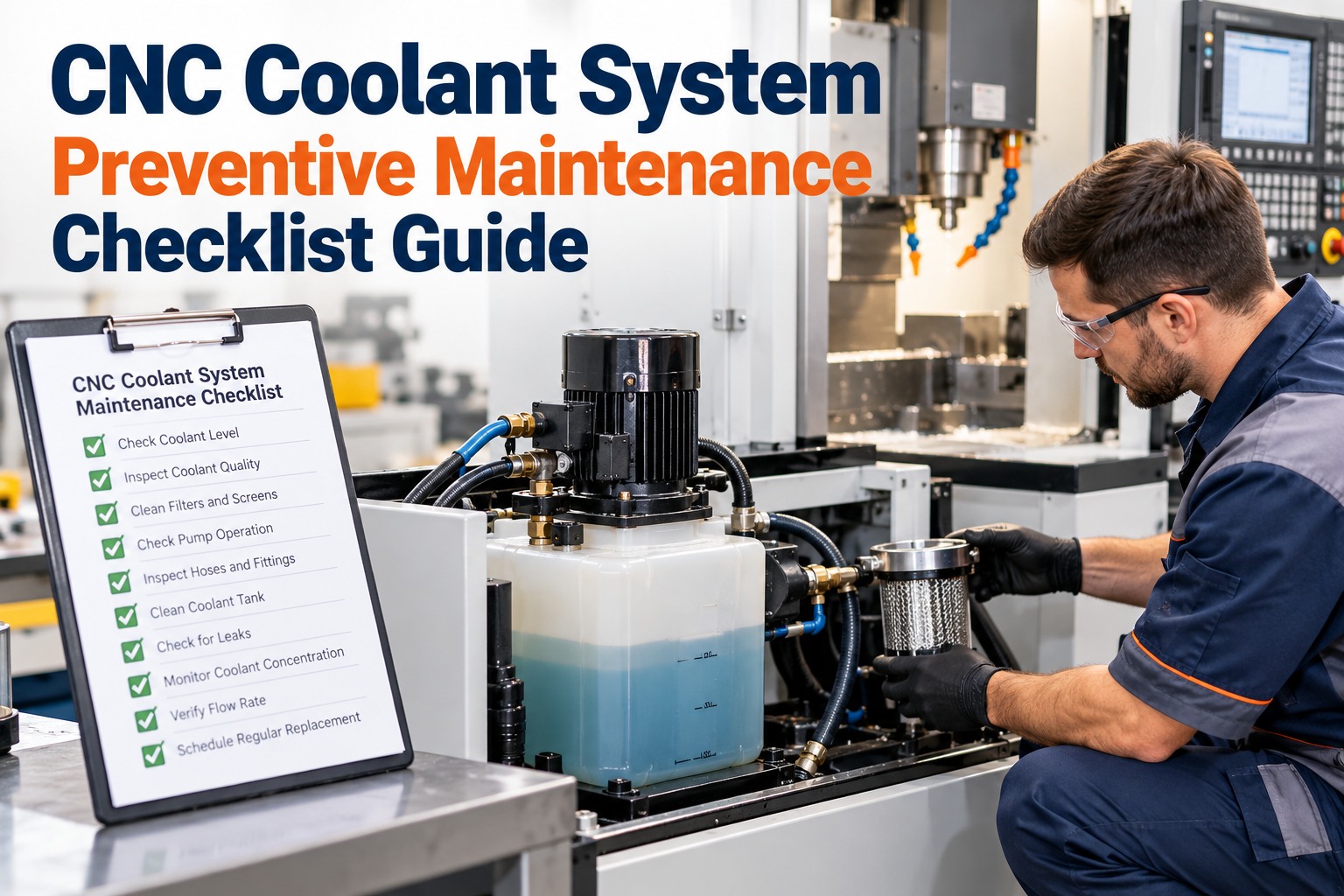
A CNC machine that misses its preventive maintenance schedule doesn't break down dramatically — it drifts. Tolerances slip, surface finishes degrade, spindle temperatures creep up, and by the time the breakdown arrives, the damage has been compounding for weeks. This complete preventive maintenance checklist covers every critical inspection point across daily, weekly, and monthly intervals — giving your operators and maintenance teams a structured, shop-floor-ready PM program that protects machine precision and keeps production running.
PM Checklist Guide
CNC Machine Preventive Maintenance
Daily · Weekly · Monthly — Complete Inspection Framework
5×
Cost of unplanned vs planned maintenance
20 yrs
Machine lifespan with consistent PM
45%
Reduction in unplanned downtime
67%
Teams still using paper or spreadsheets
Why CNC Machines Demand Structured PM
CNC machines achieve accuracy within 0.0001 inches. That precision is not self-sustaining — it requires consistent, documented maintenance across every subsystem. When preventive maintenance is skipped or inconsistent, the failure modes follow a predictable pattern: spindle bearing wear goes undetected until runout affects part quality, ball screw backlash accumulates until positional errors start showing up in finished parts, and coolant contamination degrades surface finish and accelerates tool wear long before anyone notices.
Spindle Bearing Failure
Develops gradually through noise and vibration changes. Most catastrophic CNC failure mode. Detectable early with regular runout measurements and bearing temperature monitoring.
High Severity
Ball Screw Backlash
Worn preload leads to positional inaccuracy and scrap production. Scheduled backlash checks and axis movement assessments identify the problem before dimensional errors reach customers.
Medium-High
Coolant Contamination
Bacterial growth, chip accumulation, and incorrect concentration degrade surface finish and accelerate tool wear. Regular coolant checks and tank cleaning prevent compounding effects.
Medium
Lubrication Failure
Industry data consistently identifies inadequate lubrication as a leading cause of mechanical failures in CNC equipment. Auto-lube system verification is among the highest-impact checklist items.
Medium-High
Electrical Cabinet Overheating
Clogged cabinet filters restrict airflow and raise internal temperatures, accelerating component aging. Simple but frequently overlooked — a five-minute task with outsized consequences when skipped.
High Severity
Safety System Degradation
Emergency stops, interlocks, and limit switches can wear or corrode over time. Without documented testing cycles, these failures go undetected — creating operator safety risk and compliance exposure.
Medium
Stop Managing CNC PM with Spreadsheets
OxMaint automates your CNC preventive maintenance schedule — digital checklists, auto-triggered work orders, and real-time compliance tracking built for shop floors.
Daily CNC Maintenance Checklist
Daily checks take 10–15 minutes per machine and should be completed before production begins. These tasks form the foundation of machine health — most unplanned breakdowns trace back to daily maintenance that was skipped or done inconsistently. Every item below represents a known failure mode, not a suggestion.
Cleaning & Inspection
Clear chips, coolant residue, and debris from machine bed — metal chips left overnight can cause scoring on precision surfaces
Inspect chuck or spindle area for buildup — contamination here directly affects part accuracy and toolholder grip
Wipe down all way surfaces and check for scoring or unusual wear patterns
Visual inspection for any unusual tool wear, chipped inserts, or damaged toolholders
Check and clean immediate operating area for safe operator transit and chip accumulation
Fluids & Levels
Check hydraulic fluid level and verify pressure is at correct operating value per machine spec
Verify way lube level is at proper operating level — replenish if below minimum mark
Check coolant level and inspect coolant concentration — incorrect concentration degrades surface finish
Inspect chuck pressure and grease chuck according to manufacturer recommendation
Run warm-up cycle and listen for any unusual noise or jerky movement during axis travel
Safety & Controls
Test emergency stop function before production begins — verify machine stops immediately
Inspect all guards and safety interlocks — no production with disabled safety systems
Verify axis homing positions are correct after startup
Check for active alarms or warning messages in CNC controller — document and escalate any unresolved alerts
Confirm vacuum pumps, blowers, and chip extraction systems are operating correctly
Weekly CNC Maintenance Checklist
Weekly checks go deeper into mechanical and filtration systems. These typically take 30–45 minutes and are best scheduled at the start of the week before full production begins. Tasks at this interval address the wear patterns that daily checks cannot catch — and the items most often linked to mid-week breakdowns when skipped.
Mechanical Systems
Inspect axis drive belts, racks, and pinions for visible wear or tension issues
Tighten all mechanical fasteners and mounting points — vibration loosens fasteners over time
Inspect ballscrews for surface damage and check backlash in all axes
Verify lubrication lines are clear and free from blockages — restricted lube lines cause thermal expansion and ballscrew misalignment
Inspect pneumatic and hydraulic lines for leaks or chafing damage
Spindle & Tooling
Monitor spindle bearing temperature during warm-up — abnormal increase indicates early bearing wear
Clean tool holder tapers to maintain proper tool clamping force — buildup here affects tool runout directly
Verify cooling water flow rate and temperature stability for spindle cooling system
Inspect collets and toolholder seats for wear or damage — replace any showing visible deterioration
Check ATC (automatic tool changer) operation — verify tool pot gripper function and magazine indexing
Filters & Cooling
Remove and clean CNC control cabinet air filter — every 40 hours, dirty filters cause overheating of electrical components
Clean or replace coolant system filters — check for chip accumulation that reduces coolant flow
Inspect chip conveyor and clean conveyor drive system — grease conveyor as required
Check hydraulic system filters for contamination indicators
Clean radiator fins and verify cooling unit operation if machine is equipped with a cooling unit
Monthly CNC Maintenance Checklist
Monthly maintenance addresses fluid replacement, calibration verification, and deeper mechanical inspection — the work that preserves long-term machine accuracy. These tasks require more time and, in some cases, specialized tools or manufacturer specifications. Skipping monthly PM is where spindle bearing failures and positional accuracy drift originate.
Fluid Replacement
Drain and replace hydraulic oil — also replace line filter and suction filter per manufacturer specification
Drain and replace lubricant fluids — clean lubrication unit before refilling with fresh way lube
Remove coolant tank completely — clean of sludge, chips, and oil; inspect and check for bacterial growth
Test hydraulic oil for contaminants — replace filters if contamination indicators are present
Drain and refill cooling unit if equipped — verify cooling capacity after refill
Calibration & Accuracy
Check machine leveling and adjust if necessary — thermal cycling can shift leveling over time
Verify axis repeatability and homing accuracy — document any deviation from baseline
Check backlash in all linear axes and compare to previous measurement — trending is more valuable than any single reading
Verify gantry squareness and parallelism (for machining centers) — check against original machine spec
Back up all machine parameters and control settings — protect against data loss from power failures or software updates
Deep Mechanical
Remove chucks and jaws for thorough cleaning — inspect jaw gripping surfaces for wear
Inspect all way wipers for damage — clean and replace any wipers showing deterioration
Inspect electrical connections and terminals for corrosion or looseness inside control cabinet
Perform spindle runout measurement — compare to baseline; escalate if deviation exceeds acceptable range
Review manufacturer's maintenance guidebook — confirm all OEM-required tasks completed at correct intervals
CNC PM Interval Quick Reference
| Maintenance Task |
Daily |
Weekly |
Monthly |
Quarterly/Annual |
| Machine bed chip removal |
Required |
Deep clean |
— |
— |
| Coolant level & concentration check |
Check level |
Check concentration |
Full tank clean |
— |
| Way lube level verification |
Check & replenish |
— |
Drain & replace |
— |
| Hydraulic fluid & pressure |
Check pressure |
— |
Full replacement |
— |
| Control cabinet air filter |
— |
Clean/replace |
— |
— |
| Spindle temperature monitoring |
Observe |
Monitor trend |
Runout test |
Vibration analysis |
| Axis backlash check |
— |
— |
Measure & document |
Laser calibration |
| Emergency stop & safety interlocks |
Function test |
— |
— |
Full system audit |
| Machine leveling |
— |
— |
Check & adjust |
— |
| Belt & drive system inspection |
— |
Visual check |
— |
Tension & replacement |
| Toolholder taper cleaning |
Wipe down |
Deep clean |
— |
— |
| Parameter & settings backup |
— |
— |
Full backup |
— |
The Four Subsystems That Make or Break CNC Accuracy
Every item in a CNC maintenance checklist connects to one of four core subsystems. When technicians understand which subsystem each task protects, they make better decisions about when to escalate versus when to continue production. This framework makes your PM program more intelligent — not just more thorough.
01
Spindle System
The highest-value, highest-risk CNC component. Spindle bearing failure is catastrophic and expensive. Your PM program must include daily temperature observation, weekly bearing monitoring, monthly runout measurement, and quarterly vibration analysis. Any abnormal noise during warm-up is an immediate stop-and-inspect trigger — not a monitor-and-continue situation.
Key metric: Spindle runout baseline vs current measurement
02
Motion & Axis System
Ball screws, linear guides, and drive components determine positional accuracy. Backlash accumulates gradually — which is why trending measurements matter more than any single reading. Inadequate lubrication is the primary cause of premature ballscrew failure. Verify lube line flow, not just lube reservoir level, to confirm lubrication is actually reaching the components.
Key metric: Backlash measurement trend across all axes
03
Coolant System
Coolant does more than cool — it lubricates the cut, flushes chips, and affects surface finish directly. Incorrect concentration is the most common coolant failure mode, and it's invisible without a refractometer check. Bacterial growth in the coolant tank produces a distinct odor and causes skin irritation in operators — a monthly full tank clean is non-negotiable in any serious CNC operation.
Key metric: Coolant concentration reading (refractometer)
04
Electrical & Control System
Control cabinet air filters are the most overlooked high-impact maintenance item in CNC shops. At 40-hour intervals, a clogged filter raises internal cabinet temperatures enough to shorten drive component life by years. Weekly filter cleaning, monthly electrical connection inspection, and regular parameter backup protect both machine availability and the settings data that defines machine behavior.
Key metric: Cabinet internal temperature during operation
Digital CNC PM Checklists — Built for the Shop Floor
OxMaint delivers role-based digital checklists to operator tablets, auto-schedules PM work orders by machine hours or calendar, and gives maintenance managers real-time completion visibility across every machine in the plant.
From Paper Checklists to Digital PM: What Changes
A 2024 Plant Engineering survey found that 67% of maintenance teams still rely on some combination of paper records, spreadsheets, or memory to track CNC maintenance activities. The result is missed tasks, no trend visibility, and zero ability to connect maintenance records to quality outcomes. The shift to digital PM is not about technology for its own sake — it is about making the checklist do more than capture intent.
Findings stay on clipboards, never enter a system where trends can be analyzed
No automatic work order generation when a checklist item flags a problem
Technicians re-enter data manually — time-consuming and error-prone
No real-time visibility for managers on what is completed versus overdue
Cannot correlate maintenance records with quality or scrap rate data
No escalation path when a critical check fails — the clipboard just moves to the next desk
Every finding becomes searchable history — traceable back to specific technicians, dates, and machines
Failed checklist items auto-generate corrective work orders with priority and assignment
Mobile-first interface for shop floor completion — offline capable in low-connectivity zones
Real-time dashboard for maintenance managers — overdue tasks surface before they become failures
Maintenance data paired with quality records shows which PM tasks actually protect precision
Automatic escalation routing — critical failures notify supervisors immediately, not after shift end
Frequently Asked Questions
How long does CNC daily maintenance actually take per machine?
For most standard CNC mills and lathes, daily maintenance runs 10–15 minutes per machine when performed consistently. Shops new to structured PM often overestimate the time because initial tasks involve cleaning up neglected machines — once a machine is in a maintained state, the daily routine becomes fast and routine. In smaller shops, operators typically handle their own machine's daily checks, while larger facilities with dedicated maintenance staff can service multiple machines per technician per shift.
Digital PM tools like OxMaint further reduce time spent on documentation, which is often where the real time drain occurs in paper-based programs.
Should maintenance frequency increase for machines running multiple shifts?
Yes — maintenance intervals should be based on operating hours, not just calendar days. A CNC lathe running three shifts per day accumulates operating hours three times faster than a single-shift machine. The Manufacturing Technology Insights guidance suggests that high-utilization machines may need certain checks performed twice as often as standard schedules. Specifically, coolant checks, chip handling, and lubrication verification benefit most from increased frequency under high-utilization conditions. Review your OEM guidelines and adjust intervals based on actual operating hours — most
preventive maintenance software can trigger PM tasks by machine hour counter rather than calendar date.
What is the most important monthly CNC maintenance task?
Coolant tank cleaning and hydraulic fluid replacement are the two monthly tasks with the highest consequences when skipped. Coolant tank neglect leads to bacterial growth, chip accumulation, and incorrect concentration — all of which degrade surface finish and accelerate tool wear in ways that are initially invisible. Hydraulic fluid replacement prevents contamination-driven hydraulic failures that take machines out of production for days. Beyond fluids, the monthly machine leveling check is frequently overlooked but critical for long-term accuracy — thermal cycling over weeks gradually shifts machine leveling, which affects positional accuracy in ways that calibration alone cannot fully correct.
How does preventive maintenance affect CNC machine lifespan?
CNC machines with consistent preventive maintenance routinely continue producing parts at near-factory specifications for 15–20 years. Machines without structured PM typically require major repairs within 5–8 years and accumulate maintenance costs that exceed the original purchase price. The compounding effect is significant: a well-maintained machine holds tighter tolerances, produces less scrap, and requires shorter repair windows when issues do occur because the maintenance history enables faster diagnosis. An unplanned CNC breakdown costs approximately five times more than the equivalent planned maintenance — the ROI on a structured
PM program is not theoretical.
When should we call the manufacturer's service technician instead of handling maintenance in-house?
Manufacturer service technicians should be involved for annual deep maintenance including headstock inspection, geometric accuracy validation with laser calibration tools, and any repairs involving spindle replacement or major drive component work. For shops without in-house ballscrew replacement capability, any measured backlash exceeding manufacturer tolerance should trigger a service call rather than continued operation. Additionally, any electrical faults, drive error codes that persist after standard troubleshooting, or spindle vibration anomalies identified during quarterly vibration analysis warrant manufacturer or certified service involvement — continuing to run on a degraded spindle is the fastest path to a catastrophic and expensive failure.
OxMaint Makes CNC PM Simple to Execute and Easy to Prove
Pre-built CNC maintenance templates, mobile technician checklists, automatic PM scheduling by machine hours, and full audit trail documentation — everything your shop needs to run a PM program that actually sticks.