A single unscheduled robot arm failure during peak production can idle an entire automated cell for 6–24 hours — stalling output, triggering downstream shortages, and pushing emergency repair costs past $80,000 before a wrench is turned. Yet 68% of industrial robot failures are directly traceable to skipped or incomplete preventive maintenance. Cobots and industrial robots operate at tolerances measured in fractions of a millimeter; joints degrade, encoders drift, and grippers wear in predictable patterns that a structured PM program catches long before they cascade into line-stopping failures. Book a free demo to see how Oxmaint automates robot PM scheduling and tracks every inspection task in real time.
Why Robotic PM Cannot Be Optional
68%
of robot failures caused by missed PM tasks
3×
higher repair cost when maintenance is reactive vs planned
40%
longer robot lifespan with consistent joint & servo care
$80K+
average unplanned downtime cost per robot failure event
What Makes Robot & Cobot Maintenance Different from Standard Equipment PM
Industrial robots and collaborative robots operate at the intersection of precision mechanics, servo electronics, motion control software, and safety systems. A missed lubrication cycle on a standard conveyor motor is a nuisance. The same oversight on a 6-axis robot wrist joint translates directly into positional error, accelerated gear wear, and eventual encoder failure affecting every downstream quality measurement. Cobot PM adds a critical layer that standard robot programs often overlook: functional safety verification. Force-torque limits, collision detection sensitivity, and speed monitoring must be validated at defined intervals — not just when a safety incident triggers a review.
Precision Tolerance Stack-Up
Robotic joints operate within 0.01–0.05mm tolerances. Wear accumulates invisibly across thousands of cycles — only systematic inspection reveals drift before it affects part quality or causes collisions.
Servo & Encoder Dependency
Every motion command depends on encoder feedback accuracy. Thermal cycling, connector vibration, and firmware version drift all degrade positional fidelity in ways that visual inspection alone cannot detect.
Safety System Validation
Cobot safety functions are not self-testing. Force limits, speed monitors, and emergency stop circuits require functional verification at defined intervals to remain compliant with ISO/TS 15066 and ISO 10218.
Multi-Vendor Complexity
A typical robot cell integrates 4–8 vendor components: arm, controller, gripper, vision system, safety PLC, HMI. Each has its own PM schedule — coordination across all of them is where most programs break down.
Tracking robot PM across spreadsheets and paper logs? Oxmaint centralizes every checklist, assigns tasks to technicians, and sends automated reminders before maintenance windows close.
Complete Robotic & Cobot PM Checklist by Frequency
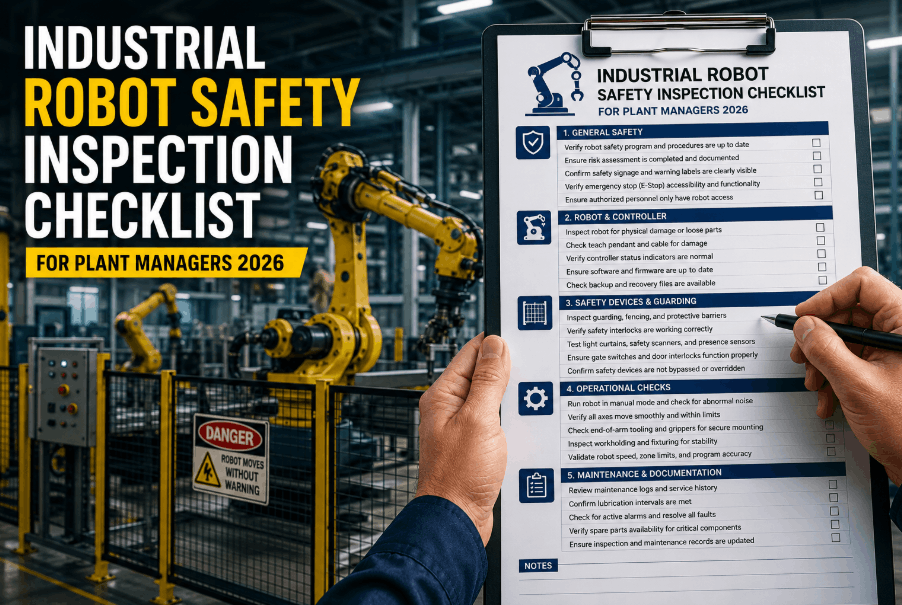
This checklist covers all major robot types — 6-axis articulated arms, SCARA robots, delta robots, and collaborative robots (cobots) from all major manufacturers including FANUC, KUKA, ABB, Universal Robots, Yaskawa, and Kawasaki. Tasks are organized by inspection frequency so maintenance teams can build structured PM plans without missing coverage gaps between daily rounds and annual overhauls.
Mechanical & Physical
Inspect all axis covers, protective panels, and cable dress for visible damage or displacement
Verify teach pendant cable and connector integrity — no kinks, fraying, or loose pins
Check end-of-arm tooling (EOAT) mounting bolts for torque retention at all attachment points
Inspect gripper jaws, fingers, and suction cups for wear, cracking, or contamination buildup
Confirm all axis overtravel limit switches are unobstructed and in correct position
Electrical & Controls
Verify controller cooling fan operation — no unusual noise, blocked intake or exhaust vents
Check controller display for active alarms, fault codes, or warning indicators
Confirm teach pendant emergency stop button functions correctly before authorizing production
Verify fence/light curtain/area scanner safety circuit status on controller I/O panel
Log any repeated position error alarms from previous shift for engineering review
Joint & Drive System
Run each axis through full range of motion manually; listen for grinding, clicking, or irregular resistance
Inspect all axis brake engagement — confirm robot holds position when drives are released
Check all axis grease nipples and zerk fittings; apply grease per OEM specification if interval reached
Inspect harmonic drive / cycloidal reducer input and output flanges for unusual movement or play
Verify counterbalance system pressure (pneumatic or spring) within OEM-specified range
Wiring, Cables & Pneumatics
Inspect internal cable harness through all inspection ports for chafing, pinching, or connector pullout
Check all pneumatic supply lines, quick-connect fittings, and valve manifolds for leaks
Verify compressed air supply pressure at robot base FRL unit — adjust regulator if outside spec
Clean controller air filters and verify fan airflow is unobstructed on all servo amplifier bays
Inspect grounding straps and bonding conductors on robot base, arm, and EOAT mounting plate
Positional Accuracy & Calibration
Run TCP (Tool Center Point) calibration verification using reference gauge pin — record XYZ error vs baseline
Check mastering / zero-point reference positions for all axes; re-master any axis showing drift beyond OEM tolerance
Verify payload and inertia settings in controller match current EOAT configuration
Run repeatability test at 5 reference positions; document peak deviation vs commissioning baseline
Cobot Safety System Verification
Test collaborative stop (Cat. 0, 1, and 2) response times against ISO/TS 15066 Annex A limits
Verify force-torque collision detection threshold using calibrated force gauge at each TCP speed zone
Confirm speed and separation monitoring (SSM) zone boundaries are intact and functioning correctly
Validate safety PLC / safety controller I/O channels: all safety inputs/outputs respond within rated reaction time
Gearbox & Reducer Inspection
Drain and replace axis gearbox oil on all joints exceeding manufacturer's change interval (typically J1–J3)
Inspect reducer output flanges with dial indicator — measure backlash and compare against wear limit specification
Check all axis coupling bolts and flange fasteners for torque value using calibrated torque wrench
Inspect motor encoder cable connectors at each axis for pin corrosion, bent pins, or partial mating
Software, Firmware & Backup
Create full controller backup: all programs, system variables, I/O configurations, and safety parameters
Verify controller firmware version against OEM security and stability bulletin — apply updates per change management
Review and clear controller error log — identify any recurring fault codes requiring root-cause investigation
Test all field bus communications (PROFINET, EtherCAT, DeviceNet) for cyclic time compliance and error rates
Build digital robot PM checklists in minutes. Oxmaint lets your team complete inspections on mobile, auto-escalates failed items, and timestamps every task for audit-ready records.
Annual & Lifecycle Maintenance: What Gets Missed Without a System
Annual and lifecycle-stage tasks are where robot PM programs most commonly fall apart. Because they happen infrequently, they're rarely on anyone's calendar until the original commissioning documentation surfaces during a breakdown post-mortem — at which point the overdue task becomes a probable cause rather than a prevention record.
Annual Overhaul Tasks
Replace all axis brake assemblies at or before OEM-rated actuation cycle count
Full cable harness inspection and replacement of any cables showing jacket cracking or continuity degradation
Servo drive capacitor health test — measure ESR and capacitance vs rated values
Battery replacement for all encoder backup batteries and safety PLC memory retention batteries
Full functional safety re-validation and re-certification per current IEC 62061 / ISO 13849 standards
Gripper & EOAT Lifecycle Tasks
Replace gripper jaw pads, finger inserts, and contact surfaces at rated cycle count — not by calendar
Inspect and replace suction cup lip seals — measure vacuum decay time vs new-cup baseline
Calibrate force-torque sensor at tool flange — verify against NIST-traceable reference load
Inspect quick-change tool coupling mechanical locks and electrical contacts for wear and debris
Update vision system calibration target and re-run intrinsic/extrinsic camera calibration routine
Critical Safety Checks Specific to Collaborative Robots
Cobots introduce a fundamentally different safety paradigm: people share the workspace with the machine. Every functional safety check is also a regulatory compliance checkpoint. A cobot that has drifted even slightly outside its validated safety parameters is no longer operating within the bounds of its risk assessment — making systematic, documented safety verification non-negotiable for any deployment involving human-robot collaboration.
Power & Force Limiting (PFL)
Test transient contact force using calibrated measurement device at each TCP velocity tier specified in the risk assessment. Document peak force vs ISO/TS 15066 biomechanical limit for each body region in the collaboration zone.
Speed & Separation Monitoring
Verify area scanner or vision safety system triggers correct protective speed reduction at defined separation distances. Confirm system response time remains within validated SIL/PL performance level calculation.
Hand-Guiding Device
Inspect enable switch functionality, dead-man switch operation, and force sensitivity calibration. Verify that releasing or applying excessive force to the hand-guide device triggers immediate protective stop.
Safety-Rated I/O Channels
Test all dual-channel safety inputs (E-stop, enabling device, safeguard reset) for cross-circuit fault detection. Verify output response time and channel discrepancy monitoring remains within rated limits.
Impact of Structured Robot PM vs Reactive Maintenance
Unplanned downtime events per year
Reactive: 8–12 events
PM-based: 1–2 events
Average repair cost per failure
Reactive: $12,000–$80,000
PM-based: $800–$4,000
Gearbox / reducer lifespan
Reactive: 4–6 years
PM-based: 10–15 years
Mean Time Between Failures (MTBF)
Reactive: 3,000–5,000 hrs
PM-based: 15,000–25,000 hrs
Data aggregated from FANUC, KUKA, and ABB reliability benchmarks, Deloitte manufacturing analytics, and cross-industry robot fleet deployment studies.
Convert this checklist into live digital work orders. Oxmaint's mobile-first CMMS lets technicians complete, sign off, and escalate robot PM tasks from the shop floor — no paper, no clipboard, no missed steps.
Frequently Asked Questions
How often should industrial robot joints be lubricated?
Lubrication intervals vary by axis, load, and operating speed. As a general rule, J1–J3 (lower axes carrying higher loads) require grease replenishment every 3–6 months, while J4–J6 wrist joints typically run 6–12 months between services. Always prioritize OEM-specified intervals over generic schedules — most manufacturers publish exact cycle-count-based intervals in their maintenance manuals that override calendar time.
What is TCP calibration and how frequently should it be verified?
TCP (Tool Center Point) calibration defines the spatial relationship between the robot flange and the tip of the end-of-arm tool. TCP drift causes positional errors, poor weld quality, missed pick locations, and increased part rejection rates. Verification should occur monthly as part of routine PM, immediately after any collision event, after any EOAT replacement, and after gearbox or axis component repairs.
Can cobots be maintained using the same checklist as industrial robots?
Partially. Cobots share most mechanical PM tasks (lubrication, joint inspection, cable checks) with industrial robots. However, cobots require additional functional safety validation tasks — force-torque limit verification, speed monitoring zone integrity checks, and safety I/O channel testing — that industrial robots behind hard guarding do not require. Cobot PM checklists must include both the mechanical and the safety compliance dimensions to remain valid.
How does Oxmaint help manage robot PM across multiple cells and facilities?
Oxmaint centralizes all robot assets, PM schedules, and inspection records in a single platform. Maintenance managers can set recurring work orders for each robot by asset, assign tasks to specific technicians, attach OEM checklists and torque specs, and receive automatic alerts when PM windows approach or tasks are overdue. Multi-site teams get a unified dashboard showing completion rates, overdue tasks, and failure trends across every robot in the fleet.
Book a demo to see the robot asset management dashboard live.
What records should be kept for robot preventive maintenance compliance?
At minimum: timestamped completion records for every PM task with technician name, measured values for calibration and safety checks, pass/fail results for functional tests, parts replaced with batch/serial numbers, and any deferred tasks with documented reason and reschedule date. For cobot deployments, safety function verification records must be retained for the life of the robot installation plus local statutory limitation periods to support incident investigation and regulatory audit.
Your Robots Are Running. Make Sure They Keep Running.
Every joint cycle, encoder reading, and safety function test tells you something about the health of your automation investment. Oxmaint turns your robot PM program into a trackable, auditable, and continuously improving system — giving your maintenance team the structure to prevent failures instead of reacting to them.