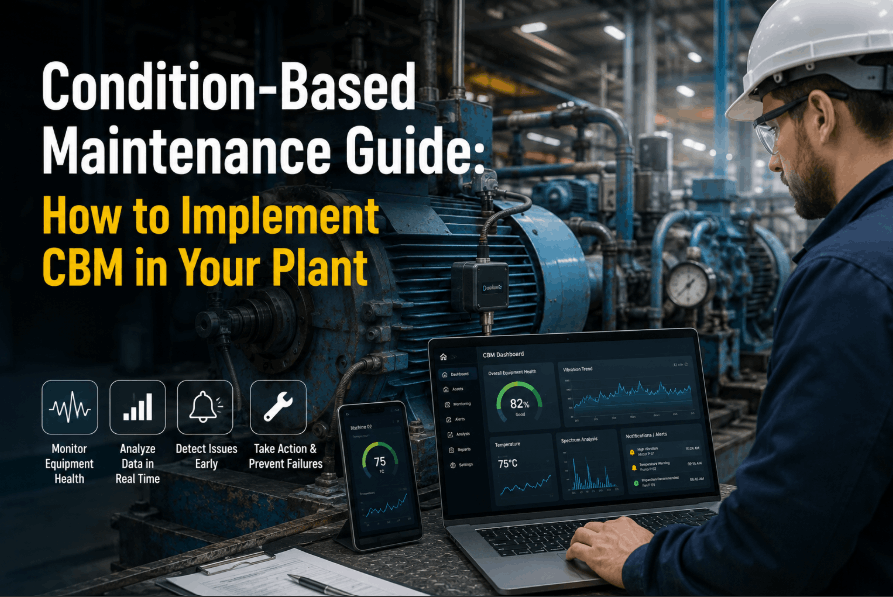
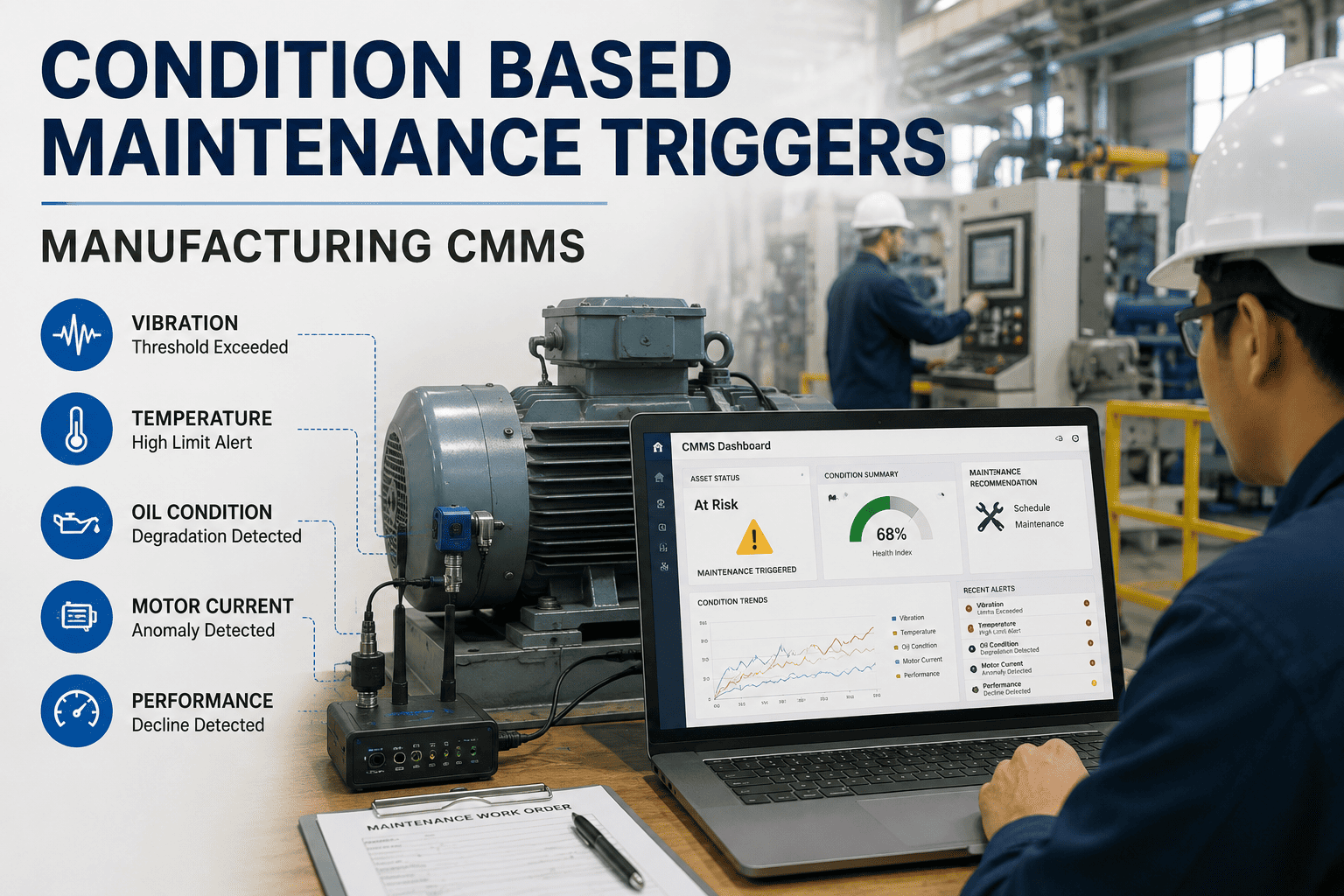
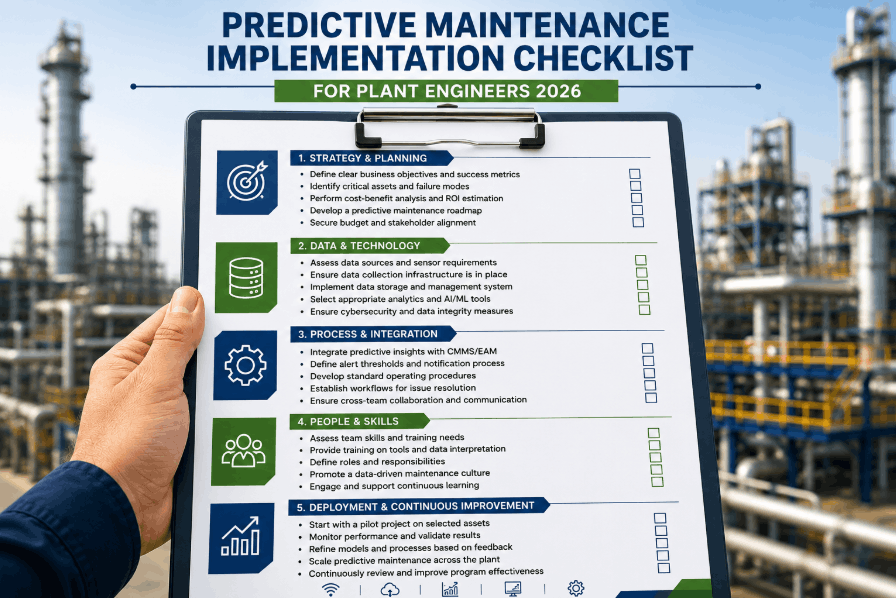
Condition-based maintenance (CBM) is reshaping how reliability engineers protect critical assets in modern manufacturing plants. Unlike fixed-interval preventive maintenance, CBM triggers work orders only when real-time sensor data or inspection readings cross predefined thresholds — eliminating unnecessary maintenance labor while catching failures before they cascade. Sign Up Free to connect your sensor data to Oxmaint's CMMS and automate condition-triggered work orders across your entire asset register. From vibration analysis on rotating equipment to oil contamination monitoring on hydraulic systems, a well-structured CBM program in 2026 reduces unplanned downtime by 30–50% while extending mean time between failures (MTBF). Book a Demo to see how leading manufacturers integrate condition monitoring data directly into their Oxmaint maintenance workflow. Whether you are starting your first CBM pilot or scaling an existing condition monitoring strategy plant-wide, this guide covers sensor selection, trigger threshold configuration, CMMS integration, and ROI measurement from implementation to maturity.
CONDITION-BASED MAINTENANCE · CBM · CMMS INTEGRATION
Connect Condition Monitoring Data to Automated Work Orders in Oxmaint
Sensor-triggered PM escalation, real-time asset health dashboards, and threshold-based work order generation — built for reliability-driven manufacturing teams.
What Is Condition-Based Maintenance and How Does It Differ from PM?
Condition-based maintenance (CBM) is a maintenance strategy where service actions are performed only when monitored parameters — vibration, temperature, pressure, oil viscosity, ultrasound — indicate declining asset health. This stands in direct contrast to time-based preventive maintenance (PM), which replaces or services components on a fixed calendar interval regardless of actual condition. CBM vs PM maintenance is not a binary choice; most high-performing plants run a hybrid model, reserving CBM for critical rotating and fluid-power assets while retaining calendar PM for lower-cost consumables. Sign Up Free to manage both strategies inside a single Oxmaint CMMS dashboard.
CBM VS PREVENTIVE MAINTENANCE — KEY DIFFERENCES
Condition-Based Maintenance (CBM)
Triggered by real sensor data or inspection readings
Work orders generated only when thresholds are breached
Eliminates unnecessary component replacements
Requires sensor infrastructure and data analysis
Best for critical, high-cost rotating assets
Higher upfront investment, higher long-term ROI
Time-Based Preventive Maintenance (PM)
Triggered by fixed calendar intervals (weekly, monthly, quarterly)
Work orders generated automatically on schedule
May over-maintain assets that are still in good condition
Simple to implement without sensor investment
Best for consumables, filters, and low-cost components
Lower setup cost, predictable labor planning
Why CBM Programs Fail in Manufacturing Facilities
Most CBM pilots fail not because the technology is flawed, but because condition monitoring data is collected in isolation — disconnected from the work order system that actually dispatches technicians. Sensors generate alerts that get lost in email threads or never escalate to a prioritized work order. Book a Demo to see how Oxmaint closes the loop between IoT sensor alerts and assigned, tracked maintenance actions.
COMMON CBM IMPLEMENTATION FAILURES
01
No CMMS Integration
Sensor alerts live in standalone monitoring software while technicians still work from paper logs — creating a dangerous gap between detection and action.
02
Undefined Trigger Thresholds
Without engineering-validated alert thresholds per asset, teams either over-respond to noise or miss true degradation signals entirely.
03
Wrong Sensor Selection
Deploying vibration sensors on assets where thermal imaging or ultrasound is more appropriate wastes budget and produces unreliable data.
04
No Baseline Data
CBM thresholds require a healthy-asset baseline. Starting condition monitoring after problems appear makes threshold calibration unreliable.
05
Alert Fatigue
Poorly tuned thresholds generate excessive false positives. Technicians begin ignoring alerts — defeating the entire purpose of condition monitoring.
06
No ROI Measurement
Without tracking avoided failure costs versus CBM program investment, reliability teams cannot justify budget expansion or prove program value.
How to Implement Condition-Based Maintenance: Step-by-Step
A successful CBM implementation follows a structured five-phase approach: asset criticality ranking, sensor technology selection, threshold calibration, CMMS integration, and continuous improvement cycles. Oxmaint supports each phase — Book a Demo to walk through the implementation roadmap for your facility's asset classes.
CBM IMPLEMENTATION ROADMAP — 5 PHASES
Phase 1
Asset Criticality Ranking
Score all assets by failure consequence, replacement cost, and production impact. Prioritize top-tier assets for CBM sensor deployment. Oxmaint's asset register supports criticality scoring across all asset classes.
Phase 2
Condition Monitoring Sensor Selection
Match sensor technology to failure mode per asset class. Vibration for rotating machinery, thermography for electrical panels, ultrasound for early bearing defects, oil analysis for hydraulics and gearboxes.
Phase 3
Baseline Capture and Threshold Calibration
Record healthy-state readings for each monitored parameter. Set alert thresholds at 20–30% deviation from baseline for early warning, with escalation thresholds at 50–60% for urgent action triggers.
Phase 4
CMMS Integration and Work Order Automation
Connect sensor data to Oxmaint via API or IoT bridge. Configure auto-escalation rules so threshold breaches instantly generate prioritized work orders assigned to the correct technician or trade.
Phase 5
ROI Tracking and Continuous Improvement
Measure avoided failure costs, reduction in emergency work orders, and MTBF improvement per asset class. Use Oxmaint's KPI dashboards to report CBM ROI to plant leadership quarterly.
Condition Monitoring Sensor Selection by Asset Class
Selecting the right sensor technology for each failure mode is the most technically critical decision in any CBM program. The table below maps common manufacturing assets to their primary condition monitoring methods and typical threshold parameters. Sign Up Free to configure Oxmaint's IoT-triggered work order rules for your monitored assets.
CBM SENSOR SELECTION REFERENCE — MANUFACTURING ASSETS
Rotating Machinery (Pumps, Motors)
Vibration sensor (accelerometer)
RMS velocity (mm/s), frequency spectrum
20% above ISO 10816 baseline
Schedule inspection WO
Gearboxes / Bearings
Ultrasound (airborne / structure-borne)
dBuV change from baseline
+8 dB from baseline
Lubrication or inspection WO
Electrical Panels / MCC
Infrared thermography
Hot spot temperature delta (°C)
ΔT > 10°C above ambient
Priority electrical WO
Hydraulic Systems / Gearboxes
Oil analysis (particle count, viscosity)
ISO particle count, viscosity index
ISO cleanliness class 18/16/13
Oil change or flush WO
Compressors / Boilers
Pressure and temperature sensors
Discharge pressure, operating temp
±5% of design operating range
Inspection or tune-up WO
HVAC / Chillers
Flow sensor + delta-T measurement
Supply/return temperature differential
> 2°F from design ΔT
Coil or filter service WO
CBM vs Predictive Maintenance: Understanding the Difference
CBM and predictive maintenance (PdM) are often used interchangeably, but they represent different levels of analytical sophistication. CBM acts when a threshold is crossed. PdM uses machine learning models to forecast the remaining useful life of an asset before any threshold is breached — enabling even earlier intervention. Oxmaint supports both approaches: threshold-based CBM triggers today and AI-assisted PdM escalation as your sensor data matures. Book a Demo to discuss the right starting point for your facility's condition monitoring maturity level.
MAINTENANCE STRATEGY MATURITY MODEL
Level 1
Reactive Maintenance
Run to failure. No planned maintenance. Highest downtime cost and emergency repair rates.
Highest Risk
Level 2
Preventive Maintenance (PM)
Calendar-based intervals. Reduces failures but risks over-maintenance of healthy assets.
Industry Baseline
Level 3
Condition-Based Maintenance (CBM)
Sensor-triggered work orders. Maintenance only when asset condition requires it. Significant cost reduction.
Recommended Target
Level 4
Predictive Maintenance (PdM)
AI forecasts remaining useful life. Enables just-in-time maintenance with maximum asset utilization.
Advanced Maturity
How Oxmaint Powers Your CBM Program
Standalone condition monitoring tools collect data but do not close the maintenance loop. Oxmaint's CMMS is the operational layer that transforms sensor alerts into tracked, documented, and completed work orders — giving reliability managers full visibility from alert to resolution across every monitored asset. Sign Up Free and connect your first condition monitoring data source to Oxmaint's automated work order engine in under 48 hours.
HOW OXMAINT SUPPORTS CONDITION-BASED MAINTENANCE
01
IoT-Triggered Work Order Escalation
When sensor data crosses a defined threshold, Oxmaint automatically generates a prioritized work order, assigns the correct technician, and logs the trigger condition for the maintenance record.
02
Asset Health Dashboard
Visualize the real-time condition status of all monitored assets in a single live dashboard. Identify at-risk equipment before it reaches a critical threshold requiring emergency intervention.
03
CBM and PM Hybrid Scheduling
Run CBM rules for critical assets alongside calendar PM for consumable components — all managed inside one CMMS without separate systems or manual coordination between teams.
04
Threshold Configuration by Asset
Configure multi-level alert thresholds per asset — early warning, advisory, and urgent action — with different work order priorities and assignee rules for each escalation tier.
05
Compliance-Ready Audit Trail
Every CBM-triggered work order is timestamped, documented, and linked to the condition reading that initiated it — providing a defensible audit trail for ISO 55000 and regulatory inspections.
06
CBM ROI and KPI Reporting
Track MTBF improvement, emergency work order reduction, and avoided failure cost per asset class. Generate quarterly CBM ROI reports for plant leadership directly from the Oxmaint dashboard.
Measuring CBM ROI: Key Metrics for Reliability Teams
Justifying and scaling a CBM program requires a clear measurement framework. Reliability teams should track both operational efficiency gains and direct cost avoidance. The metrics below are the standard KPIs used by maintenance managers to report CBM program value. Book a Demo to see how Oxmaint's KPI dashboard tracks all CBM ROI metrics automatically as work orders are completed.
CBM PROGRAM ROI METRICS — REFERENCE FRAMEWORK
MTBF Improvement
Average time between asset failures after CBM deployment
25–40% improvement within 12 months
Automated asset failure history
Emergency WO Reduction
Percentage decline in unplanned breakdown work orders
30–50% reduction in Year 1
Work order type analytics
PM Avoidance Savings
Labor and parts costs saved by eliminating unnecessary interval PMs
15–25% of PM program budget
Cost per WO reporting
CBM Alert-to-Action Time
Time from threshold breach to technician dispatched
Target: under 30 minutes
IoT trigger timestamp tracking
False Positive Rate
Percentage of CBM alerts that did not require intervention
Target: below 10% after tuning
Alert outcome tagging
CBM IMPLEMENTATION · IoT INTEGRATION · RELIABILITY ENGINEERING
Turn Condition Monitoring Alerts into Automated Work Orders with Oxmaint
Configure threshold-based CBM triggers, connect IoT sensor data, and track CBM ROI — all inside one CMMS built for modern manufacturing reliability teams.
Frequently Asked Questions
Q1 What is condition-based maintenance (CBM) in manufacturing?
CBM is a strategy where maintenance actions are only performed when monitored parameters — vibration, temperature, oil quality, pressure — indicate asset degradation beyond a defined threshold. It prevents both premature maintenance and run-to-failure breakdowns.
Q2 How does CBM differ from predictive maintenance?
CBM acts when sensor readings cross a threshold. Predictive maintenance (PdM) uses AI models to forecast the remaining useful life of an asset before any threshold is breached, enabling earlier and more precise intervention. CBM is the recommended starting point for most plants.
Q3 Which assets are best suited for a CBM program?
High-criticality rotating assets (pumps, motors, compressors, gearboxes), fluid-power systems, and electrical infrastructure deliver the highest CBM ROI. Low-cost consumables (filters, belts) are better managed under calendar PM.
Q4 How do I set CBM trigger thresholds for my assets?
Capture 4–8 weeks of healthy-state baseline readings per asset. Set early warning alerts at 20–30% deviation and urgent action triggers at 50–60% deviation from baseline. Refine thresholds after the first 90 days based on false positive rates.
Q5 Can Oxmaint integrate with existing condition monitoring sensors?
Yes. Oxmaint connects to IoT sensors and condition monitoring platforms via API. When a threshold is breached, the system automatically generates and assigns a work order — closing the loop between sensor alert and technician action.
Q6 What is a realistic CBM ROI timeline for a manufacturing plant?
Most facilities see measurable MTBF improvement and emergency work order reduction within 6–12 months of full CBM deployment. Full program ROI payback typically occurs within 18–24 months when sensor investment is amortized against avoided failure costs.
Q7 How does Oxmaint support compliance documentation for CBM programs?
Every CBM-triggered work order in Oxmaint is automatically timestamped and linked to the sensor reading that initiated it. This creates an audit-ready digital trail aligned with ISO 55000, OSHA, and EPA documentation requirements.
CONDITION-BASED MAINTENANCE · ASSET RELIABILITY · PLANT OPERATIONS
Start Your CBM Program with Oxmaint — From Sensor Alert to Resolved Work Order
IoT-triggered work orders, asset health dashboards, threshold configuration, and CBM ROI tracking — built for reliability engineers and maintenance managers in modern manufacturing.