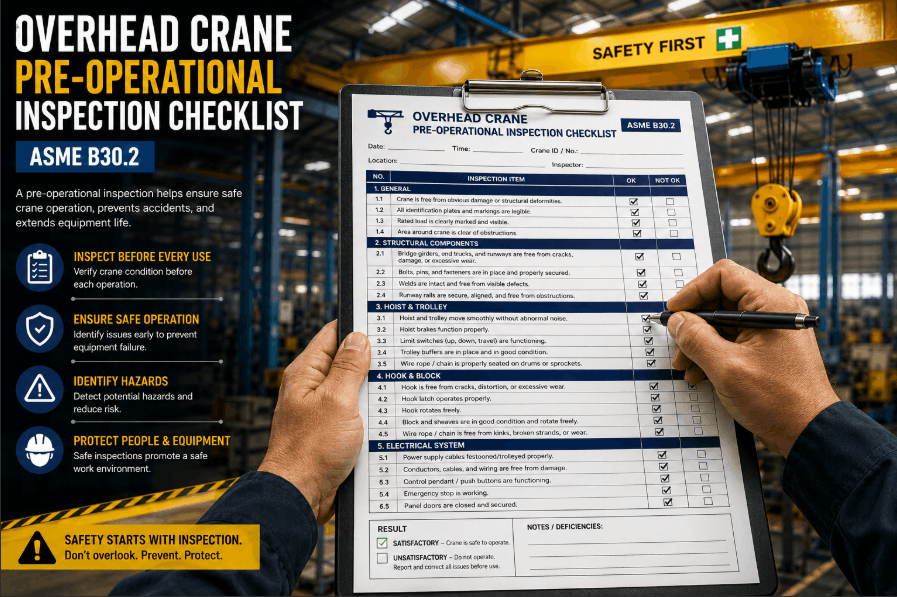
Overhead crane failures don't announce themselves — they occur mid-lift, under load, when a missed inspection item becomes a dropped load or a fatality. ASME B30.2-compliant pre-operational inspections are the frontline defense against unplanned downtime, OSHA citations, and catastrophic crane incidents in manufacturing, steel, shipbuilding, and heavy industry facilities. Studies show that over 80% of crane-related incidents are preventable through disciplined pre-shift inspection protocols. Sign Up Free with OxMaint's CMMS to digitize your entire crane inspection workflow — from hook condition and wire rope integrity to brake performance and limit switch verification — giving your safety team timestamped, auditable inspection records for every crane, every shift, every day. Book a Demo to see how OxMaint replaces paper inspection sheets with real-time compliance dashboards.
The hook is the most critical load-bearing component on any overhead crane. ASME B30.2 mandates removal from service for hooks with throat opening deformation exceeding 15%, visible cracks, or latch mechanism failure — none of these are detectable without a deliberate pre-shift check.
Zone 02
Wire Rope & Reeving System Inspection
Wire rope degradation is progressive and non-obvious. ASME B30.2 defines discard criteria around broken wires per lay length, corrosion severity, and diameter reduction — criteria that can only be evaluated through systematic visual inspection before every operational shift.
Zone 03
Brake System Functional Testing
Brake failure accounts for a disproportionate share of dropped-load incidents. ASME B30.2 requires all brakes — hoist, bridge, and trolley — to be operationally tested before each shift. A brake that passes visual inspection but fails functionally under load is the most dangerous scenario in crane operation.
Digitize Your Crane Inspection Workflow from Pre-Shift to Close-Out
OxMaint replaces paper crane inspection sheets with digital checklists, real-time defect reporting, automated work order creation, and audit-ready compliance records — giving your safety team complete visibility across every crane, every shift. Book a Demo to see the full crane inspection management workflow in action.
Limit switches are the last automated line of defense against over-travel, two-blocking, and structural overload. A limit switch that has been bypassed or has failed undetected removes the safety margin between normal operation and a catastrophic crane incident.
Zone 05
Structural & Mechanical Component Inspection
Bridge girder, end truck, and runway rail integrity are inspected less frequently but deteriorate silently under cyclic fatigue loading. Pre-operational checks catch visible deformation, fastener loss, and rail misalignment before they escalate into structural failure under load.
Zone 06
Electrical System & Conductor Bar Inspection
Crane electrical systems — conductor bars, festoon cables, controls, and motor connections — degrade from vibration, heat cycling, and mechanical contact. Electrical faults cause uncontrolled motion, control system failure, and electrocution hazards that pre-operational checks are specifically designed to catch.
What does ASME B30.2 require for pre-operational crane inspections?
ASME B30.2 requires a visual inspection of all functional operating mechanisms, hook condition, wire rope, limit switches, brakes, and audible warning devices before each shift. Any defect affecting safe operation must result in the crane being taken out of service until repaired.
How does OxMaint support overhead crane inspection compliance?
OxMaint digitizes pre-shift crane inspection checklists, automatically generates corrective work orders on defect detection, tracks equipment out-of-service status, and maintains audit-ready inspection records aligned with ASME B30.2 and OSHA 1910.179. Sign Up Free to replace paper crane sheets today.
How often should wire rope be replaced on an overhead crane?
ASME B30.2 specifies discard criteria rather than fixed replacement intervals — replace when broken wire count per lay exceeds limits, rope diameter reduces beyond 1/3 nominal, or when kinking, corrosion, or heat damage is visible. OxMaint tracks rope install dates and inspection findings to support data-driven replacement decisions.
Who is qualified to perform overhead crane pre-operational inspections?
ASME B30.2 requires inspections to be performed by a designated person — typically the trained crane operator assigned to that unit. Periodic inspections (monthly, annual) require a qualified inspector. OxMaint assigns inspections to specific personnel and records their credentials against each completed inspection.
What happens when a crane defect is found during pre-shift inspection?
The crane must be taken out of service immediately and tagged with an out-of-service notice. A corrective maintenance work order must be raised before the crane returns to operation. OxMaint automates this workflow — a failed checklist item triggers a work order and tags the asset as unavailable in real time. Book a Demo to see defect-to-work-order automation.
What are the OSHA requirements for overhead crane inspections?
OSHA 1910.179 requires pre-shift inspection of all running ropes, hooks, brakes, limit devices, and warning systems before each use. Records must be maintained. OxMaint generates timestamped, digitally-signed inspection records that satisfy OSHA documentation requirements and are retrievable instantly during audits.
Every Crane Inspected. Every Defect Tracked. Every Shift Covered.
OxMaint gives crane safety teams a single platform for digital pre-shift inspections, automated defect-to-work-order workflows, out-of-service tracking, and ASME B30.2-aligned compliance records — replacing paper checklists with real-time visibility across your entire crane fleet. Sign Up Free and run your next crane inspection on OxMaint.