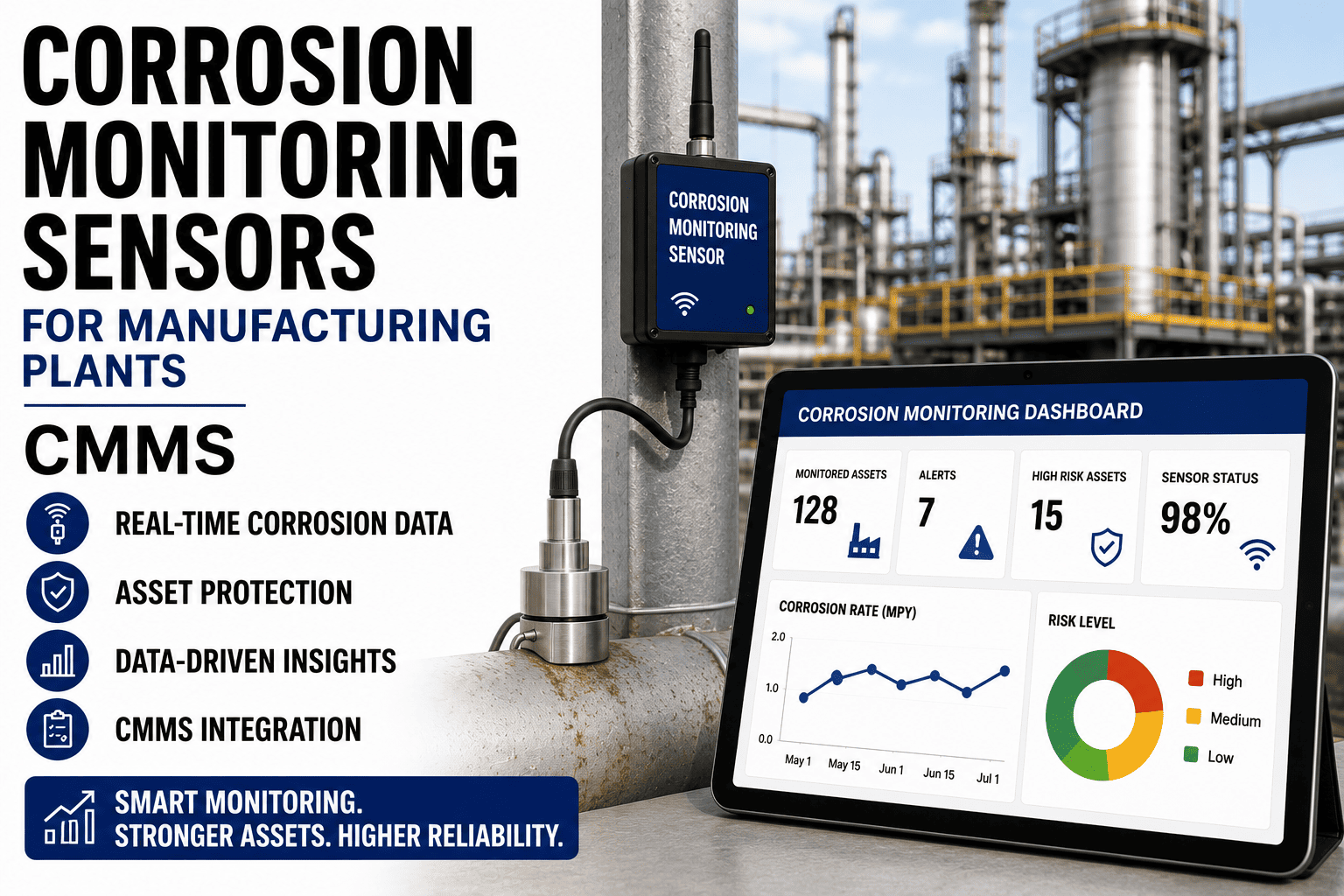
IoT sensors for factory maintenance monitoring are the physical foundation of any condition-based or predictive maintenance program. Without sensors capturing real-time asset condition data from the plant floor, maintenance decisions remain dependent on scheduled inspections, operator observation, and reactive response to failure events that have already caused production impact. With Sign Up Free on Oxmaint, manufacturing maintenance teams can connect IoT sensor data streams to automated work order workflows, asset health dashboards, and predictive maintenance alerts — turning sensor data into scheduled maintenance action rather than unviewed dashboard readings.
Why IoT Sensors Are Transforming Factory Maintenance Monitoring
Traditional maintenance monitoring relies on technicians physically visiting assets on a scheduled interval — capturing a single snapshot of asset condition every week, month, or quarter. IoT sensors replace this episodic view with continuous measurement, capturing hundreds of data points per hour across every monitored parameter. Failures that develop between inspection visits — bearing wear, insulation degradation, pressure creep, thermal stress — are invisible to scheduled inspection programs but fully detectable through continuous sensor monitoring. The gap between when a failure begins developing and when it becomes a catastrophic event is the window that IoT monitoring preserves for maintenance intervention. Book a Demo to see how Oxmaint connects IoT condition alerts to predictive maintenance workflows.
Types of IoT Sensors Used in Factory Maintenance Monitoring
Each failure mode is detectable through specific measurable parameters — and each parameter requires a specific sensor type. Selecting the right sensor for each failure mode is the first engineering decision in any IoT maintenance monitoring deployment, and the one with the most direct impact on detection accuracy. Sign Up Free to configure Oxmaint's asset registry for IoT sensor data linkage and condition threshold management.
Vibration sensors detect mechanical anomalies in rotating equipment — bearing defects, imbalance, misalignment, looseness, and gear wear — through changes in vibration frequency spectrum and amplitude. Wireless MEMS accelerometers have reduced the deployment cost of vibration monitoring to the point where continuous monitoring on motors, pumps, fans, and conveyors is economically viable even for small and mid-size plants. Vibration signatures analyzed in Oxmaint can trigger work orders automatically when frequency deviation thresholds are exceeded.
Temperature monitoring detects lubrication failure, overloading, insulation breakdown, and process deviations through rising thermal signatures in bearings, motor windings, and electrical cabinets. Wireless temperature sensors on motor housings and bearing blocks provide continuous monitoring with low installation cost and minimal wiring. Infrared thermal sensors enable non-contact monitoring of electrical panels and bus connections without opening enclosures.
Motor current monitoring detects mechanical load changes, winding degradation, voltage imbalance, and bearing wear through current signature analysis — without requiring physical access to the motor shaft or housing. Current transformers clamp around power cables during installation and begin monitoring immediately. Rising current draw without load increase, or specific harmonic signatures in the current waveform, indicate developing mechanical or electrical faults.
Pressure and flow sensors monitor hydraulic systems, compressed air networks, cooling circuits, and process fluid delivery for deviations that indicate pump wear, valve degradation, filter blockage, or leak development. Differential pressure across filters quantifies clogging progression — enabling condition-based filter replacement rather than fixed-interval PM that either replaces filters too early or misses failures between scheduled dates.
IoT Sensor Selection Guide by Asset Type and Failure Mode
Matching sensor types to asset categories and specific failure modes prevents both under-monitoring — missing detectable failure precursors — and over-instrumenting assets where simpler inspection methods would suffice. The framework below guides initial sensor selection for the most common manufacturing asset categories. Book a Demo to discuss sensor-to-Oxmaint integration for your facility's specific asset mix.
| Asset Type | Primary Failure Modes | Recommended Sensors | Monitoring Priority | Oxmaint Alert Action |
|---|---|---|---|---|
| Electric Motors | Bearing wear, winding insulation, imbalance | Vibration + temperature + current | High (all production motors) | Predictive WO auto-generate |
| Pumps | Cavitation, seal wear, impeller erosion | Vibration + flow + pressure differential | High (critical process pumps) | Threshold alert + WO creation |
| Compressors | Valve wear, bearing failure, pressure loss | Vibration + discharge temperature + pressure | Critical (production-critical only) | P1 WO + escalation notification |
| Conveyors | Belt misalignment, gearbox wear, roller failure | Vibration + temperature (gearbox) | Medium (high-utilization lines) | Trend alert + scheduled WO |
| Electrical Panels | Connection heating, breaker aging, bus failure | Infrared temperature (periodic) + fixed sensors | High (main distribution panels) | Inspection WO on threshold breach |
| Hydraulic Systems | Filter saturation, pump wear, seal leakage | Pressure differential + temperature + flow | Medium to high (press lines) | Condition-based filter PM WO |
Deploying IoT Sensors for Factory Maintenance: Implementation Roadmap
Tier and Prioritize Assets for Sensor Deployment
Categorize production assets into criticality tiers based on downtime cost, repair duration, and consequence of failure. Use Oxmaint's asset failure history to identify which assets have generated the most unplanned downtime and rank them for initial sensor deployment. Starting with Tier-1 assets — those where a single failure event costs more than the sensor installation — maximizes program ROI and builds organizational confidence before broader rollout.
Select Sensors and Define Installation Architecture
Choose sensor types matched to the specific failure modes of each priority asset, using the selection framework above. Decide between wired and wireless connectivity based on plant layout, update frequency requirements, and available network infrastructure. For most manufacturing environments, wireless vibration and temperature sensors with a local gateway represent the fastest path to operational monitoring without infrastructure delays.
Establish Baseline Readings During Normal Operation
After sensor installation, capture 2 to 4 weeks of baseline data during normal operating conditions — at various loads, temperatures, and speeds if applicable. This baseline establishes the normal operating envelope for each parameter, enabling alert thresholds to be set relative to asset-specific normal behavior rather than generic industry values that may not reflect your equipment's operating conditions.
Configure Alert Thresholds and Connect to Oxmaint Workflows
Set alert thresholds at warning and critical levels relative to established baselines. Configure the IoT platform to trigger Oxmaint work orders automatically when thresholds are exceeded — with severity classification, asset ID, sensor parameter, and deviation magnitude pre-populated. This connection is what converts condition monitoring data from a display into a maintenance action trigger that captures the full value of sensor investment.
Validate, Refine, and Expand Coverage Incrementally
After the first 90 days of operation, review alert accuracy — what percentage of threshold breaches led to confirmed maintenance findings, and how many actual failures occurred without prior alert? Use this data to adjust thresholds, add sensor measurement points on assets that produced surprise failures, and build the business case for expanding coverage to Tier-2 assets. Continuous refinement is what transforms an initial sensor deployment into a mature predictive maintenance program.
IoT Sensor Monitoring KPIs to Track in Your CMMS
The right KPIs measure both the performance of the sensor infrastructure itself and the maintenance outcomes it enables — ensuring the program is generating the failure prevention and cost reduction results that justify ongoing sensor investment. Sign Up Free to access Oxmaint's IoT-integrated asset health KPI dashboards.
Tracks the percentage of time each sensor is transmitting valid data. Availability gaps on critical assets create monitoring blind spots — a sensor that is offline during the period a bearing failure begins developing provides no more protection than no sensor at all.
The percentage of sensor threshold alerts that result in a confirmed maintenance finding when the work order is executed. Rates below 50% generate alert fatigue — technicians begin ignoring alerts before acting on them, eliminating the program's ability to prevent failures even when genuine precursor signatures are detected.
Tracks failures on IoT-monitored assets that occurred without a preceding sensor alert. Any failure on a monitored asset that was not predicted indicates either a sensor coverage gap, a threshold set too high to catch early-stage degradation, or a failure mode not captured by current sensor types.
Compares mean time between failures for IoT-monitored assets against the pre-monitoring baseline from Oxmaint work order history. MTBF improvement on monitored assets quantifies the direct reliability benefit of condition-based intervention and provides the most compelling ROI evidence for program expansion.
Measures elapsed time from sensor threshold breach to work order creation and technician assignment. Slow response times erode the advance warning advantage of IoT monitoring — a bearing that progresses from warning to critical threshold in 48 hours provides no benefit if the work order is not created for 72 hours.
Tracks the percentage of Tier-1 critical assets with active IoT sensor coverage. Gaps represent unmonitored risk where failures will always produce reactive, unplanned downtime regardless of program maturity on the monitored asset population.