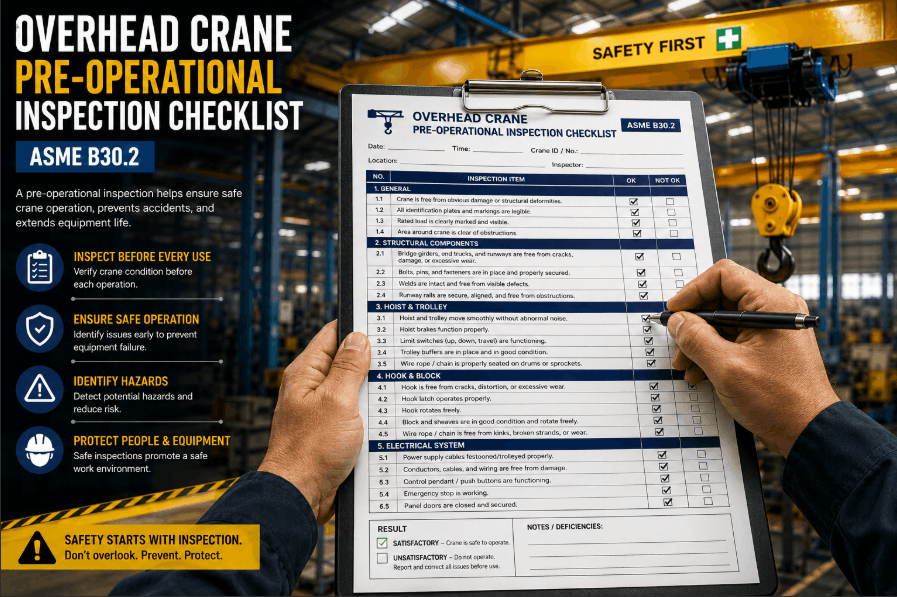
In U.S. manufacturing plants, overhead cranes and hoists move millions of pounds of material every single day — and when one fails, the consequences are not measured in lost production hours but in lives. Manufacturing accounts for roughly 24% of all crane-related fatalities nationwide, with dropped loads, wire rope failures, and rigging errors making up the bulk of incidents. OSHA 1910.179 and ASME B30.2 / B30.16 require documented inspections at three distinct intervals — every shift, every month, and every year — yet audits routinely find plants relying on memory, paper logs, or "we inspected it last week" culture. A structured crane and hoist maintenance and inspection programme protects workers, keeps production running, and creates the audit trail regulators demand. This guide walks through every inspection tier, every failure mode, and every wire rope rejection criterion your team needs to know — and you can turn the entire programme into a digital crane inspection system with OxMaint.
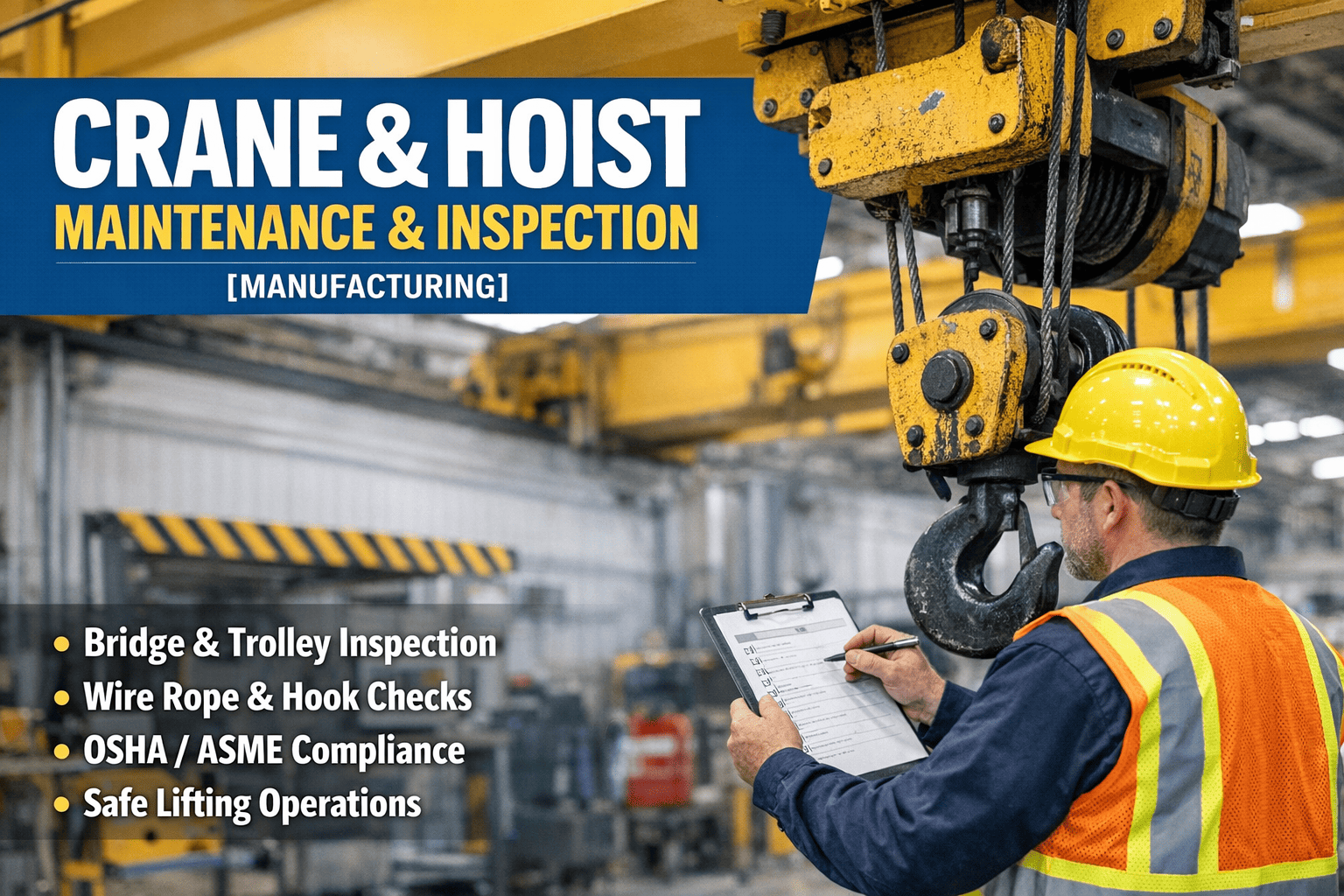
Crane & Hoist Maintenance and Inspection for Manufacturing
A three-tier inspection programme — shift, monthly, and annual — covering bridge structure, trolley systems, hoist mechanics, wire rope, hooks, brakes, and electrical controls in full alignment with OSHA 1910.179, ASME B30.2, and ASME B30.16.
How OSHA and ASME Structure Crane Inspections
Overhead cranes and hoists are not inspected on a single schedule — regulators require three distinct tiers, each with different personnel qualifications, different checklists, and different documentation rules. Missing any one of the three is a standalone OSHA violation, regardless of whether the other two are being performed perfectly. Understanding the boundary between tiers is the first step toward a defensible programme.
Frequent Inspection (Functional)
A visual and operational check performed before each shift by a designated, trained operator. No formal certification required, but training must be documented. Focuses on controls, brakes, limit switches, hook latches, and any obvious damage. Records are not required by OSHA but are best-practice for liability protection.
Frequent Inspection (Monthly Documented)
A deeper functional check focused on hooks, chains, and wire rope. OSHA 1910.179 requires a written certification record including date, inspector signature, and the serial number or identifier of each inspected component. Records must be retained and produced during any OSHA audit.
Periodic Comprehensive Inspection
A full teardown-level inspection of the entire crane — structural members, bearings, gearing, electrical components, fasteners, and load-bearing parts. Must be performed by a qualified person with a recognised degree, certificate, or demonstrable expertise (typically NCCCO-certified or manufacturer-trained). Documentation is retained for the life of the crane.
Seven Subsystems That Define Crane Health
Every inspection item in every tier maps to one of seven crane and hoist subsystems. Assigning each checklist item to a subsystem helps technicians understand what they are actually protecting — and helps maintenance managers spot which subsystem is consuming the most reactive repair budget.
Bridge & Runway Structure
Girders, end trucks, runway rails, and bolted connections. Structural cracking and loose fasteners are the rarest but most catastrophic failure mode.
Trolley System
Trolley wheels, travel drive, traverse motor, and trolley rails. Alignment drift accelerates wheel flange wear and creates track impact damage.
Hoist Drive & Gearbox
Hoist motor, gear train, drum, and couplings. Oil degradation and bearing wear create the creep that ultimately drops loads.
Wire Rope & Drum
Load rope, sheaves, drum grooves, and end terminations. Broken wires, birdcaging, and diameter loss are the leading OSHA-cited defects on overhead cranes.
Hook & Rigging
Hook body, safety latch, shank, swivel bearing, and attached slings. Throat opening growth and latch failure are easy to spot but frequently missed.
Brakes & Limits
Holding brakes, control brakes, upper limit switches, travel limits, and emergency stop circuits. Single-point-of-failure components that demand monthly test-and-document.
Electrical & Controls
Power collectors, festoon, pendant or radio controls, contactors, and overload protection. Moisture, contactor wear, and worn conductor bars drive most faults.
Pre-Shift Crane Inspection (Operator, Every Shift)
The shift inspection is fast — typically 5 to 10 minutes per crane — and is performed by the operator before the first lift of the day. It is a no-load functional check designed to surface failures that developed since the last shift. Skipping this check is the single most common citation OSHA writes during plant inspections.
Turn Every Shift Check into a Digital Record
OxMaint converts your shift inspection into a mobile checklist operators complete in under five minutes — photo evidence, digital sign-off, and automatic alerts when a critical item fails.
Monthly Documented Inspection (Competent Person)
OSHA requires the monthly inspection to be documented in writing with the inspector's signature, date, and serial number of every wire rope and hook inspected. This is the tier where most plants fail audits — either the records do not exist, are not signed, or cannot be tied to a specific component identifier. Every item below must be documented on a retained certification record.
Wire Rope Rejection Thresholds (ASME B30.2 & B30.30)
Wire rope failure under load is the most catastrophic defect an overhead crane can develop — a parted rope means a dropped load, and dropped loads cause roughly 27% of fatal industrial crane incidents. ASME defines precise, non-negotiable rejection thresholds. When any one of these conditions is observed, the rope must be removed from service before the next lift — no exceptions.
| Defect Type | Rejection Criterion | Inspection Method |
|---|---|---|
| Broken Outer Wires | 6 or more randomly distributed in one rope lay; 3 or more in one strand in one lay | Visual count, full length |
| Broken Wires at End Connections | 1 or more broken wires adjacent to a socket or wedge termination | Close visual at terminations |
| Diameter Reduction | Greater than 5% loss from nominal diameter at any single location | Caliper measurement, multiple points |
| Birdcaging / Crushing | Any distortion of rope structure — core protrusion, strand displacement, kinks | Visual inspection |
| Corrosion | Severe pitting, rust, or evidence of internal corrosion affecting individual wires | Visual + tactile check |
| Heat Damage | Any evidence of melted or heat-affected zones — metallic discolouration | Visual inspection |
| Kinks / Doglegs | Any severe permanent distortion that cannot be straightened without damaging wires | Visual inspection |
| Lubrication | Dry, rust-affected, or insufficient lubrication — compromises remaining rope life | Visual + tactile check |
ASME Hoist Service Classes & Inspection Frequency
A hoist running two lifts per shift in a maintenance bay is inspected very differently from a hoist cycling continuously in a steel mill. ASME B30.16 classifies hoists into three service duty tiers, and each tier drives its own inspection cadence. Getting the service class wrong is a common failure point — plants assume "normal" when the actual duty is "heavy" or "severe."
Distributed loads below 65% of rated capacity, irregular operation with long idle periods.
Loads regularly approaching rated capacity, high frequency operation across most of each shift.
Loads at or near rated capacity, continuous cycling, adverse environments — steel, foundry, mill duty.
Annual Comprehensive Inspection (Qualified Person)
The annual inspection is the most thorough — and the most expensive — and it is where hidden deterioration finally surfaces. Items below the shift and monthly radar for eleven months now get full examination, measurement, and load testing. This is also where a qualified person, typically an NCCCO-certified inspector or the OEM, must sign and seal the final report for legal record.
Structural & Load Path
Full inspection of bridge girders for cracks, deformation, or fatigue signs. All bolted structural connections torque-checked. End trucks and runway rails surveyed for alignment. Any welded repairs reviewed against the manufacturer's original design specification.
Hoist Teardown Review
Gear case opened and internal gears inspected for tooth wear, pitting, or spalling. Gear oil sampled and analysed. Hoist drum thoroughly measured for groove wear. Bearings checked for play, end-float, and operating temperature trend.
Load Test
Rated load test performed per manufacturer and ASME requirements — typically 100% to 125% of rated capacity depending on whether the crane was repaired or altered. Hoist brake stopping distance measured under load and compared to specification.
Electrical Insulation & Controls
Megger testing on hoist and trolley motors. Contactor contact condition inspected and arc horns replaced if pitted. VFD parameter backup and fault log review. Overload relay settings verified against motor nameplate.
Safety System Verification
All limit switches, emergency stops, anti-two-block devices, and overload protection tested end-to-end. Warning devices and lighting verified. Lock-out / tag-out procedure reviewed and updated for any equipment changes since the last annual inspection.
Documentation & Certification
Full signed and sealed inspection report including all measurements, deficiencies, corrective actions, and serial numbers. Report retained for the life of the crane and produced on demand during any OSHA audit or insurance review.
What Skipped Inspections Actually Look Like
Crane failures almost never happen without warning — they happen because warnings were missed. Below is the typical progression from a skipped shift inspection to a reportable incident, drawn from OSHA's published fatality investigations.
Shift Inspection Skipped
Operator starts lifting without checking the hook latch, wire rope, or brake response. A broken wire that developed on the previous shift goes undocumented.
Rope Damage Accelerates
Broken wires multiply at the high-flex point where rope enters the drum. A few more join them. Each lift propagates more fatigue, but no inspection catches them.
Monthly Inspection Skipped or Faked
The paper form gets signed but no one actually counts broken wires. The rope's ASME rejection threshold is quietly exceeded while documentation suggests "no deficiencies."
Rope Parts Under Load
During a routine lift at 70% rated capacity, the rope fails at the damage concentration point. The load drops. OSHA arrives, issues multiple citations, and penalties begin compounding.
Why Manufacturers Move to Digital Crane Inspections
Paper crane inspection forms fail in the exact way regulators have the lowest tolerance for — missing records, illegible signatures, forms that cannot be tied to a specific asset, and no way to prove a critical defect was actually acted on. OxMaint replaces paper with a digital PM system designed specifically for heavy equipment compliance.
Asset-Linked Inspection Records
Every shift, monthly, and annual inspection is tied to a unique crane or hoist asset ID with serial numbers for wire rope and hooks. When OSHA asks to see the record for a specific component, it is one click away — not one filing cabinet away.
Photo-Verified Sign-Off
Every critical checklist item — wire rope condition, hook throat, brake response — requires a timestamped photo before the task can be marked complete. Faked inspections become impossible.
Automatic Interval Scheduling
OxMaint schedules the next monthly or annual inspection automatically based on the last completion date. No more "did we inspect crane 4 last month?" — the system knows, and so do your inspectors.
Failure-to-Work-Order Automation
Any failed inspection item auto-creates a corrective work order assigned to maintenance, with a required resolution deadline. The audit trail shows the defect was found, acknowledged, and repaired — exactly what OSHA looks for.
Wire Rope & Hook Registry
Each wire rope, hook, and sling is registered with install date, service hours, and inspection history. Rejection-criteria flags surface automatically when diameter, broken wire count, or throat opening cross the ASME threshold.
Audit-Ready Reporting
One click produces a full compliance report — every inspection, every signature, every photo, every corrective action — formatted for OSHA, your insurer, or your internal safety committee.
Frequently Asked Questions
How often does OSHA require overhead crane inspections?
Who is qualified to perform crane inspections?
When must wire rope be removed from service?
What documents must we keep for OSHA compliance?
Do hoists need separate inspections from the crane itself?
How much can an OSHA crane violation cost?
Stop Trusting Paper for Your Most Dangerous Equipment
OxMaint gives your crane and hoist programme a digital backbone — shift checks on mobile, monthly documentation that OSHA cannot dispute, annual reports signed and archived, and photo evidence for every critical item. One platform. Every inspection tier. Every asset.