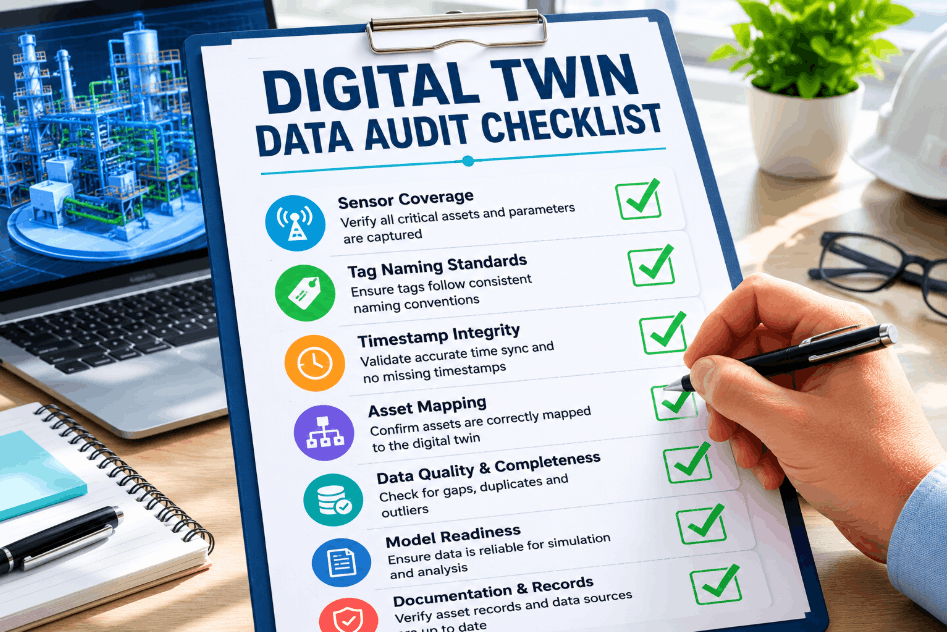
A digital twin data model that cannot maintain alignment between simulation outputs, live telemetry feeds, and maintenance history records is not a digital twin — it is a disconnected collection of data sources that each tell a different story about the same asset. Production facilities building digital twin programs need a structured data model that defines asset schema, maps telemetry to maintenance context, and governs how simulation parameters are updated when real-world asset conditions change. Maintenance teams using Sign Up Free on OxMaint can anchor digital twin programs with structured asset records, maintenance history, and real-time condition data — providing the operational context layer that simulation and telemetry systems require to stay calibrated to actual equipment state throughout the asset lifecycle.
Why Digital Twin Data Models Drift from Asset Reality
Digital twin programs frequently launch with strong simulation fidelity and then progressively degrade as the physical asset diverges from the model — through component replacements, configuration changes, wear state shifts, and maintenance interventions that are never reflected in the twin's data layer. Without a governed data model that links simulation parameters to live maintenance records and telemetry feeds, the twin becomes a historical artifact rather than a real-time decision tool. Book a Demo to see how OxMaint's asset register, work order records, and condition monitoring integration give digital twin programs the maintenance context layer they need to stay accurate over time.
Six Data Layers in a Production Asset Digital Twin Model
A complete digital twin data model for production assets requires more than telemetry ingestion and simulation rendering. It requires a structured architecture that aligns physical asset hierarchy, operational telemetry, maintenance records, and simulation parameters into a single governed data model that stays current through every asset lifecycle event. Sign Up Free to start building the asset register and maintenance data foundation that digital twin programs require to operate at production fidelity.
Asset Schema and Physical Hierarchy Definition
The digital twin data model begins with a precisely defined asset schema — identifying equipment class, subcomponent hierarchy, nameplate specifications, and installation configuration. OxMaint's asset register structures this hierarchy at the level of detail digital twin simulations require to model component-level behavior, not just equipment-class averages.
Telemetry Schema and Sensor-to-Asset Mapping
Each telemetry stream must be mapped to a specific asset node in the hierarchy — not treated as a free-floating data feed. OxMaint connects condition monitoring sensor data to asset records, ensuring telemetry readings are interpreted against the correct equipment specifications, operating envelopes, and alert thresholds for each monitored asset.
Maintenance History as Simulation Context
Simulation accuracy degrades without visibility into what has been done to the asset — what was replaced, when, with what specification, by what procedure. OxMaint work order records provide structured maintenance history at the component level, giving digital twin models the intervention timeline required to calibrate degradation curves and failure probability distributions accurately.
Failure Mode and Fault Signature Library
Digital twin simulations require a structured fault signature library that maps developing failure conditions to observable telemetry patterns. OxMaint's failure history records — fault codes, symptom descriptions, diagnosed causes, and corrective actions — provide the empirical failure mode dataset that calibrates twin-based anomaly detection models for each asset class.
Configuration Change and Asset Modification Governance
Every asset configuration change — component substitution, process parameter adjustment, operating mode modification — must be reflected in the digital twin model to prevent simulation divergence. OxMaint's change management records create an auditable configuration timeline that digital twin governance processes can consume to trigger model parameter updates when physical assets change.
Operational Context and Production Mode Tagging
Asset behavior varies significantly by production mode, load level, and process fluid condition. OxMaint's work order and inspection records carry operational context tags — load conditions, product grade, throughput rate — that allow digital twin models to interpret telemetry against the correct operating baseline rather than a single average-conditions model.
Digital Twin Data Requirements by Asset Class
Data model requirements vary by asset complexity, failure consequence, and simulation fidelity needed to drive actionable maintenance decisions. Mapping data requirements to asset class prevents over-engineering twin models for low-criticality equipment while under-specifying them for high-consequence assets. Book a Demo to explore how OxMaint's asset management platform supports digital twin data governance across production asset classes.
| Asset Class | Key Telemetry Inputs | Critical Maintenance Context | Twin Model Priority | OxMaint Data Layer |
|---|---|---|---|---|
| Rotating Machinery | Vibration, temperature, bearing load | Bearing replacement history, alignment records | High — failure prediction | Work order history + sensor-to-asset mapping |
| Heat Transfer Equipment | Flow rate, pressure drop, outlet temperature | Fouling inspection intervals, tube bundle history | Medium — efficiency modeling | Inspection records + operating condition tags |
| Electrical Drive Systems | Current draw, harmonic distortion, thermal imaging | Insulation test history, VFD configuration changes | High — failure mode detection | Fault history + configuration change log |
| Conveyance and Material Handling | Belt tension, motor load, throughput rate | Belt replacement, drive component service records | Medium — throughput optimization | PM records + parts consumption history |
| Process Control Valves | Actuator travel, response time, leakage rate | Packing replacement, seat refurbishment history | High — process safety implications | Work order completion records + specification tracking |
How Incomplete Twin Data Models Undermine Maintenance Decisions
A digital twin built on telemetry alone — without structured maintenance history, configuration records, and operational context — generates predictions that cannot be validated against real asset behavior and interventions that cannot be explained to maintenance engineers. The result is a simulation tool that production teams stop trusting. OxMaint provides the maintenance data foundation that prevents this outcome by keeping twin models connected to the actual history and current state of the physical assets they represent. Sign Up Free to build the asset data foundation your digital twin program requires to deliver production-relevant insights rather than ungrounded predictions.
Implementing a Digital Twin Data Model with OxMaint
Define Asset Schema and Register Production Asset Hierarchy
Build structured asset records in OxMaint for each production asset targeted for digital twin implementation — capturing nameplate specifications, subcomponent hierarchy, installation configuration, and criticality classification. This asset schema becomes the structural backbone of the twin data model.
Map Telemetry Streams to Asset Nodes in OxMaint
Connect condition monitoring sensor data to the specific asset records in OxMaint that each sensor monitors. Define alert thresholds and operating envelopes at the asset level — creating the sensor-to-asset mapping that makes telemetry data interpretable in the context of each asset's specifications.
Load Historical Maintenance Records as Baseline Context
Import existing maintenance history into OxMaint work order records for each digital twin target asset — failure events, repair actions, parts replaced, and inspection findings. This historical dataset provides the failure mode baseline and intervention timeline that calibrates twin simulation parameters from initial deployment.
Establish Configuration Change Governance Linked to Twin Updates
Define change management workflows in OxMaint that capture component replacements, specification changes, and configuration modifications as structured records. Create governance triggers that initiate twin model parameter reviews whenever a significant asset change is recorded — preventing simulation drift from accumulating undetected.
Review Twin Prediction Accuracy Against Maintenance Outcomes
Compare digital twin failure predictions against actual failure events recorded in OxMaint work orders each quarter. Use prediction accuracy tracking to identify model calibration gaps, update fault signature libraries, and refine simulation parameters — building a continuously improving twin model grounded in real operational outcomes.
Frequently Asked Questions: Digital Twin Data Model for Production Assets
What is a digital twin data model for production assets?
A digital twin data model defines the structured schema that connects a virtual asset representation to live telemetry, maintenance history, and simulation parameters — ensuring the twin reflects the actual current state of the physical asset it represents.
Why does maintenance context matter in a digital twin data model?
Telemetry alone cannot explain why an asset's behavior changes — maintenance interventions, component replacements, and configuration modifications are the causal context. Without maintenance records, digital twin predictions lose accuracy progressively as asset state diverges from the simulation baseline.
How does OxMaint support digital twin data alignment?
OxMaint provides structured asset records, work order history, condition monitoring integration, and configuration change records that digital twin programs use as the maintenance context layer — keeping simulation parameters grounded in actual asset conditions and intervention history.
What causes digital twin model drift?
Model drift occurs when component replacements, configuration changes, and operating condition shifts are not reflected in the twin's data model. Governed change management workflows in OxMaint trigger model parameter reviews after significant asset changes — preventing drift from accumulating.
How often should digital twin data models be recalibrated?
Recalibration should be triggered by significant maintenance events, configuration changes, or anomalous prediction performance — not on a fixed calendar schedule. OxMaint's work order and change management records provide the event-driven triggers that keep recalibration timely rather than periodic.