The digital thread for manufacturing maintenance asset data connects every record of an asset's lifecycle — from CAD models and OEM specifications through commissioning, preventive maintenance, repairs, and retirement — into one continuous, queryable history. For plants still managing this thread across disconnected spreadsheets, paper work orders, and siloed CMMS databases, the cost is measured in 20-40% higher unplanned downtime and millions in avoidable replacement spending. A manufacturing digital thread turns maintenance from reactive event logging into lifecycle intelligence, and platforms like OxMaint make that thread actionable by serving as the living CMMS asset master where design data, field telemetry, and work history converge. You can explore the platform with a Start Free Trial or book a personalized walkthrough to see it on your own asset hierarchy.
Can your CMMS see what design engineering built — and what the plant floor actually fixed?
Most maintenance teams inherit assets with no design context. The manufacturing data thread closes that gap, linking CAD, PLM, OEM manuals, and historian telemetry to every work order — so reliability decisions are made with the full lifecycle in view, not just the last breakdown.
What is the digital thread for manufacturing maintenance asset data?
A digital thread is the connected flow of data that follows a physical asset from its conceptual design through commissioning, operation, maintenance, and disposal. In a manufacturing plant, that thread stitches together at least five systems that traditionally don't talk to each other — and the CMMS sits at the center as the operational system of record.
Design & Engineering
CAD models, PLM revision history, and OEM equipment specifications define what the asset was built to do — tolerances, duty cycles, bill of materials, and expected failure modes.
Install & Commissioning
Installation qualifications, baseline sensor readings, startup checklists, and acceptance test results establish the as-built condition and original performance benchmarks.
CMMS Asset Master
The central hub — asset hierarchy, preventive maintenance schedules, work order history, spare parts inventory, and compliance records. This is where OxMaint anchors the thread.
Condition & Telemetry
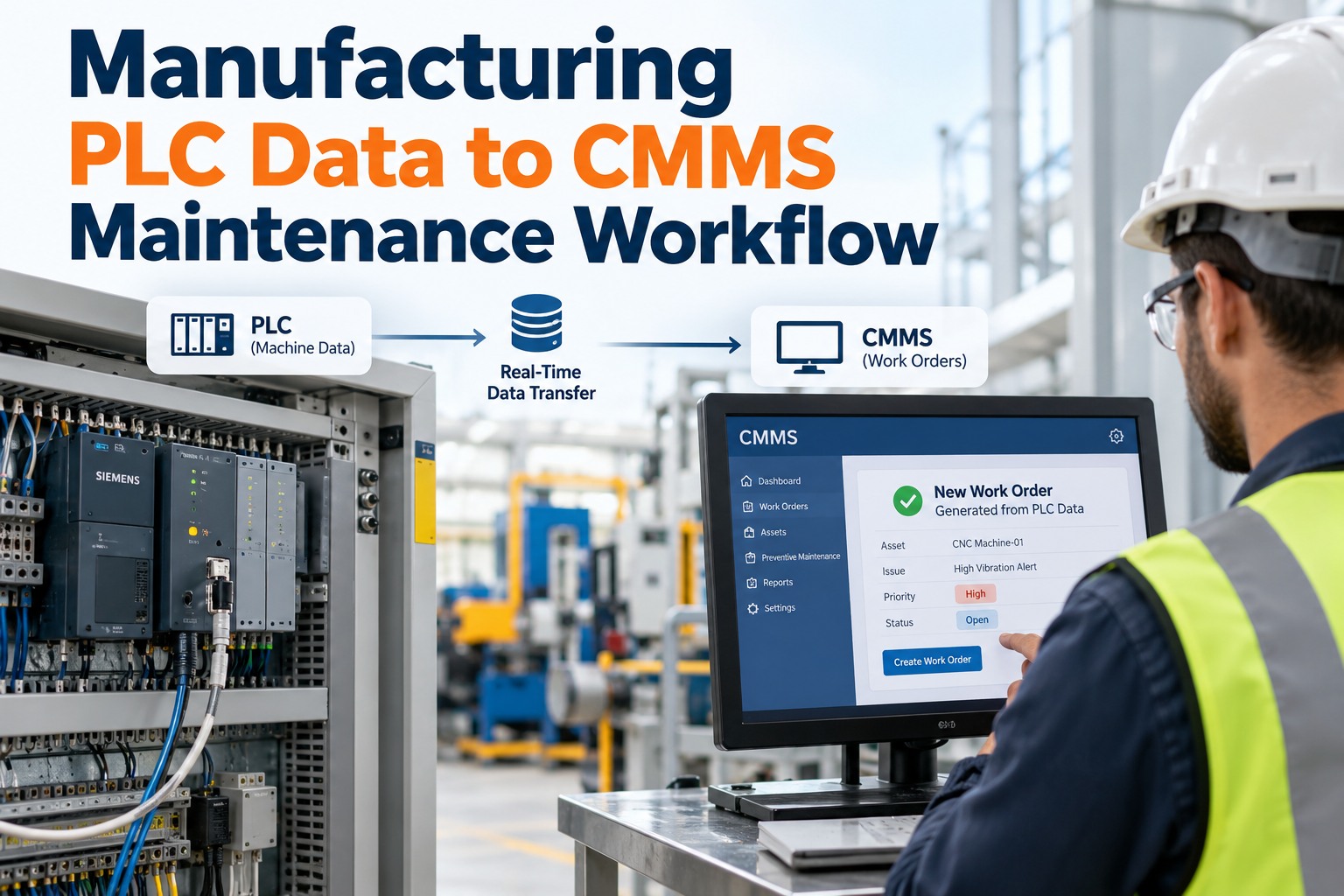
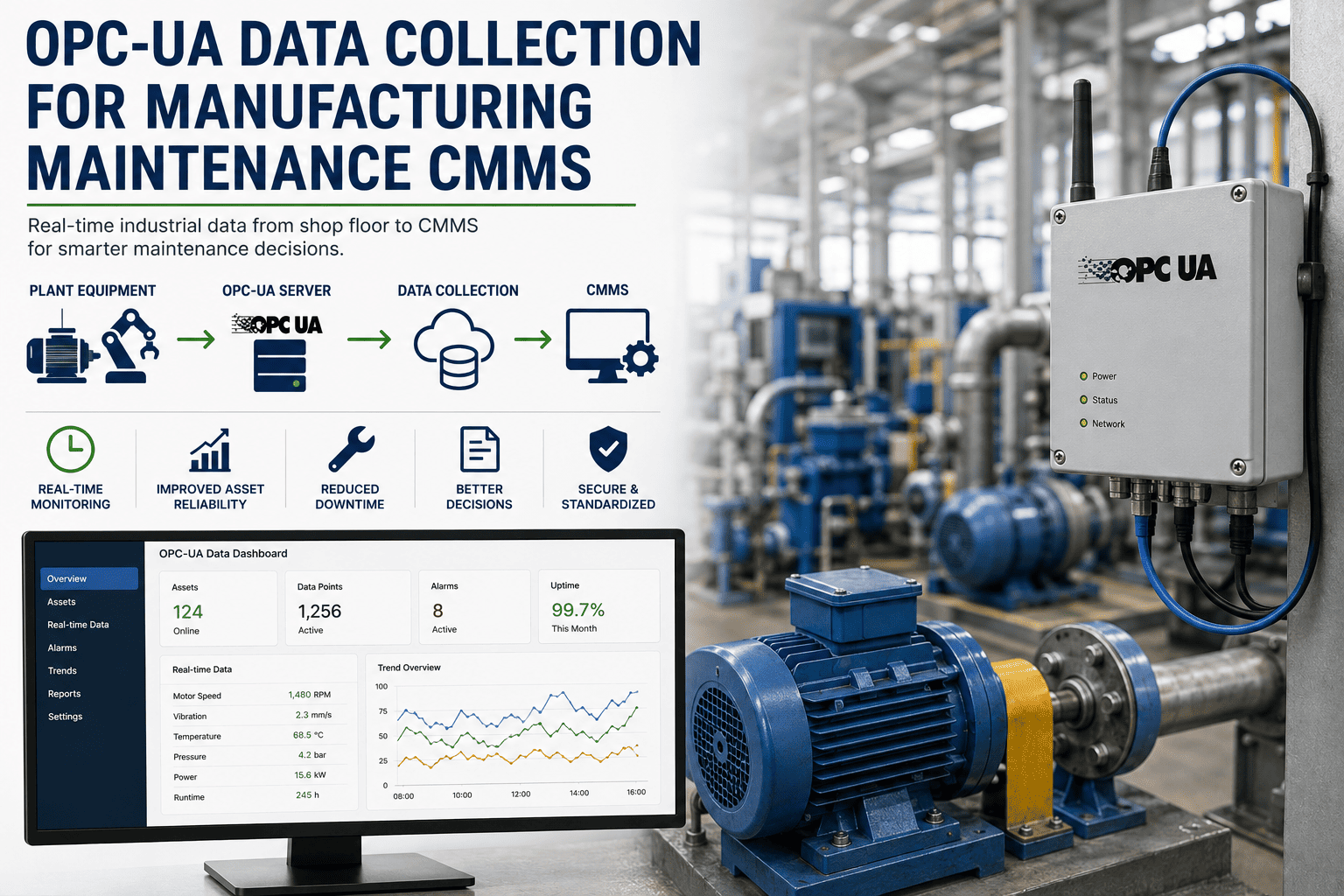
Historian data, IoT sensor streams, vibration analysis, and oil-sample results feed real-time asset health back into the CMMS to trigger predictive work orders before failure.
Feedback to Design
Closed-loop failure data flows back to engineering: which components fail early, which PM intervals are too aggressive, which OEM specs don't match plant reality.
Which systems feed the plant digital thread for maintenance?
A true manufacturing maintenance thread is not a single tool — it is the governed exchange of data across systems that already exist in your plant. The table below maps each contributing system, what it provides, and how it connects to the CMMS asset thread.
| System | Data Contributed to the Thread | Role in Maintenance Intelligence |
|---|---|---|
| CAD / PLM | 3D models, BOM, revision history, engineering tolerances | Provides design intent so technicians know OEM specs and acceptable wear limits |
| OEM Portals | Equipment manuals, service bulletins, warranty data, recommended PMs | Seeds the initial PM schedule and alerts maintenance to OEM recalls or updates |
| CMMS / EAM | Asset hierarchy, work orders, PM schedules, costs, labor hours | Serves as the operational hub where all lifecycle data is queried and acted on |
| Historian / SCADA | Vibration, temperature, pressure, run-hours, amperage trends | Feeds condition-based triggers and predictive models into the CMMS |
| ERP / Inventory | Spare parts stock levels, reorder points, purchase orders | Ensures parts availability is visible when a work order is planned |
| MES / Quality | Production counts, scrap rates, OEE, downtime reasons | Links maintenance actions to production impact and quality loss events |
How to build a digital thread for asset data in 6 phases
Building a CMMS digital thread is not a rip-and-replace project. Plants that succeed do it in phased increments, starting with the asset master and extending outward. Here is the proven six-phase roadmap most mid-to-large manufacturers follow over 6–9 months.
Audit the asset master
Inventory every critical asset in the CMMS. De-duplicate records, verify location hierarchy, and flag missing OEM data. Most plants find 15–25% of CMMS asset records are stale or orphaned at this stage.
Import design and OEM data
Link CAD drawings, PLM revision numbers, and OEM equipment manuals to each asset record. Even a PDF attached to the asset card saves a technician 10–15 minutes per work order lookup.
Standardize failure codes
Adopt ISO 14224 or a custom failure-code taxonomy so every work order captures problem, cause, and remedy in structured fields — not free-text notes that can't be analyzed.
Connect historian telemetry
Pipe run-hours, vibration, and temperature data into the CMMS so PMs trigger on actual condition rather than calendar intervals — cutting unnecessary PM labor by 20–30%.
Enable predictive models
Apply AI-driven failure prediction on connected assets. OxMaint's analytics engine flags anomaly patterns 5–21 days before functional failure, generating work orders automatically.
Close the loop to engineering
Export recurring failure patterns and MTBF trends back to design engineering and OEMs. This feedback drives spec improvements, vendor scorecards, and capital replacement decisions.
What the digital thread delivers: a 180-asset plant scenario
Consider a mid-sized food manufacturing plant with 180 critical assets — mixers, conveyors, HVAC, and packaging lines — spending roughly $42,000 per year on unplanned downtime and emergency repair labor. Here is how connecting the digital thread through a CMMS changes the math in year one.
Disconnected maintenance
- ✕ Average 4.2 hours to diagnose a failure — no OEM specs on hand
- ✕ 60% of PMs executed on calendar intervals regardless of condition
- ✕ $42K/yr unplanned downtime + $18K/yr unnecessary PM labor
- ✕ Repeat failures on 3 critical conveyors — no root-cause visibility
Connected lifecycle intelligence
- ✓ Diagnosis time drops to 1.1 hours — CAD and OEM data live in the work order
- ✓ 70% of PMs shift to condition-based, cutting PM labor by $12K/yr
- ✓ Predictive alerts prevent 8 major failures, saving $28K in downtime
- ✓ Failure-code analysis reveals misaligned sprocket spec → engineering fix
Downtime avoided ($28K) + PM labor saved ($12K) + diagnosis time saved ($9K) − Platform + implementation cost ($11K) = $38,000 net year-one savings
How OxMaint closes the CMMS digital thread for your plant
OxMaint is built to be the operational hub of your manufacturing data thread — not just a work-order tool, but the system where design context, condition telemetry, and maintenance history become a single, queryable record per asset. Here is what that looks like in practice.
Unified asset master
Every asset record carries its OEM specs, CAD attachments, PLM revision, installed baseline, and full work-order history in one place. Technicians stop searching five systems and start fixing with full context — cutting diagnosis time by 60–75%.
Predictive analytics engine
OxMaint ingests historian and IoT telemetry, applies AI models to detect anomaly patterns, and auto-generates work orders 5–21 days before functional failure — reducing unplanned downtime by 30–50% on connected assets.
Structured failure coding
Built-in ISO 14224-compatible failure taxonomy ensures every work order captures problem, cause, and remedy in structured fields. This is the data that makes root-cause analysis and the feedback loop to engineering possible.
Compliance and audit readiness
Every maintenance action — PM, repair, inspection — is timestamped, coded, and tied to the asset's lifecycle record. Audit prep that used to take days becomes a single report export, satisfying ISO 55000, FDA, and OSHA requirements.
See OxMaint close the digital thread on your assets
Book a 30-minute demo and we'll map your CAD, OEM, and historian data to a live asset hierarchy in OxMaint — so you can see lifecycle intelligence, not just work orders.
Digital thread manufacturing maintenance: FAQs
What is the digital thread in manufacturing maintenance?
The digital thread in manufacturing maintenance is the connected flow of asset data — from CAD design and OEM specs through commissioning, work orders, condition monitoring, and retirement — held together by the CMMS as the operational system of record. It lets maintenance teams see the full lifecycle of an asset, not just the last breakdown, and feeds failure patterns back to engineering for design improvement.
How does a CMMS support the digital thread?
A CMMS like OxMaint anchors the thread by maintaining the asset master — the single record where design attachments, OEM manuals, PM schedules, work-order history, and condition data converge. It is the system where telemetry triggers work orders, where failure codes are captured, and where lifecycle data is queried for compliance and reliability analysis. You can see this in action when you Start Free Trial.
What systems need to integrate for a plant digital thread?
At minimum, a plant digital thread for maintenance connects CAD/PLM (design data), OEM portals (equipment specs and service bulletins), the CMMS (work orders and asset hierarchy), a historian or SCADA (condition telemetry), and the ERP (spare parts inventory). MES and quality systems add production-context data that links maintenance actions to OEE and scrap rates.
How long does it take to implement a digital thread for asset data?
Most mid-to-large manufacturing plants implement a functional digital thread in 6–9 months, starting with a CMMS asset-master audit, then layering in OEM data, failure-code standardization, historian integration, and predictive analytics. The first measurable ROI — reduced diagnosis time and fewer unnecessary PMs — typically appears within 90 days of Phase 1.
What is the ROI of connecting the digital thread to maintenance?
Plants that connect the digital thread typically reduce unplanned downtime by 30–50%, cut PM labor by 20–30% through condition-based scheduling, and shorten mean time to repair by 60–75% because technicians have design context on hand. For a 180-asset plant, that translates to $30K–$50K in net year-one savings — and the compounding benefit grows as more assets come online. Book a Demo to see the math on your asset base.
Stop maintaining in the dark. Start your digital thread today.
OxMaint connects your asset design data, OEM specs, condition telemetry, and work-order history into one intelligent CMMS — so every maintenance decision has the full lifecycle behind it.
Free 14-day trial · No credit card