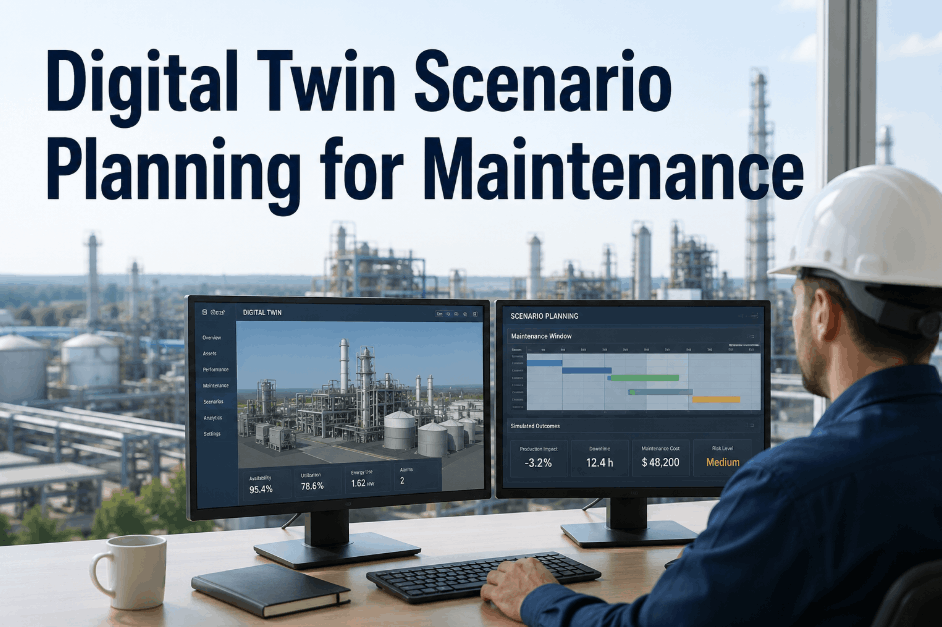
Digital twin scenario planning lets maintenance teams test maintenance windows, capacity changes, and failure events against a live model of asset health before any change reaches the actual plant floor. Without this capability, scheduling decisions rely on guesswork — a shutdown window gets approved, a capacity ramp gets planned, and only afterward does the team discover the asset couldn't support it. Oxmaint builds the asset health data, sensor history, and predictive scoring that scenario planning depends on, so decisions get tested against real equipment behavior instead of assumptions. Sign Up Free to start building asset health profiles, or Book a Demo to see how predictive data feeds scenario decisions.
Test the Decision Before You Make It
Oxmaint's predictive health scores and sensor history give reliability teams the data foundation to model maintenance windows and capacity scenarios with confidence.
Why Scenario Planning Needs Real Asset Data
A digital twin scenario is only as good as the asset data feeding it. Static maintenance schedules and disconnected spreadsheets can't model how an asset will actually behave under a new load or compressed maintenance window. Book a Demo to see how Oxmaint's live health scoring replaces guesswork with evidence-based scenario testing.
Three Scenario Types Reliability Teams Plan For
Maintenance windows, capacity changes, and failure events each require different asset data to model accurately. Oxmaint structures the underlying asset records so each scenario type can be tested before it's committed to the schedule. Sign Up Free to start capturing the asset health history these scenarios depend on.
Maintenance Window Compression
Test whether a shortened shutdown window still allows critical PM tasks to complete, using Oxmaint's shutdown management sequencing data.
Capacity and Load Changes
Model how increased runtime affects asset health scores using historical vibration, temperature, and runtime trends already logged in Oxmaint.
Failure Event Response Planning
Use Oxmaint's predictive failure flags to simulate how a critical asset failure would cascade through dependent equipment and schedules.
Building Scenario-Ready Asset Data with Oxmaint
Connect Sensors and Asset Records
Link IoT sensors and PLCs to Oxmaint so every asset has a continuously updated health and runtime profile.
Build Predictive Health Scores
Oxmaint's predictive models generate ongoing health scores that scenario planning can reference for any asset at any time.
Map Asset Dependencies
Register parent-child asset relationships so scenario testing can account for upstream and downstream effects of a schedule change.
Run Scenarios Against Live Data
Use Oxmaint's analytics dashboards to compare scenario outcomes against actual asset health trends before committing a schedule change.
Plan the Shutdown Before the Shutdown Happens
Oxmaint gives reliability teams the predictive health data and asset hierarchy needed to test maintenance and capacity scenarios with confidence.
Frequently Asked Questions: Digital Twin Scenario Planning
What is digital twin scenario planning for maintenance?
It is the practice of testing maintenance windows, capacity changes, or failure events against a live asset data model before committing to them.
How does Oxmaint support scenario planning?
Oxmaint provides predictive health scores, sensor history, and asset hierarchy data that scenario testing requires for accurate modeling.
Can scenario planning reduce unplanned downtime?
Yes. Testing schedule and capacity changes against real asset health data helps teams avoid decisions that lead to unexpected failures.
What data does Oxmaint use to model scenarios?
Oxmaint draws on sensor feeds, predictive health scores, PM compliance history, and asset relationship records.
Does this work for shutdown and turnaround planning?
Yes. Oxmaint's shutdown management sequencing data integrates directly with scenario testing for turnaround windows.
Make Every Schedule Change an Informed One
From sensor connection to predictive scoring, Oxmaint gives reliability teams the structured asset data foundation to test scenarios before the plant changes.