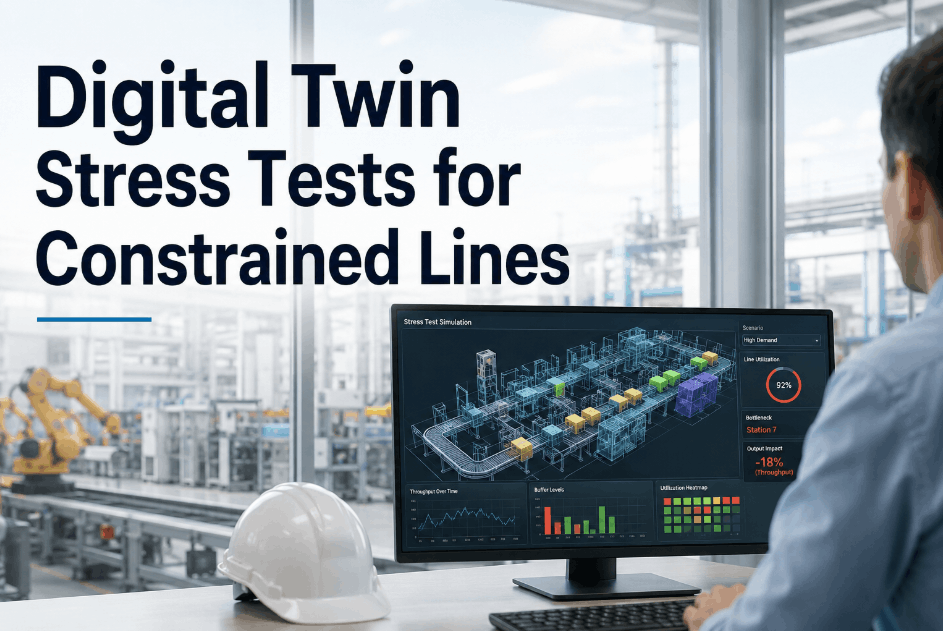
Conveyor networks move material at every stage of production — and when a speed change, load spike, or unexpected failure hits a live line, the cost lands immediately. Sign Up Free to connect your conveyor asset data inside Oxmaint and start building scenario models before the next unplanned stoppage. Book a Demo to see how digital twin scenario testing validates conveyor behavior against real operating conditions without touching the live line. The gap between a safe test and a live failure is exactly where digital twin simulation earns its place in a predictive maintenance strategy.
Asset Performance · Conveyor Systems · 2026
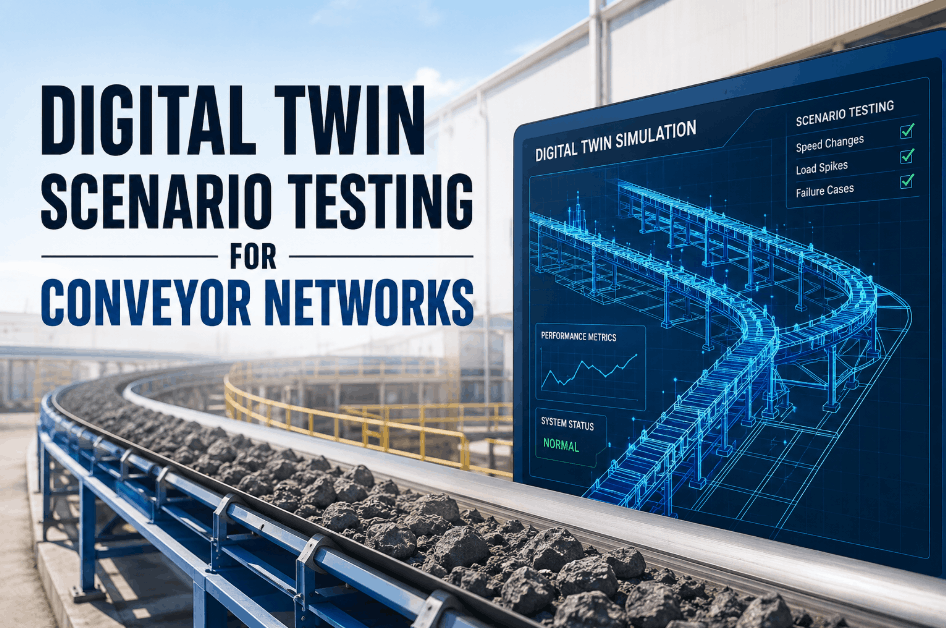
Digital Twin Scenario Testing for Conveyor Networks
Test conveyor speed changes, load spikes, and failure cases in a virtual model so your live line never absorbs the cost of an untested change.
35–50%Reduction in unplanned conveyor stoppages after digital twin scenario validation
3xFaster change validation cycles when scenarios run in simulation vs. live line testing
60%+Of failure cases identified before production impact through virtual load modeling
28%Lower conveyor maintenance cost after predictive scenarios replace reactive dispatch
Where Conveyor Scenario Testing Breaks Down Without a Digital Twin
Testing a conveyor speed change or a new load profile on a live line means accepting the risk of a stoppage, a belt overload, or a motor fault mid-production. Sign Up Free to map your conveyor asset structure into Oxmaint and create a baseline model for scenario simulation.
01
Speed Changes Tested on Live Lines
Risk Window: Belt tension and motor load limits
Structural RiskWithout a simulation layer, every conveyor speed adjustment is validated only after production absorbs the consequences of getting it wrong.
02
Load Spike Behavior Is Unknown Until It Occurs
Risk Window: Seasonal demand shifts and batch changes
Largest VariableOperations that shift product weight, batch size, or throughput rate have no way to preview how the conveyor system responds under peak load without a digital model.
03
Failure Cascades Invisible Before They Propagate
Risk Window: Multi-zone conveyor networks
Cascade DriverA belt failure or drive fault on one conveyor zone can pull downstream equipment into an unplanned stop — a propagation path that scenario testing maps before it happens on the floor.
04
No Baseline for Post-Change Reliability Comparison
Risk Window: Continuous improvement cycles
Analysis GapWithout a digital twin baseline, maintenance teams cannot objectively measure whether a conveyor configuration change improved or degraded asset reliability over time.
05
Shutdown Planning Disconnected from Live Asset State
Risk Window: Scheduled maintenance windows
Planning GapShutdown scope is often defined by history rather than current asset condition, leading to over-maintenance on healthy components and under-maintenance on worn ones.
06
Cross-Zone Dependencies Not Modeled
Risk Window: Network-wide throughput targets
Throughput GapA bottleneck in one conveyor zone throttles the entire network. Without scenario modeling, that constraint only becomes visible after throughput targets are already missed.
Conveyor Network Testing — Without vs. With Oxmaint Digital Twin
Digital twin scenario testing changes what your team can validate before production is affected. Book a Demo to walk through how Oxmaint models your conveyor network and runs failure, speed, and load scenarios against real asset data.
Digital Twin Maturity — Where Does Your Conveyor Operation Score?
Digital twin maturity for conveyor networks ranges from paper-based specs to live scenario simulation tied to real-time sensor data. Book a Demo to assess where your conveyor operation sits on this maturity curve with an Oxmaint solutions engineer.
Conveyor Digital Twin Maturity Framework
Score 5 = live scenario simulation · Score 1 = no virtual model in place
5
Live Scenario Simulation · Real-Time Asset Feed
Speed changes, load spikes, and failure cases all run through a simulation layer connected to live sensor data before touching the physical conveyor network.
Profile: Change validation time and unplanned stoppages are outcomes of the simulation framework, not of how the line feels that day.
4
Scenario Testing · Partial Live Integration
Most scenarios run through a digital model, but some zones still rely on manual data entry rather than live PLC or sensor feeds.
Action: Extend live sensor integration to remaining conveyor zones for full-network scenario coverage.
3
Static Digital Model · No Scenario Simulation
A digital model of the conveyor network exists but is updated manually and used for documentation rather than live scenario testing.
Gap: A static model without live data cannot reflect current asset wear state or produce reliable scenario outcomes.
2
Spec-Based Planning · No Virtual Model
Conveyor changes are planned against original equipment specs without a virtual model to validate behavior under current operating conditions.
Risk: Original specs diverge from current asset state as wear accumulates — spec-based decisions carry hidden failure risk.
1
No Virtual Testing Framework
All conveyor changes and load profiles are validated on the live line with no pre-testing layer between decision and production impact.
Risk: Every untested change is a live experiment whose failure cost falls directly on production output.
Stop Testing Conveyor Changes on the Live Line.
Oxmaint connects your conveyor asset data into a scenario simulation layer — so speed changes, load spikes, and failure cases are validated before production feels the impact.
How Oxmaint Supports Digital Twin Scenario Testing for Conveyor Networks
Oxmaint connects PLC sensor data, asset maintenance history, and real-time performance telemetry to build a live model of conveyor behavior — then lets operations teams run speed, load, and failure scenarios against that model before any change reaches the floor. Sign Up Free to configure your conveyor asset structure in Oxmaint. Book a Demo to see scenario testing running against a multi-zone conveyor network.
PLC & Sensor Integration
Live Asset Feed
Real operating data drives the simulation model
Oxmaint connects to existing PLC and IoT sensor feeds so the digital twin reflects current belt tension, motor load, and throughput — not original equipment specs from commissioning.
Speed & Load Scenario Engine
Pre-Change Validation
Simulate changes before any physical adjustment
Speed profiles and load spike scenarios run through the simulation layer first, producing a reliability outcome before the change is approved for live production execution.
Failure Propagation Mapping
Cross-Zone Visibility
Map how a fault in one zone affects the network
When a drive fault or belt failure is modeled in one conveyor zone, Oxmaint traces the downstream impact across connected zones so the full cascade path is visible before it occurs on the floor.
Predictive Work Order Generation
Scenario-Triggered PM
Scenario outcomes drive proactive maintenance scheduling
When a scenario flags a component approaching failure threshold under modeled load conditions, Oxmaint generates a predictive work order automatically — closing the loop between simulation and scheduled maintenance.
"
We'd been making conveyor speed adjustments based on gut feel and historical throughput data. After connecting our sensor feeds into Oxmaint and running load scenarios through their asset performance layer, we caught a motor overload condition in the simulation that would have taken us down during a peak shift. That single catch paid for the platform.
Reliability Engineer — Food & Beverage Manufacturing Plant, 6-Zone Conveyor Network, Ohio
Frequently Asked Questions
What is digital twin scenario testing for conveyor networks?
It is the practice of running speed changes, load spikes, and failure cases through a virtual model of the conveyor network before applying those changes to the live line, so production risk is validated first.
Does Oxmaint require replacing existing conveyor sensors for digital twin integration?
No. Oxmaint connects to existing PLC and IoT sensor infrastructure, applying the digital twin and scenario layer on top of the data sources already in place.
Can digital twin scenarios model multi-zone conveyor networks?
Yes. Oxmaint maps cross-zone dependencies so a fault or load change in one zone is traced against its downstream impact on connected zones before it propagates on the live line.
How does scenario testing connect to predictive maintenance in Oxmaint?
When a scenario identifies a component approaching failure threshold under modeled load conditions, Oxmaint generates a predictive work order automatically, connecting simulation outcomes to scheduled maintenance action.
What types of conveyor scenarios can be run inside Oxmaint?
Speed profile changes, load spike events, failure propagation cases, and shutdown scope validation can all be modeled against live asset data before reaching the production floor.
Validate Every Conveyor Change in Simulation — Not on the Live Line.
Oxmaint connects your conveyor sensor data to a scenario testing layer that validates speed changes, load spikes, and failure cases before production absorbs the cost.