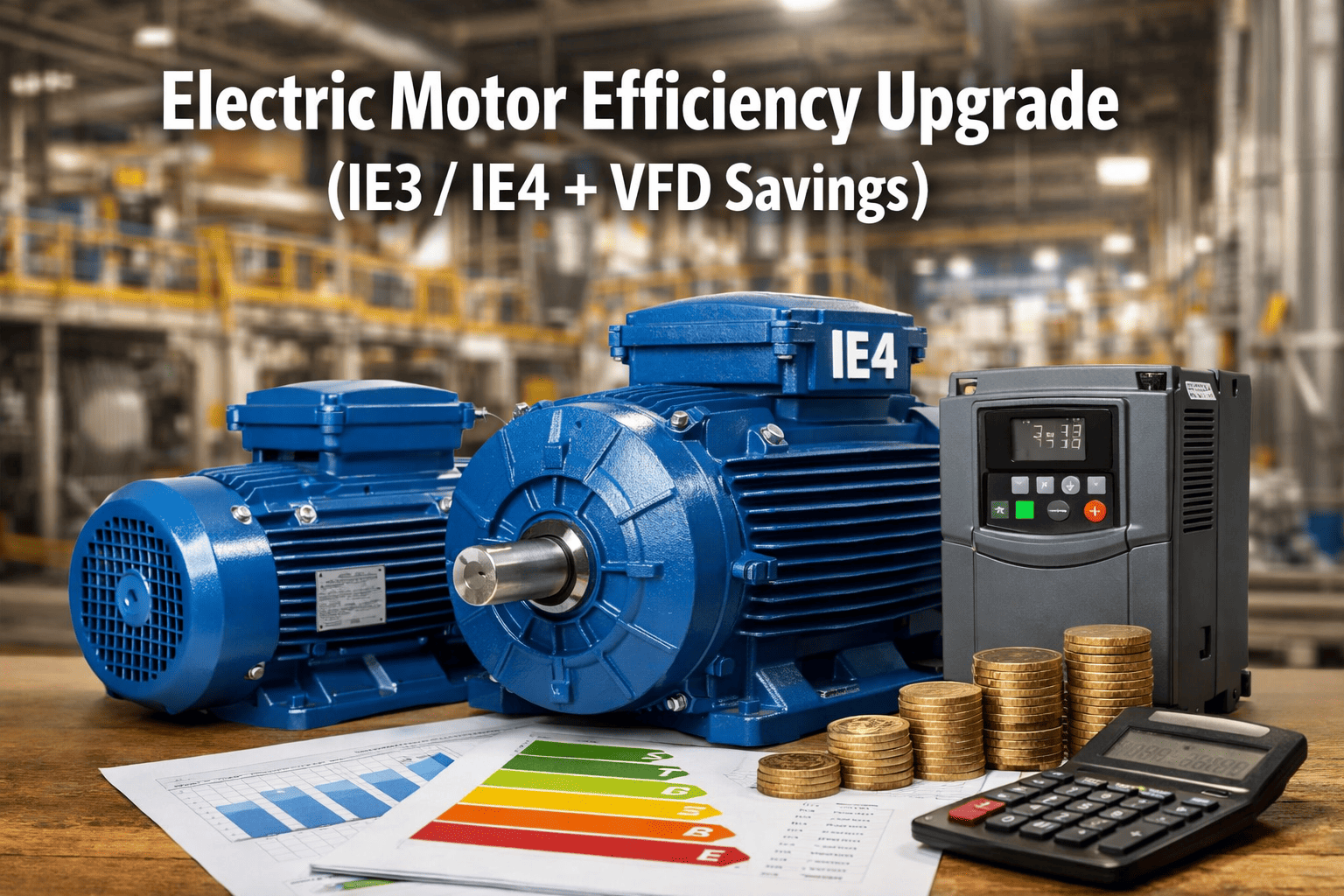
Electric motors are the hidden powerhouses of manufacturing—and the hidden money drains. They account for roughly 70% of all industrial electricity consumption, yet most plants still run aging IE1 and IE2 motors at fixed speed, burning energy around the clock regardless of actual load demand. Upgrading to IE3 or IE4 motors, combined with Variable Frequency Drives (VFDs), is one of the highest-ROI investments an operations team can make: payback periods of 6 to 18 months, energy reductions of 10–40% on pump and fan applications, and a compliance shield against tightening global regulations that now mandate IE4 for motors between 75–200 kW in the EU as of July 2023, with the US DOE following suit in 2027. This guide gives you the efficiency data, ROI calculation framework, and upgrade decision logic you need to turn your motor inventory into a strategic energy asset.
IE Class Efficiency Comparison — At Rated Load (IEC 60034-30-1)
IE1 — Standard
Being Phased Out
IE2 — High Efficiency
US Minimum Standard
IE3 — Premium
EU/UK Required (most sizes)
IE4 — Super Premium
EU Mandatory 75–200 kW
Why the Efficiency Gap Costs More Than You Think
A 2% efficiency difference between motor classes sounds negligible—until you multiply it across thousands of operating hours and a facility full of motors. For a 50 kW motor running 8,000 hours per year at an electricity cost of $0.12/kWh, that 2% difference translates to roughly $960 in annual waste per motor. Across 20 motors of similar size, that is $19,200 per year—escaping silently as heat.
IE1 → IE3
5–15%
Energy Reduction
Payback: 6–18 months
Largest absolute savings for the most outdated equipment. Immediate ROI in high-run applications.
IE3 → IE4
10–15%
Additional Savings
Payback: 1.4–2 years
Best for 24/7 operations. Lower operating temperature extends bearing life by 2–4 years.
IE3/4 + VFD
Up to 40%
Total Loss Reduction
Payback: <3 years
The power combination for fans, pumps, and compressors. Affinity laws: 20% speed cut = ~50% energy cut.
VFD + High-Efficiency Motor: The Multiplier Effect
A high-efficiency motor running at fixed speed still wastes energy when the application demands less than full load. A VFD solves this by continuously adjusting motor speed to match actual demand. The physics behind the savings—known as the Affinity Laws—are dramatic and predictable.
Speed Reduction
Flow Rate
Pressure / Head
Power (Energy)
Typical Annual Saving
10% reduction
−10%
−19%
−27% power
$3,000–$6,000 on 50 HP fan
20% reduction
−20%
−36%
−49% power
$7,000–$12,000 on 50 HP fan
30% reduction
−30%
−51%
−66% power
$12,000–$20,000 on 50 HP fan
50% reduction
−50%
−75%
−87% power
$18,000–$30,000 on 50 HP fan
Savings estimates based on $0.12/kWh, 8,000 hrs/year operation. Variable-torque loads only; constant-torque loads (conveyors, positive displacement pumps) see different profiles.
Calculate Your Motor Upgrade ROI Before You Spend a Dollar
Oxmaint helps maintenance teams track motor run-hours, log efficiency data, and build the business case for targeted upgrades—so your capital requests get approved faster.
ROI Calculation: How to Build the Business Case
Getting approval for motor upgrades requires a clear, quantified financial argument. The calculation is straightforward once you have four pieces of data: motor size, annual run hours, current efficiency, and local electricity rate. Here is the step-by-step framework used by energy managers at leading manufacturers.
1
Calculate Current Annual Energy Cost
HP × 0.746 × hours/year × $/kWh ÷ current efficiency = current annual cost
Example: 50 HP × 0.746 × 8,000 × $0.12 ÷ 0.91 = $39,254/year
2
Calculate New Motor Annual Energy Cost
HP × 0.746 × hours/year × $/kWh ÷ new efficiency = new annual cost
Example: 50 HP × 0.746 × 8,000 × $0.12 ÷ 0.96 = $37,200/year
3
Annual Savings
Current annual cost − New annual cost = Annual savings
Example: $39,254 − $37,200 = $2,054/year per motor
4
Simple Payback Period
Motor price premium ÷ Annual savings = Payback in years
Example: $800 premium ÷ $2,054 = 0.39 years (under 5 months)
5
Add VFD Savings (Variable Load Only)
Apply affinity law: speed reduction % determines additional energy % saved
Example: 20% speed reduction on same fan = additional $10,000–$15,000/year
Which Motors to Upgrade First: Prioritization Matrix
Not every motor in your facility deserves the same urgency. Use this prioritization matrix to rank your motor inventory and focus capital where the return is fastest and most certain. Start with motors that run the most hours—they drive the most savings per upgrade dollar spent.
Regulatory Timeline: When IE4 Becomes Mandatory
2021
EU: IE3 expanded to 1,000 kW
IE3 compliance band widened. Motors paired with VSDs must also meet IE3-equivalent efficiency standards.
2023
EU: IE4 mandatory for 75–200 kW (Ecodesign 2019/1781)
All new 3-phase, 2–6 pole motors in the 75–200 kW range must now meet Super Premium Efficiency. ATEX motors must hit IE3. Single-phase motors must be IE2 minimum.
2026
EU: Wider IE4 scope under review
Regulatory expansion of IE4 mandatory range is under active review. Motors below 75 kW may enter scope. Facilities should plan now to avoid emergency replacements.
2027
US DOE: IE4 required for mid-range motors
US DOE rules mandate IE4 for mid-range motor classifications starting June 2027. US utilities are already offering rebates covering 30–50% of upgrade cost for early movers.
Frequently Asked Questions
Should I upgrade to IE3 or IE4—and does it matter which I choose?
For most manufacturers, IE4 is the better long-term investment if your motors run more than 4,000 hours per year. The payback difference between IE3 and IE4 is typically only a few months, but IE4 delivers significantly more savings over the motor's 15–20 year lifespan. For applications in the EU 75–200 kW range, IE4 is now legally required regardless of economics.
Use Oxmaint to log your motor inventory and calculate which class makes the most financial sense for each unit.
Can I install a VFD on any existing motor?
Most standard induction motors (IE2 and above) can accept a VFD, but there are key considerations: ensure the motor has inverter-duty insulation rated for VFD-induced voltage spikes, check bearing compatibility to avoid electrical erosion, and verify that your application is variable-torque (pumps, fans, compressors) to maximize energy savings. Constant-torque applications like conveyors benefit less from VFDs.
Book a consultation to assess your specific motor-load pairs before purchasing drives.
What is the real payback period for an IE4 motor upgrade?
Real-world payback ranges from 5 months to 3 years depending on motor size, run hours, and electricity cost. For a 110 kW motor running continuously, European case data shows payback of 1.4–1.5 years, with lifetime savings exceeding €26,000. Higher electricity rates and more run hours shorten payback further. Rebates in the US (30–50% of cost from utilities) and EU grants can cut payback to under a year.
How does motor efficiency affect maintenance costs—not just energy?
IE4 motors run 10–15°C cooler than IE3 equivalents under identical loads. Lower operating temperature directly extends insulation life (insulation life roughly doubles with every 10°C reduction), extends bearing lubrication intervals, reduces vibration-related wear, and lowers the probability of thermal-failure-related downtime.
Oxmaint's maintenance tracking lets you log operating temperatures and schedule condition-based motor maintenance rather than guessing on time-based intervals.
When is it better to repair an existing motor rather than replace it?
As a general rule, if the repair cost exceeds 50–60% of the price of a new IE3/IE4 motor, replacement wins on both economics and performance. Motors that have been rewound twice or more lose 2–4% efficiency per rewind, making the gap versus a new high-efficiency motor even larger. For motors running fewer than 2,000 hours per year, repair may still make financial sense—but always compare total lifecycle costs, not just the repair invoice.
Build Your Motor Upgrade Strategy with Oxmaint
Track every motor's run hours, efficiency class, rewind history, and maintenance record in one platform. Generate upgrade ROI reports your finance team will approve on the spot.