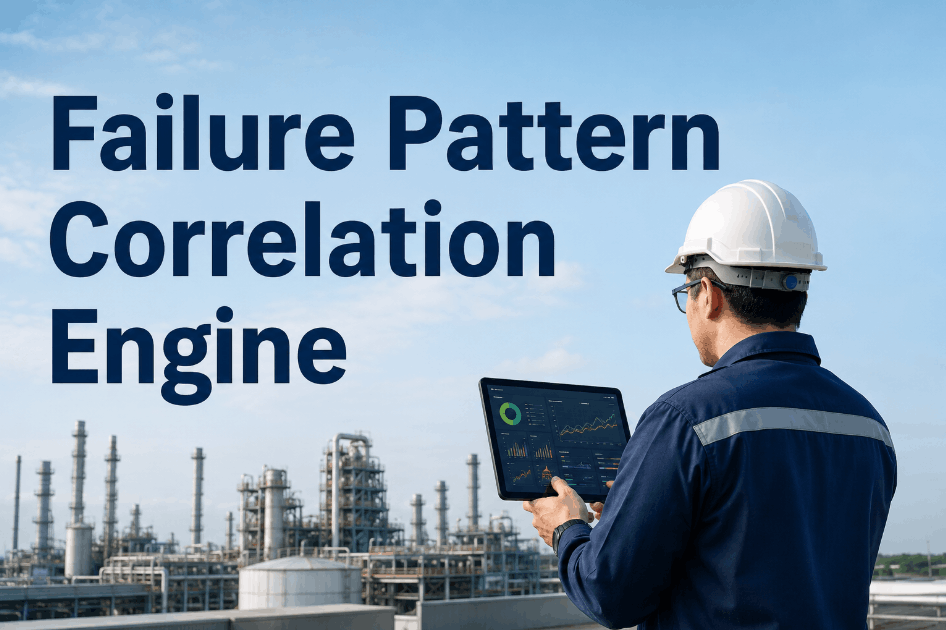
Failure pattern correlation is the discipline that turns disconnected asset breakdown records into actionable reliability intelligence — yet most maintenance organizations manage failure data in silos that make cross-asset pattern recognition structurally impossible. When recurring fault signals cannot be connected across equipment types, locations, or time periods, root cause investigations restart from scratch each time, corrective actions address symptoms rather than causes, and repeat failures continue consuming maintenance resources without resolution. Maintenance teams using Sign Up Free on OxMaint can build the structured failure history, work order linkage, and asset relationship data that a failure pattern correlation engine requires to accelerate investigations and improve corrective action quality across plant, fleet, and facility environments.
Why Failure Pattern Correlation Requires Structured Maintenance Data
Failure pattern recognition without structured data produces intuition, not insight. When failure modes, fault codes, and breakdown timestamps are recorded inconsistently across assets and work orders, the signal patterns that would reveal systemic causes remain buried in unstructured text fields and technician notes. Book a Demo to see how OxMaint's work order structure and failure code taxonomy create the data foundation your reliability team needs to run meaningful failure correlation analysis.
Six Failure Signal Types a Correlation Engine Must Connect
A failure pattern correlation engine draws value from multiple signal types — and each signal type requires a different data structure in the CMMS to support reliable pattern matching. OxMaint's work order and asset record architecture captures all six signal types in the structured format correlation analysis requires. Sign Up Free to configure OxMaint's failure taxonomy and work order fields for correlation-ready data collection across your asset inventory.
Failure Mode Codes Across Asset Classes
Standardized failure mode codes recorded on OxMaint corrective work orders allow the correlation engine to identify when the same failure mechanism — bearing fatigue, seal leak, insulation breakdown — appears across different asset types, manufacturers, or operating contexts that share an underlying cause.
Time-Between-Failure Intervals by Asset and Location
Recording failure timestamps against asset records in OxMaint enables time-between-failure analysis that surfaces when assets in similar operating environments are failing at correlated intervals — indicating a shared stress driver rather than random equipment degradation.
Maintenance Action Sequences Preceding Failures
OxMaint's work order history links maintenance actions — lubrication, calibration, part replacement — to subsequent failure events on the same asset. When a specific maintenance action consistently precedes a specific failure type, the correlation engine identifies a potential induced-failure pattern requiring procedural correction.
Parts and Component Failure Clustering
When the same part number or component batch appears in multiple corrective work orders within a defined period, OxMaint's parts history enables correlation queries that identify whether a procurement quality issue, storage condition problem, or installation practice is driving clustered component failures.
Inspection Finding Trends Before Failure Events
OxMaint inspection work orders capture pre-failure condition signals — abnormal temperatures, unusual vibration readings, visible wear indicators — that, when correlated with subsequent failure records, build the leading indicator library that shifts investigation from reactive to predictive.
Corrective Action Outcome Histories
Recording the outcome and recurrence rate of each corrective action in OxMaint closes the correlation loop — identifying which fixes resolved the underlying failure pattern and which addressed only the immediate symptom, enabling escalating investigation for persistent repeat failures.
Failure Pattern Correlation Value by Asset Relationship Type
Failure pattern correlation delivers different investigation value depending on the type of asset relationship being analyzed. Understanding which relationship structures generate the most actionable correlation findings guides data collection priorities and reliability investment decisions. Book a Demo to see how OxMaint structures asset hierarchies and work order linkages to support multi-asset failure correlation queries.
| Relationship Type | Correlation Signal Strength | Investigation Value | Common Pattern Found | OxMaint Data Structure |
|---|---|---|---|---|
| Same Asset, Multiple Failures | Very High | Repeat failure root cause | Inadequate corrective action or design gap | Asset failure history + corrective work order linkage |
| Same Asset Class, Different Units | High | Fleet-wide systemic cause | Shared operating stress, batch quality issue | Asset type grouping + failure code taxonomy |
| Parent-Child Asset Relationships | High | Upstream cause driving downstream failure | Lubrication, load, or vibration transmission | Asset hierarchy + work order parent linkage |
| Same Location, Different Assets | Medium | Environmental or process driver | Temperature, contamination, voltage quality | Location-grouped failure records + inspection findings |
| Same Technician, Multiple Failures | Medium | Induced failure from practice gap | Torque, installation, or procedure deviation | Technician-assigned work order failure history |
Four Outcomes a Failure Pattern Correlation Engine Delivers
Failure pattern correlation analysis produces four categories of maintenance intelligence that directly improve corrective action quality, investigation speed, and reliability program effectiveness. Sign Up Free to build the structured failure history in OxMaint that makes all four outcomes achievable across your asset inventory.
Building a Failure Pattern Correlation Capability with OxMaint
Establish a Standardized Failure Code Taxonomy
Configure OxMaint failure codes, cause codes, and effect codes aligned with your asset classes and failure mode library. Consistent failure code application across all corrective work orders is the prerequisite for every pattern correlation query that follows.
Build Asset Hierarchies with Relationship Mapping
Register assets in OxMaint with parent-child relationships, location groupings, and asset type classifications. Asset relationship structure determines which correlation dimensions are available when querying failure history for pattern signals.
Link Parts Records to Corrective Work Orders
Record parts used on every corrective work order in OxMaint, including part numbers, supplier references, and installation dates. Parts linkage enables the component failure clustering analysis that surfaces batch quality and procurement issues before they propagate.
Schedule Inspection Work Orders to Capture Pre-Failure Signals
Configure OxMaint inspection work orders with structured condition observation fields — temperature readings, vibration notes, visual wear indicators — that build the leading signal library the correlation engine needs to connect pre-failure conditions to subsequent breakdown events.
Run Failure Correlation Queries and Generate Reliability Reports
OxMaint's reporting dashboards enable failure history queries filtered by asset type, failure code, location, technician, and time period — producing the pattern correlation outputs that reliability engineers use to escalate investigations and validate corrective action effectiveness.
Frequently Asked Questions: Failure Pattern Correlation Engine for Maintenance Teams
What is a failure pattern correlation engine?
A failure pattern correlation engine connects recurring fault signals across assets, locations, and time periods to identify shared root causes. It transforms structured failure history data into reliability intelligence that accelerates investigation and improves corrective action targeting.
Why does failure correlation require a structured CMMS?
Pattern correlation depends on consistent failure codes, asset relationship records, and parts linkage data. Without a structured CMMS like OxMaint, failure data remains unstructured text that cannot be queried across assets or correlated with maintenance action histories.
How does OxMaint support failure pattern correlation?
OxMaint provides failure code taxonomy configuration, asset hierarchy mapping, parts-to-work-order linkage, inspection finding records, and cross-asset reporting — giving reliability teams the structured data architecture that failure correlation analysis requires.
Which asset relationship types produce the strongest correlation signals?
Same-asset repeat failures and same-class fleet patterns produce the strongest correlation signals. Parent-child asset relationships and location-grouped failures follow as high-value correlation dimensions for identifying shared stress drivers.
How does failure pattern correlation improve PM strategy?
Correlating failure occurrences with PM compliance records reveals whether preventive tasks prevent target failure modes or miss them entirely — providing evidence-based justification for PM interval changes, task revisions, or new inspection additions.