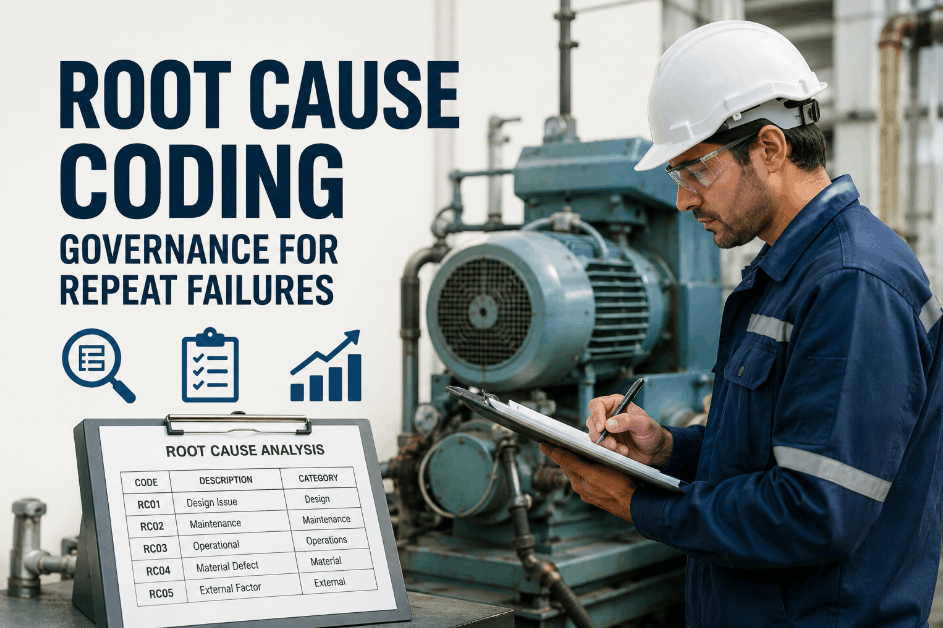
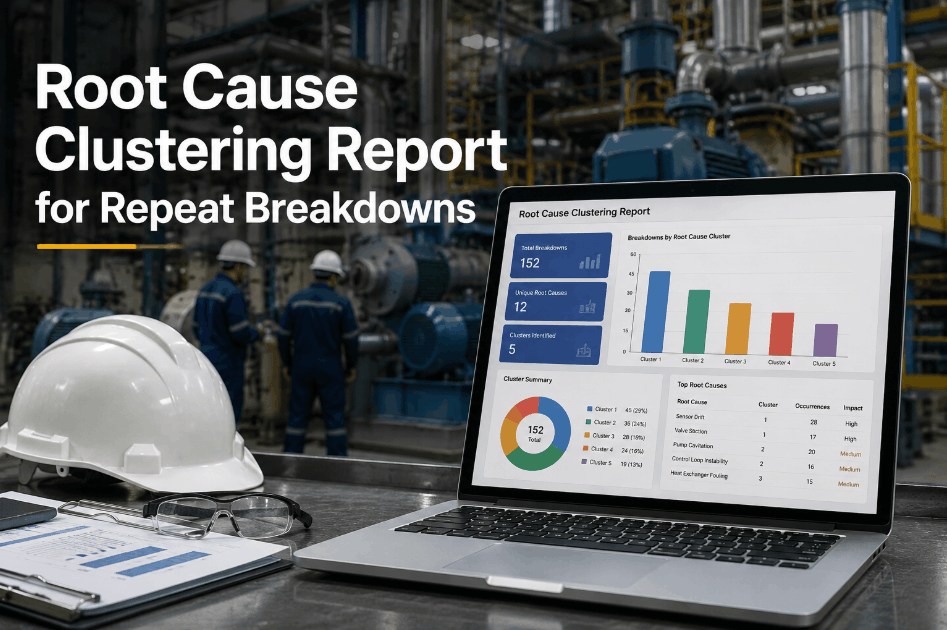
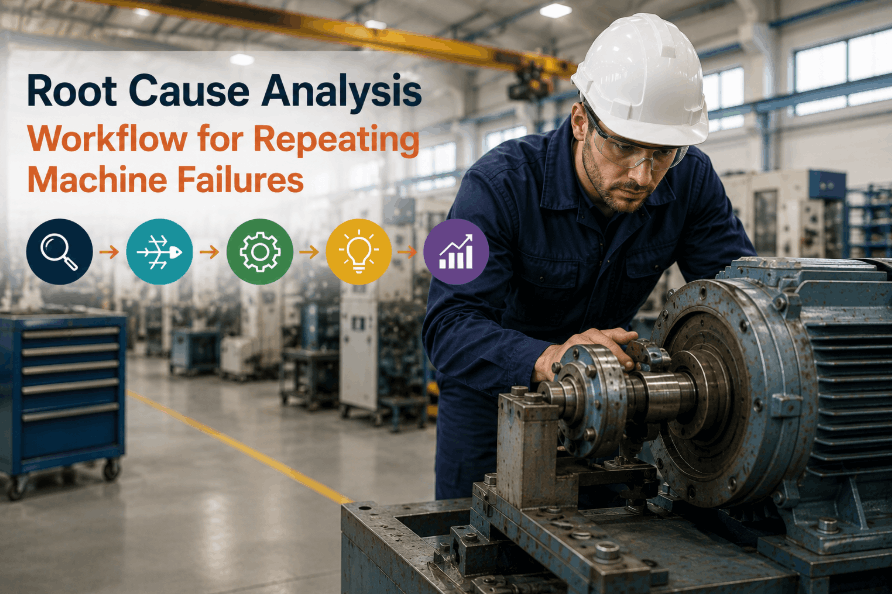
A root cause library transforms recurring fault data from scattered notes and tribal knowledge into a structured, searchable system that maintenance engineers can query before every investigation. When breakdown signatures, symptom clusters, and resolution paths are organized by fault family, teams stop re-diagnosing the same failures from scratch — dramatically cutting investigation time and preventing repeat damage. With Sign Up Free on Oxmaint, maintenance teams can capture failure patterns, tag fault families, and build a living root cause archive connected directly to work order history and asset records.
Why Recurring Faults Demand a Structured Root Cause Library
Most manufacturing plants experience the same failures repeatedly — bearing failures on specific drives, seal degradation patterns in pumps, recurring PLC faults tied to process parameter drift. Without a structured root cause library, each recurrence triggers a fresh investigation that consumes technician hours already spent months earlier. Book a Demo to see how Oxmaint's failure code framework builds institutional memory from every work order closed.
Core Components of an Effective Root Cause Library
A root cause library is not a list of past repairs — it is a structured system that maps symptoms to causes, causes to failure families, and families to proven resolution paths. Sign Up Free to configure Oxmaint's failure taxonomy and begin clustering incidents by fault signature.
Standardized observable indicators — vibration anomaly, thermal spike, pressure drop, output variance — captured at fault report time. Consistent symptom terminology enables pattern comparison across incidents that would otherwise appear unrelated in free-text records.
Grouping incidents by mechanical family — lubrication failure, electrical degradation, mechanical wear, process parameter drift — reveals recurrence clusters that single-asset views mask. Oxmaint's failure code hierarchy supports multi-level fault family classification across the asset register.
Structured causal chains linking symptom to contributing factor to root cause — documented at work order close with engineer confirmation. Root cause maps associated with asset type, operating regime, and age provide context that makes the library useful across equipment variants, not just the specific asset that failed.
Documented repair sequences, part numbers used, torque specifications, test verification steps, and return-to-service criteria — captured at work order completion. Resolution paths stored in Oxmaint become reusable task templates, cutting job planning time for every subsequent recurrence.
Root Cause Library Structure: Taxonomy and Data Fields
Designing the right data fields at fault capture time determines whether the library is searchable and comparable six months later — or a collection of inconsistent notes. Book a Demo to see Oxmaint's failure data schema and how it supports structured root cause archive design.
| Library Field | Data Type | Capture Point | Search Value | Oxmaint Location |
|---|---|---|---|---|
| Failure Mode | Controlled vocabulary | Work order creation | Fault family clustering | Failure Code field |
| Symptom Signature | Multi-select tags | Initial fault report | Pattern comparison | Asset observation log |
| Root Cause Confirmed | Structured text + code | Work order close | Causal chain lookup | Completion notes |
| Contributing Factor | Controlled vocabulary | Post-repair review | Systemic trend detection | Failure analysis field |
| Resolution Path | Task list + parts used | Work order completion | Reusable repair template | PM task library |
| Recurrence Flag | Boolean + prior WO link | Duplicate detection | Recurrence rate KPI | Work order history |
Building the Library: Step-by-Step Implementation in Oxmaint
Audit Existing Work Order History for Recurrence Patterns
Run a Pareto analysis of Oxmaint work orders by failure code and asset class to identify the top ten recurring fault types. These become the seed entries for your library — already validated by actual incident history.
Define a Controlled Failure Code Taxonomy
Establish a three-level failure code hierarchy in Oxmaint — fault family, failure mode, specific cause — and make selection mandatory at work order creation. Consistent coding from this point forward makes future library searches reliable.
Capture Symptom Tags at Fault Report Time
Configure Oxmaint's observation fields to capture standardized symptom indicators when a fault is reported — before the investigation begins. Symptom data captured before repair is more reliable than retrospective documentation and enables true pattern comparison across incidents.
Require Root Cause Confirmation at Work Order Close
Make confirmed root cause entry a mandatory completion field in Oxmaint work orders. Link the confirmed cause to the failure code taxonomy so the library builds automatically with each repair completed — no separate documentation step required.
Convert High-Recurrence Patterns to Predictive PM Actions
When library analysis confirms a recurring fault pattern with a consistent causal signature, translate the prevention action into a PM task in Oxmaint — targeting the contributing factor before the failure mode triggers. This is the step that converts the library from an analysis archive into a recurrence reduction engine.
KPIs for Measuring Root Cause Library Effectiveness
Sign Up Free to access Oxmaint's failure analytics and recurrence tracking dashboards that measure library ROI in operational terms.
Percentage of work orders flagged as recurrences of a previously documented fault pattern. Sustained decline confirms the library is generating prevention actions that hold.
Elapsed time from fault report to confirmed root cause identification. Library-covered fault types should show measurably shorter MTTD as engineers query documented patterns rather than investigating from scratch.
Percentage of the top twenty recurring fault types with at least one documented root cause entry and resolution path. Coverage gaps identify fault families where investigation still relies on tribal knowledge.
Percentage of completed corrective work orders with a confirmed root cause entry. Rates below 85% indicate that field documentation discipline is limiting library growth and search value.
Percentage of high-recurrence fault patterns that have generated a corresponding preventive maintenance task in Oxmaint. Measures how effectively the library drives action rather than remaining a passive record system.
Average technician hours spent on root cause investigation per fault type, compared between library-matched incidents and novel faults. The gap quantifies the diagnostic efficiency benefit the library delivers per recurrence event.