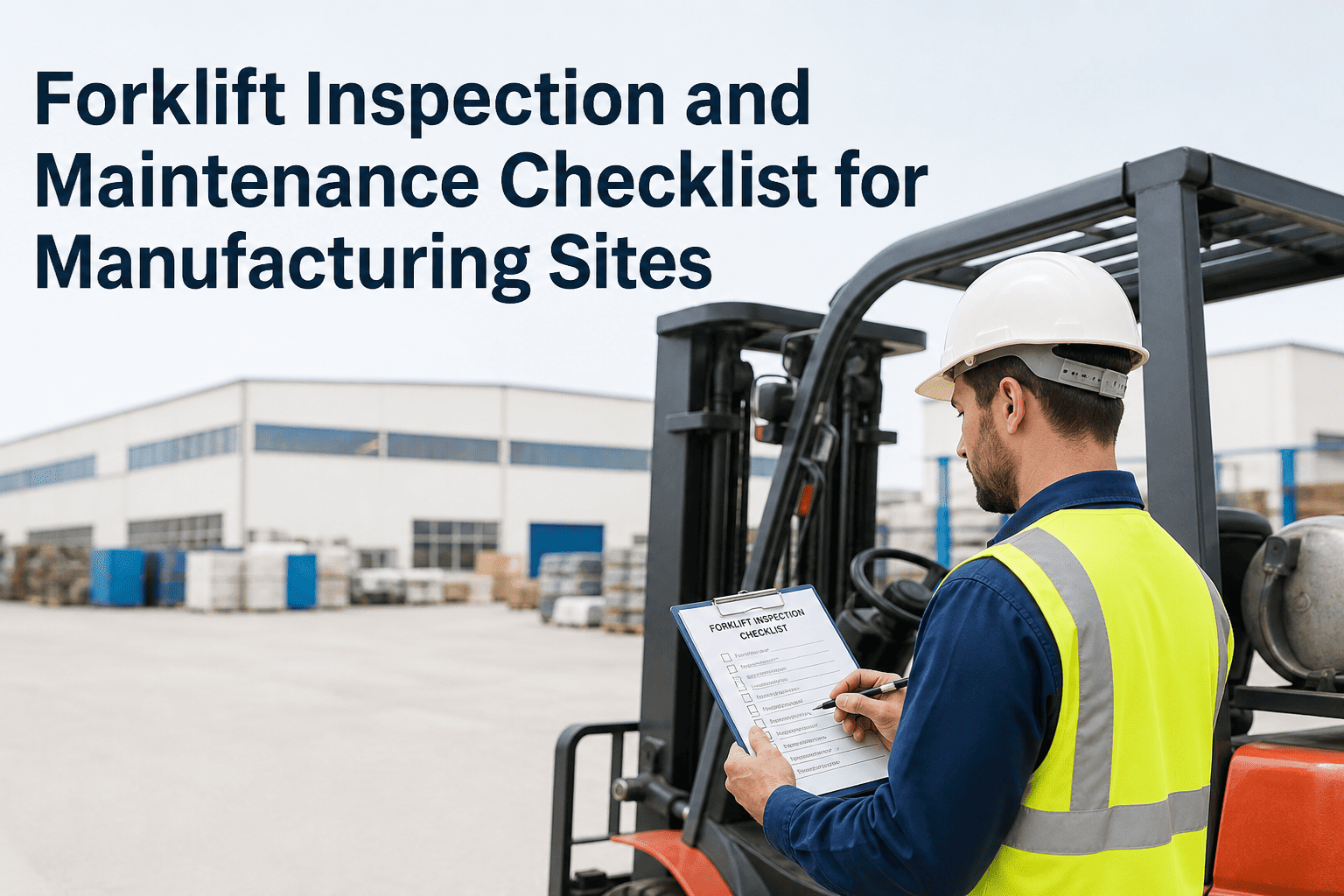
Forklift accidents cause approximately 85 fatalities and 34,900 serious injuries every year in the United States — and OSHA data shows that a significant share of these incidents trace directly to skipped pre-shift inspections and deferred preventive maintenance. Under 29 CFR 1910.178(q)(7), every forklift must be examined before each shift, or after each shift when operated round-the-clock. In 2024 alone, forklift-related OSHA violations resulted in more than $15 million in penalties — many of them for documentation failures, not visible equipment defects. This checklist covers electric and LPG forklifts across four inspection cadences — pre-shift, weekly, monthly, and quarterly — structured for manufacturing environments where uptime, floor safety, and compliance audit readiness are all non-negotiable. Start a free trial on Oxmaint to digitise your forklift inspection records and generate compliance-ready reports in seconds.
Fleet Safety · Manufacturing Compliance · OSHA 29 CFR 1910.178
Forklift Inspection & Maintenance Checklist
Pre-shift visual checks, power-type-specific tasks, periodic PM intervals, and every OSHA threshold your safety officer and auditor will verify — structured for electric and LPG fleets in manufacturing.
85
fatalities/yr
Annual forklift-related deaths in the US (OSHA)
$156K
max fine
Per willful OSHA violation — forklift inspections included
5–10
minutes
Time for a thorough pre-shift inspection — no excuse to skip
3 yrs
retention
Recommended inspection record retention for OSHA readiness
Inspection Flow
How a Compliant Pre-Shift Inspection Works
1
Key Off — Visual Walk-Around
Circle the forklift systematically. Check forks, mast, tyres, fluid leaks, and bodywork before the engine starts. Record any defect immediately.
2
Power-Type Specific Checks
Electric: battery charge, connectors, electrolyte. LPG: tank mounting, hose condition, leak test. These checks differ entirely — use the right list.
3
Engine Running — Operational Test
Test brakes, steering, horn, lights, hydraulics, and load controls. Any operational failure = remove from service before entering work area.
4
Document & Sign Off
Record pass/fail per item, note defects with description, sign with operator name and timestamp. Paper or digital — both are valid if retained correctly.
Stop managing forklift inspections on paper. Oxmaint's digital checklists guide operators through every step, flag defects instantly, and build your audit trail automatically.
Zone A — All Forklift Types
Pre-Shift Visual Inspection — Key Off
Perform this walk-around before starting the engine every shift. OSHA 29 CFR 1910.178(q)(7) requires this inspection without exception — and the forklift must not enter service if any defect affecting safety is found.
Forks inspected for cracks, bends, and unequal height — fork tip height difference must not exceed 3% of fork length
Record: Pre-shift log · Role: Forklift Operator
Top clip retaining pin and heel of forks checked — worn or cracked heel reduces load rating and creates drop risk
Record: Pre-shift log · Role: Forklift Operator
Mast chains visually inspected for wear, rust, or stretched links — do not insert hand into mast; use a stick to check chain tension
Record: Pre-shift log · Role: Forklift Operator
Overhead guard intact and unmodified — no cracks, missing bars, or structural damage that reduces operator protection
Record: Pre-shift log · Role: Forklift Operator
Load backrest extension present and undamaged — must be installed when handling loads that could shift rearward
Record: Pre-shift log · Role: Forklift Operator
Tyre condition and pressure checked — cuts, gouges, flat spots, or embedded debris require removal from service before shift start
Record: Pre-shift log · Role: Forklift Operator
Floor beneath forklift inspected for puddles — oil, coolant, or hydraulic fluid pooling indicates an active leak requiring immediate reporting
Record: Pre-shift log · Role: Forklift Operator
Oil, water, and hydraulic fluid levels checked with dipstick or sight glass — top up to manufacturer specification before first operation
Record: Pre-shift log · Role: Forklift Operator
Data plate legible and matching current configuration — any attachment that changes capacity must be reflected on the plate
Record: Pre-shift log · Role: Forklift Operator
Zone B — Power-Type Specific
Electric vs LPG — What Changes by Fuel Type
Battery charge level confirmed — minimum charge per manufacturer spec before entering service (typically 20% threshold)
Wear acid-resistant PPE when checking electrolyte levels
Battery cables and connectors inspected — no fraying, corrosion, or loose connection at battery terminals or charger plug
Record: Pre-shift log · Role: Operator
Electrolyte level and vent caps checked — low electrolyte reduces battery life and creates acid spill risk during operation
Record: Battery log · Role: Operator / Maintenance
Battery bay clean and free of corrosion deposits — clean with appropriate neutralising agent per manufacturer guidance
Record: Pre-shift log · Role: Operator
LP tank mounting bracket secure and lock ring engaged — an unsecured tank during operation is a critical fuel release hazard
Record: Pre-shift log · Role: Operator
Pressure relief valve oriented upward — valve must face skyward to prevent liquid propane release in the event of overpressure
Record: Pre-shift log · Role: Operator
Fuel hose and fittings inspected for cracks, kinks, or abrasion — apply soapy water to all connections and check for bubble formation
Record: Pre-shift log · Role: Operator
LPG gauge level noted — forklifts should not run out of fuel mid-operation; log tank weight or gauge reading at shift start
Record: Pre-shift log · Role: Operator
Zone C — Operational Test
Engine Running — Functional Checks Before Work Area Entry
These tests are performed with the engine running but before the forklift enters the working floor. Any failure here means the unit is tagged out of service — no exceptions per OSHA 1910.178(p)(1).
Service brake test — accelerate slowly in neutral, apply brake; forklift must not move, then drive forward and brake to confirm straight, prompt stop
Record: Operational test log · Role: Operator
Parking brake test — stop on an incline, engage brake; forklift must hold position without rolling under its own weight
Record: Operational test log · Role: Operator
Steering checked in both directions — no excessive play, binding, or resistance; response must be smooth and proportional to input
Record: Operational test log · Role: Operator
Drive control tested forward and reverse — smooth engagement, no grinding, no hesitation; accelerator returns to idle on release
Record: Operational test log · Role: Operator
Hydraulic lift and tilt tested — raise forks to mid-height and release; forks must hold position without drifting down (drift test)
Record: Operational test log · Role: Operator
Horn tested for audible signal — must be clearly heard above typical manufacturing floor noise levels; replace if sound is weak or intermittent
Record: Operational test log · Role: Operator
Lights and warning devices confirmed operational — headlights, warning beacon, and reverse alarm checked before operating in low-light or high-traffic zones
Record: Operational test log · Role: Operator
Operator presence sensing system tested — stand from seat; engine or travel must cut off; faulty sensing systems must be repaired before operation
Record: Operational test log · Role: Operator
Hour meter reading recorded — log current hours at shift start for PM scheduling and maintenance interval tracking
Record: Hour log · Role: Operator
Zone D — Periodic Maintenance
Weekly, Monthly & Quarterly PM Tasks
Preventive maintenance goes beyond daily inspection. The tasks below follow manufacturer recommendations and OSHA 1910.178(q)(1), which requires PM according to manufacturer-scheduled intervals. Skipping these is where most fleet failures begin.
Weekly
- Fork wear measurement — fork thickness at heel must remain above 90% of original dimension
- Hydraulic hose visual inspection for swelling, cracking, or chafing at clamp points
- Battery watering check (electric) — distilled water only, to manufacturer fill line
- LPG hose flexible section inspected for kinks, abrasion, or discolouration indicating heat exposure
- Tyre wear pattern assessed for abnormal wear indicating alignment or overloading issue
Monthly
- Mast roller and bearing lubrication — per manufacturer specification, using correct lubricant grade
- Chain elongation measured with chain wear gauge — replace at 3% elongation from original length
- Brake lining thickness checked — replace before minimum thickness threshold per manufacturer spec
- Air filter (LPG/ICE) inspected and cleaned or replaced depending on operating environment dust levels
- Battery specific gravity measured (electric) — uneven cell readings indicate a failing cell requiring service
Quarterly / 250 hrs
- Engine oil and filter change — refer to hour meter, not calendar; dusty environments shorten intervals
- Hydraulic fluid sample taken for contamination analysis — particle count above spec triggers fluid change
- Wheel bearing inspection and lubrication — steer axle bearings are highest wear items on most models
- Full brake system inspection by qualified technician — all four wheels checked for equal braking force
- LPG regulator pressure output tested with manometer — output outside spec causes cold starting and power loss
Compliance Reference
Inspection Frequency & Regulatory Reference Table
| Component / System |
Inspection Task |
Frequency |
Governing Standard |
| All Forklifts |
Pre-shift visual and operational inspection |
Every shift (daily minimum) |
OSHA 29 CFR 1910.178(q)(7) |
| Electric Battery |
Charge level, cables, electrolyte |
Each shift |
OSHA 1910.178 / ANSI B56.1 |
| LPG Tank & Hose |
Mounting, relief valve orientation, leak test |
Each shift |
OSHA 1910.178(f) / NFPA 58 |
| Forks |
Crack, bend, wear, heel thickness |
Daily visual + monthly measurement |
ANSI B56.1 / OSHA 1910.178(e) |
| Mast Chains |
Elongation measurement |
Monthly (3% elongation limit) |
ANSI B56.1 Section 7 |
| Hydraulic System |
Fluid level + hose condition + drift test |
Daily + quarterly fluid analysis |
OSHA 1910.178(q)(1) |
| Brakes |
Operational test + lining thickness |
Daily test + monthly measurement |
OSHA 1910.178(e)(1) |
| Operator Training Records |
Certification and refresher training |
Every 3 years minimum |
OSHA 29 CFR 1910.178(l) |
| Inspection Documentation |
Signed inspection records retained |
Minimum 1 year recommended |
OSHA 1910.178 general duty |
Field Insights
What Maintenance Managers Report from the Floor
01
The inspections happen — it is the records that go missing. When OSHA arrives, they do not just watch an inspection. They ask for 30 days of pre-shift logs. Paper forms get wet, torn, or simply never make it to the filing cabinet. Digital records changed our audit experience completely.
EHS Manager — Tier 1 Automotive Parts Manufacturer
02
Mast chain wear is the most underestimated PM item we see. A chain that measures 3% elongated looks completely normal to an operator. By the time it fails, you are looking at a dropped load event and a full incident investigation. Monthly measurement with a gauge takes four minutes.
Senior Forklift Technician — Distribution Centre Fleet of 40 Units
03
Battery failures on electric forklifts almost always come back to watering and charging habits, not the battery itself. Consistent weekly watering with distilled water and following the charge cycle — not opportunity charging — extends battery life by two to three years. That is a $6,000 saving per unit.
Fleet Maintenance Supervisor — Cold Storage and Logistics Facility
FAQs
Frequently Asked Questions
How often must a forklift be inspected under OSHA rules?
OSHA 29 CFR 1910.178(q)(7) requires inspection before every shift. Round-the-clock operations require inspection after each shift. If a defect affecting safety is found, the forklift must not enter service until repaired by authorised personnel.
Does OSHA require a written or digital checklist to be completed?
OSHA does not mandate a specific checklist format, but inspection documentation is the primary evidence of compliance during an OSHA inspection or post-incident review. Digital records with timestamps provide stronger evidence than handwritten forms and are harder to dispute.
Who is authorised to perform forklift inspections and repairs?
Pre-shift inspections must be completed by trained and evaluated operators per 29 CFR 1910.178(l). Any repair work must be performed only by authorised maintenance personnel — operators must not attempt repairs on equipment they are not specifically trained and cleared to service.
Are electric forklift and LPG forklift inspection checklists the same?
The walk-around and operational checks are largely the same, but the power-type specific section differs significantly. Electric units require battery, cable, and electrolyte checks. LPG units require tank mounting, pressure relief orientation, and hose leak testing. Using the wrong checklist misses critical safety points.
What happens if a defect is found during the pre-shift inspection?
The forklift must be tagged out of service immediately. The defect is recorded on the inspection log and reported to a supervisor. The unit may not return to service until the defect is corrected by authorised personnel and the repair is documented.
Every Forklift. Every Shift. Every Inspection on Record.
Oxmaint replaces paper forklift inspection forms with guided digital checklists, automatic defect alerts, and timestamped records your safety officer can pull up in seconds — from any device on the manufacturing floor.
![monthly-manufacturing-plant-safety-audit-checklist-[osha---iso-45001]](./manage-post-2k26/uploads/monthly-manufacturing-plant-safety-audit-checklist-[osha---iso-45001].png)