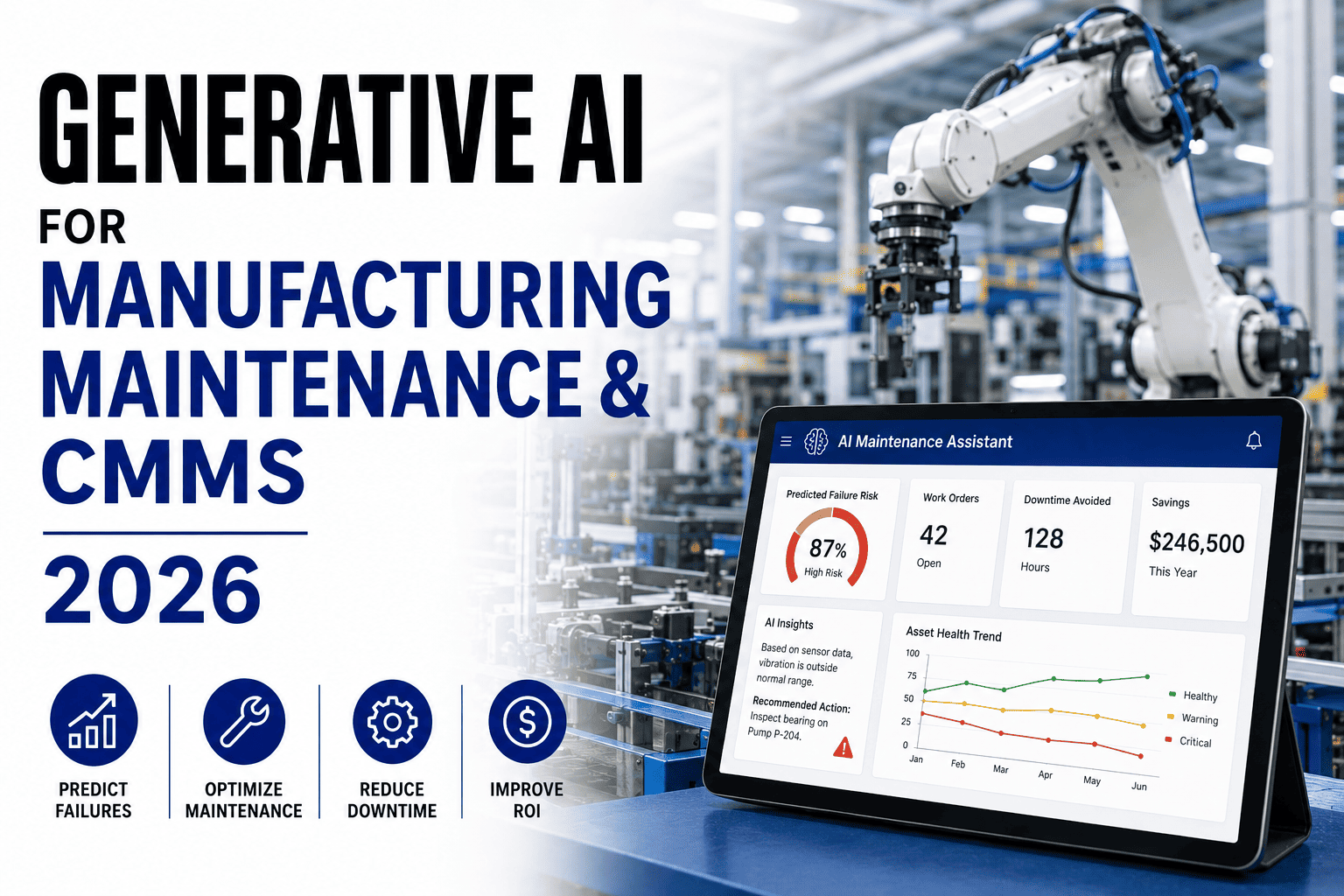
Manufacturing maintenance is entering a new era — and it's moving faster than most teams realize. Generative AI is no longer a pilot project on a whiteboard; it's already slashing unplanned downtime by 25–40%, auto-generating SOPs that used to take days, and giving frontline technicians an intelligent copilot that surfaces repair context in seconds instead of minutes. The global industrial AI market hit $43.6 billion in 2024 and is growing at 23% annually — and manufacturers that are deploying AI in maintenance today are pulling ahead in equipment reliability, cost control, and workforce efficiency in ways that are compounding each year. If you're exploring how generative AI fits into your maintenance operation, start with OxMaint's AI-powered CMMS platform — or book a demo to see it live with your team.
Generative AI in Manufacturing Maintenance: Use Cases, ROI & What's Actually Working in 2025
78% of manufacturing executives are already seeing returns from their GenAI investments. This guide breaks down exactly where generative AI delivers in maintenance — and what it takes to capture that value at your facility.
Why Generative AI Is Different From Traditional Maintenance Automation
Traditional maintenance automation — scheduling alerts, threshold-based alarms, rule-based workflows — tells your team what already happened. Generative AI reasons over context and generates actionable responses: it interprets sensor patterns across thousands of assets simultaneously, synthesizes repair history and OEM manuals to produce step-by-step troubleshooting guidance, and drafts SOPs tailored to specific equipment configurations without a single human hour spent writing them.
The critical distinction for maintenance teams: generative AI doesn't just flag a problem — it explains what is likely causing it, what similar faults looked like in the past, what steps to take, and which parts to have ready. That shift from alert to guided action is where the real productivity gains live.
6 High-Impact Generative AI Use Cases in Manufacturing Maintenance
These are the use cases that are generating documented ROI on production floors today — not theoretical applications, but operational deployments with measurable outcomes that maintenance leaders can replicate.
AI Copilot for Technicians
Highest adoption rateWhen a technician opens a work order on a compressor that's been flagged for unusual vibration, an AI copilot doesn't just show the asset record — it surfaces the last three similar fault events, the repair steps that resolved them, the parts that were used, and the OEM torque specifications for the relevant components. All of this in under 10 seconds, without the technician leaving the work order screen.
The result is a dramatic reduction in mean time to repair (MTTR), fewer escalations to senior engineers for routine faults, and a leveling effect that brings newer technicians up to the speed of experienced ones. Georgia-Pacific deployed a GenAI-based operator guidance tool and documented hundreds of millions in annual value capture across its facilities.
Automated SOP Generation
Time savingsGenerative AI analyzes historical work orders, completed PM tasks, and OEM documentation to automatically draft standard operating procedures for recurring maintenance tasks. SOPs that previously took a senior engineer 4–6 hours to write can be generated, reviewed, and published in under 30 minutes. More importantly, they stay current — the AI updates procedures as work order patterns evolve, catching drift between written SOPs and how maintenance is actually being performed on the floor.
Predictive Failure Forecasting
Cost impactBy combining sensor time-series data (vibration, temperature, pressure, current draw) with historical failure records, generative AI models simulate multiple failure scenarios and identify which assets are trending toward breakdown — days or weeks before the failure would occur. Siemens integrated GenAI into its predictive maintenance framework specifically to simulate failure modes and generate actionable maintenance recommendations. Renault reported €270 million in energy and maintenance savings in a single year from predictive AI deployment.
Intelligent Troubleshooting Assistant
Field impactWhen a fault occurs that hasn't been seen before — or that presents with an unusual symptom combination — a generative AI troubleshooting assistant reasons across the full maintenance knowledge base to suggest probable causes and diagnostic steps. Instead of technicians spending hours searching documentation or waiting for a senior engineer to be available, the AI provides a structured hypothesis with confidence levels and suggested verification steps. This is particularly valuable for facilities with high technician turnover or complex mixed-equipment environments.
Condition-Based Scheduling
PM optimizationTraditional PM schedules are calendar-based — the machine gets serviced every 90 days whether it needs it or not, or worse, gets missed entirely when the schedule slips. Generative AI shifts scheduling from fixed intervals to actual equipment condition, using runtime hours, operational load, and sensor data to determine when each asset actually needs attention. A leading auto parts supplier cut unplanned downtime by 27% using this approach — without adding new equipment or headcount.
Maintenance Knowledge Capture & Transfer
Workforce resilienceOne of manufacturing maintenance's most underrated risks is institutional knowledge loss when experienced engineers retire or leave. Generative AI acts as a continuous knowledge capture layer — extracting, structuring, and making searchable the expertise embedded in thousands of historical work orders, repair notes, and technician observations. New team members can query the system in natural language and get the same quality of guidance that would previously have required pulling a senior engineer off the floor. This is OT know-how digitization at scale — a practice Toyota has invested billions into for exactly this reason.
See These Use Cases in OxMaint
OxMaint's AI maintenance platform brings all six of these capabilities into a single CMMS built for manufacturing teams.
The ROI of Generative AI in Maintenance: What the Numbers Say
AI ROI in maintenance is no longer theoretical — it's documented across industries and facility sizes. The table below captures the documented performance improvements from real-world GenAI maintenance deployments, categorized by outcome type.
| Outcome Category | Industry Benchmark | Top Performer | Payback Window |
|---|---|---|---|
| Maintenance cost reduction | 15–25% | 25–40% | 6–12 months |
| Unplanned downtime reduction | 20–30% | Up to 50% | 8–14 months |
| MTTR (mean time to repair) | 25–35% faster | 40% faster | Immediate |
| PM completion rate improvement | 30–50 pts | 55+ pts | 30–60 days |
| SOP creation time | 70% reduction | 85%+ reduction | Immediate |
| OEE (Overall Equipment Effectiveness) | 10–20% gain | 25% gain | 12–18 months |
Renault reported €270 million in savings on energy and maintenance in a single year after deploying predictive maintenance AI across its production network. A major processed food manufacturer achieved a 25% improvement in OEE and a 30% reduction in maintenance costs through AI-driven condition monitoring — without adding any new machinery.
How Generative AI Fits Into Your Existing CMMS
A common misconception is that deploying generative AI in maintenance requires ripping out existing systems and starting over. In practice, the highest-ROI deployments layer AI capabilities on top of — or tightly integrated with — an existing CMMS, using the historical work order data and asset records already in the system as the training and context foundation for AI reasoning.
Data Foundation
Asset registry, historical work orders, PM records, and sensor feeds become the context layer that generative AI reasons over. Quality and completeness of this data directly determines AI output quality.
AI Layer Integration
Generative AI models are connected to the CMMS data layer — enabling natural language queries, contextual work order enrichment, automated SOP drafting, and failure pattern analysis in real time.
Technician Experience
Technicians interact with AI through their existing work order interface — getting repair guidance, part recommendations, and troubleshooting steps without switching applications or searching separate systems.
Continuous Learning
Every completed work order, every technician action, and every equipment outcome feeds back into the AI model — improving prediction accuracy and recommendation quality over time automatically.
GenAI Maintenance ROI Calculator: What to Measure
Before you can demonstrate ROI to leadership or justify an AI maintenance investment, you need a baseline. These are the four metrics that matter most — and how generative AI typically moves each one.
Emergency repairs cost 3–5x more than planned work. Every reactive repair eliminated goes straight to the bottom line.
AI copilots reduce the time technicians spend diagnosing and searching for repair information — the biggest hidden time sink in maintenance.
Low PM completion is the root cause of most unplanned failures. AI-driven scheduling and automated reminders are the highest-leverage intervention.
When technicians spend less time searching for information and more time executing, output per person rises without adding headcount.
What Holds Manufacturers Back — and How to Clear the Path
Frequently Asked Questions
Your Maintenance Team Deserves an AI That Actually Understands Your Equipment
OxMaint's AI-powered CMMS gives manufacturing teams the intelligent work order management, condition-based scheduling, and technician copilot capabilities that are driving measurable ROI in facilities right now — not in a future roadmap.