MTBF data exists in almost every plant that has ever logged a failure. The problem is rarely data collection — it is data coherence. When failure records use inconsistent codes, asset histories are fragmented across paper logs and digital systems, and reporting is assembled manually after the fact, the resulting MTBF figures are too unreliable to drive reliability decisions. One multi-line processing facility managing 80+ assets across four production lines was operating with exactly this problem. Failure intervals were tracked, but the coding was inconsistent, the reporting cycle was monthly, and the numbers that reached plant leadership were already outdated before any action could be taken. If your team is losing reliability signal to poor failure coding and slow reporting, Sign Up Free to see how Oxmaint cleans MTBF data from the point of capture — or Book a Demo with a reliability operations specialist.
MTBF Visibility · Failure Coding · Reliability Reporting
Connect Failure Data to Reliability Action Across Every Line
Asset-level MTBF tracking, structured failure coding, and real-time reliability dashboards — OxMaint gives maintenance leaders the data clarity to act on reliability gaps, not just observe them.
Plant Profile
The Operation: Four Lines, 80+ Assets, No Reliable MTBF Baseline
Facility Profile
IndustryProcess manufacturing — multi-product, multi-line facility
Lines4 production lines, 80+ assets under maintenance scope
Team18 maintenance technicians, 3 supervisors, 1 reliability engineer
Shifts6-day production, continuous maintenance coverage
Prior systemHybrid paper/spreadsheet failure logs, monthly manual reporting
Oxmaint featuresAsset History · Failure Code Library · MTBF Reporting · PM Scheduling · Reliability Dashboard
Baseline Reliability Problems
~40%
Failure records with inconsistent or missing failure codes — making pattern analysis unreliable
4 wks
Average lag between failure occurrence and MTBF data reaching plant leadership
0
Cross-line MTBF comparisons available to supervisors during shift — all reporting was retrospective
Root Cause Analysis
Why MTBF Data Was Unreliable — And Why Reliability Action Was Hard to Target
A structured audit of 90 days of failure records identified four specific data quality and reporting gaps that were preventing the facility from making meaningful use of its own failure history. The reliability engineer had the will and the analytical skill — but the data arriving for analysis was too inconsistent and too delayed to support confident targeting. Sign Up Free to start capturing structured failure data today — or Book a Demo to see how Oxmaint's failure code library maps to your asset classes.
43%
Inconsistent Failure Coding at Point of Capture
Technicians recorded failure descriptions in free text with no standardised coding. The same failure mode on the same asset class was described differently across technicians and shifts — making frequency and pattern analysis impossible without manual reclassification.
26%
Asset History Fragmented Across Systems
Repair records existed across paper job cards, a spreadsheet log, and a partial digital system. No single view linked all failure events to a specific asset — meaning MTBF calculations required manual data assembly from multiple sources before any analysis could begin.
19%
Reporting Cycle Too Slow for Action
MTBF figures were compiled monthly by the reliability engineer from manually assembled failure logs. By the time data reached leadership, the failure patterns it described were already four weeks old — and the window for early intervention had passed.
12%
No Cross-Line Comparison Visibility
Each line's failure data was tracked independently. Supervisors had no view into whether MTBF on Line 2 was diverging from Line 1 — preventing early identification of systemic issues that crossed asset classes or maintenance practices.
The Solution
How Oxmaint Cleaned the Failure Data and Surfaced MTBF Patterns in Real Time
The facility deployed Oxmaint to replace its fragmented failure logging system with a unified asset history platform that enforced structured failure coding at work order creation, linked every repair event to a specific asset, and made MTBF figures available to supervisors and leadership in real time — not four weeks after the fact. The reliability engineer moved from data assembly to data interpretation. Cross-line MTBF comparisons became a daily supervisory tool rather than a monthly executive report.
01
Structured Failure Code Library Applied at Every Work Order
Every work order closure requires a failure code selection from a standardised library mapped to asset class and failure mode. Free-text descriptions are retained as notes — but coded classification is mandatory. MTBF calculations are built from structured data, not retrospectively interpreted free text.
02
Unified Asset History Across All Lines
Every failure, repair, PM completion, and part replacement is recorded against the specific asset and immediately visible in that asset's history. The reliability engineer has a single, complete view of every event for every asset — eliminating manual data assembly from multiple sources before analysis can begin.
03
Real-Time MTBF Dashboard Available to Supervisors and Leadership
MTBF figures update automatically as failure events are logged and closed. Supervisors can view current MTBF by asset, by line, and across lines from any device during shift. Leadership receives weekly reliability trend summaries from live data — not manually compiled monthly reports.
04
Cross-Line MTBF Comparison for Early Pattern Identification
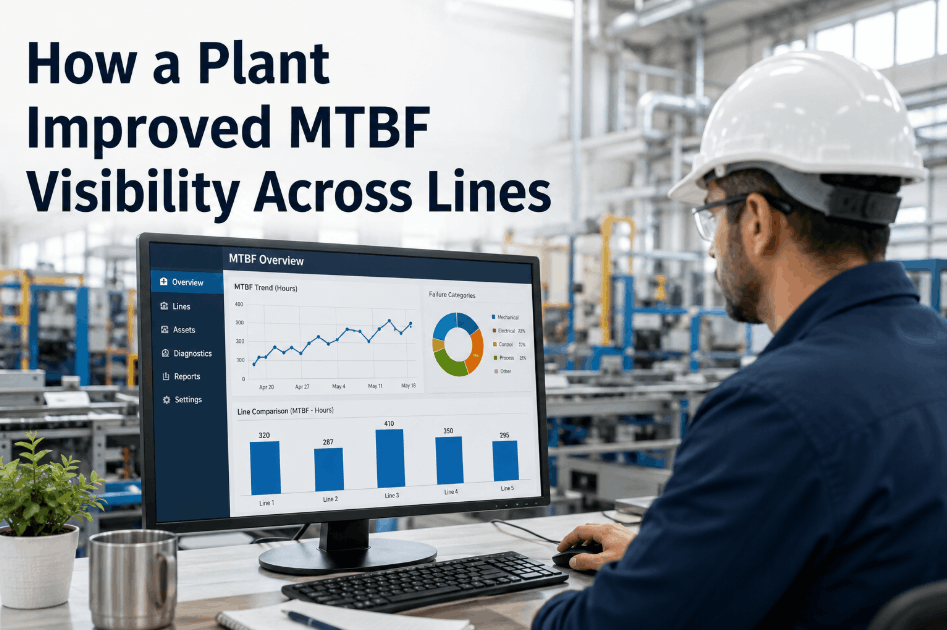
The reliability dashboard surfaces MTBF by line in a comparative view — allowing supervisors to identify divergence early. When Line 3 MTBF drops below Line 1 on a shared asset class, the signal is visible immediately — not four weeks later in a monthly report.
Results at 90 Days
What Cleaner Failure Data and Real-Time Reporting Delivered in Three Months
94%
Failure code compliance rate — up from ~60% at baseline with inconsistent free-text logging
4 wks → real-time
MTBF reporting lag eliminated — live dashboard replaced monthly manual compilation
+34%
Increase in PM-driven interventions — MTBF trends surfaced deteriorating assets before failure
3×
Faster reliability root cause identification — structured failure codes replaced manual reclassification
-41%
Reduction in repeat failures on top-10 MTBF-flagged assets within 90 days
100%
Cross-line MTBF visibility — all four lines live in a single reliability dashboard
| Metric |
Before Oxmaint |
90 Days After |
Change |
| Failure code compliance | ~60% | 94% | +57% |
| MTBF reporting lag | 4 weeks | Real-time | Eliminated |
| PM-driven interventions | Baseline | +34% | +34% |
| Repeat failures (top 10 assets) | Baseline | -41% | -41% |
| Root cause identification time | Baseline | 3× faster | 3× faster |
| Cross-line MTBF visibility | None | All 4 lines live | Full coverage |
Key Business Impact
What Real-Time MTBF Visibility Actually Changes for a Multi-Line Plant
"MTBF is one of the most powerful reliability metrics a plant can track — and one of the most commonly rendered useless by poor data quality at capture. A failure code entered as free text by one technician and a different description by the next shift creates a data set that looks complete but cannot be analysed. The fix is almost never more data collection. It is enforced structure at the point of capture. When every failure is coded consistently the moment the work order closes, MTBF trends become legible within weeks — not after months of retrospective data cleaning. Plants that make this shift almost always find that two or three assets are driving a disproportionate share of their total failure load — and that targeted PM adjustments on those assets reduce total unplanned stops measurably within a quarter."
Dr. Priya Nair, Reliability Engineering Consultant
18 years industrial reliability and asset management · Former reliability lead, multinational FMCG manufacturer · Specialist in MTBF analysis, failure mode standardisation, and PM optimisation
MTBF Tracking · Failure Coding · Cross-Line Reporting
Give Your Reliability Team Data That's Actually Usable
Structured failure codes, unified asset history, and real-time MTBF dashboards — OxMaint makes reliability action easier to target and faster to execute across every line.
FAQs
Frequently Asked Questions
How does Oxmaint improve failure code consistency across maintenance teams?
Oxmaint requires technicians to select a failure code from a structured library when closing any work order. Free-text descriptions are retained as notes, but coded classification is mandatory — eliminating inconsistent terminology that makes MTBF trend analysis unreliable.
Can Oxmaint track MTBF across multiple production lines in the same dashboard?
Yes. The Oxmaint reliability dashboard surfaces MTBF figures by asset, by line, and in cross-line comparisons — all updated in real time as failure events are logged and closed. No manual compilation required.
What happens to historical failure data already logged in spreadsheets or paper records?
Historical data can be imported into Oxmaint's asset history during onboarding. The reliability team can establish a baseline MTBF from imported records and begin tracking trend divergence from day one of deployment.
How quickly does MTBF data become actionable after Oxmaint deployment?
Failure code compliance improvements appear within the first two weeks. Reliable MTBF trend patterns are typically visible within 30–45 days. Cross-line comparison insights emerge as soon as both lines have structured failure history — usually within the first month.
Can Oxmaint help identify which assets are driving the most reliability risk?
Yes. The asset reliability dashboard ranks assets by failure frequency, MTBF trend direction, and total downtime contribution — giving reliability engineers a clear, data-driven target list for PM optimisation and root cause investigation.
Every Failure Coded Correctly Is Reliability Intelligence You Keep
Give Your Plant the MTBF Visibility It Needs to Act Early
Oxmaint brings structured failure coding, unified asset history, and real-time cross-line MTBF dashboards to multi-line maintenance operations — no data cleaning required.