How to Implement Lean Manufacturing in Plants: Complete Roadmap
By oxmaint on February 22, 2026
Most lean manufacturing transformations fail — not because the tools are wrong, but because plants lack the digital infrastructure to sustain improvements beyond the first kaizen event. Without real-time equipment visibility, standardized maintenance workflows, and reliable asset data, even the best lean program collapses under the weight of unplanned downtime and reactive firefighting. This guide walks you through a complete lean implementation roadmap built for modern plants, where continuous improvement culture and digital maintenance management work together to deliver lasting results.
What Is Lean Manufacturing and Why Do 70% of Plants Use It?
Lean manufacturing is a systematic methodology for eliminating waste — any activity that consumes resources without creating value for the customer. Originating from Toyota's Production System in the 1950s, lean has evolved from an automotive-specific approach into a universal operating philosophy adopted across industries worldwide. The core idea is deceptively simple: identify what customers value, map the process that delivers that value, remove everything else, and never stop improving. Plants that implement lean effectively report significant reductions in lead time, inventory, defects, and operating costs while simultaneously improving workforce engagement and production flexibility.
25–30%
Lower manufacturing costs reported after lean implementation
70–90%
Average reduction in production lead times with mature lean systems
Up to 80%
Fewer defects through built-in quality and standardized processes
The 8 Wastes Destroying Your Plant Efficiency (DOWNTIME)
Before you can improve a process, you must learn to see what is broken. Lean thinking categorizes all non-value-adding activities into eight wastes, known by the acronym DOWNTIME. Every waste identification exercise begins here — on the shop floor, observing real work, and asking one question: does this step create value the customer would pay for?
D
Defects
Rework, scrap, and warranty claims that consume resources without delivering value. Root causes include poor process controls, inadequate training, and equipment running out of calibration.
O
Overproduction
Making more than the customer needs or producing too early. Considered the worst waste because it triggers all other wastes — excess inventory, extra motion, additional transportation, and hidden defects.
W
Waiting
People idle while machines break down. Machines idle while materials arrive. Processes stalled by upstream bottlenecks, missing approvals, or equipment awaiting maintenance. Every minute of waiting is lost capacity.
N
Non-Utilized Talent
Frontline workers know the problems better than anyone. When organizations fail to engage employees in problem-solving and improvement, they lose their most valuable source of innovation and waste detection.
T
Transportation
Unnecessary movement of materials between processes, storage areas, and workstations. Poor facility layout and disconnected production flows force parts to travel excessive distances without adding value.
I
Inventory
Excess raw materials, work-in-progress, or finished goods beyond immediate need. Surplus inventory hides quality problems, consumes working capital, occupies floor space, and increases the risk of obsolescence.
M
Motion
Unnecessary physical movement by workers — reaching, bending, walking, searching for tools. Poor workstation ergonomics and disorganized layouts turn simple tasks into energy-draining activities.
E
Extra Processing
Doing more work than the customer requires — tighter tolerances than necessary, redundant inspections, duplicate data entry, and over-engineered features that add cost without adding perceived value.
Waiting waste from equipment breakdowns is the #1 lean killer. Oxmaint's preventive maintenance scheduling and real-time asset tracking eliminate unplanned downtime so your lean gains stick. Create your free account to start reducing equipment-related waste today.
A successful lean transformation requires a structured approach that builds organizational capability in phases. Jumping straight to advanced tools without laying the foundation of leadership alignment, baseline measurement, and cultural readiness is the primary reason most lean programs stall within the first year. This five-phase roadmap sequences each step to maximize early wins while building toward sustainable, plant-wide transformation.
01
Week 1 – 3
Secure Leadership Commitment and Define Your Lean Vision
Lean transformation cannot succeed as a shop-floor initiative alone. Senior leaders must understand the philosophy, commit resources, and actively champion the change. Define a compelling vision tied to business strategy, establish a cross-functional steering committee, and communicate the purpose to every level of the organization. Measure your current state — document baseline KPIs for cost, quality, delivery speed, and safety before any changes begin.
02
Week 4 – 6
Map Your Value Streams to Expose Hidden Waste
Value Stream Mapping (VSM) is the diagnostic engine of lean. Walk the entire flow of materials and information for your highest-volume product families. Document every step from raw material receipt to finished goods shipment. Measure cycle times, wait times, inventory buffers, and changeover durations. Most plants discover that less than 5% of total lead time actually adds customer value — the rest is waste waiting to be eliminated. Design a future-state map that shows what the process looks like with waste removed.
03
Week 7 – 12
Launch a Pilot Area with 5S, Visual Management, and Kaizen
Select one high-impact value stream as your pilot. Deploy 5S workplace organization to create visual order. Install daily management boards for real-time performance tracking. Run focused kaizen events (3–5 day intensive improvement sprints) targeting the biggest waste sources identified in your value stream map. Document every improvement with before-and-after metrics. This pilot becomes the proof of concept that builds momentum across the organization.
04
Month 4 – 8
Scale Proven Methods Across All Production Lines
Take what worked in the pilot and roll it across additional value streams. Implement kanban pull systems for inventory control, standardized work instructions for every critical process, and TPM (Total Productive Maintenance) to drive equipment reliability. This is the phase where digitizing your maintenance operations with Oxmaint becomes critical — scheduling preventive maintenance, tracking asset health, and managing work orders in real-time ensures your machines support lean flow instead of disrupting it.
05
Ongoing
Embed Continuous Improvement as a Daily Operating Habit
Lean is never "done." The final phase transforms improvement from a project into a daily habit. Train every employee in basic problem-solving methods (PDCA, 5 Whys, A3 thinking). Conduct regular gemba walks where leaders observe work at the point of value creation. Track OEE, lead time, and waste metrics continuously. Celebrate improvements publicly and share learnings across shifts and departments. The goal is a culture where every person, every day, looks for a better way.
Core Lean Tools Every Plant Manager Should Master
Lean manufacturing is not a single technique but a system of interconnected tools, each designed to solve specific waste problems. The skill lies in matching the right tool to the right problem — deploying SMED where changeovers are the bottleneck, kanban where overproduction drives excess inventory, or TPM where equipment failures create waiting waste.
5S Workplace Organization
Sort, Set in Order, Shine, Standardize, Sustain
The foundation of visual management. Creates organized workstations where abnormalities are immediately visible, tools are always accessible, and safety hazards are eliminated. 5S is not a cleaning program — it is an abnormality detection system.
Value Stream Mapping
Diagnose before you prescribe
Maps the complete flow of materials and information from raw material to customer. Quantifies where value is created versus where waste hides. The essential first step before selecting any other lean tool.
Kaizen Events
Rapid, focused improvement sprints
Cross-functional teams tackle a specific problem in 3–5 intensive days. Produces measurable results quickly, builds employee confidence in the lean approach, and creates internal improvement expertise.
Kanban Pull Systems
Produce only what is needed, when needed
Visual signaling system that controls work-in-progress and inventory based on actual customer demand rather than forecasts. Eliminates overproduction and reduces inventory by 30–50% in typical implementations.
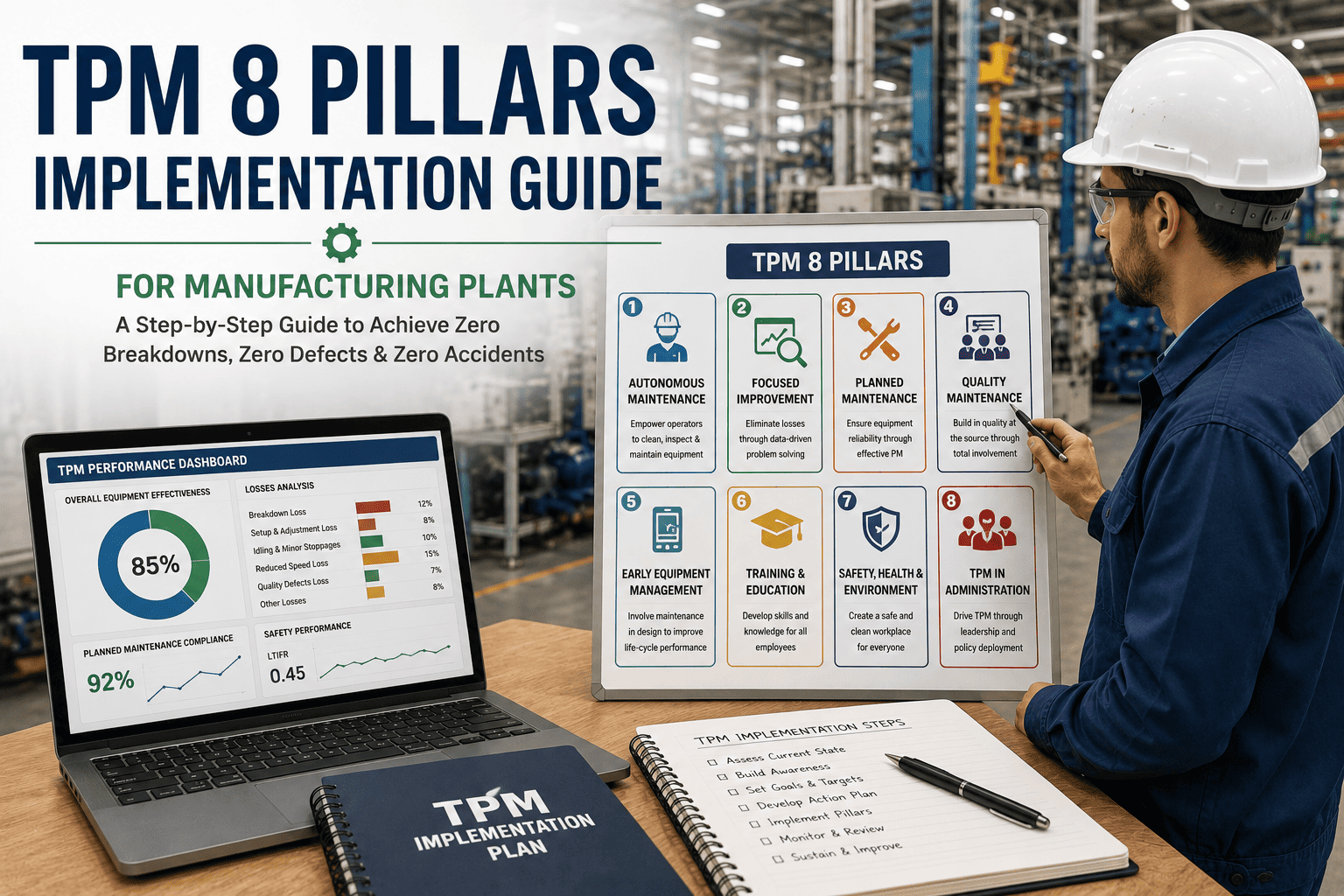
Total Productive Maintenance
Equipment reliability is a lean prerequisite
Empowers operators and maintenance teams to maximize machine availability through autonomous maintenance, planned maintenance, and focused improvement. A CMMS platform like Oxmaint makes TPM execution trackable and sustainable.
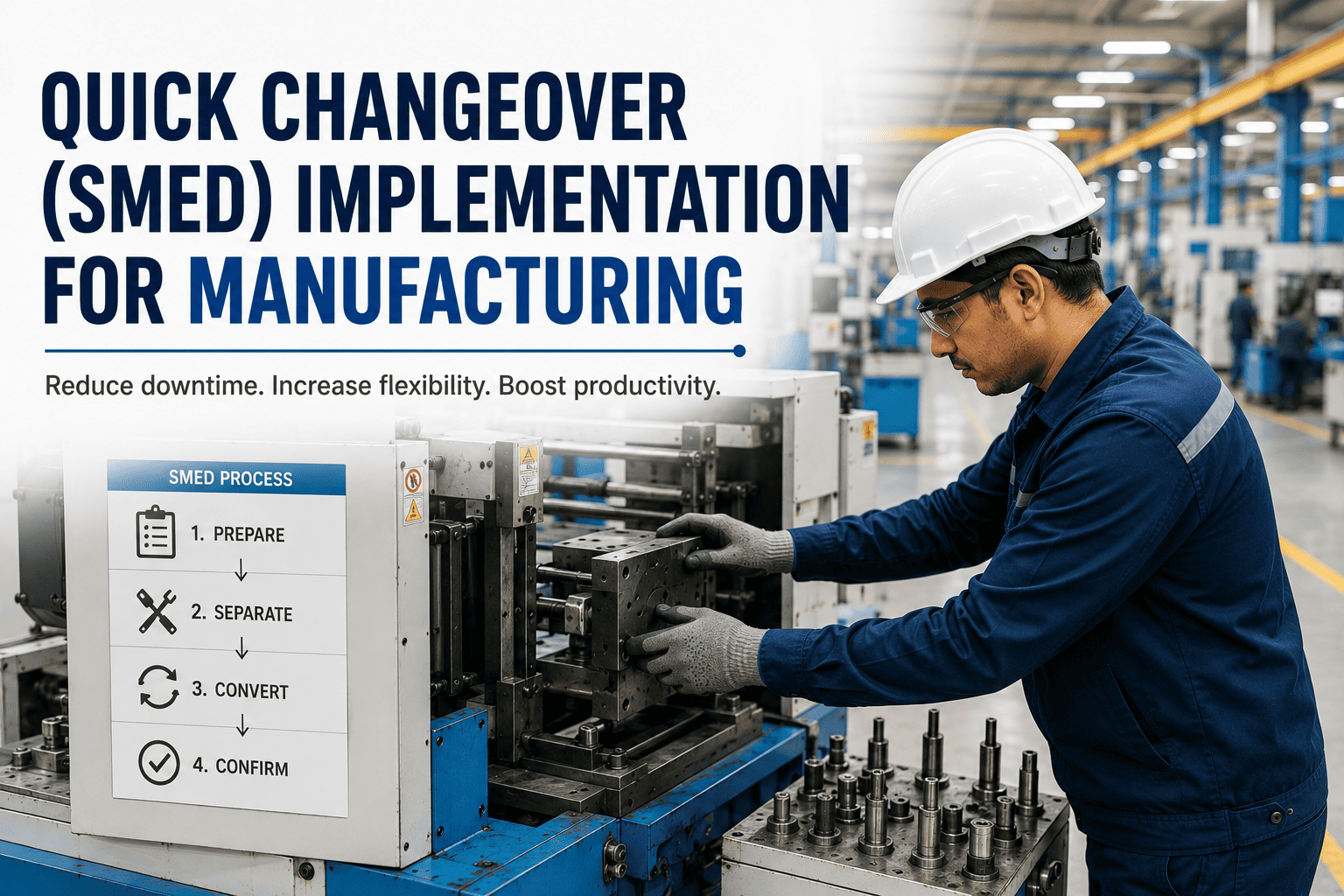
SMED Quick Changeover
Single-Minute Exchange of Dies
Reduces equipment setup times by separating internal and external setup activities. Enables smaller batch sizes, greater production flexibility, and faster response to changing customer demand.
TPM without a CMMS is just a wish list. See how Oxmaint turns your Total Productive Maintenance program into a trackable, measurable system with automated PM schedules and mobile work orders. Book a 30-minute walkthrough with our team.
Why Equipment Reliability Makes or Breaks Lean Programs
Here is the uncomfortable truth most lean guides skip: no lean tool works when machines keep breaking down. Pull systems collapse when a critical machine goes offline. Kanban signals pile up when production cells cannot maintain takt time. 5S audits become meaningless when oil leaks and equipment failures dominate the shop floor. Equipment reliability is not a support function for lean — it is a prerequisite.
Without Maintenance Management
XReactive maintenance causes 2–5x more downtime than planned repairs
XNo visibility into which assets fail most or why
XPaper-based work orders get lost, delayed, or duplicated
XSpare parts either overstocked (waste) or missing when needed (downtime)
XOEE unmeasurable — no reliable data for improvement
With Oxmaint CMMS
✓Preventive maintenance schedules eliminate 70%+ of unplanned stops
✓Asset history and failure analytics pinpoint chronic reliability issues
✓Mobile work orders reach technicians instantly with full instructions
✓Spare parts inventory optimized — right part, right time, zero waste
✓OEE dashboards provide real-time data for continuous improvement
Stop Letting Equipment Failures Undermine Your Lean Gains
Oxmaint provides the digital maintenance backbone your lean plant needs — preventive scheduling, real-time asset tracking, mobile work orders, and OEE analytics in one platform. Give your maintenance team the tools to keep machines running so your lean improvements last.
Tracking Lean Progress: Metrics That Actually Matter
Lean plants live by data. The right metrics tell you whether waste is decreasing, flow is improving, and customer value is increasing. The wrong metrics (or too many of them) create confusion and wasted reporting effort — which is itself a lean waste. Focus your lean steering committee on these five high-impact indicators.
OEE
Target: 85%+
Overall Equipment Effectiveness combines availability, performance, and quality into a single score. World-class plants achieve 85% or higher. A CMMS tracks the downtime events, speed losses, and quality rejects needed to calculate OEE accurately.
Lead Time
Reduce 25–50% in Year 1
Total elapsed time from order receipt to delivery. Lean reduces lead time by eliminating waiting, excess inventory, and overprocessing. Shorter lead times mean faster customer response and less working capital trapped in the system.
First Pass Yield
Target: 95%+
Percentage of units produced correctly without rework on the first attempt. Measures built-in quality effectiveness. Equipment calibration tracking and standardized maintenance procedures directly improve this metric.
MTBF / MTTR
Increase MTBF, Decrease MTTR
Mean Time Between Failures and Mean Time To Repair are core maintenance reliability indicators. Improving MTBF means fewer breakdowns. Reducing MTTR means faster recovery. Both directly reduce waiting waste in lean operations.
Inventory Turns
Continuous Improvement
How frequently inventory is consumed and replaced. Higher turns mean less capital locked in stock and faster response to demand changes. Pull systems and kanban directly increase inventory turns while reducing carrying costs.
You cannot improve OEE and MTBF without tracking them. Oxmaint automatically logs downtime events, maintenance response times, and equipment performance — giving your lean team the data they need to drive real improvements. Start tracking for free.
5 Reasons Lean Transformations Fail — and How to Avoid Each One
Research consistently shows that the vast majority of lean initiatives fail to deliver sustained results. Understanding these failure patterns before you start gives your plant the awareness needed to avoid them.
01
Leadership treats lean as a project, not a culture
Lean is not something you install and walk away from. Plants that treat lean as a 6-month project see initial gains evaporate within a year. Build daily improvement routines — gemba walks, huddle boards, suggestion systems — that persist long after the consultants leave.
02
Ignoring equipment reliability while pursuing flow
You cannot create production flow when machines fail unpredictably. TPM and preventive maintenance must be implemented alongside lean, not after. A CMMS platform gives your maintenance team the structure to make equipment reliability a daily reality, not an aspiration.
03
Applying tools without diagnosing the problem
Forcing SMED on a process where the bottleneck is material handling wastes time and erodes trust. Always start with value stream mapping to identify the actual constraint. Let the data choose the tool, not the other way around.
04
Sub-optimizing individual processes at the system's expense
Speeding up a process upstream of a bottleneck just creates more waiting waste at the bottleneck. Lean requires an enterprise view — always focus improvements on the system constraint first, then work outward.
05
Excluding frontline workers from improvement efforts
The people doing the work know the problems best. When improvement efforts are designed in conference rooms and imposed on the shop floor, they lack the practical insight needed to work and the buy-in needed to last. Engage operators from day one.
Your Lean Journey Starts with Reliable Equipment and Real-Time Data
Every lean principle depends on machines that run when they should and data that flows where it is needed. Oxmaint delivers preventive maintenance scheduling, mobile work orders, asset history tracking, and OEE dashboards — the digital foundation that makes lean manufacturing sustainable. Start building a plant where continuous improvement is backed by continuous equipment reliability.
How long does a lean manufacturing implementation take to show ROI?
Most plants see measurable results from a pilot lean area within 8 to 12 weeks. Quick wins from 5S, visual management, and initial kaizen events often generate enough savings to fund broader rollout. Full plant transformation is a multi-year journey, but the financial payback typically begins within the first 6 months when the implementation follows a structured roadmap. Schedule a demo to discuss a lean maintenance strategy tailored to your plant's timeline and goals.
What is the connection between CMMS and lean manufacturing?
A CMMS (Computerized Maintenance Management System) supports lean by ensuring equipment reliability — the prerequisite for production flow. It schedules preventive maintenance to prevent breakdowns, tracks asset performance for OEE measurement, standardizes maintenance procedures through digital work orders, and provides the failure data needed for root cause analysis. Without a CMMS, TPM programs remain manual and difficult to sustain. Sign up for Oxmaint to see how maintenance management integrates directly with lean operations.
Can lean manufacturing work in small or medium-sized plants?
Lean is often more effective in smaller operations because changes can be implemented faster with less organizational complexity. Start with high-impact, low-complexity tools like 5S and visual management, then build toward pull systems and standardized work as capability grows. The key for SMEs is right-sizing the approach — smaller kaizen events, simpler kanban systems, and focused value stream maps for your highest-volume products.
What are the 5 principles of lean manufacturing?
The five lean principles are: define value from the customer's perspective, map the value stream to identify all steps in the delivery process, create flow by eliminating interruptions between value-adding steps, establish pull so that production responds to actual demand rather than forecasts, and pursue perfection through continuous improvement. Each principle builds on the previous one, and all five must work together for a lean system to function.
What is the difference between lean manufacturing and Six Sigma?
Lean focuses on eliminating waste and improving flow speed, while Six Sigma focuses on reducing process variation and defects using statistical methods. In practice, many plants combine both approaches (Lean Six Sigma) — using lean tools like VSM and kanban to improve flow, and Six Sigma tools like DMAIC and statistical process control to improve quality. Both require reliable equipment data, which is why maintenance management platforms support both methodologies.