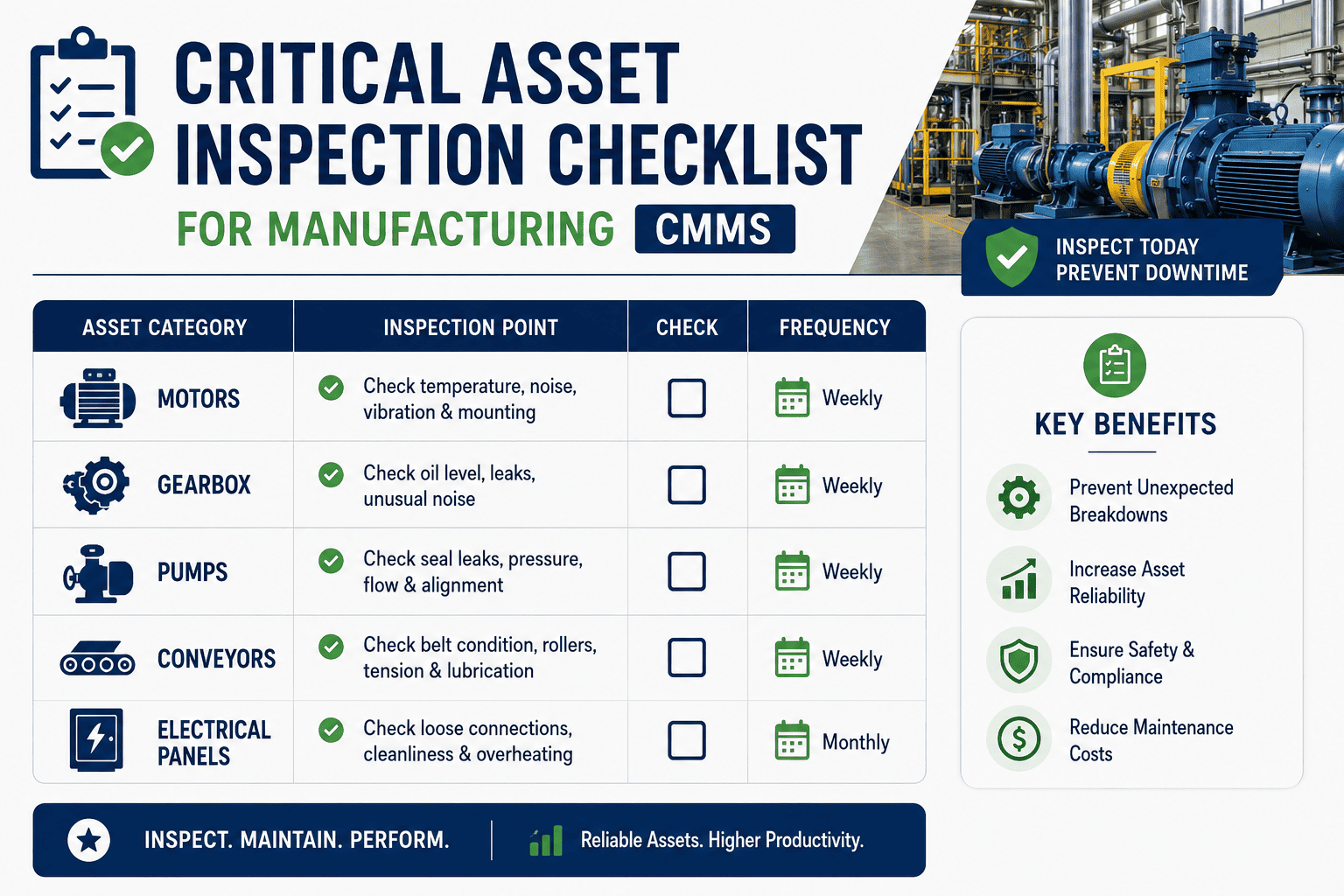
Bearing failure is one of the most predictable failures in a plant, and one of the most inconsistently checked. One technician greases on schedule and listens for noise; another checks vibration but skips the visual; a third does neither because the checklist for that machine was never actually written down. Bearings rarely fail without warning — they fail without anyone standardizing the warning signs across every technician and every shift. This guide gives you a practical, standardized bearing maintenance checklist — what to inspect, how often, and what to do when something's off — using OXMAINT AI, the AI-powered CMMS that turns this checklist into a repeatable inspection routine and an automatic corrective work order when something fails a check.
Industrial Bearing Maintenance Checklist for Manufacturing
A bearing checklist only protects a machine if every technician runs it the same way, every time. OXMAINT AI turns this checklist into a standard routine attached to each bearing's own asset record — lubrication, vibration, temperature and visual checks logged consistently, any result outside range opens a defect automatically, and that defect converts into a corrective work order before a routine failure becomes an unplanned one.
Why Bearing Failures Still Catch Plants Off Guard
Bearing degradation almost always leaves a trail — rising temperature, a change in vibration signature, a shift in the sound the machine makes. The failure isn't usually a surprise to the equipment. It's a surprise to whoever wasn't the one checking it that week, because the checklist lived in someone's habit instead of a shared record. Start free and standardize your own bearing checklist in OXMAINT AI.
- Different technicians check different things, depending on training and habit
- Lubrication intervals tracked loosely, or not tracked at all
- Vibration or temperature readings taken without comparison to the last one
- A borderline finding isn't flagged unless it's obvious enough to notice
- A failed check doesn't automatically become a scheduled repair
- Every technician runs the same checklist, on the same schedule, per bearing
- Lubrication logged and tracked against that bearing's own interval
- Vibration and temperature readings compared to the bearing's own trend
- A reading outside range flags automatically, regardless of who ran the check
- A failed check opens a defect and drafts a corrective work order on its own
The Four-Point Bearing Check
A thorough bearing check covers four areas, not just the one a technician happens to think of. OXMAINT AI runs this as one connected checklist per bearing rather than four separate, disconnected tasks. Book a demo to see this checklist on your own equipment.
Checklist at a Glance
Here's the core checklist in reference form — a general starting point your team should adjust to the specific bearing, machine, and manufacturer specifications. Sign up free and turn this into a running checklist in OXMAINT AI.
| Check item | What to look for | Typical frequency |
|---|---|---|
| Lubrication level & condition | Correct level, no contamination or discoloration | Per manufacturer's lubrication schedule |
| Vibration reading | Compared against the bearing's own established baseline | Weekly to monthly, more often on critical assets |
| Housing temperature | Within normal range for this bearing under current load | Routine rounds, or continuous if sensored |
| Visual & audible | No unusual noise, leakage, or visible looseness | Every routine inspection round |
A Checklist That Changes by Who's Running It Isn't a Checklist.
The value of a standardized routine is that it doesn't depend on which technician is on shift. OXMAINT AI keeps the checklist, the thresholds, and the history the same for every bearing, every time.
One Failed Check, Start to Close
Here's how a single flagged bearing check actually moves through OXMAINT AI. Book a demo to see this on your own equipment.
Habit-Based Checks vs. Standardized Routine
| What matters | Habit-based checks | Standardized in OXMAINT AI |
|---|---|---|
| Consistency across technicians | Varies by who's on shift | Same checklist, every time |
| Comparison basis for readings | Memory or a rough sense of "normal" | The bearing's own logged baseline |
| Lubrication tracking | Often informal or missed | Logged and tracked per interval |
| Path from failed check to repair | Depends on someone writing it up | Auto-drafted work order |
| History for the next technician | Rarely passed along fully | Sitting on the bearing's own record |
Frequently Asked Questions
Run the Same Bearing Checklist, Every Shift, Every Time.
Standardize lubrication, vibration, temperature and visual checks per bearing, and let a failed check draft its own corrective work order — no more depending on who happened to notice.