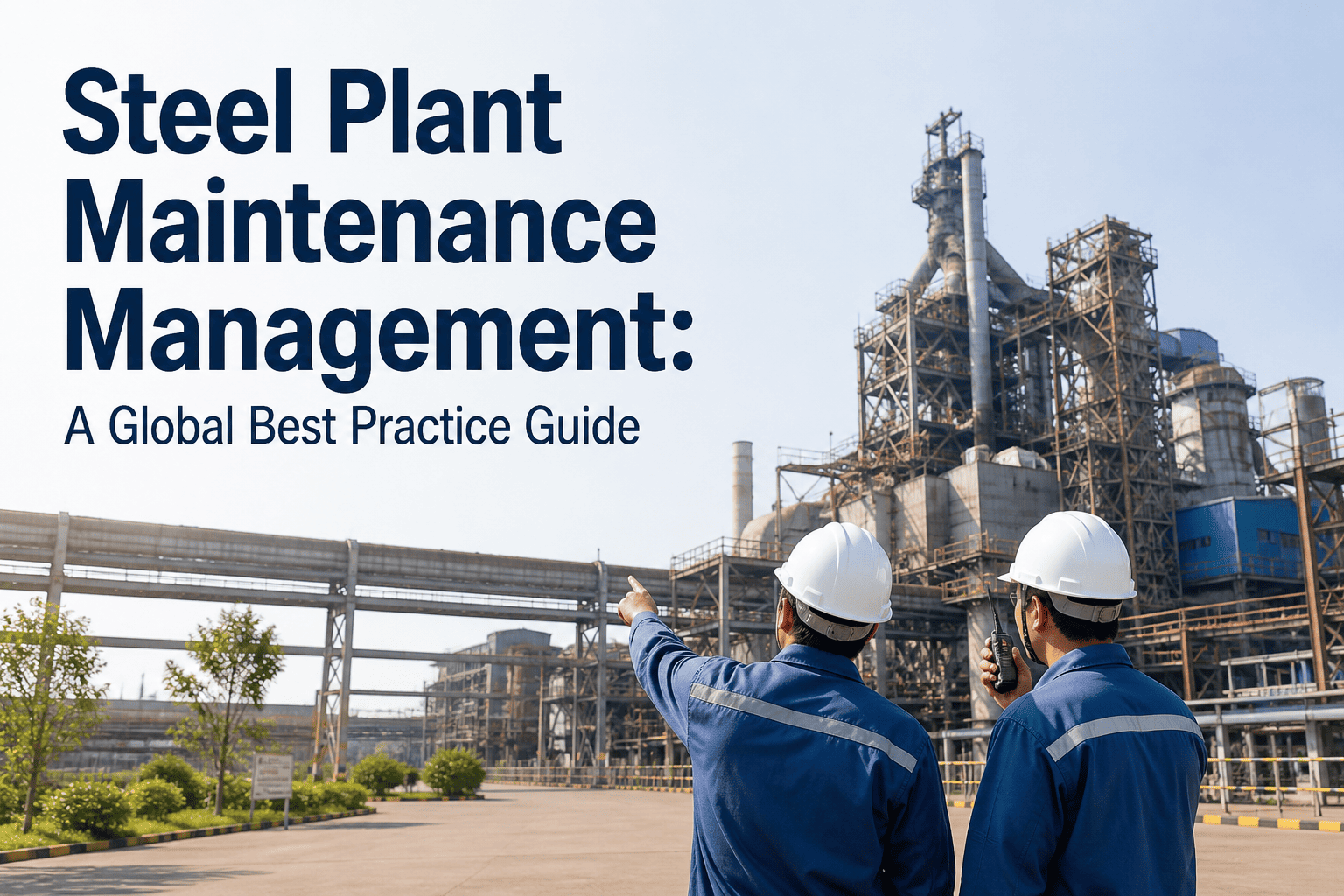
Steel manufacturing is one of the most equipment-intensive and failure-consequential industrial environments on earth. Blast furnaces run as $500 million assets operating continuously for 15–20 year campaigns at 2,000°C internal temperatures. Hot strip mills produce every coil that feeds downstream cold rolling, coating, and finishing lines — a single unplanned stand outage during a rolling campaign can strand dozens of slabs in the reheating furnace and cascade into hours of recovery time. The steel industry spent an estimated $4.2 billion on unplanned downtime in 2024 alone, and the plants driving that number down are not the ones with the newest equipment — they are the ones that have replaced calendar-based maintenance schedules with structured, asset-specific PM programs supported by a CMMS that tracks every asset from blast furnace to finishing line. Start a free Oxmaint trial to see how steel plants structure maintenance across every production zone.
GLOBAL BEST PRACTICE GUIDE
Steel Plant Maintenance That Runs the Full Campaign — Not Just Until the Next Emergency
From blast furnace refractory monitoring to rolling mill bearing management, best-in-class steel maintenance is structured, data-driven, and CMMS-enforced at every asset in the production chain.
$4.2B
Steel industry unplanned downtime cost in 2024
$20–80M
Cost of an unplanned blast furnace reline
5–10x
Higher cost for emergency vs planned repairs
The Steel Plant Production Chain and Its Maintenance Demands
Steel production is a cascade of interdependent high-consequence zones. An unplanned failure at any point can shut down every zone downstream for hours — and the maintenance disciplines required at each stage are fundamentally different from one another. A CMMS that works for a finishing line but not for a blast furnace is only solving half the problem.
Zone 1
Blast Furnace
Campaign-based | Refractory lifecycle
$500M+ asset, 15–20 year campaigns. Every tuyere, stave, and cooling circuit tracked per position on its degradation curve. Maintenance is planned months ahead — unplanned stops cost $20–80M.
Zone 2
BOF / EAF Steelmaking
Heat-cycle based | Lining management
Converter lining, oxygen lance, ladle and tundish refractory tracked against heat counts. Lining thickness projections drive planned relining campaigns — not emergency stoppages.
Zone 3
Continuous Caster
Sequence-based | Breakout prevention
Mold copper wear, oscillation mechanism, strand guide rolls, and withdrawal rolls all carry per-heat tracking. A caster breakout costs $500K–$1M in equipment damage per event.
Zone 4
Reheat Furnace
Run-hours based | Refractory condition
Skid pipe refractory, burner condition, door seal, and hearth track on calendar and production hour cycles. Furnace availability directly controls rolling mill productivity.
Zone 5
Rolling Mills
Roll-count based | Bearing management
Hot and cold mill bearings, roll chocks, AGC cylinders, and coiler internals tracked per tonnage and vibration signature. A bearing seizure at 2 AM costs $1.6M in downtime before sunrise.
Blast Furnace Maintenance: The Five Domains That Determine Campaign Life
A blast furnace cannot be stopped for non-emergency maintenance without triggering a campaign restart costing millions in refractory preparation and heat-up time. This operational reality makes blast furnace maintenance fundamentally different from every other industrial asset. The five domains below structure the maintenance program that top-performing steel plants follow to protect full campaign life.
01
Refractory and Shell Monitoring
Shell thermocouples, stave heat flux monitoring, and refractory wear measurement feed a continuous picture of lining health. CMMS-tracked shell temperature trends trigger inspection work orders when readings exceed thresholds — catching hot spots before they become campaign-ending events.
02
Tuyere and Blowpipe Lifecycle
Tuyeres last 6–18 months in service depending on blast intensity and burden chemistry. Each tuyere position has its own lifecycle record in the CMMS — inspection intervals, cooling water flow monitoring, and planned replacement scheduled against heat counts rather than calendar dates.
03
Stave Cooling Circuit Integrity
Cooling staves degrade over 5–10 years. Cooling water flow rates, inlet and outlet temperature differentials, and leak detection systems are monitored per circuit. A stave failure allows refractory to heat uncontrolled — the fastest route to an unplanned emergency reline.
04
Casthouse Equipment
Taphole drills, mud guns, and casthouse cranes require shift-level inspection — not weekly rounds. Each casting cycle stresses taphole equipment. CMMS work orders generated at shift frequency with mandatory completion sign-off are the only way to maintain casthouse reliability across a 20-year campaign.
05
Hot Blast Stoves and Gas Cleaning
Hot blast stoves cycle between combustion and blast modes thousands of times per campaign. A failed stove valve on a 3-stove configuration cuts blast capacity by 33%. The gas cleaning plant is a safety-critical installation — CO detector calibration, bleeder valve tests, and scrubber inspection records are legal compliance documents.
CAMPAIGN PROTECTION STARTS WITH PM DISCIPLINE
Every Tuyere. Every Stave. Every Bearing. One Asset History.
Oxmaint tracks blast furnace components on heat-count cycles, rolling mill bearings on vibration signatures, and caster wear on sequence counts — giving steel plant maintenance teams the data to plan ahead, not react late.
Rolling Mill Maintenance: Best Practices Across Hot and Cold Lines
Hot Strip Mill
Work Roll Bearings
Vibration signature monitoring per stand. Bearing change scheduled on campaign tonnage target, not calendar. CMMS alerts when signature deviates from normal operating envelope.
Roll Chocks and Liners
Chock condition assessed at each roll change. Liner wear measurement logged per position. Replacement scheduled ahead of wear-limit to prevent emergency stand-down during a rolling campaign.
AGC Hydraulic System
Oil analysis on scheduled interval, servo valve condition checked every 4 weeks. AGC failures cause thickness deviation across the entire rolled coil — immediate quality and yield consequence.
Descaler and Coiler
Descaler nozzle condition checked weekly — blocked nozzles cause scale defects in finished strip. Coiler mandrel and wrapper roll wear tracked per coil count in CMMS asset record.
Cold Rolling Mill
Work Roll Surface Condition
Roll surface roughness measured at defined intervals against strip surface quality specifications. Rolls returned to grinding on scheduled campaigns — not after product quality complaints arrive.
Backup Roll Bearings
Backup roll bearing replacements planned at 12-month intervals or oil analysis trigger, whichever comes first. A seized backup roll in a cold tandem mill stops the entire line — the highest-cost single failure in cold rolling.
Strip Tension and Flatness Systems
Tensiometer calibration, flatness measurement roll condition, and looper hydraulics checked monthly. Calibration drift produces strip that fails customer flatness specifications — generating quality claims and rejects.
Rolling Oil System
Oil concentration, temperature, and contamination monitored continuously. Fouled rolling oil causes mill fires and strip surface contamination. Filter condition and heat exchanger performance tracked in CMMS.
Global Best Practice Benchmarks for Steel Plant Maintenance
90–95%
Blast Furnace Availability
World-class integrated steel plants. Below 88% indicates refractory campaign management or casthouse equipment reliability issues requiring CMMS-structured intervention.
85%+
Planned Maintenance Ratio
Best-in-class steel plants run 85% planned vs reactive work orders. Plants below 65% are in a reactive cycle that compounds maintenance cost per tonne quarter over quarter.
15–20 yrs
Target BF Campaign Life
Modern blast furnaces are designed for 15–20 year campaigns between major relinings. Achieving this requires stave cooling integrity and refractory monitoring to never miss a trending anomaly.
30–50%
MTTR Reduction with CMMS
CMMS-managed spare parts availability and work order history cut mean time to repair by 30–50% compared to reactive plants searching for parts during an emergency.
CMMS Requirements Unique to Steel Plants
Campaign-Based Scheduling
Blast furnace tuyeres, converter linings, and caster molds are maintained on heat-count cycles — not calendar intervals. A CMMS must support throughput-triggered PM scheduling tied to the furnace heat counter or casting sequence count, not just date-based recurrence.
Deep Sub-Asset Hierarchy
A blast furnace has 3,000+ monitored parameters and dozens of individual maintainable sub-components — each tuyere position, each stave circuit, each cooling element has its own PM history. A flat asset list is structurally insufficient. Sub-asset tracking at the component level is a baseline requirement.
Shift-Level PM Frequency
Casthouse equipment — taphole drills, mud guns, cranes — requires inspection every shift, not every week. The CMMS must generate and track shift-level work orders reliably, with shift supervisor sign-off captured digitally before the next shift begins.
Permit-to-Work Integration
Maintenance in a steelworks operates under permit-to-work regimes that carry regulatory and legal liability. Work orders on hot assets, confined spaces, and gas hazard zones must link to PTW records — tracking isolation status, gas testing results, and competency verification before technicians are cleared to work.
Condition-Based Trigger from Process Data
Blast furnace shell thermocouples, rolling mill vibration systems, and ladle temperature histories feed directly into maintenance decisions. A steel-ready CMMS generates work orders automatically when monitored parameters exceed thresholds — not after a technician manually reviews a trend screen and raises a job card.
Frequently Asked Questions
What is the biggest maintenance risk in a blast furnace?
An undetected shell hot spot or stave cooling failure leading to an unplanned emergency reline — costing $20–80M and forcing a campaign restart. The only mitigation is continuous shell temperature monitoring with CMMS-triggered work orders when readings trend above baseline thresholds, reviewed every shift without exception.
How does rolling mill bearing management differ from standard PM scheduling?
Rolling mill bearings degrade based on tonnage throughput, rolling force, and lubrication quality — not calendar time. Best practice uses vibration signature trending to predict bearing condition 2–4 weeks ahead, combined with tonnage-based replacement campaigns. Calendar-only PM misses bearings degrading faster than expected under heavy load.
Can Oxmaint handle the sub-asset complexity of a blast furnace?
Yes. Oxmaint supports deep asset hierarchy — individual tuyere positions, stave circuits, and cooling elements each carry their own PM history, temperature records, and lifecycle tracking within the parent furnace asset. Campaign-based scheduling tied to heat counts is natively supported alongside standard time-based PM intervals.
What maintenance KPIs matter most in a steel plant?
Blast furnace availability (target 90–95%), hot metal production per campaign versus design, planned maintenance ratio (target 85%+), and MTTR on critical rotating assets. Oxmaint tracks all four from work order data automatically, giving plant managers live reliability visibility without manual reporting from Excel.
How does a CMMS support permit-to-work compliance in a steelworks?
Oxmaint links work orders on hazardous assets to permit-to-work requirements — capturing isolation confirmation, gas test results, and competency verification before the work order can be executed. Every PTW record is attached to the asset's permanent maintenance history, creating a defensible safety audit trail for regulatory review.
OXMAINT FOR STEEL PLANTS
Protect Every Campaign. Plan Every Stop. Run Every Zone at Full Capacity.
Oxmaint structures maintenance across blast furnaces, steelmaking vessels, continuous casters, reheat furnaces, and rolling mills — with campaign-based scheduling, sub-asset hierarchy, shift-level PM, and condition-based triggers from your process data.