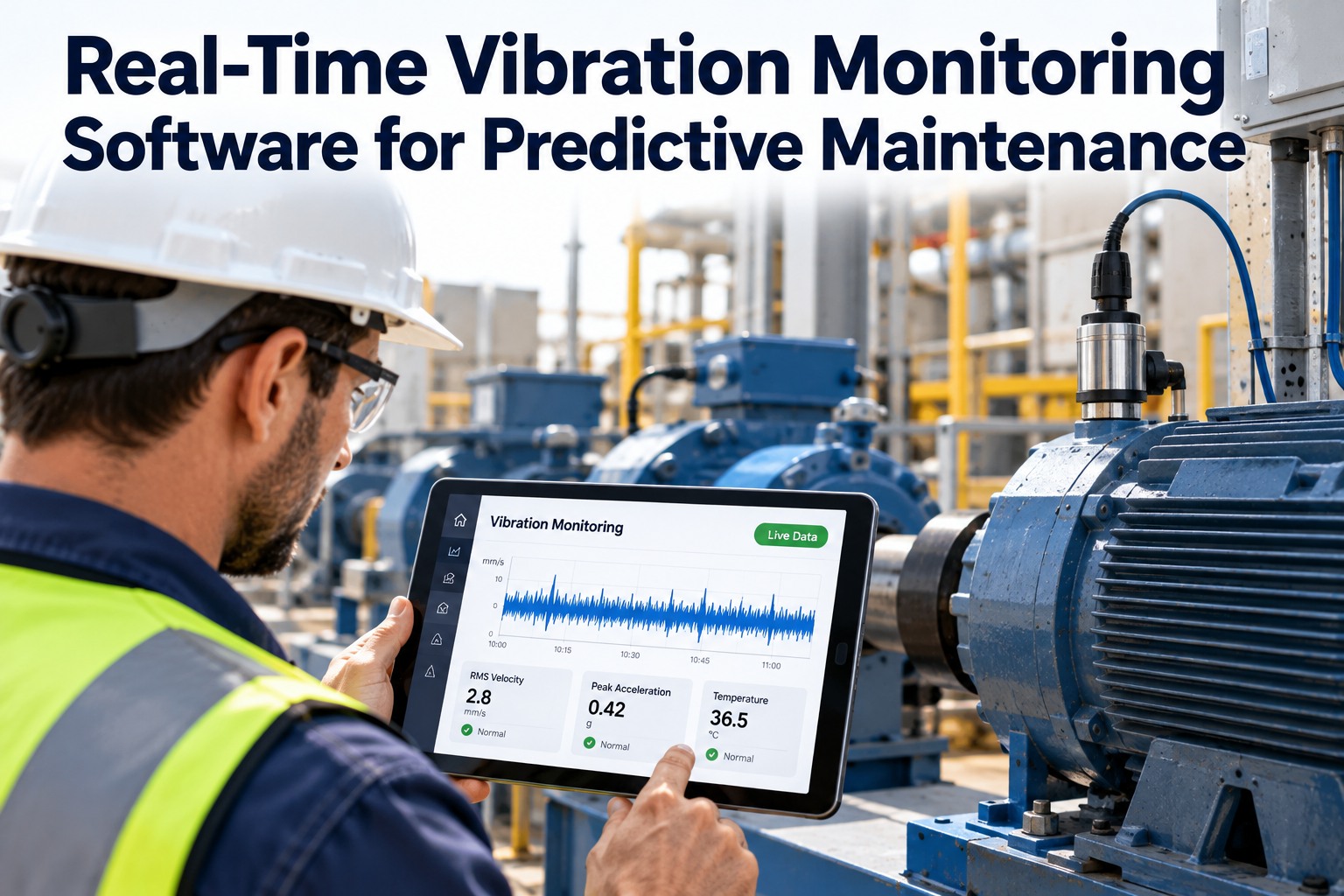
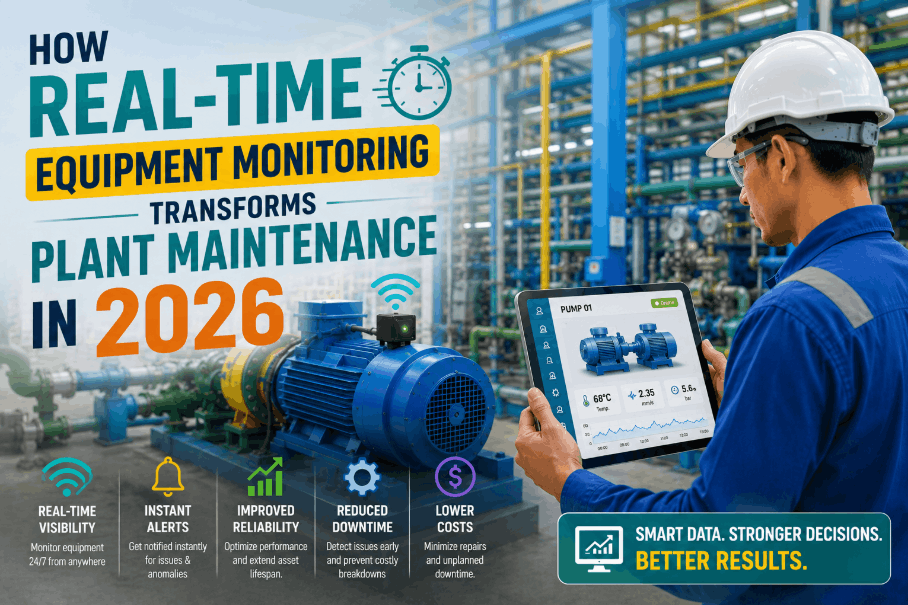
A bearing starts giving warning 7-28 days before it fails — in the vibration spectrum, not on the walkdown. A quarterly handheld route walks past most of that window. OXMAINT AI is the AI-powered CMMS and maintenance management software that samples continuously, scores against ISO 20816 zones and opens a work order the moment the trend crosses — so the planner catches the bearing on Tuesday and schedules the swap for Friday.
REAL-TIME VIBRATION MONITORING · PREDICTIVE MAINTENANCE SOFTWARE · 2026
Real-Time Vibration Monitoring Software for Predictive Maintenance
Continuous sensing, ISO-zone scoring and automatic work-order triggering turn vibration from a quarterly report into a daily response. The OXMAINT AI software reads from wireless or wired sensors, benchmarks against the asset's own baseline, matches live spectra to the fault library, and raises the work order with the suspect component attached.
AGood
BAcceptable
CUnsatisfactory
DDanger
7-28
days of early warning in the vibration spectrum before a bearing or coupling fails
4
ISO 20816 severity zones (A good → D danger) — the universal scoring scheme
6
dominant fault signatures explain almost everything you'll see in the spectrum
1
asset-grounded baseline per load point is the biggest driver of alert quality
The ISO 20816 Severity Scale
ISO 20816 gives a universal severity scale from Zone A (good) to Zone D (danger). Cutoffs depend on machine class, but the four-zone logic is the same across pumps, fans, motors and gearboxes. OXMAINT AI holds the correct class per asset — so a Zone-B reading on a small pump isn't judged against the band for a large compressor.
ISO 20816 severity · continuous mm/s RMS
A · GOOD
Newly commissioned — no action
B · ACCEPTABLE
Long-term OK — monitor trend
C · UNSATISFACTORY
Short-term only — plan corrective
D · DANGER
Risk of damage — shut down
You are here · crossing B to C
Each Fault Has Its Own Frequency
A vibration spectrum is a diagnostic language. Each rotating-equipment fault lives at a specific frequency relative to running speed. OXMAINT AI holds the fault-signature library per asset — an alert isn't "high vibration", it is "bearing outer race, BPFO at 143.6 Hz".
Fault
Signature
Direction
What you see
Unbalance
1× RPM
Radial
Single clean peak at 1×; grows with load
Misalignment
1× and 2×
Axial strong
High 2× is the fingerprint; axial often larger than radial
Looseness
1×, 2×, 3×, 4×
Radial
Rising harmonic series + elevated noise floor
Bearing (BPFO/BPFI)
Non-integer RPM
Radial
Non-sync peak + sidebands; demod envelope catches it earliest
Gear mesh
GMF = teeth × RPM
All
Peak at mesh freq; sidebands signal a worn or chipped tooth
Resonance
Natural freq
Depends
Peak that doesn't move with RPM — the structure amplifies
The Live Vibration Board at 03:00
The overnight view is a priority-ranked board of rotating assets with current zone, trend and alerts from the last four hours. OXMAINT AI generates it from the sensor stream directly — a shift handover is a glance, not a round of phone calls.
LIVE VIBRATION BOARD · CEMENT LINE 2 · 03:00
P-204 Raw-mill pump14.2 mm/sBPFO + sidebandsZone D · WO raised
F-311 ID fan drive8.6 mm/s1×, 2× axialZone C · misalignment
M-108 Kiln drive motor7.9 mm/sRising 1×Zone C · unbalance
P-209 Cooling pump1.8 mm/sStableZone A · OK
Sensor → Signal → Action
A signal that doesn't become a work order is cosmetic. The value is the full loop. OXMAINT AI runs the whole chain natively — the sensor is step one, not the whole system.
01
Sensor capture
Wireless or wired IEPE accelerometer at the bearing housing samples every 1-5 minutes.
02
Zone scoring
Overall mm/s scored against ISO 20816 band for the asset's class and its learned baseline.
03
Fault classification
Spectrum matched to the fault-signature library — the suspect component is named.
04
Work order
Zone C raises a planned WO; Zone D an urgent one with escalation. Spectrum attached.
05
Baseline relearn
Post-repair, the asset relearns its baseline so the next alert reflects reality.
A Vibration Reading Alone Is Just a Number.
The value comes from pairing it with the ISO zone, the asset's baseline, the fault library, and a work-order loop. OXMAINT AI holds all four natively.
Mounting Rules That Decide Signal Quality
A perfect model on a badly mounted sensor is still noise. Four rules decide what the sensor can actually see.
LOCATION
Bearing housing
Not the motor frame or mounting plate — signal degrades with every interface.
ORIENTATION
Radial + axial
Unbalance is radial; misalignment is axial. Two directions catch almost everything.
ATTACHMENT
Stud, not magnet
Stud mount preserves the high-frequency content needed for bearing analysis.
PATH
Short & healthy
Wired: shielded, short run. Wireless: line of sight, battery watched. A dead sensor is silent.
How OXMAINT AI Runs Continuous Monitoring
The sensor ingest, ISO scoring, fault library and work-order loop live natively in the OXMAINT AI maintenance management software — spin up a free account and connect your first sensor in OXMAINT AI.
Multi-Vendor Ingest
Wireless, wired IEPE, MQTT or OPC UA — all feed into one asset-grounded view.
ISO 20816 Policy
Machine-class aware A/B/C/D bands held per asset — scored against the right standard.
Learned Baseline
Normal band learned from the asset's own data — moves away from vendor defaults in weeks.
Fault Library
Bearing geometry, gear teeth and running speed held per asset — BPFO/BPFI/GMF flagged by name.
Zone-to-WO Loop
Zone C opens a planned WO; Zone D raises an urgent one. Spectrum + history auto-attached.
Baseline Relearn
A closed repair retires the old baseline so post-repair alerts stay honest.
Frequently Asked Questions
How much early warning does vibration monitoring give?
Typically 7-28 days before functional failure on bearings and couplings — longer on slow-speed assets, shorter on high-speed. OXMAINT AI holds the trend per asset so the planner catches it in time.
Start free and set up continuous monitoring.
Overall mm/s or full FFT — which do we need?
Both. Overall mm/s gives the ISO verdict; the FFT (and demod envelope for bearings) gives the fault identity.
Can we start without replacing handheld routes?
Yes. Continuous on tier-A critical assets, handheld on tier-B/C. OXMAINT AI holds both streams against the same asset.
How fast can we go live?
A first wave of 10-20 tier-A assets typically goes live in 4-8 weeks — sensor install, ingest, baseline learned, WO loop configured.
Catch the Bearing on Tuesday. Replace It on Friday.
Put every rotating critical asset on continuous vibration monitoring with the OXMAINT AI maintenance management software — ISO zone scored, fault matched, work order raised with the suspect component named.