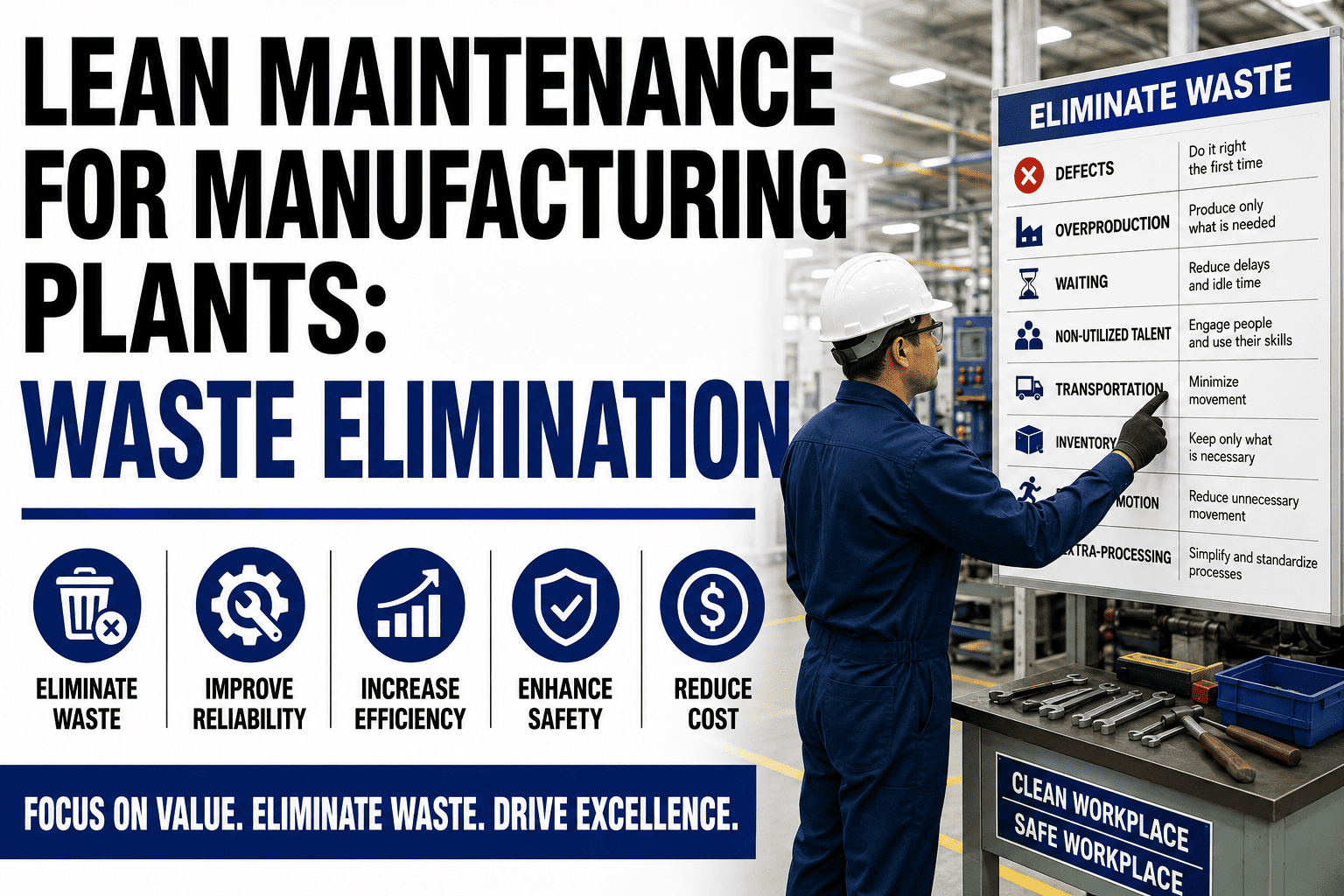
Lean maintenance for manufacturing plants takes the eight wastes of lean production — overproduction, waiting, transportation, defects, motion, inventory, over-processing, and unused talent — and applies them directly to maintenance work, where most facilities lose 30–50% of available wrench time to non-value-added activity. Manufacturing lean maintenance is not about cutting heads; it is about eliminating the friction that keeps technicians away from the asset: chasing parts, hunting for manuals, re-keying work-order data, and waiting on approvals. A lean maintenance program pairs standardized PM procedures, visual 5S storerooms, and mobile CMMS lean workflows so that every wrench turn moves the needle on OEE. Ready to see the platform in action on your assets? Start Free Trial or read on for the full waste-elimination playbook.
Is your plant losing half its wrench time to maintenance waste?
Most manufacturing plants spend more time chasing parts, paperwork, and approvals than turning wrenches. Lean maintenance reclaims that lost capacity — and a mobile CMMS locks the gains in permanently.
The 8 Wastes of Maintenance — and What Each One Costs You
The classic eight wastes of lean manufacturing map directly onto maintenance work. Identifying them is the first step in any lean maintenance program; eliminating them is where OEE gains and cost savings live. Here is what each waste looks like in a plant maintenance context and the typical cost impact.
Generating PM work orders for assets that do not need them yet — or running redundant inspections because PM intervals were never optimized. A single line can carry 15–20% more PM labor than necessary.
Technicians idle while a permit is approved, a part is pulled, or a machine is released. Waiting alone accounts for 20–30% of scheduled maintenance hours in plants without mobile work-order access.
Walking to and from the storeroom, printing paperwork at a shared kiosk, or moving tools between buildings. Unnecessary travel burns 45–90 minutes per tech per shift in poorly laid-out plants.
Repairs that fail within hours or days because the root cause was never identified. Unplanned rework drives 10–15% of total maintenance labor cost and erodes equipment reliability.
Searching for tools, climbing ladders to read a nameplate, or scrolling through spreadsheets to find an asset history. Excess motion is invisible on paper but shows up in extended job durations.
Overstocked storerooms tying up $50K–$500K in working capital, while critical spares are still stockout-prone. Lean 5S maintenance storerooms target right-size stock, not maximum stock.
Collecting the same data twice — once on a clipboard, once in a spreadsheet. Collecting 40 fields when 8 drive the decision. Paper-based work orders are the poster child of maintenance over-processing.
Senior technicians spending shifts on data entry instead of troubleshooting. Operators who see early warning signs but have no channel to flag them. Lean maintenance puts expertise back on the asset.
How Much Is Maintenance Waste Actually Costing Your Plant?
Before launching a lean maintenance program, quantify the opportunity. Most plant managers underestimate how much labor budget is absorbed by non-value-added activity. Use the formula below with your own numbers — the result is typically eye-opening.
A 180-Asset Food & Beverage Plant
Cutting that waste by even half — a realistic first-year target with standardized PMs, mobile work orders, and a 5S storeroom — frees $132,000 in capacity and roughly 2,400 labor hours for reliability projects instead of firefighting.
How to Implement Lean Plant Maintenance in 4 Months
A lean maintenance program is built in phases, not in a weekend. The four-month timeline below follows a kaizen-for-maintenance rhythm: measure, standardize, visualize, and lock in with digital workflows. Each phase delivers measurable gains before the next begins.
Baseline Wrench Time & Waste Audit
Conduct a 2-week wrench-time study across all shifts. Tag every work order with waste category (waiting, motion, defects, over-processing). Establish baseline OEE, PM compliance rate, and mean time to repair (MTTR). Most plants land at 25–35% direct wrench time.
Lean SOP Design & Standard Work for PMs
Rewrite top 20 PM procedures as standard work: step-by-step checklists with torque values, safety lockout steps, required parts, and expected duration. Eliminate duplicate data collection. Target: every PM executable by any qualified tech without verbal handoff.
5S Maintenance Storeroom & Visual Management
Apply 5S to the storeroom: sort, set in order, shine, standardize, sustain. Label bin locations, set min/max levels, post visual Kanban cards. Add shadow boards for critical tools at point of use. Target: part retrieval under 3 minutes, stockout rate below 2%.
Deploy Mobile CMMS Lean Workflows
Roll out OxMaint mobile work orders so techs receive assignments, pull parts, complete checklists, and close WOs on a tablet at the asset. Digital signatures, photo capture, and real-time KPI dashboards replace clipboards. This is what makes lean gains stick.
Lean SOP Manufacturing Checklist & 5S Maintenance Storeroom
Two pillars carry most of the waste-elimination weight: standard work for preventive maintenance and a 5S-organized storeroom. Use the checklists below to audit where you stand today and identify gaps.
Lean SOP Design Checklist
- ✓ Every PM has a numbered, step-by-step procedure — no tribal knowledge
- ✓ Required tools, parts, and PPE listed at the top of each SOP
- ✓ Safety lockout/tagout steps embedded before first wrench turn
- ✓ Expected duration and skill level tagged on every task
- ✓ Acceptance criteria defined (measurements, tolerances, pass/fail)
- ✓ SOP accessible on a mobile device at the point of work
- ✓ Procedure reviewed and updated at least annually or after any failure
5S Maintenance Storeroom Checklist
- ✓ Sort: Obsolete and expired parts removed; red-tag staging area active
- ✓ Set in Order: Every bin labeled with part number, description, min/max
- ✓ Shine: Cleaning schedule posted; storeroom audit score above 90%
- ✓ Standardize: Kanban replenishment cards or digital min/max alerts in CMMS
- ✓ Sustain: Weekly 5S audit by rotating team member; results posted visually
- ✓ Critical spares identified and stocked for all single-point-of-failure assets
- ✓ Average part retrieval time measured and under 3 minutes
| 5S Principle | Storeroom Application | Waste Eliminated | Target Metric |
|---|---|---|---|
| Sort | Remove obsolete, duplicate, and expired inventory | Inventory waste | Reduce SKUs 15–25% |
| Set in Order | Label bins, map locations, arrange by frequency of use | Motion + Transportation | Retrieval under 3 min |
| Shine | Scheduled cleaning and visual inspection of stored parts | Defects (corroded / damaged spares) | Zero defect spares issued |
| Standardize | Digital min/max alerts in CMMS, Kanban replenishment | Inventory + Overproduction | Stockout rate below 2% |
| Sustain | Weekly rotating audit, visual scoreboard, accountability | Prevents backsliding to old habits | Audit score above 90% |
How OxMaint Locks In Lean Maintenance Gains
Lean improvements made on clipboards and spreadsheets erode within one quarter. OxMaint is the AI-powered CMMS that digitalizes standard work, mobile wrench-time, and 5S inventory — so the waste you eliminate stays eliminated. Here is how four OxMaint capabilities map directly to lean maintenance waste elimination.
Mobile Work Orders
Technicians receive assignments, view lean SOPs, pull parts, capture photos, and close work orders on a tablet at the asset — eliminating the over-processing of paper-to-spreadsheet data entry and the waiting inherent in kiosk-based systems.
Standardized PM Checklists
Build step-by-step preventive maintenance procedures with required fields, pass/fail criteria, and safety steps. Every PM is executed identically by any technician — the definition of standard work, enforced digitally rather than hoped for on paper.
Spare-Parts Inventory + Min/Max
Track every spare with bin locations, min/max thresholds, and automatic reorder alerts. OxMaint makes the 5S storeroom self-sustaining — parts are visible, countable, and replenished before stockout, without over-ordering.
Predictive Analytics + KPI Dashboards
AI-driven failure prediction and real-time dashboards for wrench time, PM compliance, MTTR, and OEE let you see waste as it happens — and re-allocate effort from reactive firefighting to precision reliability work.
See OxMaint on Your Assets — Book a 30-Minute Demo
Walk through lean SOP design, mobile work orders, and 5S inventory live in the platform. We will map your top 3 maintenance wastes to a digital elimination plan before the call ends.
Lean Maintenance Manufacturing — Frequently Asked Questions
What is lean maintenance in manufacturing?
Lean maintenance applies the eight wastes of lean production — overproduction, waiting, transportation, defects, motion, inventory, over-processing, and unused talent — directly to maintenance work. The goal is to maximize value-added wrench time by eliminating the non-value-added activities that surround every repair and PM. A lean CMMS like OxMaint digitalizes the standard work, mobile workflows, and inventory controls that make those gains permanent.
How much maintenance waste does a typical manufacturing plant have?
Most plants lose 30–50% of available maintenance wrench time to non-value-added activity — waiting for permits, chasing parts, re-keying data, searching for manuals, and performing unnecessary PMs. For a 6-technician team, that often translates to $100K–$300K in annual recoverable labor cost. A wrench-time study in Month 1 of a lean program quantifies the exact figure for your facility.
How does 5S apply to a maintenance storeroom?
5S — Sort, Set in Order, Shine, Standardize, Sustain — organizes the storeroom so every part is findable in under 3 minutes, stockouts stay below 2%, and working capital is not tied up in obsolete inventory. OxMaint reinforces 5S by tracking bin locations, min/max levels, and automatic reorder alerts so the standardize and sustain phases do not depend on someone remembering to check a clipboard. You can Book a Demo to see the inventory module live.
What is the difference between lean maintenance and preventive maintenance?
Preventive maintenance (PM) is a strategy — performing scheduled work to prevent failures. Lean maintenance is a methodology for executing that work with minimum waste. A plant can have a strong PM schedule on paper but still lose 40% of wrench time to waiting, motion, and over-processing. Lean maintenance optimizes how PMs are designed, dispatched, and executed so the scheduled work actually delivers reliability gains.
How long does it take to implement a lean maintenance program?
A focused lean maintenance program can be implemented in about 4 months: Month 1 measures baseline wrench time, Month 2 standardizes PM SOPs, Month 3 deploys 5S in the storeroom, and Month 4 locks in gains with a mobile CMMS. First-year wrench-time improvement of 10–20 percentage points is a realistic target, with ROI typically achieved within 6–9 months of go-live.
Stop Losing Wrench Time to Maintenance Waste
OxMaint digitalizes lean SOPs, mobile work orders, 5S inventory, and predictive analytics — so the waste you eliminate stays eliminated. Start your free trial today or book a personalized demo with our team.
Free 14-day trial · No credit card