Lean Maintenance: Minimizing Waste and Maximizing Efficiency
By oxmaint on March 9, 2026
Manufacturing plants lose thousands of productive hours each year to disorganized maintenance workflows, unplanned breakdowns, and wasted technician time. Lean maintenance applies the core principles of lean manufacturing—waste elimination, standardized processes, and continuous improvement—directly to how your team plans, schedules, and executes maintenance work. The outcome is a maintenance operation that runs with fewer resources, delivers higher equipment reliability, and transforms from a reactive cost center into a strategic driver of production uptime. Schedule a free consultation to see how lean maintenance principles can cut your downtime and costs.
What Is Lean Maintenance and Why Does It Matter?
Lean maintenance is a systematic approach to managing maintenance operations that focuses on eliminating every activity, delay, and process that does not directly contribute to keeping equipment running reliably. Rooted in the Toyota Production System, it goes beyond simply fixing machines—it redefines how maintenance work flows through your organization, from the moment a problem is detected to the moment the asset is back in production. According to industry data, over 67% of manufacturers report that unplanned equipment downtime remains their top barrier to achieving lean production goals. That gap between ambition and execution is exactly where lean maintenance delivers its greatest value.
$5K–$20K
Cost per hour of unscheduled downtime in industrial manufacturing—a direct result of reactive maintenance culture
50%
Potential reduction in maintenance costs achievable through lean maintenance practices according to industry benchmarks
Core Principles of Lean Maintenance
Eliminate Waste
Remove every non-value-added step—unnecessary approvals, redundant inspections, excess inventory, idle waiting—from your maintenance workflow.
Standardize Work
Create repeatable, documented procedures for every maintenance task so quality stays consistent regardless of which technician performs the job.
Empower the Team
Give operators ownership of basic equipment care and free skilled technicians to focus on reliability engineering and root cause problem-solving.
Improve Continuously
Use data-driven kaizen cycles to find and fix inefficiencies every week—not once a year. Small, frequent gains compound into transformational results.
Start applying these lean principles to your maintenance operations today. Sign up for a free Oxmaint account to get instant access to automated work order management, standardized checklists, and asset tracking—the essential digital tools your team needs to begin eliminating maintenance waste from day one.
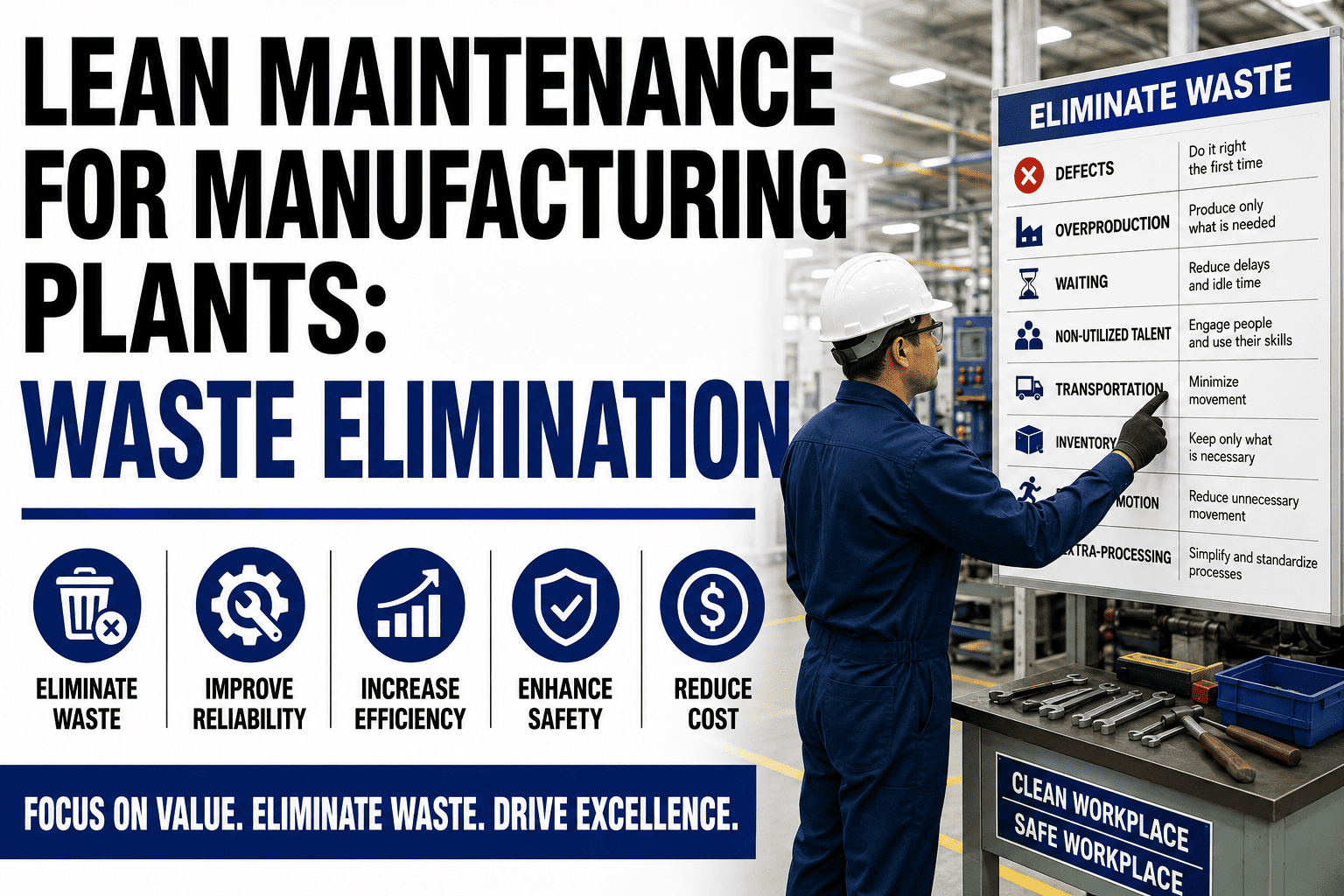
How Lean Maintenance Eliminates the 8 Hidden Wastes in Your Plant
The lean methodology identifies eight categories of waste—known by the acronym TIMWOODS—that silently drain maintenance productivity. Most maintenance teams operate with 25-35% of technician time lost to non-value-added activities. Recognizing these wastes is the critical first step toward eliminating them.
TIMWOODS
T
Transportation Waste
Technicians walking to centralized tool cribs, hauling parts across the plant, and making multiple trips to complete a single work order. Lean solution: create decentralized point-of-use storage and mobile tool kits.
I
Inventory Waste
Stockrooms full of rarely-used spare parts tying up capital, while critical components are unavailable when failures occur. Lean solution: implement min/max controls and sign up for Oxmaint to automate your spare parts tracking and right-size inventory.
M
Motion Waste
Searching for manuals, locating tools, looking up equipment history on paper records. Every unnecessary movement adds minutes that compound into hours lost daily. Lean solution: 5S workplace organization and digital asset records.
W
Waiting Waste
Idle time spent waiting for approvals, parts procurement, equipment shutdown clearance, or operator availability. Lean solution: pre-stage materials and streamline approval workflows—schedule a demo to see how Oxmaint automates work order approvals and eliminates waiting waste.
O
Overproduction Waste
Performing time-based preventive maintenance more often than necessary—replacing parts that still have significant remaining life. Lean solution: shift to condition-based maintenance using real equipment health data.
O
Overprocessing Waste
Redundant inspections, excessive paperwork, duplicate data entry across systems, and unnecessary approval layers. Lean solution: standardize procedures and digitize with a single-source CMMS.
D
Defects Waste
Repairs done incorrectly the first time, wrong parts installed, or tasks performed below quality standards—leading to costly rework and repeat failures. Lean solution: standard operating procedures with checklists.
S
Skills Underutilization
Experienced reliability engineers performing basic lubrication tasks while complex diagnostic challenges go unaddressed. Lean solution: autonomous maintenance programs that match skills to task complexity.
5 Proven Lean Maintenance Strategies That Drive Real Results
Lean maintenance is not a single technique—it is a system of interconnected strategies that, when combined, create a maintenance operation capable of delivering higher reliability at lower cost. Each strategy targets specific types of waste and builds upon the others to form a complete lean maintenance program.
01
5S Workplace Organization
Sort, Set in Order, Shine, Standardize, Sustain. Applied to maintenance workshops, tool cribs, and parts storage, 5S eliminates the motion and search time that typically accounts for 15-20% of a technician's shift. Every tool has a designated location, every workspace is kept clean and orderly, and visual management boards make work status visible at a glance. 5S is the foundation upon which every other lean maintenance practice is built.
TPM bridges the traditional divide between production and maintenance by empowering machine operators to perform routine equipment care—cleaning, lubrication, basic inspections, and minor adjustments. This frees skilled maintenance technicians to focus on complex diagnostics, root cause analysis, and reliability engineering. TPM creates shared ownership of equipment health across the entire production team, dramatically reducing the volume of reactive work orders.
Borrowed from lean manufacturing, value stream mapping (VSM) visualizes every step in your maintenance workflow—from work request submission to job completion and closeout. By mapping the current state, teams identify bottlenecks, handoff delays, approval queues, and redundant steps that extend equipment downtime. The future-state map becomes the blueprint for a streamlined, waste-free maintenance process. Sign up for Oxmaint to digitize your maintenance workflows and eliminate process bottlenecks.
Lean maintenance demands that teams go beyond fixing symptoms to permanently eliminate the source of recurring failures. Using structured 5-Why analysis, fishbone diagrams, and failure mode tracking, RCA programs identify the true root cause of equipment breakdowns. When documented and shared through a CMMS, these findings prevent the same failure from happening again—breaking the costly cycle of repeat repairs that plagues reactive maintenance organizations.
Kaizen—meaning "change for the better" in Japanese—is the engine that keeps lean maintenance evolving. Through focused, short-duration improvement workshops, frontline technicians identify waste in their daily routines and implement practical solutions. The key principle: small, frequent improvements driven by the people closest to the work deliver greater long-term results than large, top-down transformation projects. Kaizen makes improvement everyone's job, every day.
Targets: All 8 wastes through systematic, ongoing elimination
Want to see how these 5 lean strategies work inside a real CMMS platform? Schedule a free 30-minute demo where our team will walk you through automated work order routing, visual kanban boards, root cause tracking, and TPM checklists—all configured for lean maintenance operations like yours.
How to Implement Lean Maintenance: A Practical Roadmap
Transitioning from reactive to lean maintenance requires a phased approach that builds momentum through quick wins while laying the groundwork for lasting cultural change. Attempting to overhaul everything at once leads to resistance and superficial adoption. The organizations that succeed follow a deliberate, step-by-step roadmap.
Weeks 1–4
Assess and Baseline
Conduct a maintenance waste audit to quantify where time, money, and resources are being lost. Map your current-state maintenance value stream. Establish baseline KPIs including planned vs. reactive work ratio, wrench time, MTBF, and maintenance cost per unit produced. Select a pilot area—one production line or department—for initial lean implementation.
Weeks 5–8
Organize and Standardize
Implement 5S in maintenance workshops and parts storage. Write standard operating procedures for your top 20 most frequent maintenance tasks. Deploy a cloud-based CMMS like Oxmaint—sign up free to start digitizing work orders, centralize asset history, and automate preventive maintenance scheduling. These quick wins build visible momentum and team confidence.
Months 3–5
Engage and Expand
Launch autonomous maintenance training for operators. Begin root cause analysis for the top 10 recurring failures. Optimize spare parts inventory using consumption data from your CMMS. Introduce visual management boards and daily maintenance huddles. Expand lean practices from the pilot area to adjacent production zones.
Month 6+
Sustain and Improve
Establish a regular kaizen event calendar for maintenance improvement workshops. Integrate condition monitoring and predictive analytics to shift from time-based to condition-based maintenance. Benchmark your KPIs against industry standards. This phase never truly ends—it becomes how your maintenance organization operates every day.
Lean Maintenance vs. Reactive Maintenance: The Real Cost Difference
The gap between reactive and lean maintenance is not just philosophical—it shows up directly in downtime hours, maintenance budgets, technician morale, and production output. Understanding this contrast helps make the business case for investing in lean transformation.
Side-by-Side: Two Approaches to Maintenance
Reactive / Run-to-Failure
1Fix-when-broken mentality across the team
230-40% of budget consumed by emergency repairs
3Technicians constantly firefighting, no time for improvement
4Premium costs for emergency parts and overtime labor
5No data on failure patterns or root causes
3–10x
higher cost per repair compared to planned maintenance
290%+ planned maintenance ratio as standard practice
3Technicians focused on prevention and reliability improvement
4Optimized spare parts with CMMS-driven min/max controls
5Root cause analysis prevents repeat failures permanently
Up to 50%
reduction in total maintenance expenditure
Stop Firefighting. Start Optimizing.
Oxmaint helps maintenance teams transition from reactive chaos to lean, planned operations. Automate work orders, track asset health in real time, manage parts inventory, and measure your improvement with built-in KPI dashboards—all from a single platform your entire team can access on mobile.
Lean Maintenance KPIs Every Maintenance Manager Should Track
Measurement is the backbone of lean. Without clear metrics, you cannot identify waste, track improvement, or prove ROI to leadership. These are the KPIs that best-in-class lean maintenance operations monitor continuously to drive data-informed decisions.
90%
Planned Maintenance Percentage
Ratio of planned to total maintenance work. World-class target is 90% or above. Below 70% signals a reactive culture with significant waste.
85%
Overall Equipment Effectiveness
Combines availability, performance, and quality into a single score. OEE reveals the true productivity impact of maintenance on production output.
65%
Wrench Time (Direct Work Rate)
Percentage of shift time technicians spend on hands-on repair work versus traveling, waiting, or doing paperwork. Industry average sits near 35%—lean teams target 65%.
Mean Time Between Failures
Average operating time between equipment breakdowns. Rising MTBF signals that lean practices and proactive maintenance are improving asset reliability over time.
Mean Time to Repair
Average duration to complete a repair from start to finish. Lower MTTR shows your team is executing efficiently with standardized procedures and pre-staged parts.
Schedule Compliance
Percentage of scheduled preventive tasks completed on time. Low compliance creates maintenance backlog—the silent killer of lean maintenance programs.
Why a CMMS Is the Backbone of Any Lean Maintenance Program
Lean maintenance demands visibility, data accuracy, and workflow standardization—all things that paper-based systems and spreadsheets cannot reliably provide. A Computerized Maintenance Management System gives your lean program the digital infrastructure it needs to succeed at scale. Modern cloud-based CMMS platforms act as the central nervous system of lean maintenance, connecting planning, execution, parts management, and performance measurement in a single tool accessible to everyone from maintenance managers to frontline technicians on the plant floor.
Automated Work Orders
Eliminate paper-based scheduling waste. CMMS automatically generates, assigns, and routes work orders based on PM schedules, condition triggers, or operator requests—ensuring no task falls through the cracks.
Spare Parts Intelligence
Track consumption, set automated reorder points, and maintain optimal stock levels. No more emergency procurement at premium prices—and no more dead stock gathering dust in your storeroom.
Real-Time KPI Dashboards
Visual management is a core lean principle. CMMS dashboards display OEE, wrench time, backlog, MTBF, and planned maintenance ratio live—making waste visible and progress measurable.
Complete Asset History
Every repair, inspection, part replacement, and failure is logged. This historical record powers root cause analysis, helps optimize PM frequencies, and ensures institutional knowledge survives staff turnover.
Mobile-First Execution
Technicians access work orders, SOPs, equipment manuals, and checklists directly from their phone on the plant floor. No walking back to the office. No searching for paper files. Pure wrench time.
Predictive Maintenance Ready
Connect IoT sensors and condition monitoring tools to your CMMS. AI-driven analytics detect degradation patterns and auto-generate maintenance work orders before failures happen.
Lean maintenance is not about doing more maintenance faster. It is about doing only the right maintenance, at the right time, with the right resources—and eliminating everything else. When you reclaim the 30% of wasted effort hiding in most maintenance operations, you unlock capacity you never knew you had.
— Industrial Maintenance Optimization Principle
Your Lean Maintenance Journey Starts Here
Paper work orders, spreadsheet tracking, and reactive firefighting are themselves forms of waste. Oxmaint replaces them all with automated workflows, mobile-first execution, real-time asset intelligence, and continuous improvement dashboards—giving your maintenance team the digital foundation to operate lean, measure progress, and deliver measurable results from day one.
What is the difference between lean maintenance and preventive maintenance?
Preventive maintenance is one tool within the broader lean maintenance toolkit. While preventive maintenance focuses on scheduling routine tasks to prevent failures, lean maintenance is a comprehensive strategy that addresses the entire maintenance operation—including how work is planned, how parts are managed, how teams communicate, and how improvement is measured. Lean maintenance asks not just "are we doing maintenance on time?" but "are we doing the right maintenance in the most efficient way possible?" Book a demo to see how Oxmaint handles both preventive scheduling and lean workflow automation in a single platform.
How quickly can lean maintenance reduce our costs?
Most facilities see measurable results within 60-90 days. Quick wins from 5S implementation and work order standardization typically deliver a 15-20% improvement in technician productivity almost immediately. More substantial gains in equipment reliability and maintenance cost reduction—often reaching 30-50%—emerge over 6-12 months as TPM, root cause analysis, and condition-based maintenance programs mature. The key is starting with high-impact, low-effort improvements to build team confidence and organizational momentum.
Do we need a CMMS to implement lean maintenance?
While initial lean practices like 5S can begin with manual methods, a CMMS is essential for scaling and sustaining lean maintenance across your operation. Paper-based work order systems, spreadsheet tracking, and manual data collection are themselves significant sources of waste. A digital CMMS automates scheduling, centralizes asset history, tracks spare parts consumption, and provides the KPI dashboards necessary for data-driven improvement. Sign up for a free Oxmaint account to replace spreadsheets with automated lean maintenance tools.
Can lean maintenance work for small maintenance teams?
Small teams often benefit the most from lean maintenance because every hour of recovered productivity has a proportionally larger impact. When you only have 3-5 technicians, eliminating 30% waste from their day is equivalent to gaining an additional full-time team member—without any hiring cost. Start with 5S, standardize your most frequent tasks, and deploy a mobile CMMS to cut paperwork waste. Small teams that adopt lean principles typically see enough productivity recovery to absorb growing workloads without adding headcount.
What role does AI play in lean maintenance today?
AI and machine learning are accelerating lean maintenance by automating waste detection that was previously manual. AI-powered predictive maintenance analyzes sensor data to forecast equipment failures weeks in advance, eliminating both unnecessary preventive tasks and surprise breakdowns. Machine learning models can also optimize PM scheduling, identify subtle efficiency degradation, and recommend resource allocation—tasks that would take human analysts significantly longer. Schedule a free consultation to map out how AI-powered predictive maintenance fits your lean strategy.