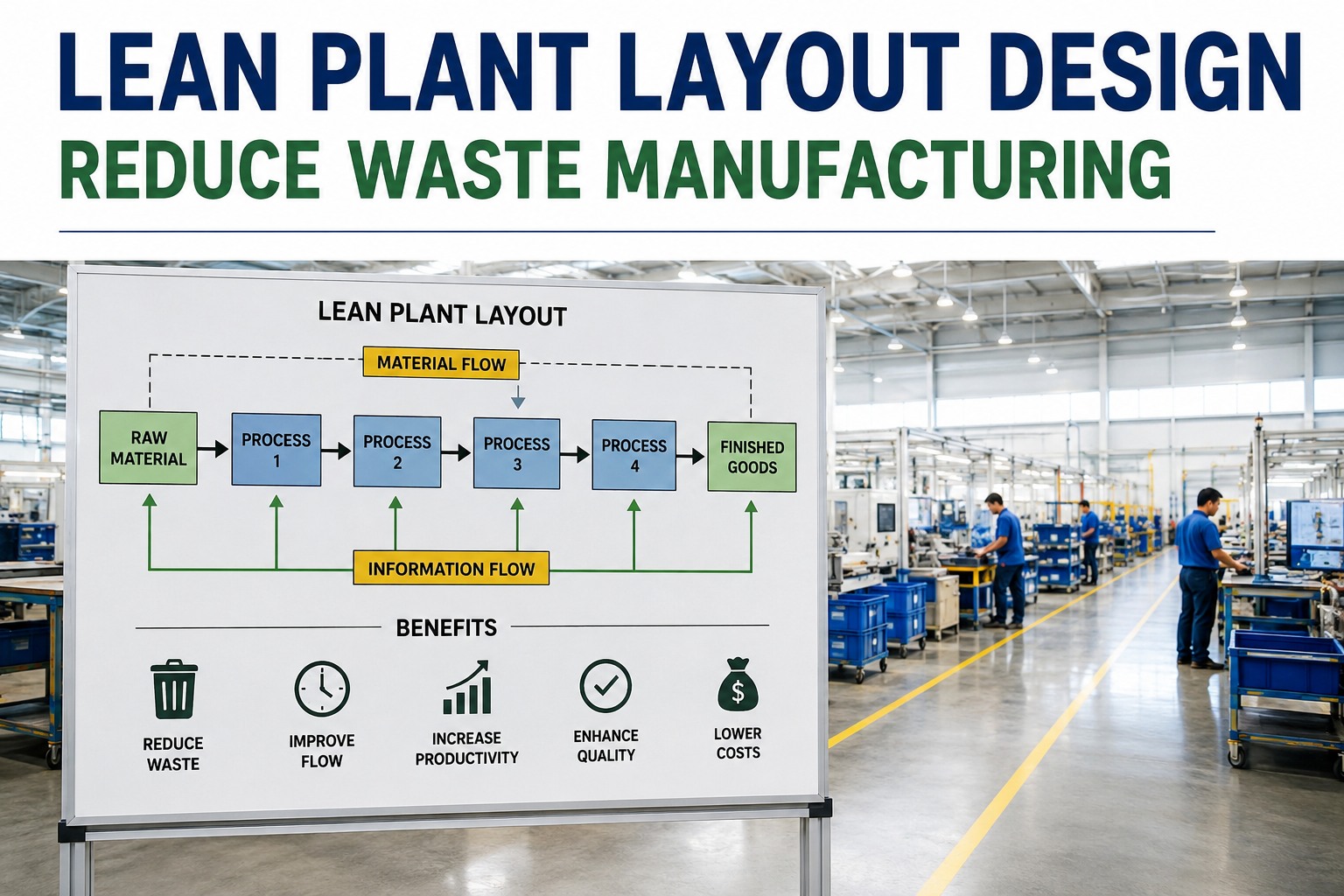
A lean plant layout removes the seven wastes of manufacturing — transport, inventory, motion, waiting, overproduction, overprocessing and defects — at the design stage, before they get baked into concrete, pipe racks and conveyor lines. Plants that redesign their floor around flow typically cut material travel 30–60%, free up 20–40% of floor space and shorten lead times by half, because the layout itself stops generating waste instead of asking operators to work around it. This guide walks through the lean layout design principles industrial engineers use — point-of-use storage, flow-based cells, one-piece flow paths and andon lines of sight — and how to translate them from value stream maps into a concrete floor plan. If you are already fighting a layout that wastes motion every shift, Start Free Trial with OxMaint and start tracking the work orders, asset moves and downtime that prove the case for change.
Is your floor plan manufacturing waste by design?
Every unnecessary foot of travel, every cross-aisle forklift run, every pallet staged "temporarily" for 6 months — that is your layout taxing every unit you ship. Lean layout design removes the seven wastes before they harden into concrete.
How a poor manufacturing layout generates waste every shift
Toyota's seven wastes (TIMWOOD) are usually taught as shop-floor behaviors — but most of them originate in the floor plan. A layout that separates linked processes by 200 feet manufactures transport and waiting waste with every single part, no matter how disciplined your operators are.
Transport
Parts hauled between distant departments. One study of a job shop found workpieces traveled 1.5 miles through the plant before shipping — 90% of it pure waste.
Inventory
Remote storage invites overproduction. Central racking far from the line means batch staging, double handling and WIP that hides defects for days.
Motion
Operators walking, reaching and searching. A poorly laid out workstation can add 2–4 hours of non-value motion per operator per shift.
Waiting
Unbalanced flow between departments creates queues. Machines sit idle while the "previous department" catches up — a layout problem, not a people problem.
Overproduction
Big batches feel efficient when the next process is far away. Proximity is what makes one-piece flow physically possible and batch logic obsolete.
Defects & Overprocessing
Long transport means damage, mix-ups and rework discovered late. Every extra touch and every extra mile is another chance to scrap a good part.
5 lean layout design principles that eliminate waste at the source
A lean factory layout is not a tidier version of your current one — it is a different logic. These five principles drive every decision, from cell placement to aisle width.
Design for flow, not departments
Group equipment by product family and process sequence — not by machine type. A value stream layout places cutting, forming, welding and assembly in the order the part actually moves, so flow replaces the forklift. Plants that switch from process villages to flow cells routinely cut lead time 50–90%.
Point-of-use storage
Store parts, tools and consumables where they are consumed — within arm's reach of the work. Point-of-use storage kills the central-warehouse walk, exposes true consumption, and shrinks inventory because there is physically nowhere to hide excess. Target: no operator walks more than 10 steps for any daily-use item.
One-piece flow paths
Size aisles, buffers and handoffs for single-piece or small-batch movement. U-shaped cells let one operator run multiple machines and return to the start point with minimal walking. If your layout requires a pallet jack to move one part, the layout is the constraint.
Andon lines of sight
Design so a supervisor can see the entire value stream from one spot. Open sight lines, low-profile equipment, visual boards and andon lights mean problems surface in seconds, not at end-of-shift counts. If you cannot see the bottleneck, you cannot fix it.
Flexibility over permanence
Bolt less, wheel more. Modular workstations, quick-disconnect utilities and movable cells let the layout evolve with demand. A lean plant design assumes change — the worst layout is the one that costs $500K to modify.
What a lean layout redesign looks like in practice
Consider a 120,000 sq ft fabrication plant running 340 assets, shipping $18M/yr. Their value stream map showed parts traveling 2,100 feet across 5 departments, with 11 days of WIP and a 23-day order-to-ship lead time.
- 2,100 ft average part travel distance
- 11 days of WIP inventory on the floor
- 23-day order-to-ship lead time
- 6 forklifts, 14 material handlers
- Defects found 3 departments downstream
- 380 ft part travel — an 82% reduction
- 2.5 days of WIP — 77% less cash on the floor
- 6-day lead time — 74% faster to ship
- 2 forklifts redeployed, 9 handlers to value work
- Defects caught at the cell, same shift
The redesign freed 28,000 sq ft — enough to bring an outsourced process in-house — and paid back its $310K implementation cost in under 9 months through labor, inventory-carrying and expediting savings alone.
How to design a lean plant layout: a 6-step process
Industrial engineers translate lean principles into concrete floor plans with a repeatable sequence. Skip a step and you end up rearranging waste instead of removing it.
Map the current value stream
Walk the flow with a stopwatch. Document every step, distance, queue and handoff for your top product families. Measure actual travel distance — most plants are shocked to find parts travel 10–20x the theoretical minimum.
Group products into families
Use a product-process matrix to find parts that share 70%+ of their routing. Each family becomes a candidate for a dedicated flow cell or line — this is the foundation of the entire lean facility layout.
Calculate takt and balance the line
Takt time = available production time ÷ customer demand. Size each cell so cycle times balance to takt. A cell balanced to a 90-second takt with 4 operators beats 6 machines running in isolation at 60% utilization.
Block the layout, then detail it
Start with a block diagram: cells, supermarkets, aisles, docks. Then detail workstation ergonomics, point-of-use storage locations, utility drops and andon positions. Involve operators here — they know where the wasted motion lives.
Simulate, then pilot one cell
Run a cardboard or digital simulation of a full shift before moving a single machine. Then pilot one cell, measure travel distance, WIP and lead time, and fix what the simulation missed. Pilot data is your business case for the full rollout.
Sustain with maintenance and 5S
A lean layout degrades fast without disciplined maintenance — a down machine in a one-piece-flow cell stops the whole cell. Tie every asset to a preventive maintenance schedule and every move to a documented work order from day one.
Keep your lean layout lean with OxMaint
A flow-based layout concentrates risk: when one machine in a cell stops, the whole cell stops. OxMaint's AI-powered CMMS protects the flow your new layout creates — and gives you the data to keep improving it.
Preventive maintenance that protects flow
Automated PM schedules for every asset in every cell, triggered by time, meter or condition. Plants on OxMaint cut unplanned downtime 30–50% — critical when a single down machine halts an entire one-piece-flow line.
Asset tracking for layout moves
Every machine relocation, utility tie-in and rigging job becomes a tracked work order with cost history. When you re-balance a cell or pilot a new layout, you know exactly what each move cost and how each asset performed in its new position.
Downtime analytics by cell and line
See MTBF, MTTR and downtime Pareto charts per asset, per cell, per line. Identify the constraint machine that throttles your takt time — and prove the ROI of layout and reliability improvements with hard numbers, not anecdotes.
Spare parts at point of use
Track min/max levels for critical spares right down to the cell-level kit. OxMaint flags stockouts before they stop a line and kills the "walk to the crib" motion waste your lean layout was designed to eliminate.
See OxMaint running on your floor — book a 30-minute demo
Bring your toughest cell, your worst downtime offender, your messiest asset list. We will show you exactly how OxMaint protects the flow your lean layout creates.
Lean plant layout design: frequently asked questions
What is a lean plant layout?
A lean plant layout is a facility design that arranges equipment, storage and aisles around the flow of value — not around departments or machine types. Its goal is to eliminate the seven wastes (transport, inventory, motion, waiting, overproduction, overprocessing, defects) structurally, so waste cannot reappear no matter how busy the floor gets.
How much can a lean layout redesign actually save?
Documented results typically include 30–60% less material travel distance, 50–90% shorter lead times, 20–40% freed floor space and 50%+ WIP reduction. A mid-size plant spending $40K/yr on forklifts and material handling often recovers half of that, plus inventory-carrying savings that usually dwarf the labor gains.
What is the difference between a process layout and a lean cell layout?
A process (functional) layout groups similar machines together — all lathes in one area, all welders in another — forcing parts to travel between departments in batches. A lean cell layout groups different machines by product family in process sequence, enabling one-piece flow. Cells cut travel, WIP and lead time dramatically, but require balanced workloads and reliable equipment to work.
Why does maintenance matter more in a lean layout?
Because flow concentrates risk. In a departmental layout, a down machine means parts queue elsewhere; in a one-piece-flow cell, one down machine stops the entire cell within minutes. That is why lean plants pair layout redesign with disciplined preventive maintenance — Start Free Trial with OxMaint to automate PM schedules across every cell, or Book a Demo to see downtime analytics per line.
Can you apply lean layout principles to an existing plant?
Yes — most lean layouts are brownfield conversions, not new builds. Start with a value stream map of your highest-volume product family, pilot one flow cell, and measure travel distance, WIP and lead time before and after. Use the pilot's results to fund the next cell. Modular equipment and quick-disconnect utilities make each successive move cheaper.
Your layout removed the waste. Now protect the flow.
OxMaint keeps every cell running with automated preventive maintenance, real-time downtime analytics and spare-parts control — so your lean layout stays lean.
Free 14-day trial · No credit card · Set up in under an hour