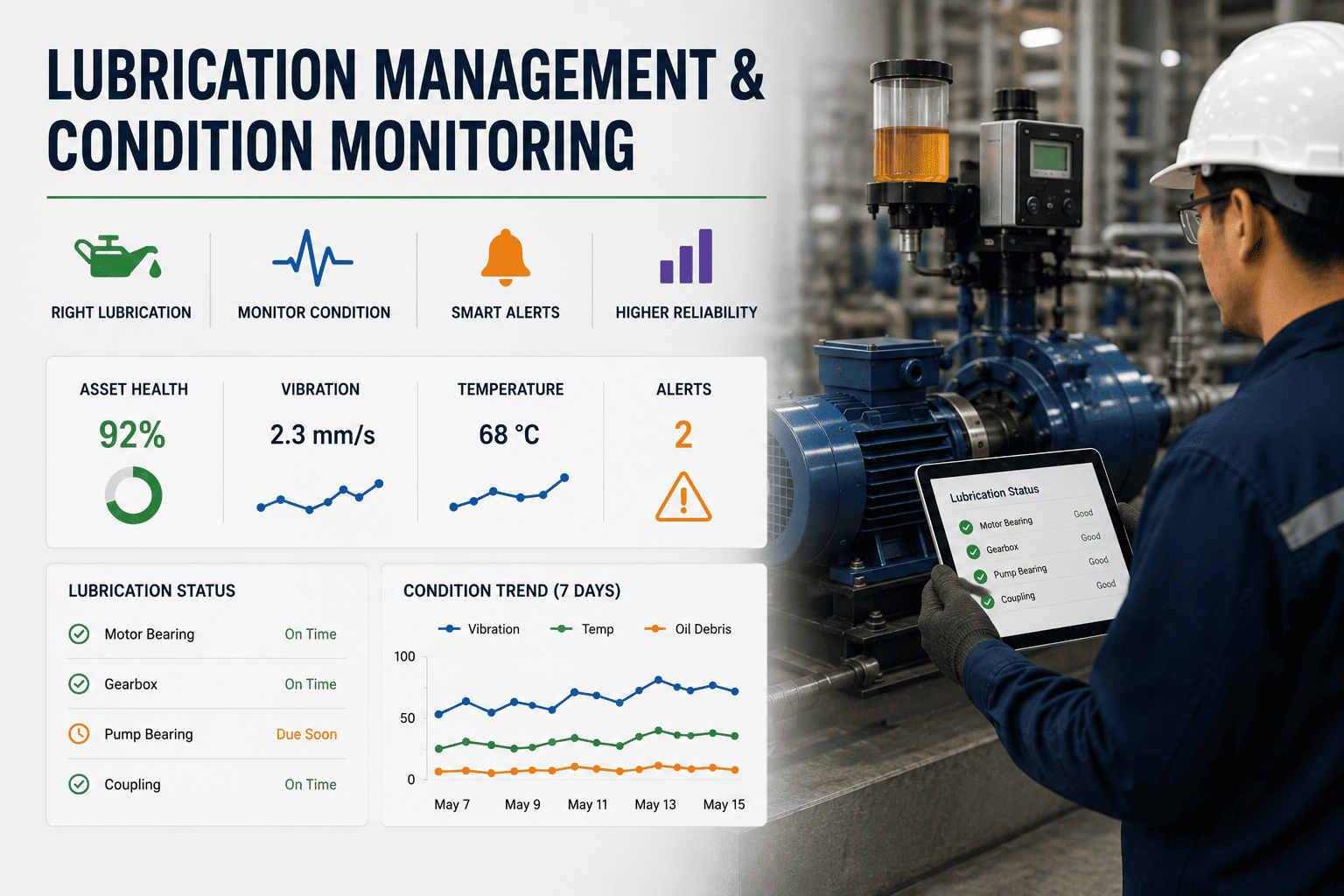
Lubrication is the single most controllable variable in equipment reliability — yet most manufacturing plants spend less than 3% of their maintenance budget on it and absorb the fallout in unplanned downtime, premature bearing failures, and energy waste. A well-structured lubrication management program paired with condition monitoring can reduce lubricant-related failures by up to 80% and extend bearing life two to three times. This guide walks through lubricant selection, contamination control, oil analysis, ultrasonic-assisted greasing, and CMMS-driven lubrication routes that turn scheduled greasing into precision maintenance. Ready to operationalize it? You can Start Free Trial and configure your first lube route in under an hour.
Is your lubrication program actually extending asset life — or just keeping it alive?
Most plants grease on a calendar, ignore oil condition signals, and discover bearing damage only after vibration crosses an alarm threshold. Integrating lubrication management with condition monitoring closes that gap — turning every sample, alarm, and route into a precision maintenance decision.
What poor lubrication actually costs your plant
Lubrication is the #1 controllable factor in equipment life. The numbers below explain why under-investing here is the most expensive false economy in maintenance.
Estimated yearly cost of premature bearing and gear failure attributable to lubrication deficits across manufacturing.
Particle contamination at ISO 21/19 can accelerate component wear tenfold compared with a clean target of ISO 16/13.
Plants that pair oil analysis with ultrasonic greasing routinely double or triple mean time between bearing replacements.
Over-greased or under-greased bearings can waste up to a third of their input power as frictional heat — invisible on most energy meters.
Five pillars of a lubrication management program
A defensible program rests on five disciplines. Skip any one and the others lose leverage — a clean oil sample from a wrongly selected lubricant still tells you the wrong story.
Match viscosity grade to speed, load, and temperature
Select lubricants using OEM viscosity minimums, operating temperature windows, and speed factors (ndm). A 10°C rise in operating temperature halves oil life; selecting the correct ISO VG and base stock (mineral, PAO, ester) is the lowest-cost reliability decision you will ever make.
Set, monitor, and defend cleanliness targets
Define target ISO cleanliness codes per asset class — typically ISO 16/13 for hydraulics, 19/16 for gearboxes, 22/19 for splash-lubricated drives. Use desiccant breathers, offline kidney-loop filtration, and sealed transfer containers. Every 2-point ISO code reduction can roughly double component life.
Turn sample data into maintenance actions
Build a route-based sampling cadence: monthly for critical turbines and hydraulics, quarterly for general gearboxes, semi-annual for splash-lubricated auxiliaries. Track viscosity, water (Karl Fischer), particle count, elemental metals (wear), and additive depletion. Alarm limits must be asset-specific, not generic lab defaults.
Stop counting strokes and listen to the bearing
Replace fixed-quantity greasing with ultrasonic-assisted greasing: a technician connects an ultrasonic probe, pumps grease until friction ultrasound drops below baseline (typically 8 dB over ambient), and records the actual quantity delivered. This eliminates the 30–40% of greasing events that over-pack or starve bearings.
Codify every route, point, and reading in the CMMS
Every lubrication point should exist as a tagged location in the CMMS — with lubricant grade, quantity, interval, and last-sampled date. Mobile route execution with barcode or RFID confirmation eliminates missed points and builds the historical dataset that makes condition monitoring predictive rather than reactive.
Oil condition monitoring — what to measure and when to alarm
The table below reflects industry-standard alarm thresholds for common rotating equipment. Treat these as starting baselines — tighten them as your sample history matures and always cross-reference oil data with vibration trends.
| Parameter | Normal | Alarm | Critical | Recommended Action |
|---|---|---|---|---|
| Viscosity change (from reference) | ±5% | ±10% | ±20% | Investigate wrong oil, fuel dilution, or additive shear |
| Water content (ppm, Karl Fischer) | <200 | 200–500 | >500 | Source water ingress, dehydrate or replace oil |
| ISO cleanliness (gearbox) | 19/16 | 21/18 | 23/20+ | Deploy offline filtration, inspect breather |
| Iron wear metals (ppm, per 100 hrs) | <15 | 15–40 | >40 | Vibration analysis, bearing inspection |
| Acid number (mg KOH/g rise) | +0.2 | +0.5 | +1.0 | Oil oxidation — schedule change-out |
| Particle quantifier index (PQ) | <20 | 20–50 | >50 | Severe wear likely — isolate and inspect |
A 180-asset plant moves from calendar greasing to condition-based lubrication
Consider a mid-size food and beverage plant running 180 lubricated assets — mixers, conveyors, pumps, and blowers — spending roughly $42,000 a year on lubricants, labor, and bearing replacements under a calendar-based greasing schedule. Here is what a 12-month migration to integrated lubrication management and condition monitoring looks like.
Asset registry and lube point mapping
Tag all 1,240 lubrication points with RFID. Map lubricant grade, volume, interval, and current condition into the CMMS. Identify 14 incompatible lubricant cross-contaminations and consolidate SKUs from 31 to 18.
Deploy sampling routes and baseline oil analysis
Establish monthly sampling on 22 critical assets, quarterly on the remaining 158. First-round results reveal 6 gearboxes above water-alarm limits and 3 pumps with viscosity drift beyond ±10% — all previously invisible.
Roll out ultrasonic-assisted greasing
Train four technicians on ultrasonic probes. Over the first 90 days, 38% of greasing events deviate from the scheduled quantity — 26% over-greased, 12% under-greased. Bearing failure incidents drop from 4 per quarter to 1.
Link oil alarms to CMMS work orders
Configure automatic work-order generation when any oil parameter crosses its alarm threshold. Cross-reference with vibration data to confirm root cause before dispatching labor. Mean time to detect lubrication faults falls from 21 days to under 48 hours.
Measure full-year impact
Annual bearing replacements fall 61%, lubricant spend drops 19% through SKU consolidation and extended drain intervals, and unplanned downtime attributed to lubrication drops from 47 hours to 11 hours. Net first-year savings: approximately $94,000 on a $28,000 program investment.
Anatomy of a precision lubrication route
A CMMS-driven lube route is not a checklist — it is a closed-loop data stream. Each step below feeds the condition monitoring layer that makes the next route smarter.
Each route is generated by the CMMS as a function of asset criticality, lubrication point count, interval (hours or cycles), and lubricant grade — sequenced geographically for minimal walk time.
Technician scans the point RFID, applies the specified lubricant, records actual quantity and ultrasonic reading, and confirms completion — offline data syncs when back in Wi-Fi range.
Completed routes update asset health scores. When oil analysis or ultrasonic readings breach limits, the CMMS auto-creates a follow-up work order linked to the exact point and reading that triggered it.
Calendar-based greasing vs condition-based lubrication
The shift from time-based to condition-based lubrication is not incremental — it changes what your technicians do, what your data tells you, and how fast you catch failure.
- Grease every bearing on a fixed weekly or monthly schedule regardless of condition
- Uniform stroke count across all bearings of the same type — load and speed ignored
- No record of actual grease volume delivered or bearing friction state
- Oil sampled reactively, only after a failure or abnormal vibration is detected
- Lubricant and condition monitoring data live in separate, disconnected systems
- 30–40% of greasing events over-pack or starve bearings — undetected
- Interval adjusted dynamically by oil analysis trends and ultrasonic baseline drift
- Grease quantity driven by real-time friction ultrasound — each bearing gets what it needs
- Every application logged with volume, ultrasonic reading, technician, and timestamp
- Proactive sampling on a route cadence with asset-specific alarm limits in the CMMS
- Oil, vibration, and route data unified on one asset record — alarms cross-validated
- Bearing failures detected at lubrication distress stage — weeks before secondary damage
What plants see in the first year
"We cut bearing replacements by half in nine months. The ultrasonic greasing alone paid for the program — we were over-greasing nearly a third of our motors without knowing it."
"Linking oil analysis alarms directly to CMMS work orders changed how we catch failures. We found three gearboxes with water ingress in the first month that we would never have caught otherwise."
"Lubrication management is not a cost center. It is the highest-leverage reliability investment a plant can make — every dollar spent here prevents three to five dollars in downstream failure."
Turn lubrication from a calendar task into a condition-based reliability engine
Configure lube routes, oil sampling alarms, and ultrasonic greasing workflows in a single CMMS — built for manufacturing plants.
Lubrication management and condition monitoring — answered
How often should I sample oil for condition monitoring?
Sample critical turbines and hydraulic systems monthly, general gearboxes quarterly, and splash-lubricated auxiliaries semi-annually. Increase cadence after any alarm breach or major lubricant change. The goal is a stable enough trend to distinguish normal variation from real degradation — typically three consecutive samples establish a defensible baseline.
What ISO cleanliness code should I target for my equipment?
Use OEM recommendations as the floor, not the ceiling. Common targets are ISO 16/13 for hydraulics and servo systems, 19/16 for gearboxes, and 22/19 for splash-lubricated drives. Every two-point reduction in the first ISO code roughly doubles rolling-element bearing life, so tighter is almost always better — if filtration can sustain it.
Can a CMMS actually manage lubrication routes, or do I need a separate lube software?
A capable CMMS handles lube routes, RFID point confirmation, lubricant grade tracking, sampling schedules, and alarm-to-work-order conversion in one system. If your CMMS cannot link oil analysis results to asset records and auto-generate corrective work orders, it is not built for condition-based lubrication. You can Book a Demo to see how oxmaint handles this end-to-end.
Is ultrasonic-assisted greasing worth the investment?
Yes — typically payback arrives within 6 to 9 months for plants with more than 50 lubricated bearings. Ultrasonic probes cost a few hundred dollars each but eliminate the 30–40% of greasing events that over-pack or starve bearings. Most plants recoup the cost through avoided bearing replacements alone, before counting downtime savings.
How do I justify a lubrication program to leadership?
Build the case on three numbers: current annual bearing replacement spend, current unplanned downtime hours attributable to lubrication, and current lubricant spend. Most plants find that a program costing $25,000–$40,000 per year returns $80,000–$150,000 in the first year through reduced replacements, less downtime, and SKU consolidation. Start your trial at app.oxmaint.ai and use the built-in ROI calculator to model your plant.
Start your lubrication management program this week
Map assets, build lube routes, set oil analysis alarms, and link condition data to work orders — all in one platform designed for manufacturing plants.
Free 14-day trial · No credit card