Machine-related incidents cause over 18,000 amputations, lacerations, and crush injuries in U.S. manufacturing every year, and OSHA's National Emphasis Program on Amputations specifically targets plants with inadequate machine guarding. A single amputation citation averages $16,131 per instance, climbs to $161,323 for willful or repeat violations, and the human cost is far steeper. Guarding is not optional paperwork — it is the physical barrier between an operator and a point of operation that can remove a hand in under 0.3 seconds. Oxmaint tracks every guard, every interlock, and every inspection across your plant so compliance evidence is ready the moment an auditor walks in, and a live demo shows exactly how it works on your equipment.
Safety & Compliance
The Five Machine Guard Types That Stand Between Your Operators and a Citation
OSHA 29 CFR 1910.212, ANSI B11, and NFPA 79 do not name specific products — they require that every point of operation, every nip point, and every rotating part is guarded by a method proven to prevent body contact during the operating cycle. Here is how each guard type works, when to use it, and how to document compliance across your fleet.
18,000+
U.S. manufacturing machine-contact injuries recorded annually including amputations, crushing, and lacerations
$16,131
Average OSHA per-instance penalty for serious machine guarding violations under 1910.212
$161,323
Maximum OSHA penalty per willful or repeat guarding violation under the 2026 adjusted schedule
0.3 sec
Time it takes a press ram, rotating shaft, or rollers to cause permanent amputation injury
Quick Definition
Machine guarding is the system of physical barriers, interlocked access points, presence-sensing devices, and two-hand control systems that prevents an operator or nearby employee from contacting hazardous machine motion. OSHA 1910.212 requires guarding wherever a point of operation, nip point, rotating part, or flying debris hazard exists. The five primary guard types (fixed, interlocked, adjustable, presence-sensing, and two-hand control) each serve different access-frequency and risk profiles.
Where Hazards Live on Every Machine
Before choosing a guard, you have to map the hazard. OSHA classifies four hazard zone categories that must be guarded on any machine exposing an employee to injury. A single piece of equipment typically has three or more of these zones — a press, for example, has a point of operation, a flywheel, a clutch, and ejected slug hazards all at once.
Zone A
Point of Operation
Where the actual work is performed on the material — press dies, saw blades, shear knives, drill bits, grinding wheels. The highest-severity zone because operators must work close to it.
Press dies, saw teeth, milling cutters
Zone B
Power Transmission
All components that transmit energy to the point of operation: flywheels, pulleys, belts, chains, couplings, cams, gears, and drive shafts. Often overlooked because they are behind the machine.
Belts, pulleys, gears, shafts
Zone C
In-Running Nip Points
Any point where two rotating parts converge and pull material inward — roller pairs, gear meshes, or a belt entering a pulley. Can pull in gloves, sleeves, and hair faster than an operator can react.
Roll-to-roll, belt-to-pulley, gear mesh
Zone D
Flying Chips and Sparks
Ejected material from cutting, grinding, and punching operations. Fragments can exit at over 150 mph and cause eye, facial, and bystander injuries at significant distance from the machine.
Grinding debris, slug ejection, coolant mist
The Five Guard Types Ranked by Access Frequency
The right guard is not the strongest guard — it is the guard that matches how often the operator needs to access the hazard zone. A guard that gets defeated or removed because it blocks production is worse than no guard at all. Match the guard to the workflow, not the other way around.
01
Fixed Guards
Access: Rare or Never
A permanent physical barrier welded, bolted, or integrated into the machine body. Required tools to remove. Covers power transmission zones (belts, flywheels, gears) and point-of-operation hazards on machines that do not require frequent operator access. OSHA's preferred first choice under 1910.212(a)(2).
Best forBelt drives, flywheels, gearboxes, fan blades
Access timeTool-based removal only
Compliance ref1910.212(a)(2), 1910.219
02
Interlocked Guards
Access: Routine
A movable barrier electrically or mechanically interlocked to the machine control system. Opening the guard cuts power to hazardous motion; the machine will not restart until the guard is closed and the safety circuit is re-armed. Essential for equipment requiring material loading, tool changes, or routine operator access.
Best forRobot cells, CNC enclosures, packaging lines
Key devicesSafety door switches, guard locking, safety relays
Compliance refANSI B11.19, ISO 14119, NFPA 79
03
Adjustable and Self-Adjusting Guards
Access: Per Stock Size
Barriers that adjust to accommodate different workpiece sizes while maintaining exposure limits. Common on table saws, band saws, and woodworking equipment where stock thickness varies. Self-adjusting guards move automatically with the material; adjustable guards are set manually per job.
Best forTable saws, radial arm saws, bandsaws
Key riskOperator removal or improper adjustment
Compliance ref1910.213, ANSI O1.1
04
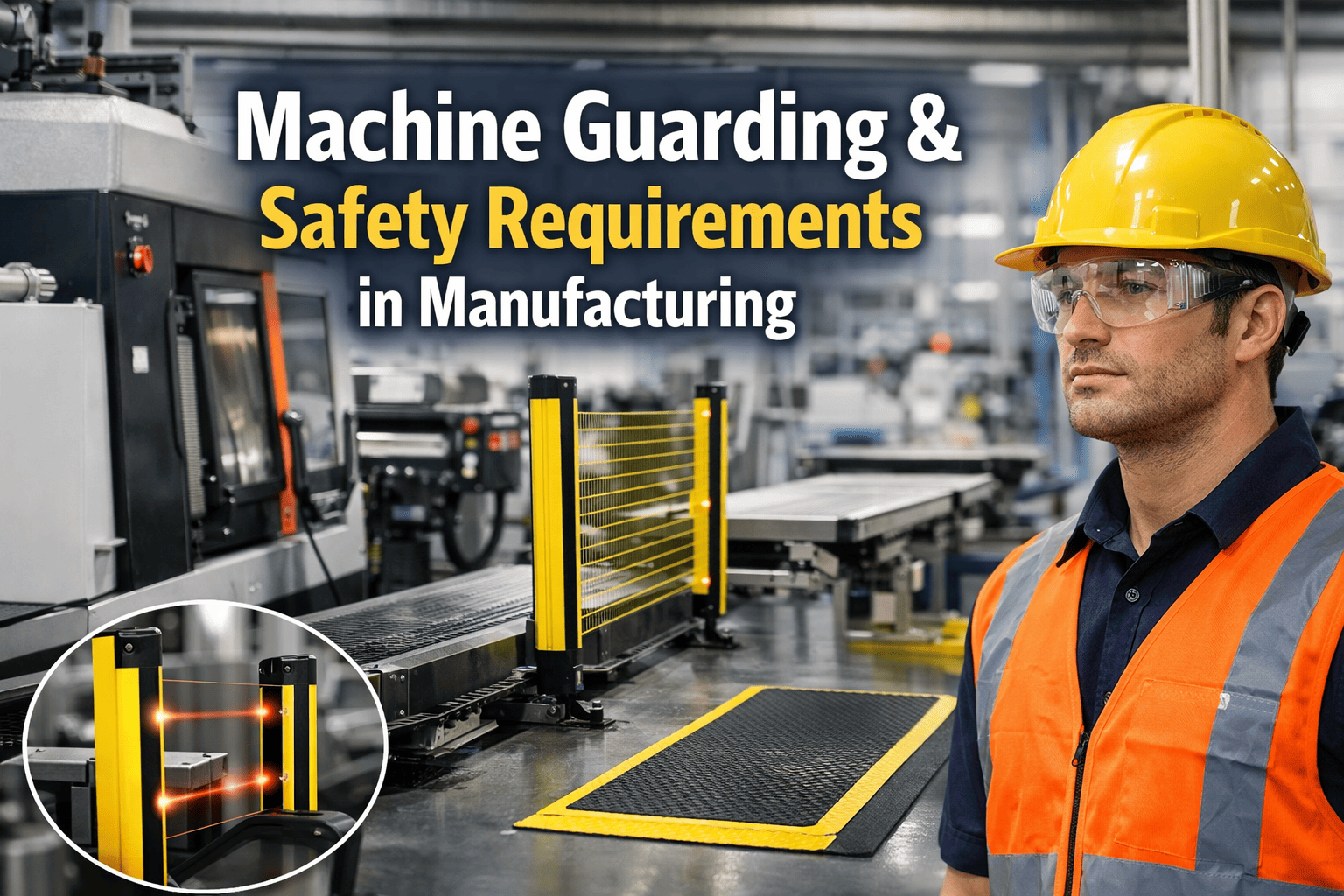
Presence-Sensing Devices
Access: Continuous
Electronic safeguards — safety light curtains, laser scanners, and safety mats — that detect operator entry into a hazard zone and stop hazardous motion before contact. Type 4 light curtains for high-risk applications (SIL3/PLe); Type 2 for lower-risk. Muting and blanking features accommodate material flow without defeating protection.
Best forPress brakes, punch presses, palletizers
Response timeTypically under 20 ms
Compliance refIEC 61496, ANSI B11.19, 1910.217
05
Two-Hand Controls and Trip Devices
Access: Single Operator Only
Safety actuators requiring the operator to use both hands on separated control buttons during the hazardous portion of the cycle. Prevents hands from being in the point of operation during actuation. Does not protect bystanders — must be combined with perimeter guarding for multi-operator environments.
Best forSingle-operator power presses, assembly jigs
Key riskButton tying, anti-tiedown required
Compliance ref1910.217(b)(6), ANSI B11.1
Every guard on every machine, tracked in one place
Stop Losing Sleep Over OSHA Inspections You Did Not See Coming
Oxmaint stores your guard inventory, interlock test schedules, and light curtain calibration records tied to each asset. When an OSHA inspector walks in, your compliance evidence is one click away — not buried in a filing cabinet in the maintenance office.
Standards That Apply to Your Equipment
OSHA cites under 1910.212 as the general requirement, but compliance in practice means layered conformance to ANSI, NFPA, and ISO standards that specify exactly how to design, install, and validate each guard type. Here is the map of which standards apply to which equipment category.
The Guarding Decision Tree
Selecting the right guard type comes down to three questions asked in order. Skipping this sequence is how plants end up with productivity-blocking guards that get defeated, or with presence-sensing devices installed where a fixed barrier was required.
Q1
Does the operator need to access the hazard zone during normal production?
NOUse a fixed guard. Welded or bolted enclosure. No interlock needed.
YESContinue to Q2.
Q2
Can the machine be stopped before the operator reaches the hazard?
NOUse interlocked guards with guard locking. Machine cannot restart until safe state is confirmed.
YESContinue to Q3.
Q3
Is operator access frequent, rapid, and requires visibility into the process?
NOInterlocked movable guard is sufficient. Safety door switch with mechanical interlock.
YESUse presence-sensing device (Type 4 light curtain or laser scanner) with safe distance calculation per ANSI B11.19.
What an Inspection Program Actually Looks Like
Guards installed on day one degrade over months of production use. Bolts loosen, interlock switches wear, light curtain alignment drifts, and well-meaning operators defeat interlocks to save time. Without a documented inspection program, a plant is one worn switch away from a citation or an amputation. Here is the cadence that keeps guarding effective over time.
Daily
Pre-Shift Visual Check
Operator confirms all guards present and secure, emergency stops functional, light curtain indicators green, two-hand controls not tied down. Logged via mobile checklist on Oxmaint with photo evidence per machine.
Weekly
Interlock Function Test
Maintenance verifies every safety interlock trips the machine when actuated. Test pulse-test of dual-channel circuits. Any failure triggers immediate work order and removes machine from service.
Monthly
Light Curtain and PSD Validation
Test object verification of minimum object detection, safe distance measurement, muting sensor function check, and cross-reference of response time to stop time. Deviation triggers recalibration work order.
Quarterly
Physical Guard Integrity Audit
Full inspection of fastener torque, guard material condition, viewing port integrity, anchor points, and verification that no unauthorized modifications exist. Findings documented to asset record.
Annual
Compliance Review and Risk Reassessment
Full ANSI B11 risk assessment refresh, OSHA standard change review, incident trend analysis, and guarding upgrade plan for any equipment showing chronic issues or near-miss events.
Cost of Getting It Wrong
Direct Costs Per Incident
OSHA serious violation penalty$16,131
OSHA willful or repeat violationUp to $161,323
Average amputation medical cost$110,000+
Workers comp indemnity average$140,000+
Equipment downtime during investigation$40K-$200K
Indirect Costs That Compound
OSHA follow-up inspection scope expansionPlant-wide risk
EMR increase affecting insurance premiums3-5 years impact
Customer contract compliance clausesBid disqualification
Legal fees and third-party litigation$75K-$500K+
Operator morale and retention impactUnquantified but real
How Oxmaint Turns Guarding Into a Managed Program
01
Guard Inventory Per Asset
Every fixed guard, interlock switch, light curtain, and two-hand control registered against the parent machine. Inspection history, calibration dates, and manufacturer specs attached to each component.
02
Automated Inspection Scheduling
Daily, weekly, monthly, and annual inspection tasks auto-generate with asset-specific checklists. Overdue inspections escalate to supervisors before they become audit findings.
03
Mobile Checklist Execution
Operators complete pre-shift checks on a phone or tablet at the machine. Photo evidence, pass/fail, and issue flags sync instantly. No paper, no transcription gaps, no lost records.
04
Interlock Defeat Detection
Pattern analysis flags machines where interlock trip frequency drops suddenly or where guard-open events disappear from the log — both signals of defeat attempts that require supervisor intervention.
05
Audit-Ready Compliance Reports
One-click export of inspection history, calibration records, and corrective action closure for any asset or date range. OSHA inspectors see a structured record instead of a filing cabinet search.
06
Near-Miss and Incident Linking
Every near-miss or incident ties back to the specific guard involved, enabling trend analysis by guard type, machine, shift, and operator. Root causes surface before they become amputations.
From guard inspection backlog to audit-ready evidence
The Difference Between a Near-Miss and an Amputation Is Often a 20-Minute Interlock Test
Oxmaint schedules every inspection, tracks every result, and flags every missed check before it becomes the finding that an OSHA inspector cites. Plants that switched from paper-based guarding programs report 73% reduction in overdue safety inspections within 90 days.
Frequently Asked Questions
What is the single most-cited machine guarding violation under OSHA?
29 CFR 1910.212(a)(1) — failure to provide a guarding method for a point of operation, nip point, or rotating part — remains the top-cited general industry machine guarding violation every year under OSHA's amputations NEP.
Can a light curtain replace a fixed guard on a power press?
Only on part-revolution presses that can be stopped mid-stroke. Full-revolution mechanical presses must use fixed barrier guards, gates, or two-hand trip controls per 1910.217(c)(3)(iii)(a). A light curtain alone is not compliant on a full-revolution press.
How is the safe distance for a light curtain calculated?
ANSI B11.19 and ISO 13855 specify a formula combining machine stop time, light curtain response time, and an intrusion constant. The light curtain must be mounted at or beyond this calculated distance so the machine fully stops before a hand reaches the hazard.
How often do safety interlocks need to be tested?
ANSI B11.0 and ISO 14119 recommend weekly functional testing at minimum, with full validation at installation and after any maintenance. High-use applications may require daily verification. All test events should be logged against the specific interlock device in your CMMS.
Guarding compliance, backed by evidence, every shift
Turn Your Machine Guarding Program From a Binder on a Shelf Into a System That Manages Itself
Oxmaint tracks every guard, schedules every inspection, documents every test result, and produces audit-ready evidence the moment you need it. Deploy in days, not quarters, with no changes to your existing equipment.
![monthly-manufacturing-plant-safety-audit-checklist-[osha---iso-45001]](./manage-post-2k26/uploads/monthly-manufacturing-plant-safety-audit-checklist-[osha---iso-45001].png)


