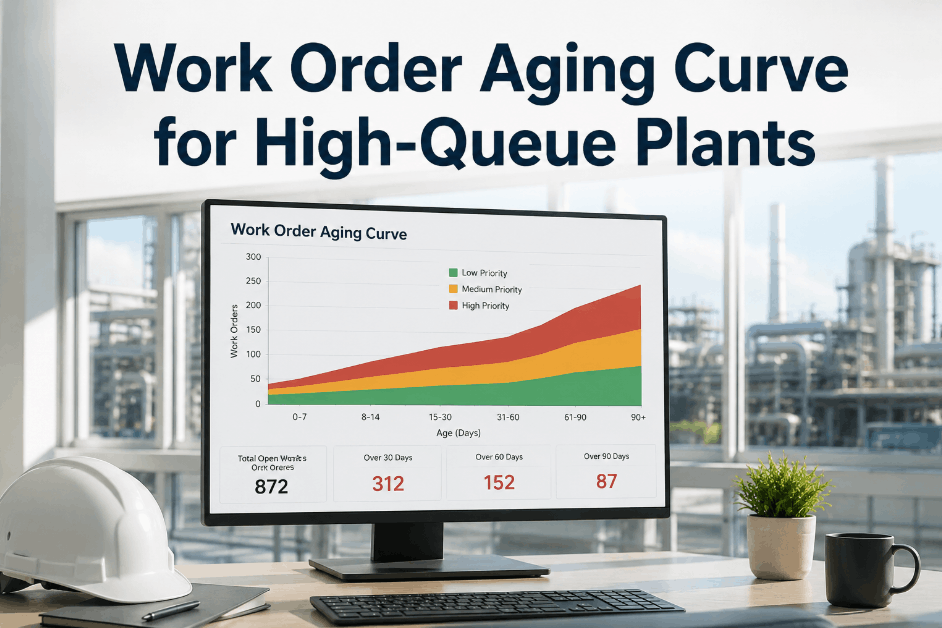
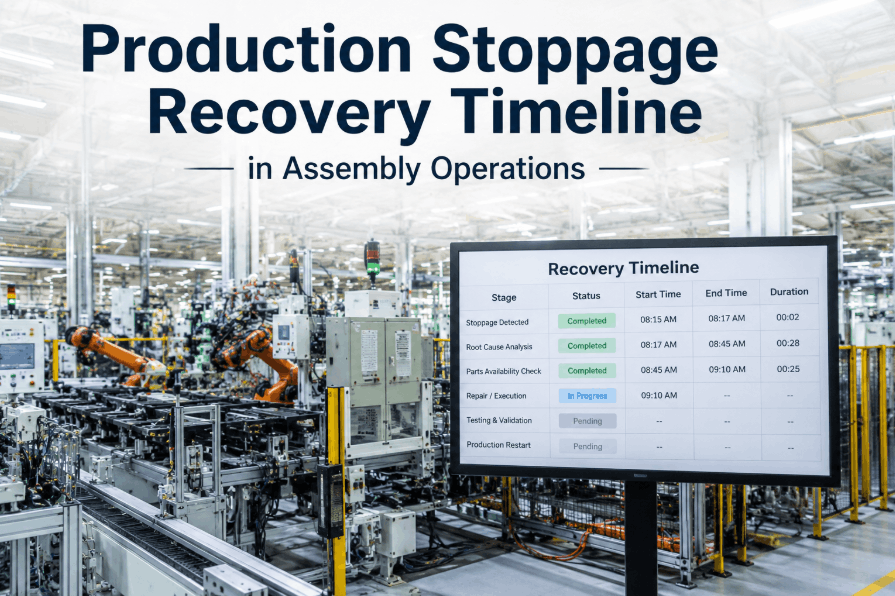
Multi-line plants operate under constant repair demand — but most maintenance teams don't know how exposed they actually are until backlog has already spilled into output loss. Open work pressure, overdue PM drift, and dispatch lag are the three metrics that reveal where execution speed is breaking down before the production floor feels it. Sign Up Free to measure your backlog exposure index and close the gaps before they become throughput events. OxMaint surfaces queue pressure, task aging, and labor loading in real time — giving multi-line plant managers the visibility to act before recovery becomes reactive. Book a Demo to see how backlog analytics maps across your plant's active lines and shift plans.
Maintenance Analytics · Multi-Line Plants · 2026
Maintenance Backlog Exposure Index for Multi-Line Plants
Open-work pressure, overdue PM drift, and dispatch lag — the three signals that show where multi-line plants are losing execution speed before backlog spills into output.
3×Faster backlog identification with real-time queue pressure monitoring
−41%Overdue PM drift in plants using automated task aging alerts
22 minAverage dispatch lag reduction per shift with OxMaint work control
89%Work order priority accuracy with automated capacity risk scoring
What the Backlog Exposure Index Measures — And Why It Matters
The backlog exposure index is not a single number — it's a composite signal built from three operational dimensions that together reveal where a multi-line plant is most vulnerable to output loss. Plants running OxMaint track these dimensions continuously, converting raw work order data into actionable reliability signals across every active line. Sign Up Free to configure your plant's exposure scoring in under 30 minutes.
Open-Work Pressure
Signal: Unresolved work orders per line per shift
Queue Load
Measures how many open tickets each line is carrying relative to crew capacity — the first indicator that execution is falling behind demand.
Overdue PM Drift
Signal: Days past scheduled PM due date by asset
PM Aging
Tracks how far preventive maintenance has slipped from its original schedule — the leading indicator of unplanned breakdown frequency.
Dispatch Lag
Signal: Time from work order creation to technician assignment
Response Gap
Reveals where the planning-to-execution handoff is breaking down — dispatch lag above 45 minutes directly extends mean time to repair.
Labor Loading
Signal: Estimated hours queued vs. available crew hours
Capacity Risk
Compares the estimated hours queued in open work orders against available crew hours — the structural constraint beneath surface-level backlog.
Task Aging
Signal: Work orders open beyond their priority window
Age Exposure
Flags tickets that have aged past their assigned priority response window — converting priority rules from policy into measurable execution compliance.
Repair Demand Rate
Signal: New reactive work orders per line per week
Demand Signal
Measures how fast new reactive demand is entering the queue — when demand exceeds closure rate, exposure compounds until output is affected.
Priority Rule Adherence
Signal: % of P1/P2 tickets dispatched within SLA
Plan vs. Actual
Shows whether shop floor cadence is following the priority sequencing defined in the maintenance plan — or overriding it under shift pressure.
Service Recovery Rate
Signal: % of overdue orders closed within rolling 7 days
Recovery Speed
Tracks how effectively the maintenance team recovers from backlog peaks — plants with high service recovery rates absorb demand spikes without output impact.
Backlog Exposure — Before vs. After OxMaint CMMS
The difference between a plant managing backlog reactively and one with real-time exposure visibility is measurable in every shift report. The comparison below shows how each backlog signal changes when OxMaint connects open-work pressure to labor loading and PM scheduling in a single dashboard.
Backlog Exposure Maturity — Where Does Your Plant Score?
Backlog visibility in multi-line plants exists on a spectrum from zero structured measurement to fully automated exposure scoring integrated with labor planning and PM scheduling. The framework below helps operations managers identify their current maturity level — and the specific capability gap that is letting backlog convert into output risk today. Book a Demo to walk through your plant's current exposure profile with an OxMaint solutions engineer.
Plant Backlog Visibility Maturity
Score 5 = real-time exposure index · Score 1 = no backlog measurement
5
Live Exposure Index · Multi-Signal · CMMS-Integrated
Open-work pressure, PM drift, dispatch lag, labor loading, and task aging all scored in real time. Backlog exposure triggers automatic escalation before production is affected.
Profile: Maximum operational control. Backlog is managed as a leading indicator, not a lagging consequence. Production support is proactive, not reactive.
4
Partial Visibility · Key Signals Active
PM drift and open-work pressure tracked. Dispatch lag and labor loading still manual. Exposure score not yet calculated across signals.
Action: Connect dispatch lag and labor loading data into OxMaint's exposure dashboard. Configuration task — no additional hardware needed.
3
Weekly Reporting · No Real-Time Signal
Backlog reviewed in weekly planner meeting using spreadsheet exports. Overdue items visible but dispatch lag and labor loading unmeasured in real time.
Gap: Weekly cadence means exposure compounds for 5 days before any action. Real-time queue pressure is the missing signal at this maturity level.
2
Work Order System Only · No Backlog Analytics
Work orders logged and tracked but no backlog analysis. Overdue items accumulate without structured review. Dispatch handled by supervisor discretion.
Risk: Open-work pressure and PM drift are compounding invisibly. Configure three priority signals in OxMaint as an immediate first step.
1
No Backlog Measurement
Maintenance tracked informally. No structured work order system, no backlog review, no PM schedule compliance measurement. Exposure only visible when production breaks down.
Risk: Every overdue PM and untracked open order is an invisible exposure event. Backlog is already affecting output — it just hasn't been attributed yet.
Stop Managing Backlog After It Hits the Floor.
OxMaint gives multi-line plants real-time backlog exposure scoring — open-work pressure, PM drift, dispatch lag, and labor loading in one dashboard.
How OxMaint Calculates and Acts on Backlog Exposure
OxMaint's CMMS doesn't just record open work orders — it connects queue pressure to labor capacity, PM schedules to asset criticality, and dispatch timing to production priority. The result is a plant-level exposure score that tells maintenance planners exactly where to focus crew effort before throughput control becomes crisis management. Book a Demo to see how OxMaint maps backlog exposure across your specific line configuration. Predictive maintenance workflows escalate high-exposure assets to inspection queues before failure probability crosses the output risk threshold. Sign Up Free and configure your first backlog exposure threshold in under one hour.
Work Order Engine
Queue → Exposure Score
Open orders converted to line-level pressure index
Every open work order contributes to a per-line queue score. When pressure crosses the configured threshold, the planner is notified before dispatch lag becomes MTTR impact.
PM Schedule Tracker
Drift → Alert
Overdue PM items surface automatically
PM due dates tracked against actual completion. Drift beyond the configured window triggers an alert and moves the asset up the priority queue — preventing PM backlog from becoming breakdown backlog.
Dispatch Analytics
Lag → SLA Compliance
Assignment timing measured per priority class
Time from work order creation to technician assignment recorded for every ticket. SLA compliance tracked by priority level — P1 dispatch lag reported separately from planned maintenance.
Labor Load Planner
Capacity → Risk Flag
Queued hours vs. available hours per shift
Estimated repair hours in the open queue measured against available crew hours. When the ratio exceeds the safe loading threshold, the system flags capacity risk before the next shift begins.
"
We had three lines with backlog levels nobody could see clearly — the data was in three different spreadsheets updated by different planners. After configuring OxMaint's queue pressure dashboard, we caught a labor loading problem on Line 7 two days before it would have caused a planned maintenance delay. That one catch paid for the system in a single shift.
Maintenance Manager — Discrete Manufacturing, 6 production lines, Ontario, Canada
Frequently Asked Questions
What is the maintenance backlog exposure index?
It's a composite score built from open-work pressure, overdue PM drift, dispatch lag, and labor loading — giving multi-line plant managers a single signal that shows where execution is falling behind before output is affected.
How does OxMaint measure dispatch lag?
OxMaint records the timestamp when a work order is created and when it is assigned to a technician. The difference is dispatch lag — reported per priority class and per shift, with SLA breach alerts configured per plant.
Can OxMaint track backlog across multiple production lines simultaneously?
Yes — OxMaint supports unlimited line configurations. Queue pressure, PM drift, and labor loading are tracked independently per line and aggregated into a plant-level exposure score.
How does labor loading connect to backlog exposure?
Labor loading compares the estimated hours in the open work order queue against available crew hours. When queued demand exceeds available capacity, backlog compounds — OxMaint flags this before the next shift starts.
Does OxMaint integrate with existing CMMS or ERP systems?
Yes — OxMaint integrates with SAP, Oracle, and major telematics and ERP platforms. Backlog data can be imported and exported, and exposure scoring works with your existing work order data.
Turn Backlog Signals Into Execution Actions.
OxMaint connects open-work pressure, PM drift, and dispatch lag into one exposure index — and acts on it automatically. Free to start.