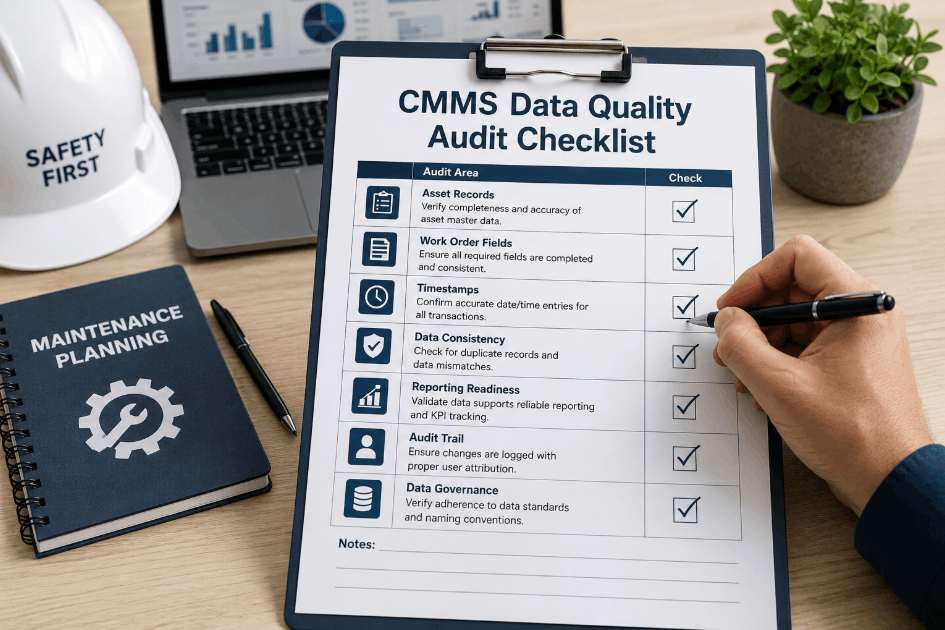
Maintenance data integrity checks are the verification layer that separates a CMMS that informs decisions from one that produces noise. Duplicate asset records, missing required fields, and bad timestamps do not just create reporting problems — they distort the reliability picture that factory maintenance teams depend on to prevent unplanned downtime. Sign Up Free on OxMaint to deploy integrity checks that catch data quality failures before they reach your reporting layer. When factory teams operate with verified, integrity-checked maintenance data, planners trust their priority queues, managers trust their KPI dashboards, and reliability engineers can identify failure patterns that would otherwise be obscured by corrupt records. Data integrity is not an IT function — it is a maintenance performance function, and it belongs inside your CMMS workflow. Book a Demo to see how OxMaint's validation and audit tools keep your maintenance records accurate, complete, and ready for analysis at any time.
What Are Maintenance Data Integrity Checks?
Maintenance data integrity checks are systematic validation rules applied to CMMS records — asset master data, work orders, inspection results, and inventory transactions — to detect and flag errors before they compound into unreliable reporting. Integrity checks verify that records are complete, non-duplicate, internally consistent, and temporally accurate. In factory environments where hundreds of work orders are created and closed per week, automated integrity validation is the only scalable way to maintain data quality at production speed.
Identifies asset records with identical or near-identical names, serial numbers, or location codes — preventing maintenance history from being split across duplicate records that inflate apparent asset counts and corrupt reliability calculations.
Flags work orders and asset records with required fields unpopulated at creation or closure — ensuring that failure codes, labor times, and corrective actions are present before records enter the reporting data set.
Detects impossible timestamp sequences — work orders closed before they were opened, repair times that exceed shift duration, or maintenance events logged on future dates — that indicate backfill entry or manual time manipulation.
Validates that parts consumed on a work order match inventory transaction records, that PM work orders reference valid scheduled maintenance plans, and that labor recorded does not exceed available technician hours for the shift.
The Six Most Damaging Data Integrity Failures in Factory CMMS Systems
Sign Up Free on OxMaint to deploy automated integrity checks that prevent each of these failure modes from entering your maintenance data pipeline.
When the same physical asset is registered multiple times under different names or by different technicians, maintenance history is split across records. MTBF and cost-per-asset calculations use incomplete data — producing reliability scores that overstate actual asset performance and miss recurring failure patterns entirely.
Uncoded work orders are invisible to failure analysis. A factory that closes 500 corrective work orders per month with 40% missing failure codes has effectively destroyed nearly 200 data points per month that would otherwise feed FMEA, PM optimization, and root cause programs. The loss compounds year over year.
Technicians who enter times from memory hours after completing work introduce systematic bias — rounding, underreporting, or overreporting repair times. This corrupts MTTR, response time SLAs, and labor productivity metrics in ways that are statistically invisible but directionally wrong — leading to incorrect shift staffing and scheduling decisions.
Work orders created without a valid asset ID reference cannot be attributed to any asset's performance history. In factories with informal work request processes, a significant share of corrective work orders are logged against generic asset buckets — making asset-level reliability analysis impossible for those records.
Narrative failure descriptions cannot be aggregated, sorted, or analyzed at scale. "Motor vibration — bearing noise fixed" and "bearing replaced due to noise" describe the same failure mode but will never appear in the same failure trend analysis. Without structured code enforcement, semantic integrity is lost permanently at the moment of data entry.
When parts consumed on work orders are not recorded against inventory transactions — or when quantities are estimated rather than counted — maintenance cost reporting diverges from actual parts expenditure. This creates a systematic budget variance that compounds across reporting periods and erodes financial confidence in the maintenance program. Book a Demo with OxMaint to see how integrated parts management and work order closure eliminate inventory reconciliation failures.
Maintenance Data Integrity Check Framework
| Integrity Check Type | Data Layer | Detection Method | Remediation Action |
|---|---|---|---|
| Duplicate Asset Detection | Asset master | Name, serial number, and location code matching | Merge records with history consolidation |
| Missing Required Fields | Work orders | Closure validation rules — block until populated | Enforce mandatory completion at point of closure |
| Timestamp Sequence Validation | Work orders | Start/close time logic check — flag impossible sequences | Flag for supervisor review and correction |
| Orphaned Work Order Check | Work orders | Asset ID foreign key validation | Require valid asset link before creation is permitted |
| Free-Text Failure Code Check | Work orders | Code field type enforcement — structured list only | Replace free-text input with taxonomy dropdown |
| Inventory Reconciliation | Parts / Work orders | Parts consumed vs. inventory transaction cross-match | Flag unmatched transactions for parts manager review |
| PM Completion Without Checklist | Preventive WOs | Checklist completion status at closure | Block PM closure until all checklist items are completed |
Implementing Maintenance Data Integrity Checks in 5 Steps
Before configuring integrity checks, assess the current state of your CMMS records. Measure the percentage of work orders with complete failure codes, the number of duplicate asset records, the share of timestamps that fall within plausible ranges, and the percentage of PM work orders with checklist completions. This baseline defines which integrity checks have the highest ROI for your specific data environment.
Map the minimum required fields for each work order type and asset record class. Configure your CMMS to enforce these rules at the point of creation and closure — blocking records from progressing without required data. Replace free-text failure description fields with structured taxonomy dropdowns, and validate asset ID references against the master asset list at work order creation.
Run a one-time duplicate detection pass on your existing asset master using name similarity, serial number matching, and location code analysis. Merge duplicate records with full history consolidation — preserving all work order history under the canonical asset record. Then configure ongoing duplicate prevention rules that flag new asset records with potential matches before they are saved.
Deploy mobile work order execution to all field technicians so that timestamps are captured at the moment of each event rather than reconstructed from memory. OxMaint's mobile app records job start, travel, parts pull, and closure timestamps automatically — eliminating the backfill entry problem and enabling timestamp sequence validation checks to run on data that is structurally sound from creation.
Configure automated weekly integrity reports that surface field completion rates, newly detected duplicates, timestamp anomalies, and orphaned work orders — delivered directly to the data steward and maintenance manager. Sign Up Free on OxMaint to activate pre-built integrity dashboards that run these checks continuously without manual extraction or SQL queries.