A nonconformance escalation matrix for quality teams is the structured routing framework that determines which issues get resolved at the floor level, which require supervisor review, and which demand immediate cross-functional escalation — ensuring that the right response reaches the right person within the time window that separates a contained quality event from a regulatory finding or a production shutdown. Without a defined escalation matrix, quality teams face a familiar failure mode: critical nonconformances sit in an inbox waiting for manual triage while the production line keeps running, audit evidence accumulates incompletely, and corrective actions are initiated too late to prevent the next occurrence. Sign Up Free to see how OxMaint helps quality teams build nonconformance workflows with severity-based routing, escalation triggers, and digital audit trails that support regulatory compliance. Quality operations that implement a formal escalation matrix report 40–60% faster mean time to corrective action and significantly stronger audit trail completeness compared to teams relying on informal escalation judgment.
Build Your Nonconformance Escalation Matrix with OxMaint
Severity-based routing. Digital audit trail. Corrective action workflows. Regulatory compliance support. OxMaint gives quality teams the structured escalation framework to close nonconformances faster and with complete evidence.
Why Nonconformance Escalation Fails Without a Structured Matrix
Most nonconformance management breakdowns are not failures of detection — they are failures of routing. When severity classification is inconsistent and escalation paths are not documented, quality teams route issues based on individual judgment that varies by shift, site, and experience level. Book a Demo to see how OxMaint's inspection and work order workflow modules support structured nonconformance routing and evidence closure across plant operations.
Inconsistent Severity Classification
Without defined severity criteria, identical nonconformances are classified differently across shifts and departments — routing critical quality events through low-priority channels and delaying corrective action initiation.
Escalation Delay Between Detection and Response
Manual escalation processes that rely on verbal handoffs, email chains, or shared spreadsheets create delays between nonconformance detection and response team activation — expanding the window during which defective product continues to be produced.
Audit Trail Gaps at Evidence Closure
Nonconformances closed without complete supporting evidence — inspection records, corrective action confirmation, signoff discipline — create regulatory exposure during audits and make pattern analysis unreliable for quality improvement programs.
Corrective Actions Not Linked to Root Cause
When corrective action records are not formally linked to root cause analysis findings, quality teams address symptoms rather than systemic causes — and the same nonconformance recurs in the next production period.
No Cross-Functional Escalation Trigger
Quality events that affect safety, regulatory compliance, or customer delivery commitments require cross-functional escalation — but without defined triggers, these issues reach engineering, operations, or compliance teams too late for effective response.
SOP Drift Across Shifts and Sites
Without a system-enforced escalation matrix, nonconformance management procedures drift between shifts and site locations over time — creating inconsistent quality records that undermine both internal process quality and external audit readiness.
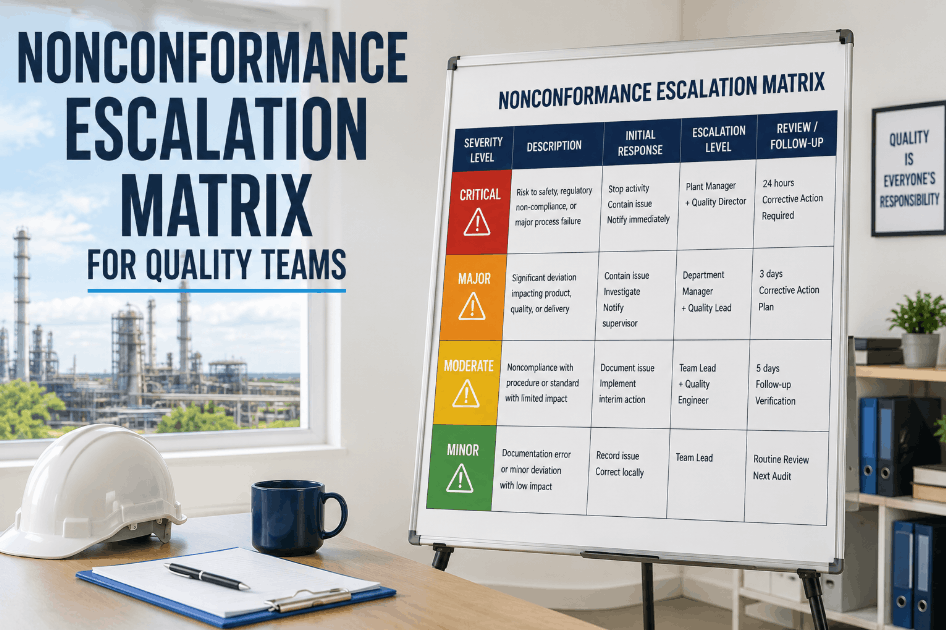
Nonconformance Escalation Matrix — 5 Severity Levels and Response Framework
A well-designed escalation matrix defines five nonconformance severity levels — each with explicit response time requirements, escalation path, and evidence closure criteria. Sign Up Free to configure this framework in OxMaint's inspection and compliance workflow modules.
| Severity Level |
Nonconformance Type |
Response Time Target |
Escalation Path |
OxMaint Feature |
| Level 1 — Minor |
Cosmetic defects, non-production-impacting deviations |
48 hours |
Floor technician resolution |
Inspection Record + Corrective Note |
| Level 2 — Moderate |
Process deviation, specification boundary crossing |
24 hours |
Supervisor review and corrective action |
Work Order Workflow + Signoff |
| Level 3 — Significant |
Repeated deviation, customer impact risk, SOP breach |
8 hours |
Quality manager + engineering review |
Escalation Routing + RCA Linkage |
| Level 4 — Critical |
Safety risk, regulatory deviation, production hold required |
2 hours |
Cross-functional team activation |
Priority Alert + Compliance Workflow |
| Level 5 — Emergency |
Product recall risk, regulatory reportable event, facility shutdown trigger |
Immediate |
Executive and regulatory notification |
Emergency Escalation + Audit Trail |
How OxMaint Supports Nonconformance Escalation for Quality Teams
01
Structured Inspection Records with Severity Classification
OxMaint's inspection module captures nonconformance findings with mandatory severity classification at point of detection — enforcing consistent rating criteria across all inspectors, shifts, and sites. This eliminates the classification variability that causes critical quality events to be routed through low-priority channels.
Book a Demo to configure nonconformance severity classification for your quality workflows.
02
Automated Escalation Routing by Severity Level
OxMaint routes nonconformance records automatically to the correct response team based on severity level — triggering notifications, assigning ownership, and setting response time deadlines without manual dispatch. This closes the escalation delay gap that allows quality events to deteriorate before the right team is engaged.
03
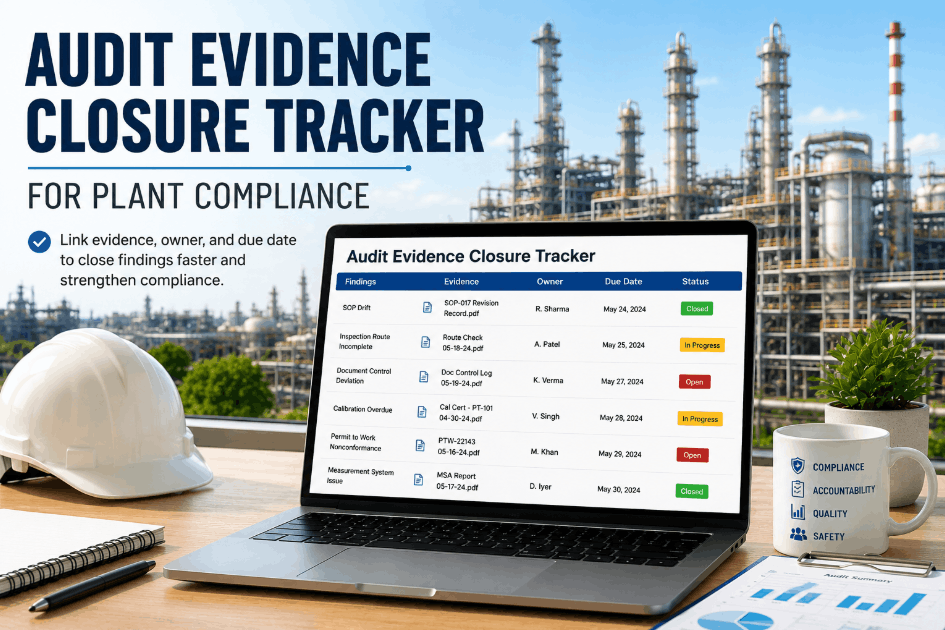
Digital Audit Trail and Evidence Closure
OxMaint enforces evidence closure requirements at each nonconformance resolution stage — capturing inspection records, corrective action confirmation, root cause linkage, and supervisor signoff in a complete digital audit trail. This provides the document integrity and record completeness that regulatory auditors require without manual assembly.
Sign Up Free to activate digital audit trail configuration for your quality team.
04
Root Cause Linkage and Corrective Action Tracking
OxMaint links corrective action records directly to nonconformance findings and root cause analysis outcomes — ensuring that remediation addresses the systemic cause rather than just the immediate symptom. Recurrence tracking alerts quality teams when the same nonconformance reappears within a defined period, triggering escalation review of the corrective action effectiveness.
Nonconformance Escalation Results in Quality Operations
The following examples show how quality teams used OxMaint's inspection and workflow modules to implement structured escalation matrices — reducing response times, strengthening audit evidence, and cutting nonconformance recurrence rates.
Medical Devices
Mean Time to Corrective Action Reduced 58%
ChallengeNonconformances routed by email — Level 3 events averaging 31 hours before corrective action initiated
AppliedOxMaint severity-based routing with automated escalation notifications and 8-hour response time enforcement
ResultLevel 3 mean response time reduced from 31 to 6.8 hours; FDA audit passed with complete corrective action evidence
Automotive Tier 1
Audit Evidence Completeness from 61% to 97%
ChallengeIATF audit identified 39% of closed nonconformances lacked complete corrective action evidence and signoff records
AppliedOxMaint mandatory evidence closure workflow; nonconformance records cannot be closed without required documentation fields completed
ResultAudit evidence completeness reached 97% within one quarter; zero evidence gaps in subsequent IATF surveillance audit
Food Safety
Nonconformance Recurrence Rate Reduced 44%
Challenge28% of quality nonconformances recurring within 90 days — corrective actions addressing symptoms without root cause linkage
AppliedOxMaint mandatory RCA linkage at corrective action creation; 90-day recurrence monitoring alert per nonconformance type
ResultRecurrence rate reduced from 28% to 15.6% within two quarters; systemic causes identified in 3 recurring equipment categories
Pharmaceutical
Cross-Functional Escalation Triggered in Under 90 Minutes
ChallengeLevel 4 nonconformances reaching compliance and engineering team 6–8 hours after detection during night shifts
AppliedOxMaint automated Level 4 escalation with immediate multi-role notification and mandatory acknowledgment within 30 minutes
ResultAverage cross-functional activation time reduced to 87 minutes across all shifts; no regulatory exceedances during 12-month review period
Step-by-Step: Implementing a Nonconformance Escalation Matrix in OxMaint
Step 1
Define Severity Classification Criteria Per Nonconformance Type
Document severity classification criteria for each nonconformance category in your facility — including specific production, safety, regulatory, and customer impact thresholds that trigger each severity level. These criteria must be objective enough to be applied consistently across inspectors, shifts, and site locations.
Book a Demo to see severity classification configuration in OxMaint's inspection module.
↓
Step 2
Map Escalation Paths and Response Teams Per Severity Level
Define the exact response team, notification recipients, and response time target for each severity level — documenting who owns resolution, who must be notified, and what evidence is required for closure. OxMaint automates this routing once the escalation matrix is configured.
↓
Step 3
Configure Evidence Closure Requirements per Severity
Define the mandatory evidence fields and signoff discipline required to close nonconformance records at each severity level in OxMaint. Higher severity levels require root cause analysis linkage, engineering sign-off, and corrective action verification before the record can be moved to closed status — protecting audit trail completeness.
Sign Up Free to configure evidence closure workflows for your quality team.
↓
Step 4
Link Corrective Actions to Root Cause Records
Configure OxMaint to require root cause analysis linkage on all Level 3 and above corrective actions — ensuring that remediation targets the systemic cause identified in the RCA rather than simply addressing the immediate defect. This linkage also feeds back into inspection threshold reviews and process quality monitoring.
↓
Step 5
Activate Recurrence Monitoring and Escalation Review
Enable OxMaint's recurrence tracking to flag nonconformance types that reappear within 90 days of corrective action closure — triggering automatic escalation review when recurrence is detected. This closes the feedback loop that prevents corrective action effectiveness from going unmeasured.
Sign Up Free to activate nonconformance recurrence monitoring in OxMaint.
Key KPIs for Nonconformance Escalation Performance
These metrics give quality leaders objective visibility into escalation matrix effectiveness — measuring response speed, evidence quality, and corrective action outcomes across the nonconformance management program. Book a Demo to see how OxMaint tracks nonconformance KPIs for your quality operations.
Mean Time to Corrective Action
Average time from nonconformance detection to corrective action initiation by severity level. The primary indicator of escalation matrix effectiveness — declining times indicate the routing framework is directing issues to the right teams at the right speed.
Audit Evidence Completeness Rate
Percentage of closed nonconformance records with complete supporting evidence — inspection records, corrective actions, root cause linkage, and signoff. The primary indicator of audit readiness and document integrity across the quality management system.
Escalation Compliance Rate
Percentage of nonconformances escalated to the correct severity level and response path within the defined time window. Gaps indicate classification inconsistency or response team availability issues that require process intervention.
Nonconformance Recurrence Rate
Percentage of closed nonconformances recurring within 90 days. High recurrence rates signal that corrective actions are addressing symptoms rather than root causes — requiring escalation matrix review and RCA process reinforcement.
Signoff Discipline Rate
Percentage of nonconformance records closed with all required supervisor and quality manager signoffs captured in-system. Low signoff rates signal evidence closure gaps that create regulatory exposure before the next audit window.
SOP Drift Index
Variance in nonconformance classification and escalation behavior across shifts, departments, and site locations. High variance indicates the escalation matrix is being interpreted inconsistently — requiring refresher calibration across quality teams.
Implement Your Nonconformance Escalation Matrix with OxMaint
Severity-based routing. Automated escalation notifications. Digital audit trail. Root cause linkage. Recurrence monitoring. OxMaint gives quality teams the structured tools to close nonconformances faster and with complete regulatory evidence.
Frequently Asked Questions
What is a nonconformance escalation matrix for quality teams?
It is a structured framework that classifies quality deviations by severity level and defines the response team, notification path, time target, and evidence closure requirements for each level — ensuring the right response happens at the right speed for every nonconformance type.
How does OxMaint support nonconformance escalation management?
OxMaint captures nonconformances with mandatory severity classification, routes them automatically to the correct response team, enforces evidence closure requirements, and tracks corrective action outcomes — building a digital audit trail that supports regulatory compliance.
Why is audit evidence completeness important for quality teams?
Regulators and certifying bodies require documented evidence that nonconformances were detected, escalated, investigated, and corrected within defined timeframes. Incomplete records create findings even when the actual quality response was adequate.
How does root cause analysis linkage reduce nonconformance recurrence?
When corrective actions are formally linked to RCA findings, the remediation targets the systemic cause rather than the symptom — reducing the probability that the same nonconformance pattern reappears in the next production cycle.
What KPIs should quality teams track for nonconformance escalation?
Core KPIs include mean time to corrective action by severity level, audit evidence completeness rate, escalation compliance rate, nonconformance recurrence rate, signoff discipline rate, and SOP drift index across shifts and sites.
What causes SOP drift in nonconformance escalation?
SOP drift typically results from verbal-only escalation procedures, insufficient calibration training after personnel changes, and no system-enforced routing that keeps classification criteria consistent across teams and locations.
Give Your Quality Team the Escalation Tools They Need
OxMaint delivers severity classification, automated routing, digital audit trails, root cause linkage, and recurrence monitoring — purpose-built for quality teams managing nonconformance response across plant operations.