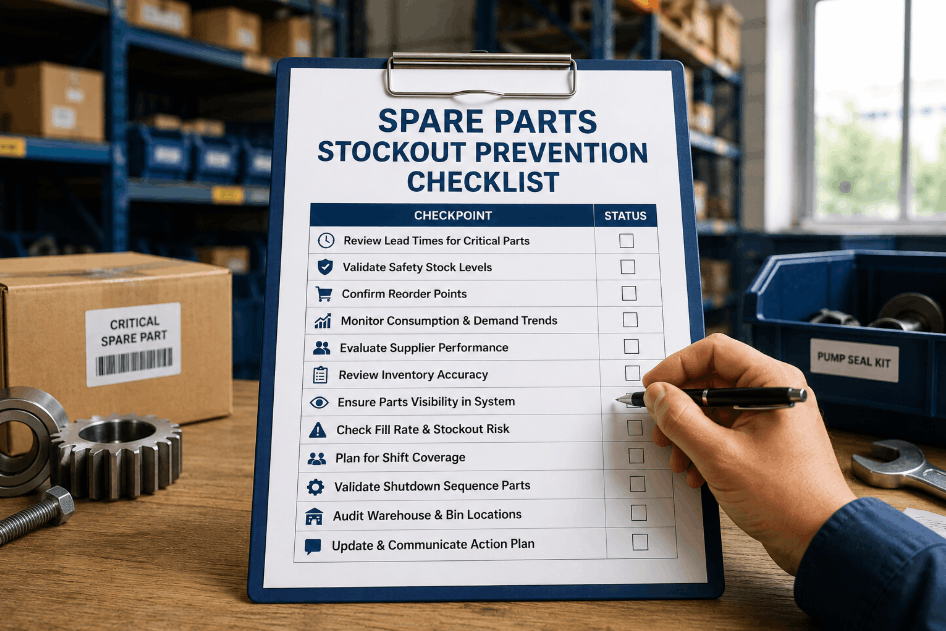
MRO spare parts eat 40–50% of the total maintenance budget at most industrial facilities, and yet 23% of unplanned downtime events trace directly back to an unavailable spare part, according to Plant Engineering's 2025 Maintenance Survey. The frustrating part is that the same storeroom usually has both problems at once — 15–25% of inventory sitting idle as obsolete or surplus stock, while the one bearing a technician actually needs that afternoon is on back-order. This isn't a procurement problem. It's a math problem that got replaced with guesswork: a reorder point is a formula, not a gut feeling, and most storerooms are running on the latter. This guide covers the reorder-point math, criticality classification, and how OXMAINT AI ties parts consumption to the work orders that actually drive it.
Manufacturing · MRO & Spare Parts · Stockout Prevention · 2026
Manufacturing Stockout Prevention for Maintenance Parts
A technician standing at an empty bin with a broken machine behind them is a stockout that started weeks earlier, invisibly. OXMAINT AI connects the workflow that prevents it: every part is linked to the asset it serves, consumption is tracked automatically from closed work orders, and a reorder fires the moment stock crosses a threshold calculated from real usage and lead time — not a static minimum nobody's revisited in two years.
Parts Linked to Assets
→
Consumption Tracked from Work Orders
→
Reorder Point Triggered
→
PO Created
40–50%
of the total maintenance budget goes to MRO spare parts and materials
23%
of unplanned downtime events directly attributable to an unavailable spare part
15–25%
of typical MRO inventory sits idle as obsolete or surplus stock
95–97%
target service level — the share of part requests fillable from stock without an emergency order
The Two-Sided Failure
Most storerooms don't just have a stockout problem or an overstock problem — they have both, at the same time, on different shelves. Sign up free and see where your own inventory sits on both sides.
Understocked
Stockout & Downtime
A critical bearing, seal or drive component is missing when the machine fails. A four-hour repair becomes a four-day wait, and the emergency order that follows typically costs 3 to 5 times the normal price.
Overstocked
Idle Capital & Carrying Cost
Parts for retired equipment, duplicate SKUs and "just in case" purchases sit on a shelf costing 20–30% of their value every year in storage, insurance and obsolescence risk.
The Reorder Point Formula
The right stock level isn't a guess — it's driven by how fast a part gets used and how long it takes to arrive. Book a demo to see this calculated automatically from your own work order history.
ABC/XYZ Criticality Classification
Not every part deserves the same stocking policy. Classifying by failure impact and demand predictability tells you exactly where a zero reorder point is acceptable — and where it never is.
Class A — Critical
High failure impact. Mandatory minimum stock, never allowed to hit zero — the parts that stop a line if missing.
Class B — Important
Moderate impact, predictable usage. Reorder points calculated from consumption and lead time, reviewed quarterly.
Class C — Routine
Low impact, high volume consumables. Consolidated for bulk pricing, stocked loosely rather than precisely.
Class D — Volatile Demand
Unpredictable consumption regardless of criticality. Needs higher safety stock or a vendor agreement for fast turnaround.
Where Stockouts Actually Come From
🗓
Static Reorder Points
A minimum stock level set two years ago never adjusted as production volume, equipment age or supplier lead times changed.
🔗
Parts Not Linked to Assets
Nobody can say which parts a specific machine actually consumes, so purchasing stocks by guesswork instead of real demand.
📊
No Consumption Data
Parts get pulled from the crib off a spreadsheet, disconnected from the work order that actually used them.
🚚
Lead Time Assumptions Go Stale
A supplier's quoted four-week lead time has quietly become six, but the reorder point was never recalculated to match reality.
From Work Order to Reorder — Automatically
1
Part used on a work order
A technician closes a repair, consuming a part tied to the specific asset.
→
2
Stock level updates
Inventory decrements automatically — no separate manual entry into a spreadsheet.
→
3
Consumption rate recalculates
Real usage data refines the part's reorder point, rather than a number set once and forgotten.
→
4
Threshold crossed
Stock drops to the calculated reorder point based on current lead time and safety stock.
→
5
Purchase order created
A PO generates automatically before the shelf runs dry — not after a machine's already down.
A Reorder Point Set Two Years Ago Isn't a Safety Net. It's a Guess That's Aged Badly.
OXMAINT AI recalculates every reorder point from real consumption and current lead times — so the storeroom stays accurate as your operation changes.
Spreadsheet Guesswork vs. OXMAINT AI Automated Reorder
Spreadsheet & Manual Reorder
Reorder points set once, rarely revisited
Parts consumption tracked separately from work orders
Lead times based on what the supplier quoted, not actual history
A stockout is usually the first sign a reorder point is wrong
Automated Reorder in OXMAINT AI
Reorder points recalculate from real, ongoing consumption
Every part usage ties directly to the work order that consumed it
Lead times tracked from actual delivery history, not quotes
A PO fires before the shelf empties, not after a line goes down
What OXMAINT AI Gives Maintenance & Procurement Teams
Asset-Linked Parts Catalog
Every part mapped to the specific asset it serves, so technicians know exactly what to pull and purchasing knows exactly what to stock.
Automatic Consumption Tracking
Parts used on a work order decrement inventory automatically, feeding real usage data back into reorder calculations.
Dynamic Reorder Points
Reorder thresholds recalculate as consumption rates and supplier lead times actually change — not a static number set once.
Criticality Classification
Parts categorized by failure impact and demand pattern, so mandatory minimums apply where a stockout actually hurts.
Automated PO Generation
A purchase order fires the moment stock crosses its reorder point, before an emergency order at premium pricing becomes necessary.
Vendor Lead Time Tracking
Actual delivery history tracked per supplier, so reorder points reflect real lead times instead of optimistic quotes.
"
Our reorder points were set when the plant was running one shift, and we'd been on three shifts for over a year before anyone noticed the minimums hadn't changed. We were stocking out on a critical drive belt roughly every other month, paying emergency freight every time. Once parts were linked to the actual work orders consuming them, the reorder points recalculated on their own, and the belt hasn't stocked out since — meanwhile we've actually reduced total inventory value because the slow-moving stuff finally got flagged too.
Maintenance Storeroom Supervisor · Automotive Parts Manufacturer
Frequently Asked Questions
How is a reorder point actually calculated?
Reorder point equals consumption rate multiplied by lead time, plus safety stock. A part used twice a month with a four-week lead time needs roughly eight units on hand just to bridge the wait, plus extra safety stock for demand variability — so the reorder point isn't a round number, it's driven by real usage and delivery time.
Why do facilities end up both overstocked and stocked out at the same time?
Because inventory is usually managed by habit rather than data — low-criticality consumables get over-ordered "just in case," while reorder points on critical parts go stale as usage patterns or lead times change, so the same storeroom accumulates idle capital and misses the parts that actually matter.
How does linking parts to work orders improve reorder accuracy?
When a part's consumption is recorded automatically every time it's used on a closed work order, the reorder point calculation is based on what a machine actually consumes — not an estimate made when the part was first stocked, which may no longer reflect current production volume or equipment age.
Should every part have the same reorder policy?
No. Critical, production-stopping parts should carry a mandatory minimum that never reaches zero, while high-volume, low-impact consumables can run leaner and be consolidated for bulk pricing. Classifying parts by criticality and demand volatility is what makes that distinction workable at scale.
Stop Guessing at Reorder Points. Start Calculating Them.
Every part your team already uses can update its own reorder point from real consumption and lead time — firing a purchase order before the shelf runs dry. That's the workflow OXMAINT AI runs.