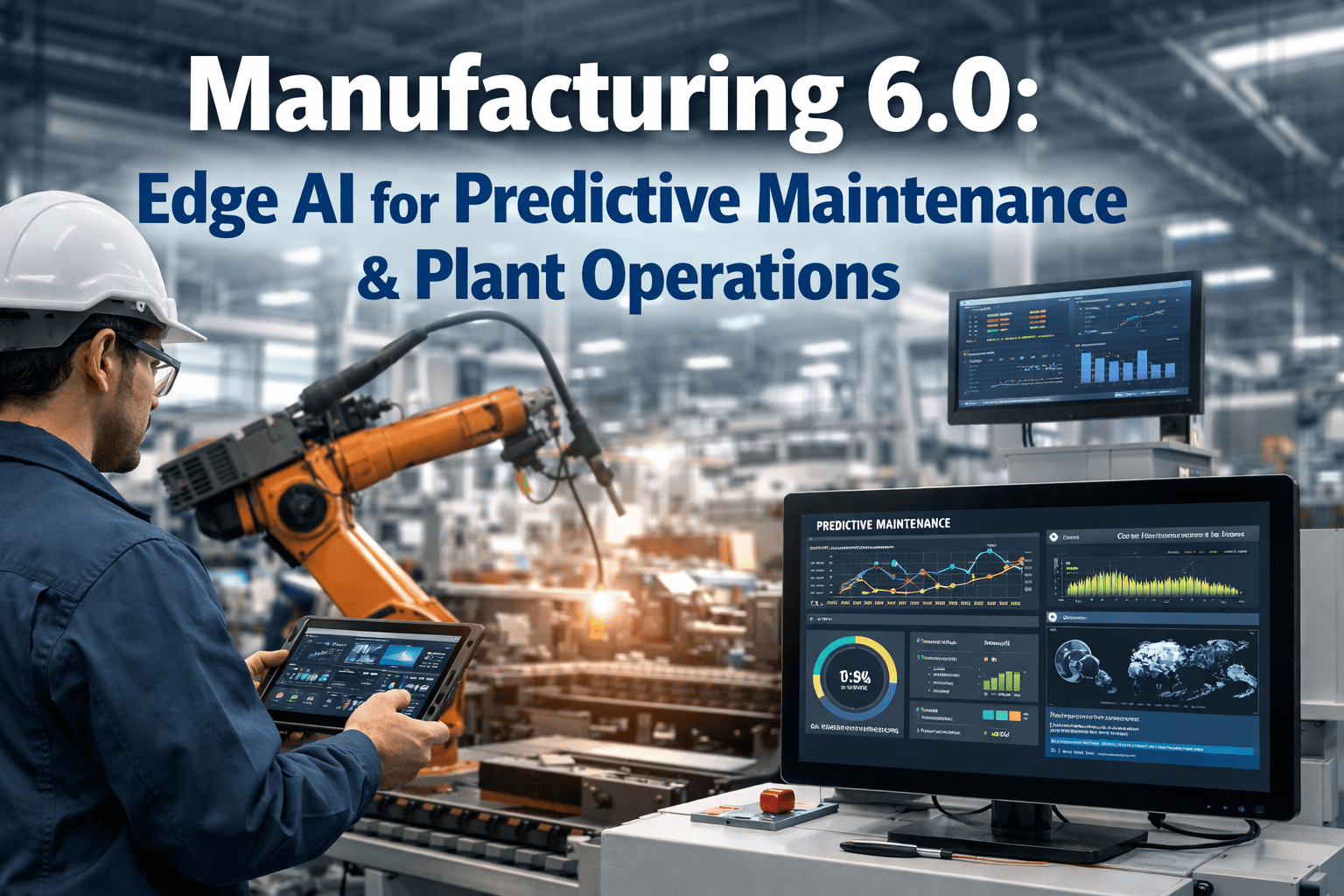
The factory floor has always been where fortunes are made and lost — but for the first time in industrial history, the machines themselves are learning to prevent the losses before they happen. Manufacturing 6.0 is not a buzzword coined in a conference room; it is the convergence of edge AI, real-time analytics, autonomous decision-making, and predictive operations that is actively reshaping production floors across the world right now. If your plant is still reacting to failures instead of predicting them, sign up for Oxmaint to see what proactive, AI-powered maintenance looks like in practice — or book a demo with our team to walk through your specific operation.
Edge AI Is Rewriting the Rules of the Factory Floor
From reactive breakdowns to autonomous, self-healing operations — here is what the numbers say about where manufacturing is heading.
What Separates Manufacturing 6.0 from Everything That Came Before
Industry 4.0 promised smart factories. Most plants got sensor overload, disconnected data silos, and cloud latency that made real-time decisions impossible. Manufacturing 6.0 fixes those structural failures by moving intelligence directly onto the factory floor.
- Cloud-dependent AI with 200–400ms latency
- Reactive alerts after failures occur
- Data sent off-site, creating privacy risk
- Pilot projects that never scaled
- Scheduled maintenance on fixed intervals
- Edge AI processing in milliseconds, on-device
- Autonomous failure prediction before symptoms appear
- Data stays on-premise, fully compliant
- Scalable deployment across every production line
- Condition-based maintenance triggered by real equipment state
Four Pillars That Make Manufacturing 6.0 Work
Manufacturing 6.0 is not a single technology — it is four converging capabilities that, together, enable a factory to think, predict, and act without waiting for a human decision at every step.
Neural Processing Units embedded directly in industrial sensors run machine learning models locally — consuming 10–20x less power than GPU-based cloud approaches while delivering sub-millisecond response. When a bearing begins running 2°C above its optimal temperature range, the edge device detects the anomaly, cross-references it against failure history, and triggers a corrective action before the human eye would notice anything wrong.
Vibration, temperature, pressure, current draw, and acoustic data streams are analysed continuously by LSTM and transformer-based models trained on millions of historical failure events. The system does not wait for a threshold breach — it identifies the trajectory toward failure and schedules intervention at the optimal maintenance window, balancing production continuity against repair urgency.
Every physical asset — motor, conveyor, compressor, CNC spindle — has a live digital counterpart that mirrors its real-time operating state. The digital twin runs predictive simulations: if this asset continues at current load with this vibration signature, what is the probability of failure in the next 72 hours? Decisions that once required engineering judgement now happen continuously, at scale, without analyst involvement.
When the predictive layer identifies a maintenance need, it does not send an alert that gets buried in an inbox. It creates a structured work order — pre-populated with asset history, recommended parts, estimated labour time, and urgency classification — routed directly to the right technician on the right shift. Platforms like Oxmaint connect this AI output to real-world maintenance execution, closing the loop from prediction to completion.
Is Your Plant Still Reacting to Failures?
Every unplanned breakdown is a data point your system failed to use. Oxmaint connects your existing equipment data to AI-powered predictive maintenance — so your team fixes problems before production stops, not after. See how manufacturers are reducing unplanned downtime by up to 50% with predictive operations built on real maintenance data.
What Manufacturing 6.0 Delivers — Measured Results Across Industries
The data from plants that have deployed edge AI and predictive operations consistently points to the same conclusion: the ROI is not theoretical, and the payback timeline is faster than most operations teams expect.
| Operational Metric | Legacy Approach | With Edge AI / Mfg 6.0 | Verified Improvement |
|---|---|---|---|
| Unplanned downtime | Reactive — fix after failure | Predicted 24–72 hrs ahead | 20–50% reduction |
| Equipment lifespan | Fixed-interval replacement | Condition-based replacement | Up to 40% longer |
| Maintenance cost | Emergency + scheduled overhead | Optimised predictive schedule | 25–40% lower |
| Energy consumption | Unmonitored, fixed load | AI-optimised per asset | 12% avg savings |
| Quality defect rate | Post-production inspection | In-line AI vision detection | Up to 90% catch rate |
| Work order admin time | Manual creation and filing | Auto-generated from sensor data | 88% admin reduction |
| AI payback period | 18–36 months estimated | Modular deployments | 6–18 months actual |
Scroll right to view full table on mobile
The Three Stages Every Plant Goes Through Adopting Manufacturing 6.0
Plants that succeed with edge AI and predictive operations do not flip a switch. They move through three distinct stages — and knowing which stage you are in determines what your next move should be.
Before any AI model can predict failures, your maintenance history needs to exist in a structured, searchable form. Most plants in this stage are still running paper work orders or disconnected spreadsheets. The priority is digitalising maintenance records, building an asset register, and establishing baseline equipment health metrics. Without this foundation, predictive AI has nothing to learn from. This is where most plants underestimate the time investment — and where early wins in administrative efficiency provide the budget justification for the next stage.
With 6–12 months of clean digital maintenance data as a baseline, edge AI sensors can be deployed on high-criticality assets. The AI models are trained on the combination of sensor telemetry and historical work order data — meaning a plant with good Stage 1 data will achieve significantly higher predictive accuracy than one deploying sensors without historical context. Target assets with the highest unplanned failure frequency first: the ROI concentrates fastest where downtime costs are highest.
The autonomous factory does not just predict failures — it responds to them without waiting for a human to triage the alert. Digital twin models run continuous simulations. Edge AI detects anomalies in milliseconds. Maintenance platforms auto-generate and route work orders to the right technician. Supply chain integration ensures parts are available before the technician reaches the storeroom. Human expertise is redirected from reactive firefighting to strategic optimisation. This is Manufacturing 6.0 operating at full capability.
Where Oxmaint Sits in the Manufacturing 6.0 Stack
Every Manufacturing 6.0 deployment needs a maintenance execution layer — the place where AI predictions become completed work orders, technician actions become searchable data, and equipment history becomes the training fuel for the next predictive model. That is the role Oxmaint plays.
Every maintenance event captured in Oxmaint — asset, fault type, parts used, time taken, technician — becomes structured data that edge AI models can learn from. Plants with Oxmaint as their maintenance backbone build richer predictive models faster than those relying on unstructured records.
Oxmaint's automated PM scheduling engine replaces paper-based and spreadsheet schedules with condition-aware task assignment. PM tasks are triggered not just by calendar intervals but by the actual maintenance history and parts consumption patterns of each individual asset.
The dashboards that Manufacturing 6.0 operations managers need — PM completion rate, mean time between failures, corrective vs preventive ratio, parts spend by asset — are generated continuously from live work order data. No clerk, no compilation delay, no decisions made on last month's numbers.
Oxmaint connects to SAP MM, SAP PM, and major ERP systems — giving technicians real-time parts availability inside their work orders and giving procurement teams live consumption signals that eliminate the emergency purchasing cycles that inflate maintenance costs by 1.5–2x the standard price.
Your Maintenance Data Is Your AI Training Set
Plants that start building structured digital maintenance records today will train better predictive models six months from now than plants that wait. Every work order completed in Oxmaint is a data point that makes your predictive AI smarter. Start building your maintenance intelligence layer before your competitors do — or talk to our team about integrating Oxmaint with your existing sensor infrastructure.
Manufacturing 6.0 and Edge AI — Questions Operations Leaders Are Asking
Industry 4.0 described the vision of connected, data-driven factories — but most implementations stalled on cloud latency, data silos, and scaling challenges. Manufacturing 6.0 is the operational reality that emerges when edge AI, autonomous decision-making, and real-time predictive systems actually work together on the production floor. The key difference is autonomy: in Manufacturing 6.0, the factory does not just collect data, it acts on it without waiting for human intervention. If you want to understand what this looks like in practice, book a demo and we can walk through a live example relevant to your industry.
Cloud AI processes sensor data at a remote data centre, introducing latency of 200–400ms or more — which is too slow to prevent a fast-moving equipment failure. Edge AI runs inference models directly on the device or at the factory network edge, reducing response time to under 10ms. For a conveyor belt accelerating toward a mechanical failure, that latency gap is the difference between an automated correction and a production stop. Edge processing also keeps sensitive production data on-premise, eliminating the compliance and bandwidth costs of cloud-dependent architectures. Sign up for Oxmaint to see how edge AI integrates with maintenance workflows.
Predictive AI models learn from structured historical data: work order records linked to specific assets, failure types, parts consumed, and maintenance outcomes. Plants with 12–36 months of clean digital maintenance history can deploy meaningful predictive models within weeks of sensor installation. Plants starting from paper records typically need 3–6 months of digital work order capture before the AI has enough signal to distinguish genuine anomalies from operating noise. The fastest path to predictive readiness is implementing a structured CMMS like Oxmaint and building your data foundation while running normal operations.
Modular deployments targeting high-criticality assets — typically 3–5 assets with the highest unplanned failure frequency — typically achieve measurable ROI within 6–10 weeks of go-live, primarily through avoided emergency repairs and reduced parts procurement costs. Full-plant implementations with integrated predictive scheduling, digital twins, and automated work order generation typically achieve payback within 6–18 months. The fastest returns come when the maintenance data foundation is already in place. Talk to our team and we can model the expected ROI for your specific asset base and downtime cost profile.
Yes — the majority of edge AI deployments in established manufacturing facilities retrofit sensors onto legacy assets rather than replacing equipment. Wireless vibration, temperature, and current-draw sensors can be installed non-invasively on motors, pumps, compressors, and conveyors without equipment modification or production downtime. The AI learns from the sensor streams against historical maintenance records, meaning even a 30-year-old lathe can become a predictive maintenance target if its maintenance history is structured. The key constraint is data quality, not equipment age — which is why the maintenance data foundation matters so much before sensor deployment.
The Plants That Win the Next Decade Are Building Their Data Foundation Today
Manufacturing 6.0 is not a future state — it is being built right now on floors that made one decision: to replace reactive, paper-driven maintenance with structured digital data that AI can actually learn from. Oxmaint is the maintenance platform that makes that transition practical, fast, and measurable. Every work order your team completes in Oxmaint is a step toward the predictive, autonomous operations that define the next generation of manufacturing leadership.